
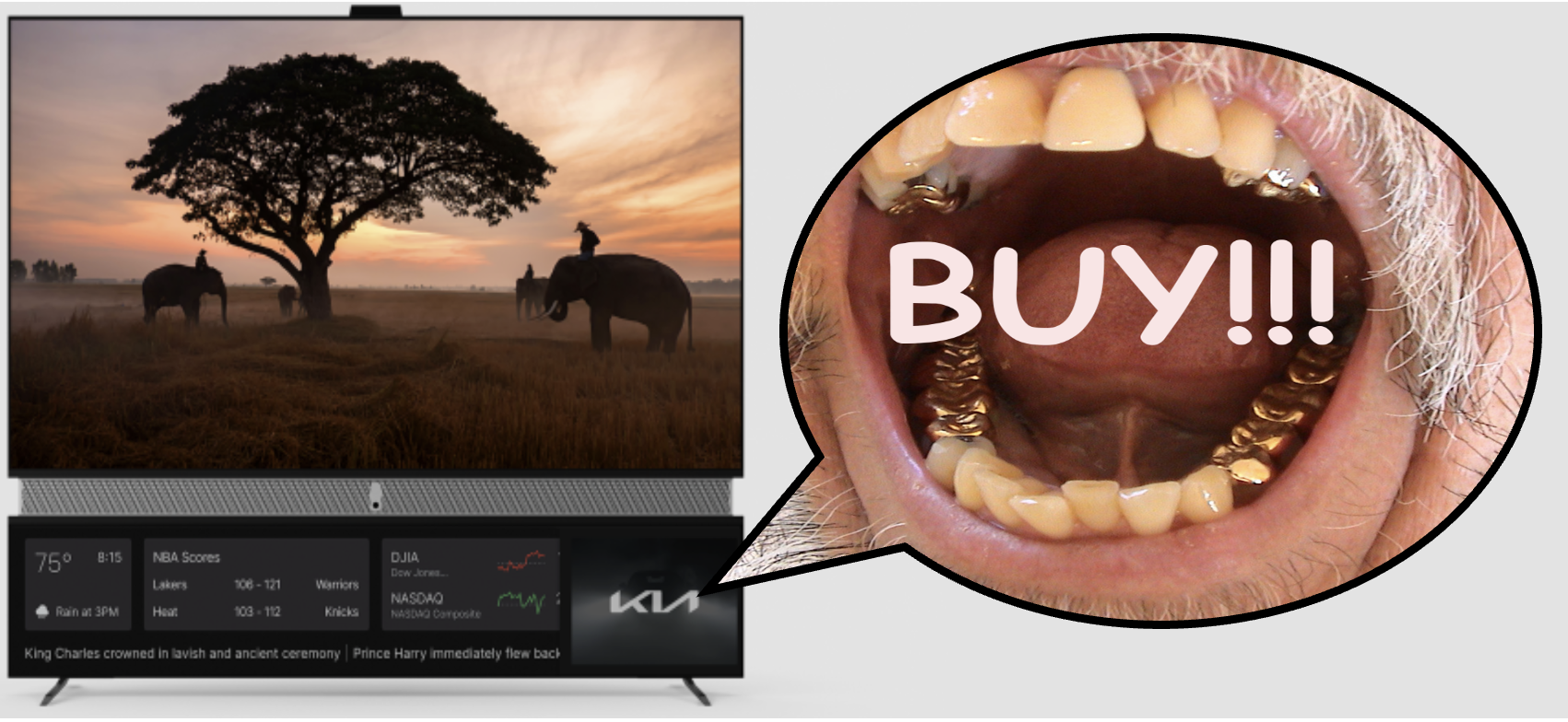
Maybe history will defeat itself.
Remember FreePC? It was a thing, briefly, at the end of the last millennium, right before Y2K pooped the biggest excuse for a party in a thousand years. This may help. The idea was to put ads in the corner of your PC’s screen. The market gave it zero stars, and it failed.
And now comes Telly, hawking free TVs with ads in a corner, and a promise to “optimize your ad experience.” As if anybody wants an ad experience other than no advertising at all.
Negative demand for advertising has been well advertised by both ad blocking (the biggest boycott in human history) and ad-free “prestige” TV, (or SVOD— Subscription Video On Demand). With those we gladly pay—a lot— not to see advertising. (See numbers here.)
But the advertising business (in the mines of which I toiled for too much of my adult life) has always smoked its own exhaust and excels best at getting high with generous funders. (Yeah, some advertising works, but on the whole people still hate it on the receiving end.)
The fun will come when our own personal AI bots, working for our own asses, do battle with the robot Nazgûls of marketing — and win, because we’re on the Demand side of the marketplace, and we’ll do a better job of knowing what we want and don’t want to buy than marketing’s surveillant AI robots can guess at. Supply will survive, of course. But markets will defeat marketing by taking out the middle creep.
The end state will be one Cluetrain forecast in 1999, Linux Journal named in 2006, the VRM community started working on that same year, and The Intention Economy detailed in 2012. The only thing all of them missed was how customer intentions might be helped by personal AI.
Markets will become new and better dances between Demand and Supply, simply because Demand will have better ways to take the lead, and not just follow all the time. Simple as that.
*For more on how this will work, see Individual Empowerment and Agency on a Scale We’ve Never Seen Before.
As an aside, the mouth in whch BUY!!! appears is mine. The gold crowns were provided by students of the UNC School of Dentistry, under the direction of Dr. Clinton Max Studevant for just $25 each, half a century ago. The original photo is here on Flickr, was shot with a Sony camcorder that could take low-res stills, and has had more than 80,000 views, which is way more than any of the 80,000 other photos I have on Flickr. I don’t know why.
Demand has the option to lead with their wallet or join the big boycott. Supply has access to the same tech & AI bots Demand has, so Whack-a-Nazgûl sucks a lot of the air from Supplying work Demand likes. Good work gets through to the market all the time — along with a lot that’s not as good.
Ad-subsidized PCs and TVs haven’t worked, but it has with phones and the web. Successful execution weaves good work the market likes in better proportion to intrusive bullshit to make a buck.
Do you think Demand should have no more options than to buy what they want (“lead with their wallet”), to block tracking and/or ads (“join the big boycott”), and to wait for the occasionally successful marketing scheme to work?
All we’ve ever advocated here is more and better forms of agency on the customer side. Such as what might be coming from personal AI: https://projectvrm.org/2023/11/11/individual-empowerment-and-agency-on-a-scale-weve-never-seen-before/
The article provides a fascinating and insightful look into the evolution of advertising and market dynamics. The historical reference to FreePC is particularly intriguing, illustrating how certain ideas may be ahead of their time or simply misaligned with consumer desires. The introduction of Telly, with its ‘optimized ad experience,’ seems to tread a similar path, ignoring the clear message sent by consumers through the popularity of ad blockers and SVOD services: the preference for an ad-free experience.
Your point about the advertising industry being somewhat self-deluded is well-taken. It often appears that the industry is more focused on finding new ways to push ads rather than understanding the fundamental shift in consumer attitudes towards advertising. The notion of personal AI as a game-changer in this dynamic is particularly thought-provoking. It suggests a future where the balance of power in the marketplace shifts, enabling consumers to assert more control over their purchasing decisions and preferences, a true embodiment of demand-side strength.
The vision of markets evolving into ‘dances’ between Demand and Supply, facilitated by personal AI, is both futuristic and grounded in the current trajectory of technology. This perspective aligns with the predictions of Cluetrain, Linux Journal, and The Intention Economy, adding the crucial element of personal AI as a tool for empowering consumer intentions. It’s an exciting prospect that could redefine the fundamentals of market interaction, making it more consumer-centric rather than supply-driven.
In essence, this article not only critiques the current state of advertising but also offers a glimpse into a future where consumer empowerment through technology could lead to a more balanced and fair marketplace. It’s a thought-provoking read that challenges us to reconsider our understanding of market dynamics in the digital age.
Thanks, Steve. I just added more of that glimpse here: https://projectvrm.org/2023/11/11/individual-empowerment-and-agency-on-a-scale-weve-never-seen-before/
Thank you for the reply. It’s really cool to think about how personal AI could change the way we shop and make decisions. The idea that we could have more control and make better choices with technology is exciting. I wonder how companies will keep up with this and what challenges we might face. Looking forward to seeing how all this turns out!
Demand has the option to lead with their wallet or join the big boycott. Supply has access to the same tech & AI bots Demand has, so Whack-a-Nazgûl sucks a lot of the air from Supplying work Demand likes. Good work gets through to the market all the time — along with a lot that’s not as good.