Category: freedom (Page 1 of 7)

The Original and the Eventual Intention Economy

The Intention Economy subtitle. It’s the whole thing, right there.

A recent post by Simon Taylor on X expresses something important about AI agents and markets: if an AI agent arrives in a market with a clear mandate—

Get me X. Budget Y. Constraints Z.

—it obsolesces business-as-usual for digital marketing.

See, all of martech and adtech starts with the assumption that human intent is fuzzy and manipulable—and that the best customers are captive and manipulated. Let’s look at this from three angles, which are also the three things that happen in markets:

  • transactions
  • conversations
  • relationships.

On the transaction side, companies invest heavily in tracking people, analyzing their behavior, targeting ads at them, and then (in many cases) rationalizing extremely wasteful results. Plus, of course, discounting or ignoring boundless negative externalities, such as the annoying people to new extremes and massively abusing personal privacy. (In fact, the system treats absent personal privacy as a base feature.) Anyway, the entire surveillance-based advertising fecosystem exists to guess what people want, or to influence what they might want.

On the relationship side, all we have so far is on the sell side: CRM, for Customer Relationship Management, and CX, for Customer Experience. We’ve been trying here to build (or to encourage building) systems for VRM, for Vendor Relationship Management, to give CRM customer hands to shake. But, in VRM’s absence, CRM is all we’ve got. One hand clapping. Or slapping. Or pushing prospects into a funnel.

What many of us, including Simon Taylor, suggest is facilitating conversation through AI agents. Simon’s case, specifically, is that an agent representing a person doesn’t need to be guessed at. It already knows the user’s intent. So there is no attention to capture and no desire to manufacture or manipulate. The demand signal is clear from the start. That’s why he says agents can collapse the attention economy.

The underlying shift in this direction has been visible for a long time. In The Intention Economy: When Customers Take Charge (Harvard Business Review Press, 2012), I argued that markets work best when customers drive them with clear signals of demand, rather than when sellers try to infer demand through surveillance and unwelcome persuasion. I also said markets can be far richer and more vital when customers and companies operate as equals, with relationships based on mutual interest rather than forms of coercion (such as “loyalty” programs that aren’t).

The work of Vendor Relationship Management (VRM) has been about correcting that imbalance.

Instead of companies managing relationships with customers through CRM (Customer Relationship Management) systems, we need customers able to manage relationships with vendors through VRM (Vendor Relationship Management) tools.

Note that relationship is the middle name of both CRM and VRM. Markets are not just about transactions. They are about relationships that continue over time.

That’s why a working intention economy will involve far more than simple buying transactions.

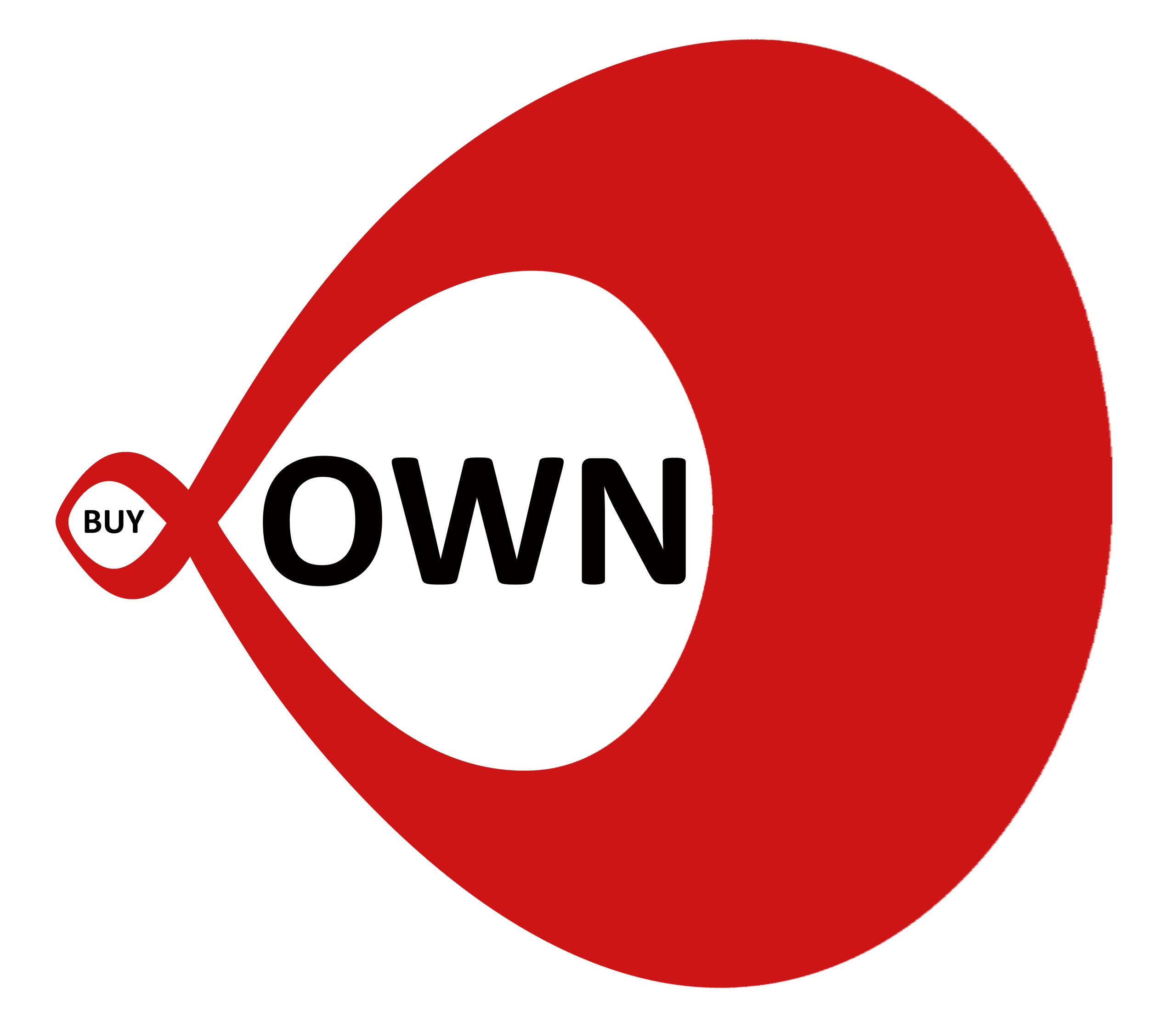
As Esteban Kolsky once put it, companies often focus almost entirely on the “buy cycle.” But customers live mostly in the “own cycle”—the long period of using, maintaining, fixing, improving, and learning from the products and services they already have:
In an intention economy, intelligence about that experience flows both ways between customers and companies. I wrote about this recently here:

Market intelligence that flows both ways.

VRM has long described one key mechanism for this: intentcasting, where customers signal their needs directly to the market rather than being targeted by guesses and ads.

Agents may make this far more feasible than it was when we first started talking about VRM nearly two decades ago.

But there’s an important point that often gets missed in current AI discussions.

The agency that matters most is the person’s, not the agent’s.

A personal AI agent is an instrument—like a phone, a computer, or a car. It acts on behalf of the individual, but the intention behind it must be the person’s own.

And that leads to another requirement:

The only truly personal agents will be owned and operated by individuals.

We don’t have that yet.

What we have instead are assistants that live inside corporate systems—helpful, sometimes impressive, but ultimately operating within feudal structures run by very large companies.

They are, at best, friendly suction cups on the tentacles of giants.

Individuals may well rent or borrow AI models from those giants. But the agents that represent us should operate inside our own environments, in our exclusive interest, rather than inside corporate systems whose interests may diverge from ours.

In other words, our agents should live in our own castles, not inside someone else’s kingdom.

When that happens—when individuals can show up in markets through tools they control—then the deeper shift becomes possible: from guesswork based on surveillance of captive customers to servicing self-qualified leads from free customers in the open marketplace.

Markets then begin to work the way markets are supposed to work: with demand and supply meeting in the open, in relationships that can last far beyond a single transaction.

This is also where work like MyTerms and the emerging ecosystem around personal AI becomes important. If individuals are to operate in markets through their own agents, those agents need ways to assert the person’s terms, preferences, and boundaries in forms that other systems can recognize and respect.

That is the direction VRM has been pointing for nearly twenty years: toward a world where individuals can arrive in markets with their own tools, their own data, and their own terms—and where markets can finally listen.

When that happens, markets will stop guessing what customers want—and start hearing them.

[Later… I actually wrote this post about a month ago, and put off publishing it while I worked on other things. Meanwhile, Adrian Gropper posted A Fork in the Road, which is required reading. I thank him for reminding me in the comments below, and for being a founding participant in ProjectVRM—going back to our earliest meetings almost 20 years ago.]


The Personal AI Greenfield

What forms of pAI—personal AI—are Apple, Mozilla, Google, Meta, Microsoft and the rest not doing?

Let’s look at those first two because they’re at the top of the news LIFO buffer.

Apple Intelligence (“coming in beta this fall*“), announced yesterday, will help you with writing and creating images while giving you less lame answers from Siri. (Which they should re-name. Siri is Apple’s Clippy.) It “can draw on larger server-based models, running on Apple silicon, to handle more complex requests for you while protecting your privacy.” The “larger models” will be white-labeled ChatGPT, plus Apple’s own small language models (SLMs).

Mozilla, which got $400+ million a year from Google (for search in the Firefox browser) starting in 2020, announce on June 3 that they will be Building open, private AI with the Mozilla Builders Accelerator. Jive:

This program is designed to empower independent AI and machine learning engineers with the resources and support they need to thrive. It aims to cultivate a more innovative AI ecosystem, and it’s one of Mozilla’s key initiatives to make AI meaningfully impactful — alongside efforts like Mozilla.ai, the Responsible AI Challenge and the Rise25 Awards.

The Mozilla Builders Accelerator’s inaugural theme is local AI, which involves running AI models and applications directly on personal devices like laptops, smartphones, or edge devices rather than depending on cloud-based services…

We chose Local AI as the theme for the Accelerator’s first cohort because it aligns with our core values of privacy, user empowerment, and open source innovation. This method offers several benefits including:

  • Privacy: Data stays on the local device, minimizing exposure to potential breaches and misuse.
  • Agency: Users have greater control over their AI tools and data.
  • Cost-effectiveness: Reduces reliance on expensive cloud infrastructure, lowering costs for developers and users.
  • Reliability: Local processing ensures continuous operation even without internet connectivity.

Looks to me like both of these are Big AI writ small. It’s “local,” not personal. It’s made to serve your needs with what BigAI offers through APIs. It is still essentially AIaaS (AI as a Service), rather than truly personal AI (pAI): personalized more than personal.

That’s also what I see when I read between the lines at Mozilla’s AI job openings. Take platform engineer. This person will (among other things), “assist in managing and orchestrating workloads across multiple cloud providers.” That’s fine. I’m sure true pAIs will do that too. But most of pAI will be more personal than that. It will deal with the mundanities of your everyday life. Not with coughing up answers that can only come from AIaaSes.

The problem with personalizing AI giant offerings is that they are large language models (LLM) trained on everything that can be crawled on the Internet, plus who knows what else. Not on your truly personal stuff. This is why “prompt engineering” worthy of the noun is ” not for anybody:

Prompt engineering is crucial for deploying LLMs but is poorly understood mathematically. We formalize LLM systems as a class of discrete stochastic dynamical systems to explore prompt engineering through the lens of control theory. We investigate the reachable set of output token sequences $R_y(\mathbf x_0)$ for which there exists a control input sequence $\mathbf u$ for each $\mathbf y \in R_y(\mathbf x_0)$ that steers the LLM to output $\mathbf y$ from initial state sequence $\mathbf x_0$. We offer analytic analysis on the limitations on the controllability of self-attention in terms of reachable set, where we prove an upper bound on the reachable set of outputs $R_y(\mathbf x_0)$ as a function of the singular values of the parameter matrices. We present complementary empirical analysis on the controllability of a panel of LLMs, including Falcon-7b, Llama-7b, and Falcon-40b. Our results demonstrate a lower bound on the reachable set of outputs $R_y(\mathbf x_0)$ w.r.t. initial state sequences $\mathbf x_0$ sampled from the Wikitext dataset. We find that the correct next Wikitext token following sequence $\mathbf x_0$ is reachable over 97% of the time with prompts of $k\leq 10$ tokens. We also establish that the top 75 most likely next tokens, as estimated by the LLM itself, are reachable at least 85% of the time with prompts of $k\leq 10$ tokens. Intriguingly, short prompt sequences can dramatically alter the likelihood of specific outputs, even making the least likely tokens become the most likely ones. This control-centric analysis of LLMs demonstrates the significant and poorly understood role of input sequences in steering output probabilities, offering a foundational perspective for enhancing language model system capabilities.

But all that stuff applies mostly when we’re prompting a big LLM system.

What about using AI in our own lives, where the data that matters most are in our calendars, contacts, financial and health records, our travels, our correspondence (email, chat, whatever)? And how about all the location data we might get from our cars, phone apps, and phone companies? These should be much easier for a pAI to gather, examine, and help us do useful things. Caring about much less data also means a pAI will be less likely to give wrong (hallucinated) answers.

Today the mental frame almost everybody uses for AI is the Big kind, ingesting everything they can get their crawlers on, and munching all of it in giant compute farms. Those systems are great for lots of stuff, but they still don’t deal with personal data listed in the last paragraph.

Not yet, anyway.

Look at it this way. For each of us, there are three data pools:

  1. The entire Net, which is what gets crawled by all the giant LLM operators, plus whatever else they can get their claws on.
  2. One’s personal life, some of which is digitized in useful form (contacts, calendar, mail, stuff in folders inside PCs and attached drives).
  3. Personal data that is in the hands of giants, but is rightfully ours. These include our driving record and driving practices (,recorded by our late model cars and snitched to insurance companies and others), our location data (kept and shared by car and phone carriers to the likes of Google and the feds), our TV viewing habits, (gathered by Google, Amazon, Roku, Apple, etc.).

The pAI greenfield is with the last two.

Tell us who is working on what there, preferably with open source, and not sitting on walled garden silicon.

[Later… ] Since readers told me I had small language models (SLMs) wrong in one of the paragraphs above, and I’m not sure I had them right, I rewrote them out of the piece. I invite readers to post comments to further correct and expand on the subject of pAIs and what they can do.

On Customer Constituency

A customer looks at a market where choice rules and nobody owns anybody. Source: Microsoft Copilot | Designer

I’m in a discussion of business constituencies. On the list (sourced from the writings of Doug Shapiro) are investors, employees, suppliers, customers, and regulators.

The first three are aware of their membership, but the last two? Not so sure.

Since ProjectVRM works for customers, let’s spin the question around. Do customers have a business constituency? If so, businesses are members by the customer’s grace. She can favor, ignore, or more deeply engage with any of those businesses at her pleasure. She does not “belong” to any of them, even though any or all of them may refer to her, or their many other customers, with possessive pronouns.

Take membership (e.g. Costco, Sam’s Club) and loyalty (CVS, Kroger) programs off the table. Membership systems are private markets, and loyalty programs are misnomered. (For more about that, read the “Dysloyalty” chapter of The Intention Economy.)

Let’s look instead at businesses that customers engage as a matter of course: contractors, medical doctors, auto mechanics, retail stores, restaurants, clubs, farmers’ markets, whatever. Some may be on speed dial, but most are not. What matters in all cases is that these businesses are responsible to their customers. “The real and effectual discipline which is exercised over a workman is that of his customers,” Adam Smith writes. “It is the fear of losing their employment which restrains his frauds and corrects his negligence.” That’s what it means to be a customer’s constituent.

An early promise of the Internet was supporting that “effectual discipline.” For the most part, that hasn’t happened. The “one clue” in The Cluetrain Manifesto said “we are not seats or eyeballs or end users or consumers. we are human beings and our reach exceeds your grasp. deal with it.” Thanks to ubiquitous surveillance and capture by corporate giants and unavoidable platforms, corporate grasp far outreaches customer agency.

That’s one reason ProjectVRM has been working against corporate grasp since 2006, and just as long for customer reach. Our case from the start has been that customer independence and agency are good for business. We just need to prove it.

Markets vs. Marketing in the Age of AI

Maybe history will defeat itself.

Remember FreePC? It was a thing, briefly, at the end of the last millennium, right before Y2K pooped the biggest excuse for a party in a thousand years. This may help. The idea was to put ads in the corner of your PC’s screen. The market gave it zero stars, and it failed.

And now comes Telly, hawking free TVs with ads in a corner, and a promise to “optimize your ad experience.” As if anybody wants an ad experience other than no advertising at all.

Negative demand for advertising has been well advertised by both ad blocking (the biggest boycott in human history) and ad-free “prestige” TV, (or SVOD— Subscription Video On Demand). With those we gladly pay—a lot— not to see advertising. (See numbers here.)

But the advertising business (in the mines of which I toiled for too much of my adult life) has always smoked its own exhaust and excels best at getting high with generous funders. (Yeah, some advertising works, but on the whole people still hate it on the receiving end.)

The fun will come when our own personal AI bots, working for our own asses, do battle with the robot Nazgûls of marketing — and win, because we’re on the Demand side of the marketplace, and we’ll do a better job of knowing what we want and don’t want to buy than marketing’s surveillant AI robots can guess at. Supply will survive, of course. But markets will defeat marketing by taking out the middle creep.

The end state will be one Cluetrain forecast in 1999, Linux Journal named in 2006, the VRM community started working on that same year, and The Intention Economy detailed in 2012. The only thing all of them missed was how customer intentions might be helped by personal AI.

Personal, not personalized.

Markets will become new and better dances between Demand and Supply, simply because Demand will have better ways to take the lead, and not just follow all the time. Simple as that.


*For more on how this will work, see Individual Empowerment and Agency on a Scale We’ve Never Seen Before.

As an aside, the mouth in whch BUY!!! appears is mine.  The gold crowns were provided by students of the UNC School of Dentistry, under the direction of Dr. Clinton Max Studevant for just $25 each, half a century ago. The original photo is here on Flickr, was shot with a Sony camcorder that could take low-res stills, and has had more than 80,000 views, which is way more than any of the 80,000 other photos I have on Flickr. I don’t know why.

Toward better buy ways

For sixteen years, ProjectVRM has encouraged the development of tools and services that solve business problems from the customer side. This work is toward testing a theory: that free customers are more valuable—to themselves and to the businesses they engage—than captive ones. That theory can only be tested when tools for doing that are in place.

We already have some of those tools. Our big four in the digital world are the browser, the phone, email, and texting. In the analog offline world, our best model is cash. From The Cash Model of Customer Experience:

Here’s the handy thing about cash: it gives customers scale. It does that by working the same way for everybody, everywhere it’s accepted. It’s also anonymous by nature, meaning it carries no personal identifiers. Recording what happens with it is also optional, because using it doesn’t require an entry in a ledger (as happens with cryptocurrencies). Cash has also been working this way for thousands of years. But we almost never talk about our “experience” with cash, because we don’t need to.

The problem with our four personal digital tools—browser, phone, email and texting—is that they are not fully ours. So our agency is at best compromised. Specifically,

  1. The most popular browsers are also agents of Apple, Google, Microsoft, plus countless thousands of third parties inserting cookies and other tracking instruments into our devices.
  2. Our phones are not just ours. They are corporate tentacles of Apple and Google, lined with countless personal data suction cups from unknown surveillance systems. (For more on this, see Apple vs (or plus) Adtech, Part I and Part II.)
  3. Apple and Google together supply 87% of all email software and services. Apple promises privacy, while Google makes a business out of knowing the contents of your messages, plus every other Google-provided or -involved piece of software reveals to the company about your life. As for how well Apple delivers on its privacy promises, look up apple+compromised+privacy.
  4. The original messaging service for phones, SMS, is owned and run by phone companies. Other major messaging, texting and chat services are run entirely by private companies.
  5. Among common Internet activities, only email and browsing are based on open and simple standards. The main ones are SMTP, IMAP, and POP3 for email, and HTTP/S for browsing. Those share the Internet’s three NEA virtues: Nobody owns them, Everybody can use them, and Anybody can improve them.

This is important: If a product or service mostly works for some company, it’s not yours. You are a user or a consumer. You are not a customer; nor are you operating with full agency in a truly free market. So, while it is obvious that all of us are made more valuable to business, and to ourselves, because we use browsers, phones, email, and messaging, we can’t say that we are free while we do.

But the Internet is still young: dating in its current form—supportive of e-commerce—since 30 April 1995, when the NSFNET (one of the Internet’s backbones) was decommissioned, and its policy forbidding commercial traffic on its pipes no longer stood in the way. The Net will also be with us for dozens or hundreds of decades to come, with its base protocol, TCP/IP, continuing to support freedom for every node on it.

More importantly, there are many business problems best or only solved from the customer side. Here is a list:

  1. Identity. Logins and passwords are burdensome leftovers from the last millennium. There should be (and already are) better ways to identify ourselves by revealing to others only what we need them to know. Working on this challenge is the SSI—Self-Sovereign Identity—movement.  (Which also goes by many other names. The latest is Web5.) The solution here for individuals is tools of their own that scale. Note that there is a LOT happening here. One good way keep up with it is in the Identisphere newsletter.  You can also participate by attending the twice-yearly Internet Identity Workshop, which has been going strong since 2005.
  2. Subscriptions. Nearly all subscriptions are pains in the butt. “Deals” can be deceiving, full of conditions and changes that come without warning. New customers often get better deals than loyal customers. And there are no standard ways for customers to keep track of when subscriptions run out, need renewal, or change. The only way this can be normalized is from the customers’ side.
  3. Terms and conditions. In the world today, nearly all of these are ones that companies proffer; and we have little or no choice about agreeing to them. Worse, in nearly all cases, the record of agreement is on the company’s side. Oh, and since the GDPR came along in Europe and the CCPA in California, entering a website has turned into an ordeal typically requiring “consent” to privacy violations the laws were meant to stop. Or worse, agreeing that a site or a service provider spying on us is a “legitimate interest.” The solution here is terms individuals can proffer and organizations can agree to. The first of these is #NoStalking, and allows a publisher to do all the advertising they want, so long as it’s not based on tracking people. Think of it as the opposite of an ad blocker. (Customer Commons is also involved in the IEEE’s P7012 Standard for Machine Readable Personal Privacy Terms.
  4. Payments. For demand and supply to be truly balanced, and for customers to operate at full agency in an open marketplace (which the Internet was designed to support), customers should have their own pricing gun: a way to signal—and actually pay willing sellers—as much as they like, however, they like, for whatever they like, on their own terms. There is already a design for that, called EmanciPay. Its promise for the music industry alone is enormous.
  5. Intentcasting. Advertising is all guesswork, which involves massive waste. But what if customers could safely and securely advertise what they want, and only to qualified and ready sellers? This is called intentcasting, and to some degree, it already exists. Toward this, the Intention Byway is a core focus of Customer Commons. (Also see a list of intentcasting providers on the ProjectVRM Development Work list.)
  6. Shopping. Why can’t you have your own shopping cart—that you can take from store to store? Because we haven’t invented one yet. But we can. And when we do, all sellers are likely to enjoy more sales than they get with the current system of all-silo’d carts.
  7. Internet of Things. We don’t have this yet. Instead, we have the Apple of things, the Amazon of things, the Google of things, the Samsung of things, the Sonos of things, and so on, each silo’d in separate systems we don’t control. Things we own on the Internet should be our things. We should be able to control them, as independent operators, as we do with our computers and mobile devices. (Also, by the way, things don’t need to be intelligent or connected to belong to the Internet for us to control what’s known about them. They can be, or have, picos.)
  8. Loyalty. All loyalty programs are gimmicks, and coercive. True loyalty is worth far more to companies than the coerced kind, and only customers are in a position to truly and fully express it. We should have our own loyalty programs, to which companies are members, rather than the reverse.
  9. Privacy. We’ve had privacy tech in the physical world since the inventions of clothing, shelter, locks, doors, shades, shutters, and other ways to limit what others can see or hear—and to signal to others what’s okay and what’s not. Instead, all we have are unenforced promises by others not to watch our naked selves, or to report what they see to others. Or worse, coerced urgings to “accept” spying on us and distributing harvested information about us to parties unknown, with no record of what we’ve agreed to.
  10. Customer service. There are no standard ways for customers and companies to enjoy relationships, with useful data flowing both ways, and for help to come when it’s needed. Instead, every company does it differently, in its own silo’d system. For more on this, see # 12 below.
  11. Regulatory compliance. Especially around privacy. Because really, all the GDPR and the CCPA want is for companies to stop spying on people. Without any privacy tech on the individual’s side, however, responsibility for everyone’s privacy is entirely a corporate burden. This is unfair to people and companies alike, as well as insane—because it can’t work. (Worse, nearly all B2B “compliance” solutions only solve the felt need by companies to obey the letter of a law while ignoring its spirit. But if people have their own ways to signal their privacy requirements and expectations (as they do with clothing and shelter in the natural world), life gets a lot easier for everybody, because there’s something there to respect. We don’t have that yet online, but it shouldn’t be hard. For more on this, see Privacy is Personal and our own Privacy Manifesto.
  12. Real relationships: ones in which both parties actually care about and help each other, and good market intelligence flows both ways. Marketing by itself can’t do it. All you get is the sound of one hand slapping. (Or, more typically, pleasuring itself with mountains of data and fanciful maths first described in Darrell Huff’s How to Lie With Statistics, written in 1954). Sales departments can’t do it either, because their job is done once the relationship is established. CRM can’t do it without a VRM hand to shake on the customer’s side. From What Makes a Good Customer: “Consider the fact that a customer’s experience with a product or service is far more rich, persistent and informative than is the company’s experience selling those things, or learning about their use only through customer service calls (or even through pre-installed surveillance systems such as those which for years now have been coming in new cars). The curb weight of customer intelligence (knowledge, know-how, experience) with a company’s products and services far outweighs whatever the company can know or guess at. So, what if that intelligence were to be made available by the customer, independently, and in standard ways that work at scale across many or all of the companies the customer deals with?”
  13. Any-to-any/many-to-many business: a market environment where anybody can easily do business with anybody else, mostly free of centralizers or controlling intermediaries (with due respect for inevitable tendencies toward federation). There is some movement in this direction around what’s being called Web3.
  14. Life management platforms. KuppingerCole has been writing and thinking about these since not long after they gave ProjectVRM an award for its work, way back in 2007. These have gone by many labels: personal data clouds, vaults, dashboards, cockpits, lockers, and other ways of characterizing personal control of one’s life where it meets and interacts with the digital world. The personal data that matters in these is the kind that matters in one’s life: health (e.g. HIEofOne), finances, property, subscriptions, contacts, calendar, creative works, and so on, including personal archives for all of it. Social data out in the world also matters, but is not the place to start, because that data is less important than the kinds of personal data listed above—most of which has no business being sold or given away for goodies from marketers. (See We can do better than selling our data.)

All of these, however, are ocean-boiling ideas. In other words, not easy, especially without what the military calls “robust funding.” So our strategies are best aimed toward what are called “blue” rather than “red” (blood filled) oceans. One of those is the Byway (or “buyway”) project by Customer Commons, in Bloomington, Indiana. An excerpt:

There are three parts to the Byway project as it now stands (in July 2022): an online community (Small Town/mastodon), a matcher tool (Intently), and a local e-commerce “buyway.” (For more on that one, download the slide deck presented by Doc and Joyce at The Mill in November 2021. Or download this earlier and shorter one.)

We also see the Byway as complementary to, rather than competitive with, developments with similar and overlapping ambitions, such as SSI, DIDcomm, picos, JLINC, Digital Homesteading / Dazzle and many others.

Joyce and I, both founders and board members of Customer Commons, are heading up to DWeb Camp in a few minutes, and plan to make progress there on Byway development. I’ll report here on progress.

[Later…] DWeb Camp was a great success for us. We are now in planning conversations with developers and others. Stay tuned for more on that.

How the Web sucks

This spectrum of emojis is a map of the Web’s main occupants (the middle three) and outliers (the two on the flanks). It provides a way of examining who is involved, where regulation fits, and where money gets invested and made. Yes, it’s overly broad, but I think it’s helpful in understanding where things went wrong and why. So let’s start.

Wizards are tech experts who likely run their own servers and keep private by isolating themselves and communicating with crypto. They enjoy the highest degrees of privacy possible on and around the Web, and their approach to evangelizing their methods is to say “do as I do” (which most of us, being Muggles, don’t). Relatively speaking, not much money gets made by or invested in Wizards, but much money gets made because of Wizards’ inventions. Those inventions include the Internet, the Web, free and open source software, and much more. Without Wizards, little of what we enjoy in the digital world today would be possible. However, it’s hard to migrate their methods into the muggle population.

‍Muggles are the non-Wizards who surf the Web and live much of their digital lives there, using Web-based services on mobile apps and browsers on computers. Most of the money flowing into the webbed economy comes from Muggles. Still, there is little investment in providing Muggles with tools for operating or engaging independently and at scale across the websites and services of the world. Browsers and email clients are about it, and the most popular of those (Chrome, Safari, Edge) are by the grace of corporate giants. Almost everything Muggles do on the Web and mobile devices is on apps and tools that are what the trade calls silos or walled gardens: private spaces run by the websites and services of the world.

Sites. This category also includes clouds and the machinery of e-commerce. These are at the heart of the Web: a client-server (aka calf-cow) top-down, master-slave environment where servers rule and clients obey. It is in this category that most of the money on the Web (and e-commerce in general) gets made, and into which most investment money flows. It is also here that nearly all development n the connected world today happens.

 Ad-tech, aka adtech, is the home of surveillance capitalism, which relies on advertisers and their agents knowing all that can be known about every Muggle. This business also relies on absent Muggle agency, and uses that absence as an excuse for abusing the privilege of committing privacy violations that would be rude or criminal in the natural world. Also involved in this systematic compromise are adtech’s dependents in the websites and Web services of the world, which are typically employed by adtech to inject tracking beacons in Muggles’ browsers and apps. It is to the overlap between adtech and sites that all privacy regulation is addressed. This is why, the GDPR sees Muggles as mere “data subjects,” and assigns responsibility for Muggle’s privacy to websites and services the regulation calls “data controllers” and “data processors.” The regulation barely imagines that Muggles could perform either of those roles, even though personal computing was invented so every person can do both. (By the way, the adtech business and many of its dependents in publishing like to say the Web is free because advertising pays for it. But the Web is as free by nature as are air and sunlight. And most of the money Google makes, for example, comes from plain old search advertising, which can get along fine without tracking. There is also nothing about advertising itself that requires tracking.)

 Crime happens on the Web, but its center of gravity is outside, on the dark web. This is home to botnets, illegal porn, terrorist activity, ransom attacks, cyber espionage, and so on. There is a lot of overlap between crime and adtech, however, given the moral compromises required for adtech to function, plus the countless ways that bots, malware and other types of fraud are endemic to the adtech business. (Of course, to be an expert criminal on the dark web requires a high degree of wizardry. So I one could arrange these categories in a circle, with an overlap between wizards and criminals.)

I offer this set of distinctions for several reasons. One is to invite conversation about how we have failed the Web and the Web has failed us—the Muggles of the world—even though we enjoy apparently infinite goodness from the Web and handy services there. Another is to explain why ProjectVRM has been more aspirational than productive in the fifteen years it has been working toward empowering people on the commercial Net. (Though there has been ample productivity.) But mostly it is to explain why I believe we will be far more productive if we start working outside the Web itself. This is why our spinoff, Customer Commons, is pushing forward with the Byway toward i-commerce. Check it out.

Finally, I owe the idea for this visualization to Iain Henderson, who has been with ProjectVRM since before it started. (His other current involvements are with JLINC and Customer Commons.) Hope it proves useful.

A New Way

Cross-posted from Customer Commons

Some questions:

  1. Why do you always have to accept websites’ terms? And why do you have no record of your own of what you accepted, or when‚ or anything?
  2. Why do you have no way to proffer your own terms, to which websites can agree?
  3. Why did Do Not Track, which was never more than a polite request not to be tracked off a website, get no respect from 99.x% of the world’s websites? And how the hell did Do Not Track turn into the Tracking Preference Expression at the W2C, where the standard never did get fully baked?
  4. Why, after Do Not Track failed, did hundreds of millions—or perhaps billions—of people start blocking ads, tracking or both, on the Web, amounting to the biggest boycott in world history? And then why did the advertising world, including nearly all advertisers, their agents, and their dependents in publishing, treat this as a problem rather than a clear and gigantic message from the marketplace?
  5. Why are the choices presented to you by websites called your choices, when all those choices are provided by them? And why don’t you give them choices?
  6. Why does the GDPR call people mere “data subjects,” and assign the roles “data controller” and “data processor” only to other parties?* And why are nearly all the 200+million results in a search for GDPR+compliance about how companies can obey the letter of the law while violating its spirit (by continuing to track people)?
  7. Why does the CCPA give you the right to ask to have back personal data others have gathered about you on the Web, rather than forbid its collection in the first place? (Imagine a law that assumes that all farmers’ horses are gone from their barns, but gives those farmers a right to demand horses back from those who took them. It’s kinda like that.)
  8. Why, 22 years after The Cluetrain Manifesto said, we are not seats or eyeballs or end users or consumers. we are human beings and our reach exceeds your grasp. deal with it. —is that statement still not true?
  9. Why, 9 years after Harvard Business Review Press published The Intention Economy: When Customers Take Charge, has that not happened? (Really, what are you in charge of in the marketplace that isn’t inside companies’ silos and platforms?)

The easiest answer to all of those is the cookie.  Partly because without it none of those questions would be asked, and partly because it’s at the center of attention for everyone who cares today about the issues involved in those quesions.

The idea behind the cookie (way back in 1994, when Lou Montulli thought it up) was for a site to remember its visitors by planting reminder files—cookies—in visitors’ browsers. That would make it easy for site visitors to pick up where they left off when they arrived back. It was an innocent idea at the time; but it reified a construct: one that has permanently subordinated visitors to websites.

And it has thus far proven impossible to change that construct. It is, alas, the way the Web works.

Hey, maybe we can still change it. But why bother when there should be any number of other ways for demand and supply to signal each other in a networked marketplace? Better ways: ones that don’t depend on sites, search engines, social media and other parties inferring, mostly through surveillance, what might be “relevant” or “interest-based” for the individual? Ones that give individuals full agency and signaling power?

So we’d like to introduce one. It’s called the Intention Byway. It’s the brain-baby of our CTO, Hadrian Zbarcea, and it is informed by his ample experience with the Apache Software Foundation, SWIFT, the FAA and other enterprises large and small.

In this model, the byway is the path along which messages signaling intent travel between individuals and companies (or anyone), each of which has a simple computer called an intentron, which sends and receives those messages, and also executes code for the owner’s purposes as a participant in the open marketplace the Internet was designed to support.

As computers (which can be physical or virtual), intentrons run apps that can come from any source in the free and open marketplace, and not just from app stores of controlling giants such as Apple and Google. These apps can run algorithms that belong to you, and can make useful sense of your own data. (For example, data about finances, health, fitness, property, purchase history, subscriptions, contacts, calendar entries—all those things that are currently silo’d or ignored by silo builders that want to trap you inside their proprietary systems.) The same apps also don’t need to be large. Early prototypes have less than 100 lines of code.

Messages called intentcasts can be sent from intentrons to markets on the pub-sub model, through the byway, which is asynchronous, similar to email in the online world and package or mail forwarding in the offline world. Subscribers on the sell side will be listening for signals from markets for anything. Name a topic, and there’s something to subscribe to. Intentcasts on the customers’ side are addressed to markets by topical name. Responsibilities along the way are handled by messaging and addressing authorities. Addresses themselves are URNs, or Uniform Resource Names.

These are some businesses that can thrive along the Intention Byway:

  • Intentron makers
  • Intentron sellers
  • App makers
  • App sellers (or stores)
  • Addressing authorities
  • Messaging authorities
  • Message routers (operating like CDNs, or content distribution networks)

—in addition to sellers looking for better signals from the demand side of the market than surveillance-based guesswork can begin to equal.

We are not looking to boil an ocean here (though we do see our strategy as a blue one). The markets first energized by the promise of this model are local and vertical. Real estate in Boston and farm-to-table in Michigan are the two we featured on VRM/CuCo Day and in all three days of the Internet Identity Workshop, which all took place last week. Over the coming days and weeks, we will post details on how the Intention Byway works, starting with those two markets.

We also see the Intention Byway as complementary to, rather than competitive with, developments with similar ambitions, such as SSI, DIDcomm, picos, and JLINC. Once we take off our browser blinders, a gigantic space for new e-commerce development appears. All of those, and many more, will have work to do in it.

So stay tuned for more about life after cookies—and outside the same old bakery.


*Specifically, a “data controller” is “a legal or natural person, an agency, a public authority, or any other body who, alone or when joined with others, determines the purposes of any personal data and the means of processing it.”

While this seems to say that any one of us can be a data controller, that was not what the authors of the GDPR had in mind. They only wanted to maximize the width of the category to include solo operators, rather than to include the individual from whom personal data is collected. (Read what follows from that last link to see what I mean.) Still, this is a loophole through which personal agency can move, because (says the GDPR) the “data subject” whose rights the GDPR protects, is a “natural person.”

Toward e-commerce 2.0

Phil Windley explains e-commerce 1.0  in a single slide that says this:

One reason this happened is that client-server, aka calf-cow  (illustrated in Thinking outside the browser) has been the default format for all relationships on the Web, and cookies are required to maintain those relationships.  The result is a highly lopsided power asymmetry in which the calves have no more power than the cows give them. As a result,

  1. The calves have no easy way even to find  (much less to understand or create) the cookies in their browsers’ jars.
  2. The calves have no identity of their own, but instead have as many different identities as there are websites that know (via cookies) their visiting browsers. This gives them no independence, much less a place to stand like Archimedes, with a lever on the world. The browser may be a great tool, but it’s neither that place to stand, nor a sufficient lever. (Yes, it should have been, and maybe still could be; but meanwhile, it isn’t.)
  3. All the “agreements” the calves have with the websites’ cows leave no readable record on the calves’ side. This severely limits their capacity for dispute, which is required for a true relationship.
  4. There exists no independent way the calves to signal their intentions—such as interests in purchase, conditions for engagement, or the need to be left alone (which is how Brandeis and Warren define privacy).

In other words, the best we can do in e-commerce 1.0 is what the calf-cow system provides: ways for calves to depend utterly on means the cows provide. And some of those cows are mighty huge.

Nearly all of signaling between demand and supply remains trapped inside these silos and walled gardens. We search inside their systems, we are notified of product and service availability inside their systems, we make agreements inside their systems (to terms and conditions they provide and require), or privacy is dependent on their systems, and product and service delivery is handled either inside their systems or through allied and dependent systems.

Credit where due: an enormous amount of good has come out of these systems. But a far larger amount of good is MLOTT—money left on the table—because there is a boundless sum and variety of demand and supply that still cannot easily signal their interest, intentions of presence to each other in the digital world.

Putting that money on the table is our job in e-commerce 2.0.

So here is a challenge: tell us how we can do that without using browsers.

Some of us here do have ideas. But we’d like to hear from you first.


Cross-posted at the ProjectVRM blog, here.

Customertech Will Turn the Online Marketplace Into a Marvel-Like Universe in Which All of Us are Enhanced

enhanced-by-customertech

We’ve been thinking too small.

Specifically, we’ve been thinking about data as if it ought to be something big, when it’s just bits.

Your life in the networked world is no more about data than your body is about cells.

What matters most to us online is agency, not data. Agency is the capacity, condition, or state of acting or of exerting power (Merriam-Webster).

Nearly all the world’s martech and adtech assumes we have no more agency in the marketplace than marketing provides us, which is kind of the way ranchers look at cattle. That’s why bad marketers assume, without irony, that it’s their sole responsibility to provide us with an “experience” on our “journey” down what they call a “funnel.”

What can we do as humans online that isn’t a grace of Apple, Amazon, Facebook or Google?

Marshall McLuhan says every new technology is “an extension of ourselves.” Another of his tenets is “we shape our tools and thereafter our tools shape us.” Thus Customertech—tools for customers—will inevitably enlarge our agency and change us in the process.

For example, with customertech, we can—

Compared to what we have in the offline world, these are superpowers. When customertech gives us these superpowers, the marketplace will become a Marvel-like universe filled with enhanced individuals. Trust me: this will be just as good for business as it will be for each of us.

We can’t get there if all we’re thinking about is data.

By the way, I made this same case to Mozilla in December 2015, on the last day I consulted the company that year. I did it through a talk called Giving Users Superpowers at an all-hands event called Mozlando. I don’t normally use slides, but this time I did, leveraging the very slides Mozilla keynoters showed earlier, which I shot with my phone from the audience. Download the slide deck here, and be sure to view it with the speaker’s notes showing. The advice I give in it is still good.

BTW, a big HT to @SeanBohan for the Superpowers angle, starting with the title (which he gave me) for the Mozlando talk.


Our radical hack on the whole marketplace

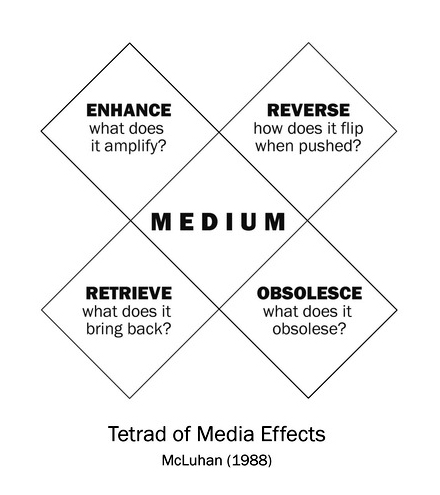
In Disruption isn’t the whole VRM story, I visited the Tetrad of Media Effects, from Laws of Media: the New Science, by Marshall and Eric McLuhan. Every new medium (which can be anything from a stone arrowhead to a self-driving car), the McLuhans say, does four things, which they pose as questions that can have multiple answers, and they visualize this way:

tetrad-of-media-effects

The McLuhans also famously explained their work with this encompassing statement: We shape our tools and thereafter they shape us.

This can go for institutions, such as businesses, and whole marketplaces, as well as people. We saw that happen in a big way with contracts of adhesion: those one-sided non-agreements we click on every time we acquire a new login and password, so we can deal with yet another site or service online.

These were named in 1943 by the law professor Friedrich “Fritz” Kessler in his landmark paper, “Contracts of Adhesion: Some Thoughts about Freedom of Contract.” Here is pretty much his whole case, expressed in a tetrad:

contracts-of-adhesion

Contracts of adhesion were tools industry shaped, was in turn shaped by, and in turn shaped the whole marketplace.

But now we have the Internet, which by design gives everyone on it a place to stand, and, like Archimedes with his lever, move the world.

We are now developing that lever, in the form of terms any one of us can assert, as a first party, and the other side—the businesses we deal with—can agree to, automatically. Which they’ll do it because it’s good for them.

I describe our first two terms, both of which have potentials toward enormous changes, in two similar posts put up elsewhere: 

— What if businesses agreed to customers’ terms and conditions? 

— The only way customers come first

And we’ll work some of those terms this week, fittingly, at the Computer History Museum in Silicon Valley, starting tomorrow at VRM Day and then Tuesday through Thursday at the Internet Identity Workshop. I host the former and co-host the latter, our 24th. One is free and the other is cheap for a conference.

Here is what will come of our work:
personal-terms

Trust me: nothing you can do is more leveraged than helping make this happen.

See you there.


« Older posts

© 2026 ProjectVRM

Theme by Anders NorenUp ↑