Category: Personal (Page 1 of 2)

Toward a Personal AI Roadmap for VRM

On the ProjectVRM list, John Wunderlich shared a find that makes clear how advanced and widespread  AI-based shopping recommendation has gone so far (and not just with ChatGPT and Amazon). Here it is: Envisioning Recommendations on an LLM-Based Agent Platform: Can LLM-based agents take recommender systems to the next level?

It’s by Jizhi ZhangKeqin BaoWenjie WangYang ZhangWentao ShiWanhong XuFuli Feng, and Tat-Seng Chua* and is published in the Artificial Intelligence and Machine Learning section of Research and Advances in Communications of the ACM. So it’s serious stuff.

Here’s one graphic from the piece, with its caption:

Illustration of the Rec4Agentverse. The left side depicts three roles in the RecAgentverse: the user, the Agent Recommender, and Item Agents, along with their interconnected relationships. In contrast to traditional recommender systems, the Rec4Agentverse has more intimate relationships among the three roles. For instance, there are multi-round interactions between 1) users and Item Agents and 2) the Agent Recommender and Item Agents. The right side demonstrates how the Agent Recommender can collaborate with Item Agents to affect the information flow of users and offer personalized information services.

With VRM, however, we need our own personal AI agents, and useful data that’s not limited to what’s gathered by surveillance (which we can assume is most if not all of the Information layer).
So I started a conversation with ChatGPT. I’ll divide it into sections:
  1. Who wrote the CACM piece
  2. The state of recommendation science
  3. Who is working on personal AI
  4. How one can get started
  5. Forms of personal data to manage

There’s a lot here. The meat of it, for ProjectVRM purposes, starts in section 3. (The first two are more about what we’re up against.) Please read the whole thing and help us think through where to go with the challenge facing us. As we see in section 3, we do have some stuff on our side.

1. Who wrote the CACM piece
Me:
Can you tell me more about the authors here: https://cacm.acm.org/research/envisioning-recommendations-on-an-llm-based-agent-platform/?
ChatGPT:

🧑‍💼 Jizhi Zhang

Affiliation: University of Science and Technology of China (USTC), Data Science Lab (inferred from USTC page) cacm.acm.org+14data-science.ustc.edu.cn+14x.com+14.
Research Interests: Recommendation systems, LLM-based agent platforms, and interactive intelligent systems—his lead authorship and continued work on Prospect Personalized Recommendation on LLM-Based Agent Platform (arXiv Feb 2024) reinforce this arxiv.org.


🧑‍🔬 Keqin Bao, Wenjie Wang, Yang Zhang, Wentao Shi, Fuli Feng, Tat‑Seng Chua

Affiliations: While CACM doesn’t list this, Jizhi Zhang and Fuli Feng are part of USTC’s Data Science Lab; Tat‑Seng Chua is a distinguished researcher from the National University of Singapore known for multimedia and information retrieval.
Expertise: A mix of recommender system design, LLM-agent evaluation, multimedia analysis, and human-AI interaction—reflecting a blend of USTC’s strengths and CACM relevance data-science.ustc.edu.cn+8cacm.acm.org+8data-science.ustc.edu.cn+8linkedin.com+4arxiv.org+4researchgate.net+4.


🧑‍🎓 Wanhong Xu

Affiliation: USTC Data Science Lab (USTC LDS), contributor to the same article .
Role: Emerging researcher whose latest publication is this Rec4Agentverse article, indicating an early-career focus in LLM-based recommender systems linkedin.com+8data-science.ustc.edu.cn+8linkedin.com+8.


🧠 Broader Context & Contributions

The group operates at the intersection of Large Language Models, agent-oriented systems, and recommender systems, pioneering a Rec4Agentverse paradigm that treats LLM-powered agents as “recommendable” items collaborating with one another—an evolution of traditional recommendation frameworkscacm.acm.org+5cacm.acm.org+5cacm.acm.org+5.
Their work continues earlier research (e.g., Prospect Personalized Recommendation… in Feb 2024), solidifying their ongoing commitment to expanding intelligent, conversational recommendation platforms arxiv.org.


🧭 Why This Matters

Academic Thought Leadership: Jizhi Zhang and colleagues are pushing forward thinking about how recommendations can evolve when agents—not passive items—are central.
Institutional Backing: All deeply connected to USTC’s Data Science Lab, underscoring strong Chinese academic investment in AI-driven recommender innovation.
Collaborative Reach: Including scholars like Tat‑Seng Chua broadens the research to include international perspectives in multimedia and retrieval systems.


In summary: This team is a multidisciplinary cohort—centered at USTC with international collaboration—who are pioneering the idea that LLM agents can become interactive, dynamic items in recommender systems. Their work positions them at the forefront of intelligent agent systems and could reshape how platforms personalize experiences in the future.

If you’re curious about any individual’s past publications, citation impact, or related work (e.g., on Agent4Rec), I’d be happy to dive deeper!


3. The state of recommendation science

Me:

How large is the emerging science, within the AI field, of recommendations?

ChatGPT:

The science of recommendations, particularly within the AI field, is not just emerging—it’s a massive, rapidly evolving subfield that is both academically rich and commercially dominant. That said, it’s also entering a new phase, driven by the rise of large language models (LLMs)interactive agents, and multimodal platforms.


📚 Academic Scope

1. Established Field: Recommender Systems

Recommender systems (RecSys) are a well-developed domain within AI and machine learning, with roots in the 1990s.
Annual conferences like:
ACM RecSys (since 2007)
SIGIRKDDWSDM, and NeurIPS regularly feature recommendation research.
Thousands of papers annually on topics like:
Collaborative filtering
Matrix/tensor factorization
Deep learning for recommendation
Fairness, transparency, and explainability in RecSys
Reinforcement learning and bandit algorithms for personalization

🔎 As of 2024, over 60,000 papers in academic databases (e.g., Google Scholar) are tagged or indexed under “recommender systems”.


📈 Current Trends & Expanding Frontiers

2. LLMs + Recommendation = New Subfield

major shift is underway: integrating Large Language Models (LLMs) into recommendation systems.
These go beyond “you may also like” to:
Use natural language context and dialogue
Generate explanations, not just rankings
Support conversational recommendation
Coordinate agent ecosystems, e.g., multi-agent reasoning environments

Example paradigms:

RecMind – reasoning-aware recommendation agents
Rec4Agentverse – treating agents as recommendable entities
ChatRecs – integrating LLMs into live user conversations


3. Multimodal & Multitask Integration

Systems increasingly blend text, image, video, behavior, and user feedback.
LLMs allow richer personalization using complex user intent derived from unstructured data.


4. Industry Investment

FAANG companies (especially YouTube, Netflix, Amazon, TikTok, and Spotify) base their core user experience on AI-driven recommendation.
Billions of dollars are spent optimizing:
Ranking quality
Engagement prediction
Real-time inference
Federated and privacy-preserving personalization


🧭 Estimate of Scope

Area

Estimate (2024–25)

📄 Academic papers (RecSys + AI)

60,000+ overall; thousands per year

📚 Top conferences with recommender tracks

20+ (ACM RecSys, SIGIR, KDD, NeurIPS, etc.)

👩‍💼 Active researchers

Tens of thousands globally

🧠 Emerging subfields

LLM-based Rec, conversational Rec, agent-based Rec, explainable Rec

💰 Industry scale

$10B+ annually invested in personalization tech


🧠 In Summary

The science of recommendation is:

Not new, but rapidly evolving
Core to AI applications, especially with LLMs and agents
One of the most commercially and socially impactful domains in modern AI
Growing into new subfields (e.g. Rec4Agentverse, LLM Rec, multi-agent Rec)

Let me know if you’d like a visual map of how the recommendation science ecosystem is structured—or who the top authors and institutions are in this space

3. Who is working on personal AI
Me:
And who, if anyone, is working to provide customers with their own personal AI tools: ones that work for them, to empower their own agency in the marketplace? By which I mean truly personal AI, and not the kind personalized by some external LLM (or similar) system.
ChatGPT:

That’s an essential and forward-looking question—especially as most “AI for you” today really means “AI about you, for someone else.”

While Big Tech firms dominate personalized AI, a growing ecosystem is focused on truly personal AI—that is, AI you own, that works for you (not advertisers or platforms), and that enhances your agency in the marketplace and your life.

Here are the most notable people, projects, and initiatives advancing truly personal AI today:


🧠 1. Kwaai and pAI-OS (South Africa / Global)

Kwaai is building an open-source, user-sovereign personal AI OS called pAI-OS.
Designed to run locally or at user discretion, with full data ownershipmodular agent systems, and plugin capability.
Aligns with IEEE P7012 (“MyTerms”) privacy standards (see below).
Actively exploring intentcastingcustomer signaling, and VRM (Vendor Relationship Management).
Site: https://kwaai.ai


🛠️ 2. Indie AI and Personal Agent projects

Several smaller open-source initiatives are trying to build personal agent toolkits that you can host and configure:

Examples:

AutoGen Studio (Microsoft) – allows building agent workflows, some of which can be user-defined. But it’s not yet fully personal or private.
Langroid – open-source framework for local agent-based LLM systems. Designed for extensibility, can be made personal with effort.
OpenDevinSuperagentAuto-GPT – can be self-hosted, though most are still tool-centric rather than user-centric.
Personal.ai – A commercial startup that says it is personal, but uses centralized storage and fine-tuning, so actual user control is limited.

🔍 Reality check: Most of these still rely on external LLMs (like OpenAI or Anthropic), even if they claim to be “your AI”.


🌐 3. Solid Project (by Tim Berners-Lee)

While not AI per se, Solid is a decentralized identity and data storage architecture that allows individuals to store their own data in personal data pods.
AI tools can be layered on top to access only the data you choose to share.
Foundation for personal AI assistants that can work with your data, not on others’ clouds.
https://solidproject.org


📜 4. IEEE P7012 – MyTerms

A standard being developed to flip the notice-and-consent regime—so individuals, not companies, dictate the terms of data use.
Backed by Customer Commons and designed to support intentcasting and personal marketplace signaling.
This enables a personal AI to serve as your agent, enforcing your terms and engaging the marketplace on your behalf.


🧩 5. Project VRM (Vendor Relationship Management)

Initiated by Doc Searls to empower customers with tools to manage vendors, not just the reverse.
Envisions personal tools (including AI) to:
Signal intent
Manage service contracts
Retain records of offers, purchases, warranties
Avoid manipulation, surveillance, and lock-in

Project VRM is not a software project per se, but a framework guiding developers to build personal tools that support individual autonomy.


🔒 6. Open-source LLM stacks for local use

Several local LLM projects can be combined with personal data layers to build truly personal AI:

LM Studio – runs local models on desktop
PrivateGPT – local inference + local documents
Ollama – macOS-native interface for fast-running models like LLaMA, Mistral
LangChain / LlamaIndex – frameworks for building RAG systems with local documents

These aren’t personal AI systems yet—but they are key ingredients.


🧭 Summary

Name / Project

What They Do

Status

Kwaai / pAI-OS

Open, personal AI OS and agent platform

Early but active

Solid

Personal data control layer

Stable; in use

IEEE P7012

Standards for user-enforced data terms

In development

Project VRM

Framework for tools that empower buyers

Thought leadership; toolkits emerging

Local AI frameworks

Tech foundations for personal AI

Available, DIY-friendly


🚧 The Gap

Despite this promising landscape, no major platform today delivers a fully integrated, easy-to-use personal AI that you own, configure, and direct—yet. But:

A personal AI revolution is underway, led by privacy advocates, open-source communities, and a few visionary developers—not Big Tech.

Would you like help putting together a DIY stack for your own personal AI toolkit based on this landscape?

Me:
Can you name some of the people in the personal AI revolution, and tell me what that DIY stack would contain?
ChatGPT:

Absolutely. Here’s a breakdown of key people involved in the personal AI movement, followed by a practical DIY stack you can start building today.


👤 People Leading or Advancing the Personal AI Revolution

These individuals aren’t all working on the same projects, but they’re aligned in trying to build AI that’s ownedrun, and controlled by the individual—not centralized platforms.

🧑‍🔬 Tim Berners-Lee

Project: Solid (stewarded by ODI, commercially implemented by companies including TBLs Inrupt)
Focus: Decentralized web and personal data ownership via data pods
Impact: Infrastructure for privacy-respecting personal AI agents
https://solidproject.org


👤 Doc Searls

Project: Project VRM, Customer Commons, IEEE P7012
Focus: Customer empowerment, intentcasting, reversing surveillance capitalism
Impact: Philosophy and standards for customer-directed personal AI
https://projectvrm.org


🧠 Tawanda Kembo & Kwaai team

Project: pAI-OS (personal AI operating system)
Focus: Agent-centric open-source operating system for personal AI
Impact: One of the few efforts aiming to create a complete personal AI stack
https://kwaai.ai


🧑‍💻 Simon Willison

Project: Datasette, open tools for data management
Focus: Personal data control, lightweight databases, LLM + local tooling
Impact: Key figure in the open data + local AI tooling space
https://simonwillison.net


🤖 Brian Roemmele

Project: Multiplex (personal voice AI)
Focus: Voice-first personal assistants you run locally
Impact: Vocal advocate for true personal AI, often referencing “software you own”


🛠️ A DIY Personal AI Stack (2025 Edition)

This stack assumes local-first, modular, privacy-respecting tools. You can mix and match based on your needs.

🧩 Core Components

Layer

Tools / Projects

Notes

1. OS Layer

LinuxpAI-OS (in dev)

Linux gives flexibility; pAI-OS aims to be a full personal AI OS

2. Local LLM Inference

OllamaLM StudioPrivateGPTLocalAI

Run models like LLaMA 3, Mistral, Phi-3 entirely offline

3. Vector Database

ChromaWeaviateMilvus, or SQLite with FTS5

Store and retrieve embedded text data

4. Personal Indexing

LlamaIndexLangChainAutoGenGPTPilot

Feed personal documents and data to your LLM

5. Personal Data Storage

Solid PODDatasetteObsidian

Your life’s data, structured and queryable

6. Personal Agent Framework

SuperagentCrewAILangroidAutoGen

Design agents that act on your behalf, modular and scriptable

7. Front-end Interface

GradioStreamlitTauri appElectron

Local GUI/UX to interact with your agent

8. Voice Interface (optional)

OpenVoiceVoskWhisper.cppCoqui TTS

Build voice-in/voice-out agent on your machine


🧠 Optional Add-ons

Offline search: Chat over your files, PDFs, photos, and emails with LlamaIndex + PrivateGPT
Calendar/notes: Sync with Obsidian or local markdown-based knowledge base
Browser agent: Auto-control browser via Puppeteer/Playwright for marketplace navigation


🧭 What’s Still Missing?

True personal OS integration (like what pAI-OS is trying to do)
Seamless data portability and contract enforcement (IEEE P7012 is working on it)
Trusted personal AI app ecosystem (some apps, like Beeper or Obsidian, are getting close)


Would you like a tailored recommendation for building a personal AI stack based on your technical skill level or use cases (e.g., journaling, research, negotiation, shopping, data querying)?

4. How can I get started?
Me:
Yes. My technical skill level is modest at best. I can write HTML and do very basic stuff in the command line. I have an extra laptop I can devote to solo work, and Ethernet to a 2.1GB/s symmetrical fiber connection to the Internet with no data limits.
ChatGPT:

Great — with your setup (modest technical skills, spare laptop, blazing-fast fiber), you’re in an excellent position to begin building a practical personal AI system without diving too deep into complex dev work. Here’s a recommended stack tailored to your current skills and goals:


🧰 YOUR PERSONAL AI STARTER STACK (2025)

🔧 1. Platform Base

Use a Linux distribution designed for ease of use and AI tinkering:

RecommendedPop!_OS or Ubuntu 24.04
Easy GUI, good hardware compatibility, lots of online support
Optional: Use your laptop in “air-gapped” mode for privacy and full local control


🤖 2. Run a Local LLM with LM Studio

LM Studio (macOS/Windows/Linux) lets you run LLaMA 3MistralPhi-3, and others without coding.
Built-in UI — chat with models locally, no internet required after download.
You can download 7B or 13B models based on your hardware.
Best for: private journaling, summarizing files, answering questions.

✅ Why it’s ideal for you:

GUI-based
Just click and download models
No API keys or command-line needed once installed


📁 3. Chat with Your Files (PrivateGPT / LlamaIndex)

PrivateGPT or GPTPilot can let you ask questions across PDFs, emails, and notes stored on your machine.
Start simple: drop files into a folder, let the AI index them.
Optionally install via Docker (one command), or use their prebuilt apps.

✅ Use case:

“Summarize this research PDF”
“What did I write about project X last month?”
“Find the email where someone mentioned a refund”


📚 4. Knowledge Base + Journaling with Obsidian

Obsidian = Markdown-based knowledge base.
Everything you write stays local.
You can point LM Studio to your notes to query your own memory.

✅ Easy way to:

Keep private journals
Index your life
Ask your AI things like “What are my goals for June?”


🗂️ 5. Personal Data Management with Datasette

Datasette by Simon Willison lets you browse and query your own data with simple SQL and CSV files.
Feeds AI with structured personal info (purchases, inventory, plans, etc.)
You can install it with a single terminal command:
bash
pip install datasette datasette serve your-data.db
datasette serve your-data.db

✅ Combine with LM Studio to get responses like:

“What subscriptions do I need to cancel?”
“When did I last back up my photos?”


🌐 6. Optional: Browser Helper Agent (Local, Simple)

Use AutoBrowser or a simpler Puppeteer script to automate browsing tasks (like checking prices, news, account activity).
Start with prebuilt scripts. No coding needed if you copy/paste working examples.


🔒 7. Privacy Boosters

Run Tailscale or WireGuard to access your AI remotely if needed.
Use LocalAI or Ollama if you later want to run everything without GUI (more advanced).


🧭 Putting It All Together

Task

Tool

Chat privately with an AI

LM Studio

Summarize your own notes or PDFs

PrivateGPT or GPTPilot

Store and reflect on your life data

ObsidianDatasette

Manage subscriptions and tasks

Datasette + Chat

Ask about your files or history

LlamaIndex or GPT over Obsidian notes

Use voice later (optional)

Whisper.cppOpenVoice (easy tools)


🪜 Next Steps (in plain order)

Install Pop!_OS or Ubuntu on your spare laptop
Install LM Studio and download a 7B model like Mistral or LLaMA 3
Start using it to answer personal questions and summarize documents
Add Obsidian to start journaling and reflecting
Try PrivateGPT or Datasette to search your past or track your life


Would you like a checklist or an install script to get started with this stack? I can also help you set up a file structure to begin tracking and querying your own data.

5. Forms of personal data to manage
Me:
The personal data I need to manage are health records (from 20-plus providers), financial records (fewer than health), travel records (including the kind kept by apps that watch my movements), subscriptions and other recurring payments, shows I have watched and on what channels or services (data gathered by my Samsung and Roku TVs and presumably shared with others but to which I don’t yet have access), continuing work and work history with various clients and employers, contacts, archival and current calendars, real estate, personal items bought or acquired from various sources and where they are kept or stored, and business dealings. What would be the file structure for all that, and how would I manage it? Note that I am not talking about shopping yet; that’s a separate concern.
ChatGPT:

Thanks for the detailed breakdown — you’re describing the foundation of a true personal data architecture: structured, queryable, and under your control. Let’s build you a file structure and management strategy that matches your needs without overcomplicating the tech.


📁 Recommended Top-Level Folder Structure

This folder structure is designed to be future-proofmachine-readable, and human-usable. Use plain foldersCSV/JSON/Markdown files, and optional SQLite databases to store structured data. You can later layer tools (like LLMs or Datasette) on top.

markdown
/PersonalAI_Data

├── Health/
│ ├── Providers/
│ ├── Visits/
│ ├── Prescriptions/
│ ├── Labs_
Imaging/
│ └── Insurance_Claims/

├── Finance/
│ ├── Bank_
Accounts/
│ ├── Credit_Cards/
│ ├── Investments/
│ └── Taxes/

├── Travel/
│ ├── Trips/
│ ├── Locations_
History/
│ └── Maps_GPX_KML/

├── Subscriptions/
│ ├── Streaming/
│ ├── News_Publications/
│ ├── Software_
Tools/
│ └── Utilities_Bills/

├── Media_
Viewed/
│ ├── TV_Shows/
│ ├── Movies/
│ ├── Channels_
Services/
│ └── Watch_History.csv

├── Work/
│ ├── Employers/
│ ├── Clients/
│ ├── Projects/
│ └── Timesheets_
Invoices/

├── Contacts/
│ └── contacts.csv

├── Calendar/
│ ├── Archive_ICS/
│ ├── Current_
ICS/
│ └── Events_Tags.csv

├── Real_
Estate/
│ ├── Properties_Owned/
│ ├── Rentals/
│ └── Maintenance_
Records/

├── Personal_Items/
│ ├── Furniture/
│ ├── Electronics/
│ ├── Art_
Collectibles/
│ └── Inventory.csv

└── Business/
├── Deals/
├── Agreements/
├── Partners/
└── Notes/

🧠 Strategy for Managing It All

1. Use Consistent File Types

Data Type File Format
Structured entries .csv.json.sqlite
Notes or logs .md (markdown)
Documents .pdf.docx.txt
Images/attachments store in attachments/ subfolder per topic

2. Naming Conventions (Machine + Human Friendly)

Use ISO-like formats to make things sortable and parseable:

yaml
2024-06-16_labresults_providerX.csv
2023_Q4_taxes_federal.pdf
clientA_2022-11_contract.pdf

3. Data Capture Tools

You don’t need to build it all manually:

  • Use Obsidian for ongoing notes (e.g. travel journal, work logs)

  • Use Paperless-ngx (optional) to OCR and tag your scanned PDFs (health, finance)

  • Use GPS History Export from Google and Apple for travel/locations

  • Use email filters or Zapier to auto-download bills, statements, confirmations


4. Querying and Reviewing

Add one or more of these later:

  • Datasette → browse and search CSVs/SQLite locally

  • LM Studio + PrivateGPT → ask, “When did I last visit Dr. Chen?” or “What devices are in storage?”

  • LlamaIndex → index your file tree and let AI search/summarize it


✅ Summary of Benefits

Goal This Setup Delivers
Total local control You decide access, storage, retention
Future AI-readiness Structured enough for agents to use
Easy to back up Plain files, portable databases
Modular growth Start simple, layer in AI when ready

Would you like me to generate a starter template with folder structure and some CSV/Markdown file formats filled in with mock data for each domain? That way you can load it directly into your system and start customizing.

Me again:

That’s it for now.

What should my next request be, or what other direction would you like me (or us) to take this?
Or, what are the learnings we have so far in this field that barely exists?
Oh, and excuse whatever inaccuracies ChatGPT may have floated above. Or give me fixes.
Thanks.

*The links are mine and based on searches for those names. I might have some of them wrong, however, since searches for those names bring up many scholars with the same names. And, while each name had a link, they all went to an author archive page that was absent (with one exception) of other contributions to the publication.

Markets vs. Marketing in the Age of AI

Maybe history will defeat itself.

Remember FreePC? It was a thing, briefly, at the end of the last millennium, right before Y2K pooped the biggest excuse for a party in a thousand years. This may help. The idea was to put ads in the corner of your PC’s screen. The market gave it zero stars, and it failed.

And now comes Telly, hawking free TVs with ads in a corner, and a promise to “optimize your ad experience.” As if anybody wants an ad experience other than no advertising at all.

Negative demand for advertising has been well advertised by both ad blocking (the biggest boycott in human history) and ad-free “prestige” TV, (or SVOD— Subscription Video On Demand). With those we gladly pay—a lot— not to see advertising. (See numbers here.)

But the advertising business (in the mines of which I toiled for too much of my adult life) has always smoked its own exhaust and excels best at getting high with generous funders. (Yeah, some advertising works, but on the whole people still hate it on the receiving end.)

The fun will come when our own personal AI bots, working for our own asses, do battle with the robot Nazgûls of marketing — and win, because we’re on the Demand side of the marketplace, and we’ll do a better job of knowing what we want and don’t want to buy than marketing’s surveillant AI robots can guess at. Supply will survive, of course. But markets will defeat marketing by taking out the middle creep.

The end state will be one Cluetrain forecast in 1999, Linux Journal named in 2006, the VRM community started working on that same year, and The Intention Economy detailed in 2012. The only thing all of them missed was how customer intentions might be helped by personal AI.

Personal, not personalized.

Markets will become new and better dances between Demand and Supply, simply because Demand will have better ways to take the lead, and not just follow all the time. Simple as that.


*For more on how this will work, see Individual Empowerment and Agency on a Scale We’ve Never Seen Before.

As an aside, the mouth in whch BUY!!! appears is mine.  The gold crowns were provided by students of the UNC School of Dentistry, under the direction of Dr. Clinton Max Studevant for just $25 each, half a century ago. The original photo is here on Flickr, was shot with a Sony camcorder that could take low-res stills, and has had more than 80,000 views, which is way more than any of the 80,000 other photos I have on Flickr. I don’t know why.

The only path from subscription hell to subscription heaven

I subscribe to Vanity Fair. I also get one of its newsletters, replicated on a website called The Hive. At the top of the latest Hive is this come-on: “For all that and more, don’t forget to sign up for our metered paywall, the greatest innovation since Nitroglycerin, the Allman Brothers, and the Hangzhou Grand Canal.”

When I clicked on the metered paywall link, it took me to a plain old subscription page. So I thought, “Hey, since they have tracking cruft appended to that link, shouldn’t it take me to a page that says something like, “Hi, Doc! Thanks for clicking, but we know you’re already a paying subscriber, so don’t worry about the paywall”?

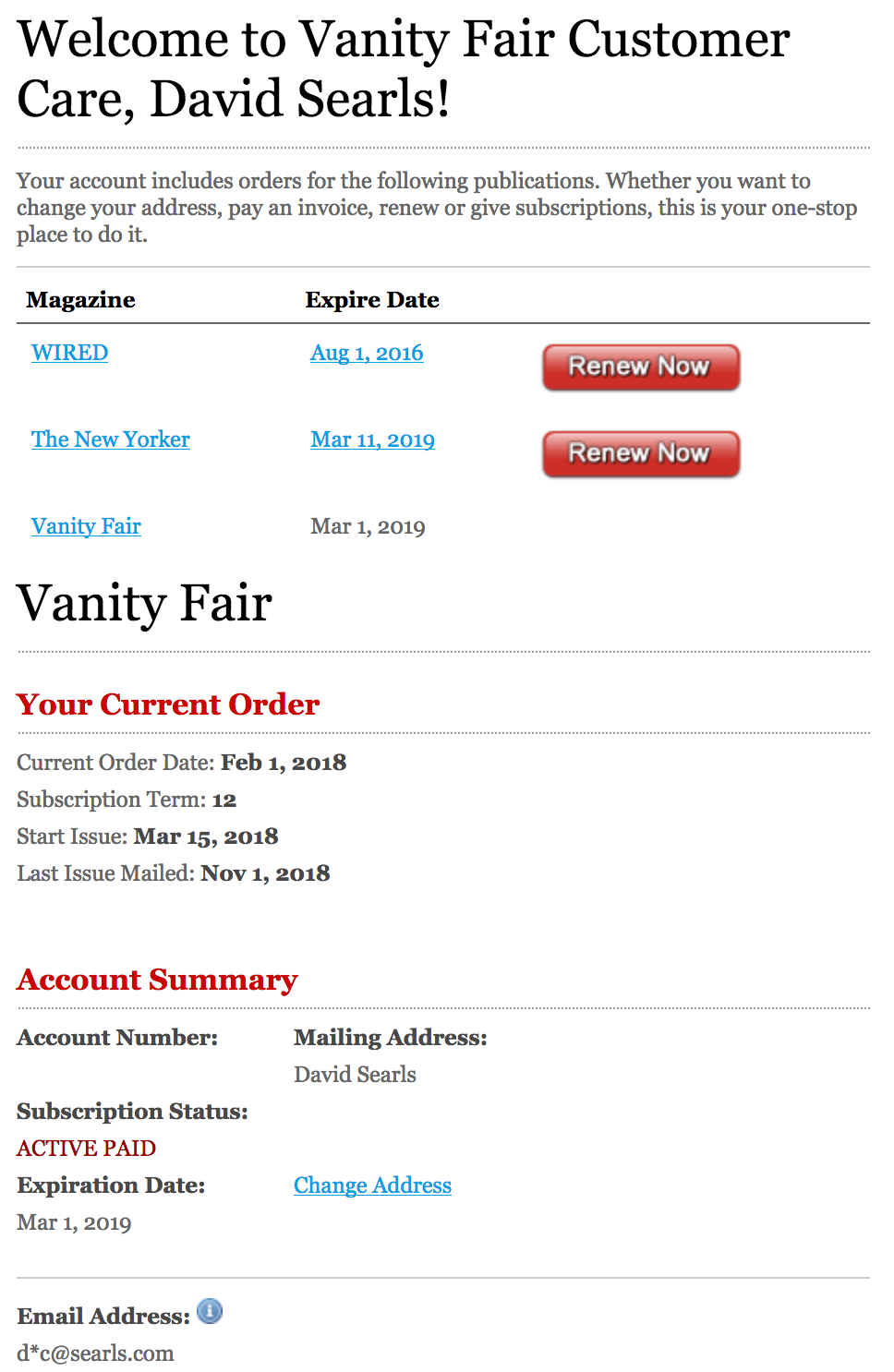
So I clicked on the Customer Care link to make that suggestion. This took me to a login page, where my password manager filled in the blanks with one of my secondary email addresses. That got me to my account, which says my Condé Nast subscriptions look like this:

Oddly, the email address at the bottom there is my primary one, not the one I just logged in with.  (Also oddly, I still get Wired.)

So I went to the Vanity Fair home page, found myself logged in there, and clicked on “My Account.” This took me to a page that said my email address was my primary one, and provided a way to change my password, to subscribe or unsubscribe to four newsletters, and a way to “Receive a weekly digest of stories featuring the players you care about the most.” The link below said “Start following people.” No way to check my account itself.

So I logged out from the account page I reached through the Customer Care link, and logged in with my primary email address, again using my password manager. That got me to an account page with the same account information you see above.

It’s interesting that I have two logins for one account. But that’s beside more important points, one of which I made with this message I wrote for Customer Care in the box provided for that:

Curious to know where I stand with this new “metered paywall” thing mentioned in the latest Hive newsletter. When I go to the link there — https://subscribe.condenastdigital.com/subscribe/splits/vanityfair/ — I get an apparently standard subscription page. I’m guessing I’m covered, but I don’t know. Also, even as a subscriber I’m being followed online by 20 or more trackers (reports Privacy Badger), supposedly for personalized advertising purposes, but likely also for other purposes by Condé Nast’s third parties. (Meaning not just Google, Facebook and Amazon, but Parsely and indexww, which I’ve never heard of and don’t trust. And frankly I don’t trust those first three either.) As a subscriber I’d want to be followed only by Vanity Fair and Condé Nast for their own service-providing and analytic purposes, and not by who-knows-what by all those others. If you could pass that request along, I thank you. Cheers, Doc

When I clicked on the Submit button, I got this:

An error occurred while processing your request.An error occurred while processing your request.

Please call our Customer Care Department at 1-800-667-0015 for immediate assistance or visit Vanity Fair Customer Care online.

Invalid logging session ID (lsid) passed in on the URL. Unable to serve the servlet you’ve requested.

So there ya go: one among .X zillion other examples of subscription hell, differing only in details.

Fortunately, there is a better way. Read on.

The Path

The only way to pave a path from subscription and customer service hell to the heaven we’ve never had is by  normalizing the ways both work, across all of business. And we can only do this from the customer’s side. There is no other way. We need standard VRM tools to deal with the CRM and CX systems that exist on the providers’ side.

We’ve done this before.

We fixed networking, publishing and mailing online with the simple and open standards that gave us the Internet, the Web and email. All those standards were easy for everyone to work with, supported boundless economic and social benefits, and began with the assumption that individuals are full-privilege agents in the world.

The standards we need here should make each individual subscriber the single point of integration for their own data, and the responsible party for changing that data across multiple entities. (That’s basically the heart of VRM.)

This will give each of us a single way to see and manage many subscriptions, see notifications of changes by providers, and make changes across the board with one move. VRM + CRM.

The same goes for customer care service requests. These should be normalized the same way.

In the absence of normalizing how people manage subscription and customer care relationships, all the companies in the world with customers will have as many different ways of doing both as there are companies. And we’ll languish in the login/password hell we’re in now.

The VRM+CRM cost savings to those companies will also be enormous. For a sense of that, just multiply what I went through above by as many people there are in the world with subscriptions, and  multiply that result by the number of subscriptions those people have — and then do the same for customer service.

We can’t fix this inside the separate CRM systems of the world. There are too many of them, competing in too many silo’d ways to provide similar services that work differently for every customer, even when they use the same back-ends from Oracle, Salesforce, SugarCRM or whomever.

Fortunately, CRM systems are programmable. So I challenge everybody who will be at Salesforce’s Dreamforce conference next week to think about how much easier it will be when individual customers’ VRM meets Salesforce B2B customers’ CRM. I know a number of VRM people  who will be there, including Iain Henderson, of the bonus link below. Let me know you’re interested and I’ll make the connection.

And come work with us on standards. Here’s one.

Bonus link: Me-commerce — from push to pull, by Iain Henderson (@iaianh1)

Weighings

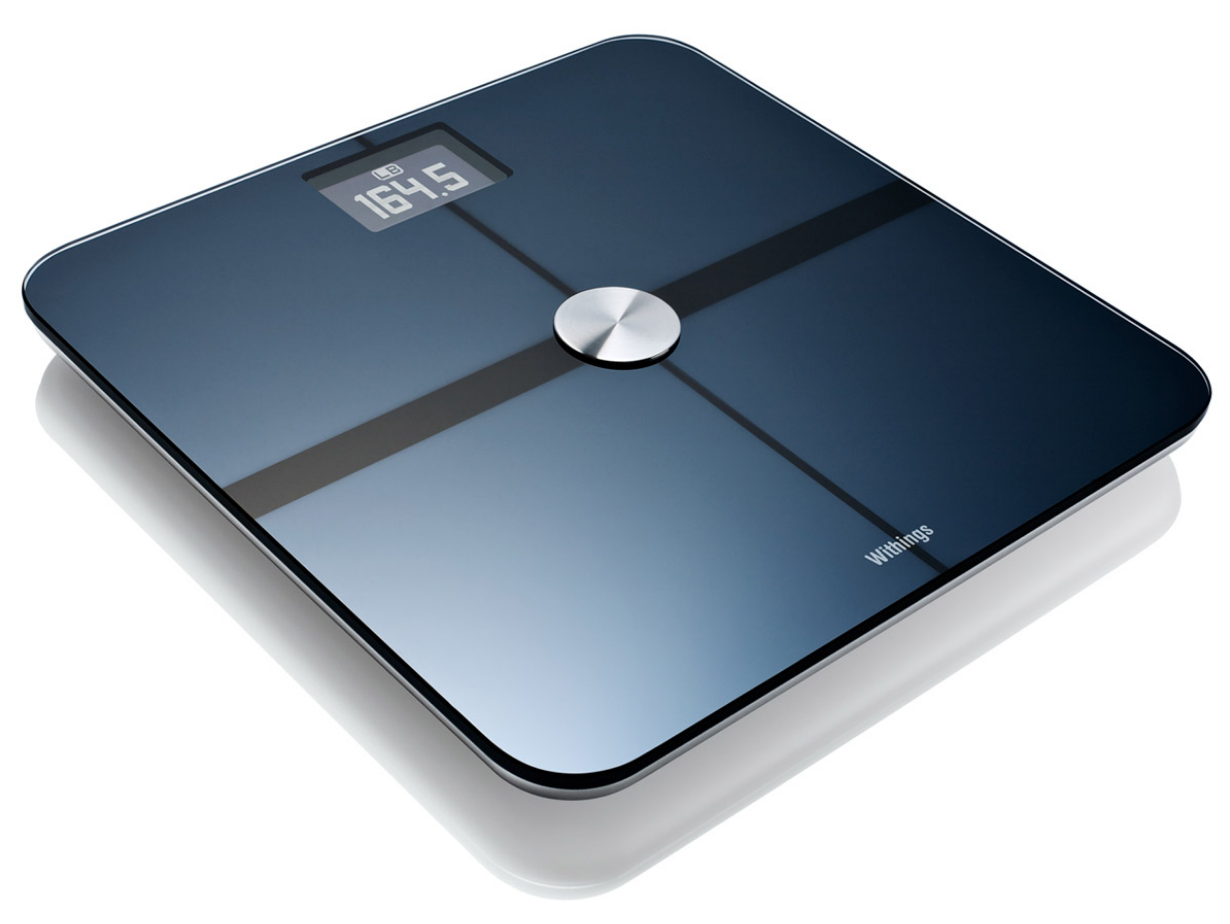
A few years ago I got a Withings bathroom scale: one that knows it’s me, records my weight, body mass index and fat percentage on a graph informed over wi-fi. The graph was in a Withings cloud.

I got it because I liked the product (still do, even though it now just tells me my weight and BMI), and because I trusted Withings, a French company subject to French privacy law, meaning it would store my data in a safe place accessible only to me, and not look inside. Or so I thought.

Here’s the privacy policy, and here are the terms of use, both retrieved from Archive.org. (Same goes for the link in the last paragraph and the image above.)

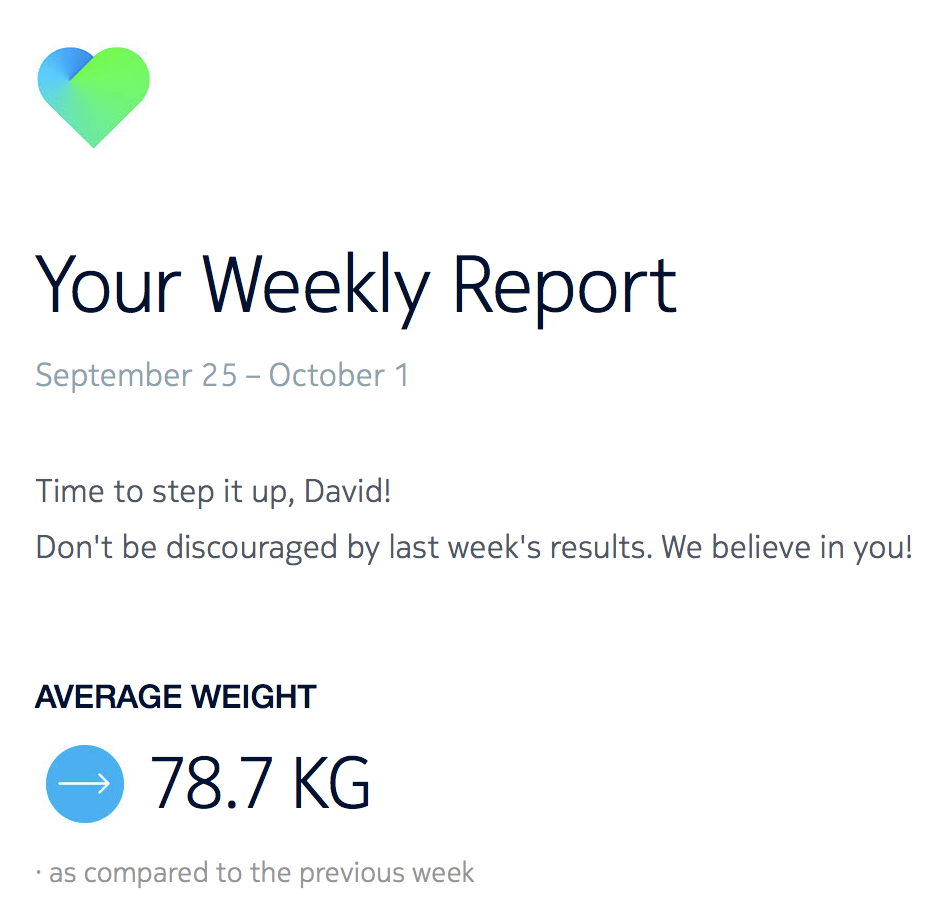
Then, in 2016, the company was acquired by Nokia and morphed into Nokia Health. Sometime after that, I started to get these:

This told me Nokia Health was watching my weight, which I didn’t like or appreciate. But I wasn’t surprised, since Withings’ original privacy policy featured the lack of assurance long customary to one-sided contracts of adhesion that have been pro forma on the Web since commercial activity exploded there in 1995: “The Service Provider reserves the right to modify all or part of the Service’s Privacy Rules without notice. Use of the Service by the User constitutes full and complete acceptance of any changes made to these Privacy Rules.” (The exact same language appears in the original terms of use.)

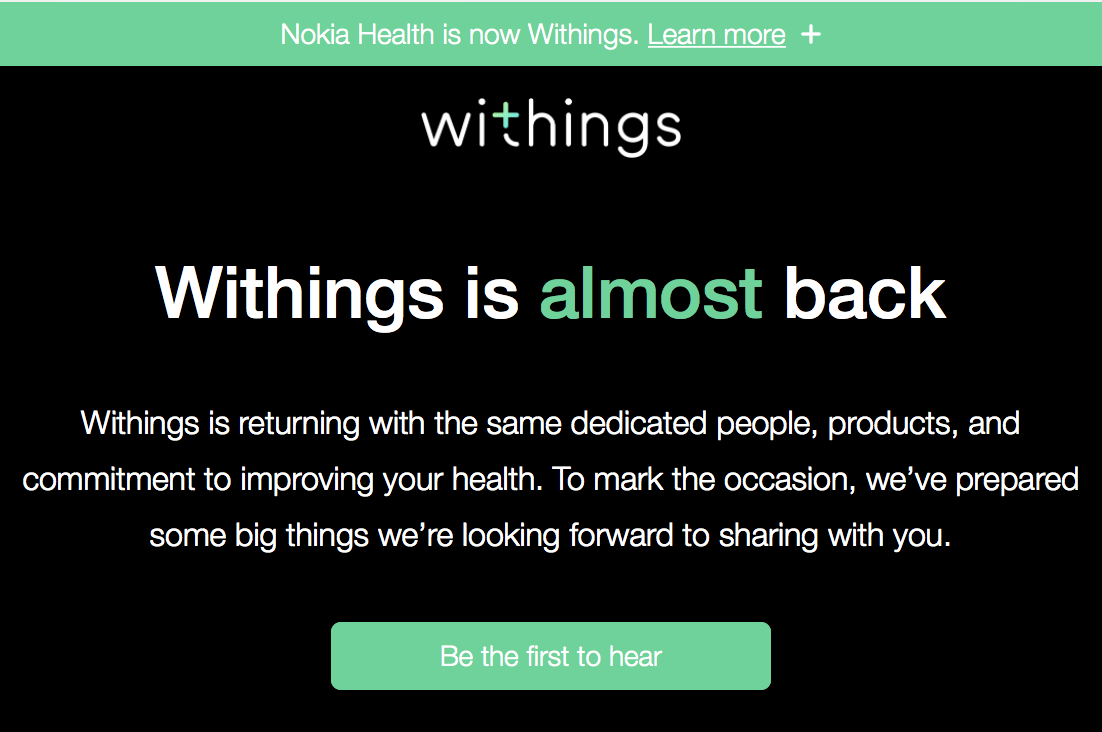
Still, I was too busy with other stuff to care more about it until I got this from community@email.health.nokia two days ago:

Here’s the announcement at the “learn more” link. Sounded encouraging.

So I dug a bit and and saw that Nokia in May planned to sell its Health division to Withings co-founder Éric Carreel (@ecaeca).

Thinking that perhaps Withings would welcome some feedback from a customer, I wrote this in a customer service form:

One big reason I bought my Withings scale was to monitor my own weight, by myself. As I recall the promise from Withings was that my data would remain known only to me (though Withings would store it). Since then I have received many robotic emailings telling me my weight and offering encouragements. This annoys me, and I would like my data to be exclusively my own again — and for that to be among Withings’ enticements to buy the company’s products. Thank you.

Here’s the response I got back, by email:

Hi,

Thank you for contacting Nokia Customer Support about monitoring your own weight. I’ll be glad to help.

Following your request to remove your email address from our mailing lists, and in accordance with data privacy laws, we have created an interface which allows our customers to manage their email preferences and easily opt-out from receiving emails from us. To access this interface, please follow the link below:

Obviously, the person there didn’t understand what I said.

So I’m saying it here. And on Twitter.

What I’m hoping isn’t for Withings to make a minor correction for one customer, but rather that Éric & Withings enter a dialog with the @VRM community and @CustomerCommons about a different approach to #GDPR compliance: one at the end of which Withings might pioneer agreeing to customers’ friendly terms and conditions, such as those starting to appear at Customer Commons.

We’re done with Phase One

Here’s a picture that’s worth more than a thousand words:

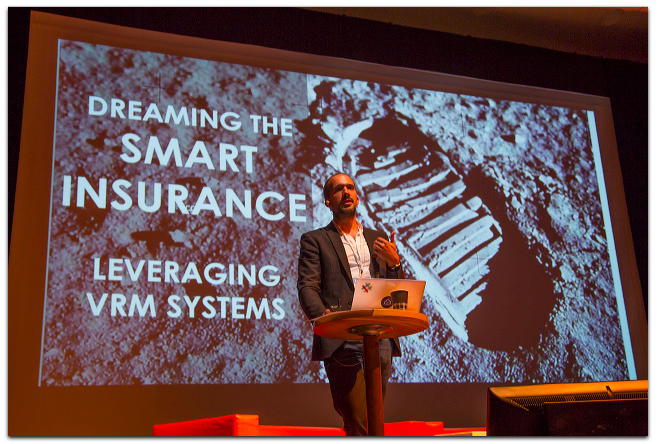
maif-vrm

He’s with MAIF, the French insurance company, speaking at MyData 2016 in Helsinki, a little over a month ago. Here’s another:

sean-vrm

That’s Sean Bohan, head of our steering committee, expanding on what many people at the conference already knew.

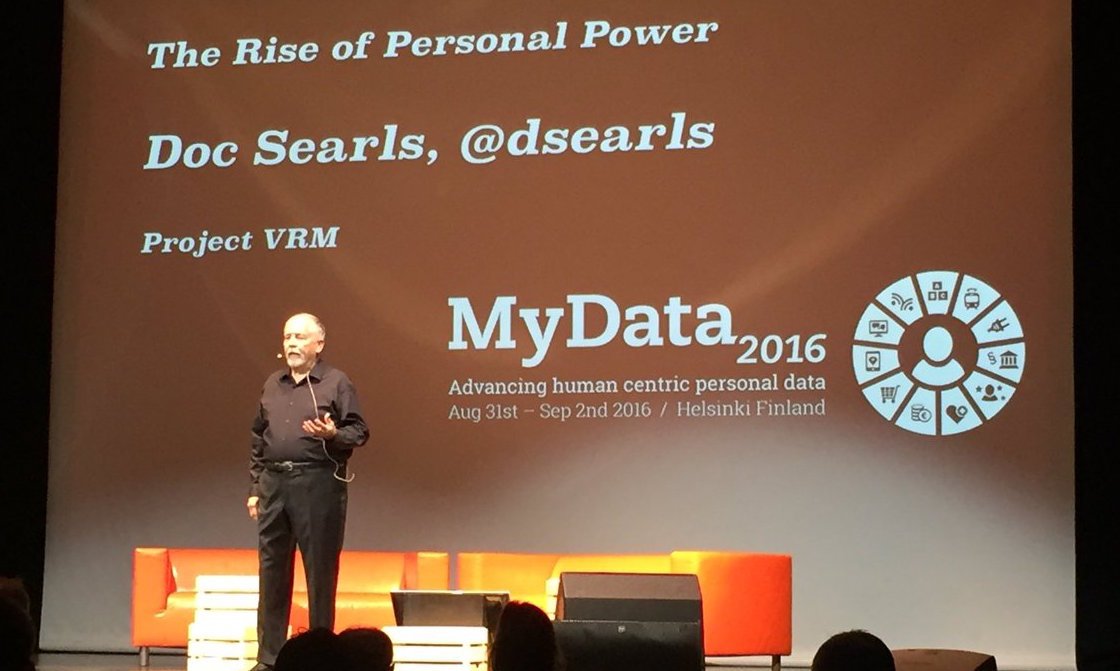
I was there too, giving the morning keynote on Day 2:

cupfu1hxeaa4thh

It was an entirely new talk. Pretty good one too, especially since  I came up with it the night before.

See, by the end of Day 1, it was clear that pretty much everybody at the conference already knew how market power was shifting from centralized industries to distributed individuals and groups (including many inside centralized industries). It was also clear that most of the hundreds of people at the conference were also familiar with VRM as a market category. I didn’t need to talk about that stuff anymore. At least not in Europe, where most of the VRM action is.

So, after a very long journey, we’re finally getting started.

In my own case, the journey began when I saw the Internet coming, back in the ’80s.  It was clear to me that the Net would change the world radically, once it allowed commercial activity to flow over its pipes. That floodgate opened on April 30, 1995. Not long after that, I joined the fray as an editor for Linux Journal (where I still am, by the way, more than 20 years later). Then, in 1999, I co-wrote The Cluetrain Manifesto, which delivered this “one clue” above its list of 95 Theses:

not

And then, one decade ago last month, I started ProjectVRM, because that clue wasn’t yet true. Our reach did not exceed the grasp of marketers in the world. If anything, the Net extended marketers’ grasp a lot more than it did ours. (Shoshana Zuboff says their grasp has metastasized into surveillance capitalism. ) In respect to Gibson’s Law, Cluetrain proclaimed an arrived future that was not yet distributed. Our job was to distribute it.

Which we have. And we can start to see results such as those above. So let’s call Phase One a done thing. And start thinking about Phase Two, whatever it will be.

To get that work rolling, here are a few summary facts about ProjectVRM and related efforts.

First, the project itself could hardly be more lightweight, at least administratively. It consists of:

Second, we have a spin-off: Customer Commons, which will do for personal terms of engagement (one each of us can assert online) what Creative Commons (another Berkman-Klein spinoff) did for copyright.

Third, we have a list of many dozens of developers, which seem to be concentrated in Europe and Australia/New Zealand.  Two reasons for that, both speculative:

  1. Privacy. The concept is much more highly sensitive and evolved in Europe than in the U.S. The reason we most often get goes, “Some of our governments once kept detailed records of people, and those records were used to track down and kill many of them.” There are also more evolved laws respecting privacy. In Australia there have been privacy laws for several years requiring those collecting data about individuals to make it available to them, in forms the individual specifies. And in Europe there is the General Data Protection Regulation, which will impose severe penalties for unwelcome data gathering from individuals, starting in 2018.
  2. Enlightened investment. Meaning investors who want a startup to make a positive difference in the world, and not just give them a unicorn to ride out some exit. (Which seems to have become the default model in the U.S., especially Silicon Valley.)

What we lack is research. And by we I mean the world, and not just ProjectVRM.

Research is normally the first duty of a project at the Berkman Klein Center, which is chartered as a research organization. Research was ProjectVRM’s last duty, however, because we had nothing to research at first. Or, frankly, until now. That’s why we were defined as a development & research project rather than the reverse.

Where and how research on VRM and related efforts happens is a wide-open question. What matters is that it needs to be done, starting soon, while the “before” state still prevails in most of the world, and the future is still on its way in delivery trucks. Who does that research matters far less than the research itself.

So we are poised at a transitional point now. Let the conversations about Phase Two commence.

VRM at MyData2016

mydata2016-image

As it happens I’m in Helsinki right now, for MyData2016, where I’ll be speaking on Thursday morning. My topic: The Power of the Individual. There is also a hackathon (led by DataBusiness.fi) going on during the show, starting at 4pm (local time) today. In no order of priority, here are just some of the subjects and players I’ll be dealing with,  talking to, and talking up (much as I can):

Please let me know what others belong on this list. And see you at the show.

Save

If it weren’t for retargeting, we might not have ad blocking

jblflip2This is a shopping vs. advertising story that starts with the JBP Flip 2 portable speaker I bought last year, when Radio Shack was going bankrupt and unloading gear in “Everything Must Go!” sales. I got it half-off for $50, choosing it over competing units on the same half-bare shelves, mostly because of the JBL name, which I’ve respected for decades. Before that I’d never even listened to one.
The battery life wasn’t great, but the sound it produced was much better than anything my laptop, phone or tablet put out. It was also small, about the size of a  beer can, so I could easily take it with me on the road. Which I did. A lot.

Alas, like too many other small devices, the Flip 2’s power jack was USB micro-b. That’s the tiny flat one that all but requires a magnifying glass to see which side is up, and tends to damage the socket if you don’t slip it in exactly right, or if you force it somehow. While micro-b jacks are all design-flawed that way, the one in my Flip 2 was so awful that it took great concentration to make sure the plug jacked in without buggering the socket.

Which happened anyway. One day, at an AirBnB in Maine, the Flip 2’s USB socket finally failed. The charger cable would fit into the socket, but the socket was loose, and the speaker wouldn’t take a charge. After efforts at resuscitation failed, I declared the Flip 2 dead.

But I was still open to buying another one. So, to replace it, I did what most of us do: I went to Amazon. Naturally, there were plenty of choices, including JBL Flip 2s and newer Flip 3s, at attractive prices. But Consumer Reports told me the best of the bunch was the Bose Soundlink Color, for $116.

So I bought a white Bose, because my wife liked that better than the red JBL.

The Bose filled Consumer Reports’ promise. While it isn’t stereo, it sounds much better than the JBL (voice quality and bass notes are remarkable). It’s also about the same size (though with a boxy rather than a cylindrical shape), has better battery life, and a better user interface. I hate that it  charges through a micro-b jack, but at least this one is easier to plug and unplug than the Flip 2 had been. So that story had a happy beginning, at least for me and Bose.

It was not happy, however, for me and Amazon.

Remember when Amazon product pages were no longer than they needed to be? Those days are gone. Now pages for every product seem to get longer and longer, and can take forever to load. Worse, Amazon’s index page is now encrusted with promotional jive. Seems like nearly everything “above the fold” (before you scroll down) is now a promo for Amazon Fashion, the latest Kindle, Amazon Prime, or the company credit card—plus rows of stuff “inspired by your shopping trends” and “related to items you’ve viewed.”

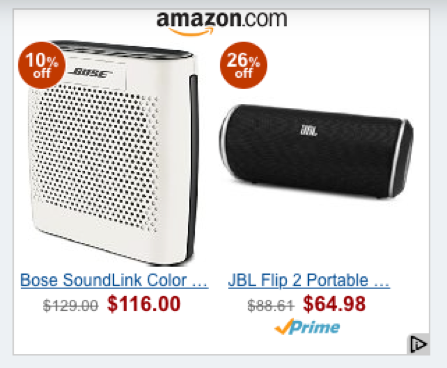
But at least that stuff risks being useful. What happens when you leave the site, however, isn’t. That’s because, unless you’re running an ad blocker or tracking protection, Amazon ads for stuff you just viewed, or put in your shopping cart, follow you from one ad-supported site to another, barking at you like a crazed dog. For example:

amazon1

I lost count of how many times, and in how many places, I saw this Amazon ad, or one like it, for one speaker, the other, or both, after I finished shopping and put the Bose speaker in my cart.

Why would Amazon advertise something at me that I’ve already bought, along with a competing product I obviously chose not to buy? Why would Amazon think it’s okay to follow me around when I’m not in their store? And why would they think that kind of harassment is required, or even okay, especially when the target has been a devoted customer for more than two decades, and sure to return and buy all kinds of stuff anyway?  Jeez, they have my business!

And why would they go out of their way to appear both stupid and robotic?

The answers, whatever they are, are sure to be both fully rationalized and psychotic, meaning disconnected from reality, which is the marketplace where real customers live, and get pissed off.

And Amazon is hardly alone at this. In fact the practice is so common that it became an Onion story in October 2018: Woman Stalked Across 8 Websites By Obsessed Shoe Advertisement.

The ad industry’s calls this kind of stalking “retargeting,” and it is the most obvious evidence that we are being tracked on the Net. The manners behind this are completely at odds with those in the physical world, where no store would place a tracking beacon on your body and use it to follow you everywhere you go after you leave. But doing exactly that is pro forma for marketing in the digital world.

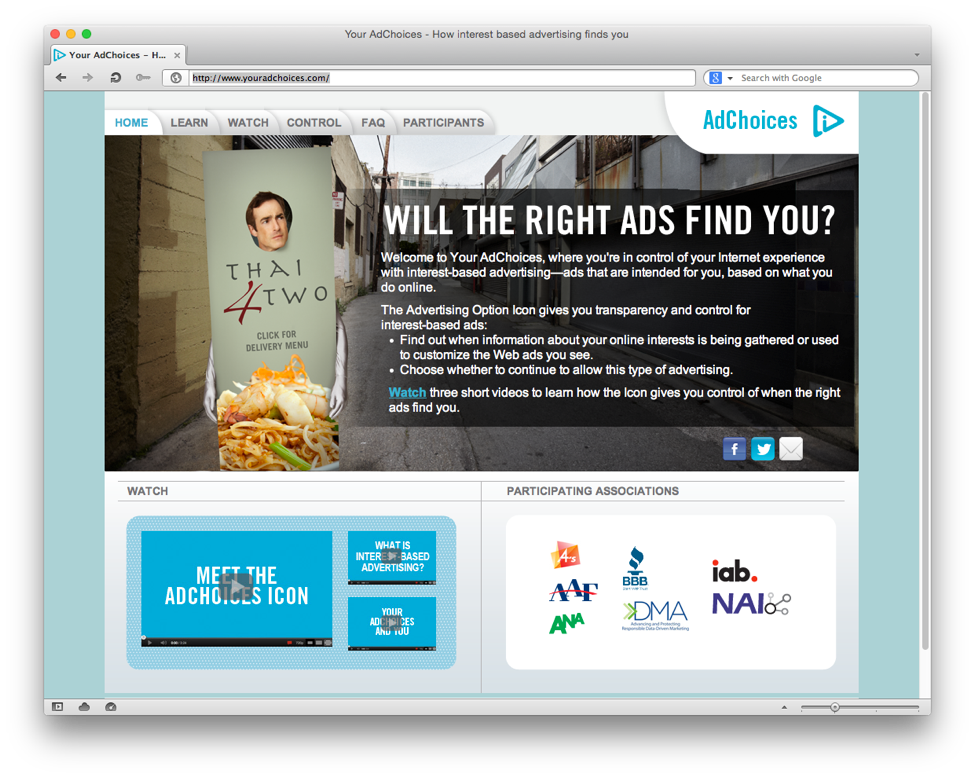
When you click on that little triangular symbol in the corner of the ad, you can see how the “interactive” wing of the advertising business, generally called adtech, rationalizes surveillance:

adchoices1The program is called AdChoices, and it’s a creation of those entities in the lower right corner. The delusional conceits behind AdChoices are many:

  1. That Ad Choices is “yours.” It’s not. It’s theirs.
  2. That “right ads” exist, and that we want them to find us, at all times.
  3. That making the choices they provide actually gives us control of advertising online.
  4. That our personal agency—the power to act with full effect in the world—is a grace of marketers, and not of our own independent selves.

Not long after I did that little bit of shopping on Amazon, I also did a friend the favor of looking for clothes washers, since the one in her basement crapped out and she’s one of those few people who don’t use the Internet and never will. Again I consulted Consumer Reports, which recommended a certain LG washer in my friend’s price range. I looked for it on the Web and found the best price was at Home Depot. So I told her about it, and that was that.

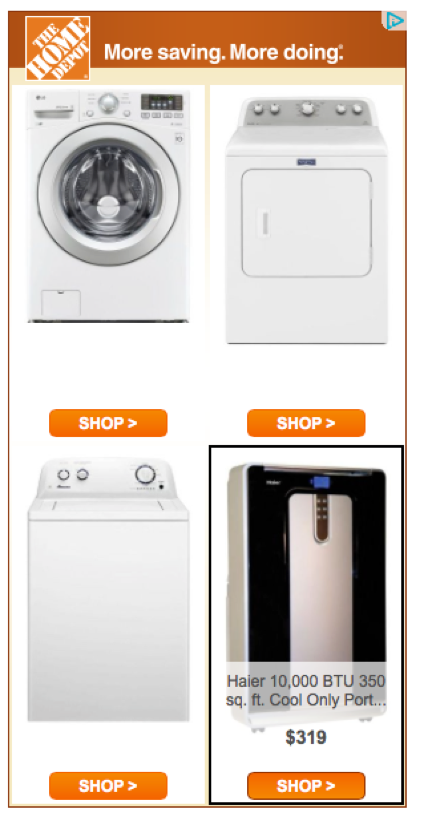
For me that should have been the end of it. But it wasn’t, because now I was being followed by Home Depot ads for the same LG washer and other products I wasn’t going to buy, from Home Depot or anybody else. Here’s one:

homedepot1

Needless to say, this didn’t endear me to Home Depot, to LG, or to any of the sites where I got hit with these ads.

All these parties failed not only in their mission to sell me something, but to enhance their own brands. Instead they subtracted value for everybody in the supply chain of unwelcome tracking and unwanted message targeting. They also explain (as Don Marti does here) why ad blocking has grown exactly in pace with growth in retargeting.

I subjected myself to all this by experimentally turning off tracking protection and ad blockers on one of my browsers, so I could see how the commercial Web works for the shrinking percentage of people who don’t protect themselves from this kind of abuse. I do a lot of that, as part of my work with ProjectVRM. I also experiment a lot with different kinds of tracking protection and ad blocking, because the developers of those tools are encouraged by that same work here.

For those new to the project, VRM stands for Vendor Relationship Management, the customer-side counterpart of Customer Relationship Management, the many-$billion business by which companies manage their dealings with customers—or try to.

Our purpose with ProjectVRM is to encourage development of tools that give us both independence from the companies we engage with, and better ways of engaging than CRM alone provides: ways of engaging that we own, and are under our control. And relate to the CRM systems of the world as well. Our goal is VRM+CRM, not VRM vs. CRM.

Ad blocking and tracking protection are today at the leading edge of VRM development, because they are popular and give us independence. Engagement, however, isn’t here yet—at least not at the same level of popularity. And it probably won’t get here until we finish curing business of the brain cancer that adtech has become.

[Later…] After reading this, a friend familiar with the adtech business told me he was sure Bose’s and JPL’s agencies paid Amazon’s system for showing ads to “qualified leads,” and that Amazon’s system preferred to call me a qualified lead rather than a customer whose purchase of a Bose speaker (from Amazon!) mattered less than the fact that its advertising system could now call me a qualified lead. In other words, Amazon was, in a way, screwing Bose and JPL. If anyone has hard facts about this, please send them along. Until then I’ll consider this worth sharing but still unproven.

IoT & IoM next week at IIW

blockchain1

(This post was updated and given a new headline on 20 April 2016.)

In  The Compuserve of Things, Phil Windley issues this call to action:

On the Net today we face a choice between freedom and captivity, independence and dependence. How we build the Internet of Things has far-reaching consequences for the humans who will use—or be used by—it. Will we push forward, connecting things using forests of silos that are reminiscent the online services of the 1980’s, or will we learn the lessons of the Internet and build a true Internet of Things?

In other words, an Internet of Me (#IoM) and My Things. Meaning things we own that belong to us, under our control, and not puppeted by giant companies using them to snarf up data about our lives. Which is the  #IoT status quo today.

A great place to work on that is  IIW— the Internet Identity Workshop , which takes place next Tuesday-Thursday, April 26-28,  at the Computer History Museum in Silicon Valley. Phil and I co-organize it with Kaliya Hamlin.

To be discussed, among other things, is personal privacy, secured in distributed and crypto-secured sovereign personal spaces on your personal devices. Possibly using blockchains, or approaches like it.

So here is a list of some topics, code bases and approaches I’d love to see pushed forward at IIW:

  • OneName is “blockchain identity.”
  • Blockstack is a “decentralized DNS for blockchain applications” that “gives you fast, secure, and easy-to-use DNS, PKI, and identity management on the blockchain.” More: “When you run a Blockstack node, you join this network, which is more secure by design than traditional DNS systems and identity systems. This  is because the system’s registry and its records are secured by an underlying blockchain, which is extremely resilient against tampering and control. In the registry that makes up Blockstack, each of the names has an owner, represented by a cryptographic keypair, and is associated with instructions for how DNS resolvers and other software should resolve the name.” Here’s the academic paper explaining it.
  • The Blockstack Community is “a group of blockchain companies and nonprofits coming together to define and develop a set of software protocols and tools to serve as a common backend for blockchain-powered decentralized applications.” Pull quote: “For example, a developer could use Blockstack to develop a new web architecture which uses Blockstack to host and name websites, decentralizing web publishing and circumventing the traditional DNS and web hosting systems. Similarly, an application could be developed which uses Blockstack to host media files and provide a way to tag them with attribution information so they’re easy to find and link together, creating a decentralized alternative to popular video streaming or image sharing websites. These examples help to demonstrate the powerful potential of Blockstack to fundamentally change the way modern applications are built by removing the need for a “trusted third party” to host applications, and by giving users more control.” More here.
  • IPFS (short for InterPlanetary File System) is a “peer to peer hypermedia protocol” that “enables the creation of completely distributed applications.”
  • OpenBazaar is “an open peer to peer marketplace.” How it works: “you download and install a program on your computer that directly connects you to other people looking to buy and sell goods and services with you.” More here and here.
  • Mediachain, from Mine, has this goal: “to unbundle identity & distribution.” More here and here.
  • telehash is “a lightweight interoperable protocol with strong encryption to enable mesh networking across multiple transports and platforms,” from @Jeremie Miller and other friends who gave us jabber/xmpp.
  • Etherium is “a decentralized platform that runs smart contracts: applications that run exactly as programmed without any possibility of downtime, censorship, fraud or third party interference.”
  • Keybase is a way to “get a public key, safely, starting just with someone’s social media username(s).”
  • ____________ (your project here — tell me by mail or in the comments and I’ll add it)

In tweet-speak, that would be @BlockstackOrg, @IPFS, @OpenBazaar, @OneName, @Telehash, @Mine_Labs #Mediachain, and @IBMIVB #ADEPT

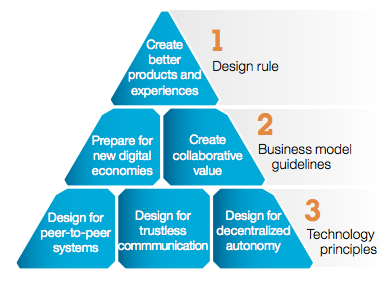
On the big company side, dig what IBM’s Institute for Business Value  is doing with “empowering the edge.” While you’re there, download Empowering the edge: Practical insights on a decentralized Internet of Things. Also go to Device Democracy: Saving the Future of the Internet of Things — and then download the paper by the same name, which includes this graphic here:

ibm-pyramid

Put personal autonomy in that top triangle and you’ll have a fine model for VRM development as well. (It’s also nice to see Why we need first person technologies on the Net , published here in 2014, sourced in that same paper.)

Ideally, we would have people from all the projects above at IIW. For those not already familiar with it, IIW is a three-day unconference, meaning it’s all breakouts, with topics chosen by participants, entirely for the purpose of getting like-minded do-ers together to move their work forward. IIW has been doing that for many causes and projects since the first one, in 2005.

Register for IIW here: https://iiw22.eventbrite.com/.

Also register, if you can, for VRM Day: https://vrmday2016a.eventbrite.com/. That’s when we prep for the next three days at IIW. The main focus for this VRM Day is here.

Bonus link: David Siegel‘s Decentralization.


Privacy isn’t about secrecy and freedom isn’t about license. Both are about agency.

Agency is the power to act with effect in the world. We have agency when we type on a keyboard, hammer a nail, ride a horse or drive a car.  Here’s a dictionary definition:

a·gen·cy (ā′jən-sē)
noun.

  1. The condition of being in action; operation.
  2. The means or mode of acting; instrumentality.

It is derived from agere: Latin for to do.

We are built to do a lot: with our brains, our opposable thumbs, our lack of fur, our capacity to sweat and to learn — and our strange ability to walk or run on two feet instead of four (almost ceaselessly, at least when we are young and fit) — we can do an amazing variety of things with our bodies.

For what we can’t do, we invent tools and machines. These extend our agency outward through technology. A hammer becomes another length of arm. With one in our hand, we have the power to drive nails with a metal fist. A car gives us an engine and wheels, so we can zoom down roads at dozens of miles (or kilometers) per hour. A plane gives us engines and wings, so we can fly far and high.  Each expands our agency to distant horizons of effect and experience in the world.

Infrastructure and services expand what each and all of us can do as well. But at the base of human capacity is the individual’s ability to do stuff in the world. Or, in a word, agency.

Which brings me to the second world we built alongside the physical one we all share. That second world is the Internet: a Giant Zero shaped by an oddly simple protocol: TCP/IP. Never mind how it works. Just note what it does: reduce to zero the functional distance between everything and everybody on it. Also the cost.

As a way to expand human agency, the Internet has no rivals. It gives all our voices, all our ideas, all our actions, worldwide scale. Any of us can speak, write, publish and much more, across any distance, at levels of inconvenience and cost that veer toward zero.

And we’ve been doing that, routinely, ever since the Internet assumed its current form. (That happened in April 1995, when the NSFnet‘s backbone — one network within the Internet — was decommissioned and commercial activity, which the NSFnet forbade, could begin to flourish across the whole Net.)

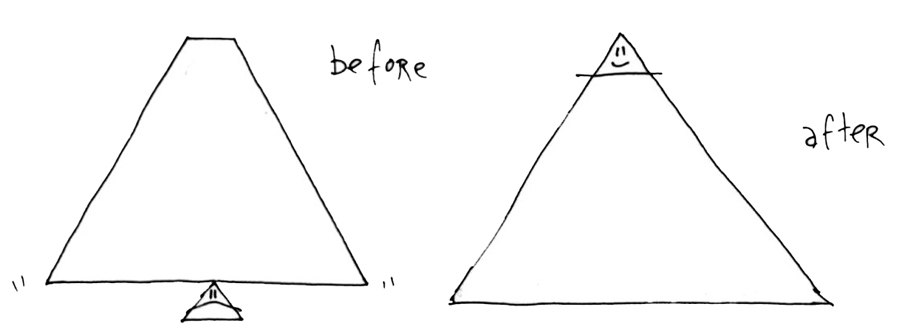
The Net has an end-to-end architecture. Every body and every thing is an end point, and the Net’s protocol does its best to move data between any and all of those. This is what Paul Baran, one of the Net’s fathers, described as a distributed design, rather than a centralized or decentralized one. Here is how he illustrated the difference, way back in 1962:

Paul Baran, On Distributed Communications Networks, 1962

And that became the Net’s basic design. Or at least its ideal.

Yet, for the sake of convenience — especially in the early days of the Net, when most of us were still on dial-up — we defaulted to a client-server architecture for deploying servers and services. With client-server, each server is a central point, which makes the Net, in a practical sense, a decentralized thing, rather than a distributed one.

And yet the distributed nature of the Net persists, grounding our agency in the world it defines.

Conflicts between centralized, decentralized and distributed capacities on the Net — and uneven development of tools and services enlarging our agency — are behind many of our crises on the Net today.

Take privacy for example. It’s a huge issue. Survey after survey (e.g. from Pew, TRUSTe and Customer Commons) say that 90% and more of us are concerned about personal privacy on the Net, don’t trust many service providers, or lie and hide to obscure personal identity. Advertising and tracking blockers are the most popular browser extensions, and with good reason: we are still naked on the Net.

That’s because the Net, like nature in the physical world, doesn’t come with privacy installed. We have to make it for ourselves. In the physical world we did it by inventing clothing and shelter. In the virtual world we still don’t have either. Tracking blockers are fig leaves at best. They also all work differently. We are still in early times.

Since we have no privacy yet (other than by staying off the Net, or by isolating ourselves on it by declining to accept cookies and staying away from services such as Google’s and Facebook’s), we tend to think about privacy in terms of secrets: things we don’t want others to know about us. But think instead about what we do to create privacy in the physical world, with clothing and shelter. Both do more than cover our bodies and and our lives. We express both. We also express with them. Our clothing and shelter send signals about ourselves. They speak of our tastes, our gender, our status, our memberships. Most of these speakings are subtle, but many are not. What matters is that they all valve our exposure to others. Buttons and zippers on our clothes speak of what can, can’t and shouldn’t be opened by others, without permission. Doors, shades and shutters on our homes do the same.

All of those things facilitate our agency. We need the same in the networked world.

The main difference is that we’ve had thousands of years to work them out in the physical world, and just twenty in the networked one. In the history of civilization, and even of business, this is close to nothing. We’re barely started.

There will, inevitably, emerge a symbiosis between centralized, decentralized and distributed capacities. Brian Behlendorf uses the term “minimum viable centralization” to label what we’re looking for here. Meanwhile we have maximum viable centralization on a network that is also distributed by design. Just like the humans on it.

We are seeing today a collapse of intermediary institutions. Publishing (e.g. blogs) Hospitality (e.g. Airbnb), dispatch (e.g. Uber), broadcast (e.g. Meerkat and Periscope) and payments (e.g.  Bitcoin) come quickly to mind, and many more are coming along. Yet through all of those there must remain some degree of trust in the graces that institutions — governments and companies — alone can provide. How can their minimum viable agencies help us enlarge our own? That’s the main challenge for the coming years.

The question we need to ask, as we address that challenge through VRM, is this: What is best done by the individual, and what is best done by the institution — and how an the two work together?

To answer that, agency must be key. Without it we’ll only get more centralized BS to distrust.


First we take Oz

Sydneydoc 017-018_combined_medAustralia’s privacy principles are among the few in the world that require organizations to give individuals personal information gathered about them.* This opens the path to proving that we can do more with our own data than anybody else can.

Estimating the size of the personal data management business is like figuring the size of the market for talking or driving. (Note: we can also do more with those than companies can.)

Starting us down this path is  Ben Grubb (@BenGrubb) of the Sydney Morning Herald. Ben requested personal data held by the Australian telco giant Telstra, and found himself in a big fightwhich he won. (Here’s the decision. Telstra is appealing, but they’re still gonna lose.)

Bravo to Ben — not just for whupping a giant, but for showing a path forward for individual empowerment in the marketplace. Thanks to Australia’s privacy principles, and Ben’s illustrative case, the yellow brick road to the VRM future is widest in Oz.

Here (and in New Zealand) we not only have lots of VRM developers (Flamingo, Fourth Party, Geddup, Meeco, MyWave, OneExus, Welcomer and others I’ll insulting by not listing yet), but legal easement toward proving that individuals can do the more with their own data than can the companies that follow us. And proving as well that individuals managing their own data will be good for those companies as well. The data they get will be richer, more accurate,  more contextual, and more useful.

This challenge is not new. It’s as old as our species. The biggest tech revolutions have always been inventions individuals could put to the best use:

  • Stone tools
  • Weaving
  • Smithing
  • Musical instruments
  • Hand-held hunting and fighting tools
  • Automobiles
  • PCs
  • The Internet (which is a node-to-node invention, not an advanced phone or cable company, even though we pay those things for access to it)
  • Mobile phones and tablets
  • Movable type (which would be nowhere without individual authors — and writing tools in the hands of those authors)

There should be symbiosis here. There are things big organizations do best, and things individuals do best. And much that both do best when they work together.

Look at cars, which are a VRM technology: we use them to get around the marketplace, and to help us do business with many companies. They give us ways to be both independent and engaging. But companies don’t drive them. We do. Companies provide parking lots, garages, drive-up windows and other conveniences for drivers. Symbiosis.

So, while Telstra is great at building and managing communication infrastructure and services, its customers will be great at doing useful stuff with the kind of data Ben requested, such as locations, calls and texts — especially after customers get easy-to-use tools and services that help them work as points of integration for their own data, and managers of what gets done with it. There are many VRM developers working toward that purpose, around the world, And many more that will come once they smell the opportunities.

These opportunities are only apparent when you look at the market through your own eyes as a sovereign human being. The same opportunities are mostly invisible when you look at the market from the eye at the top of the industrial pyramid.

Bonus links:


* My understanding is that privacy principles such as the OECD’s and Ontario’s provide guidance but not the full force of law, or means of enforcement. Australia’s differ because they have teeth. See the Determination on page 36 of the Privacy Commissioner’s investigation and decision. Canada’s also has teeth. See the list of orders issued in Ontario. If there are other examples of decisions like this one, anywhere in the world, please let us know.

« Older posts

© 2026 ProjectVRM

Theme by Anders NorenUp ↑