Page 3 of 44

A simple plan to de-enshittify CVS

Fifteen years ago, The Onion published this story:

Study Finds Paint Aisle At Lowe’s Best Place To Have Complete Meltdown

Now it’s the vitamin aisle at CVS:

Enshittification at work.

When Cory Doctorow coined enshittification, he was talking about how online platforms such as Google, Amazon, and TikTok get shitty over time. Well, the same disease also afflicts many big retail operations, especially ones that flood their zones with discounts and other gimmicks, enshittifying what marketers call “the customer experience” (aka CX).

Take the vitamin aisle, above. The only people who will ever get down on all fours to read the yellow tags near the floor are the cursed employees who have to creep the length of the aisle putting them there.

For customers, the main cost of shopping at CVS is cognitive overhead. Think about—

  • All those yellow stickies
  • All the slow-downs at check-out when you wave your barcode at a reader, punch your phone number into a terminal, or have a CVS worker to do the same
  • All the conditionalities in every discount or “free” offer that  isn’t
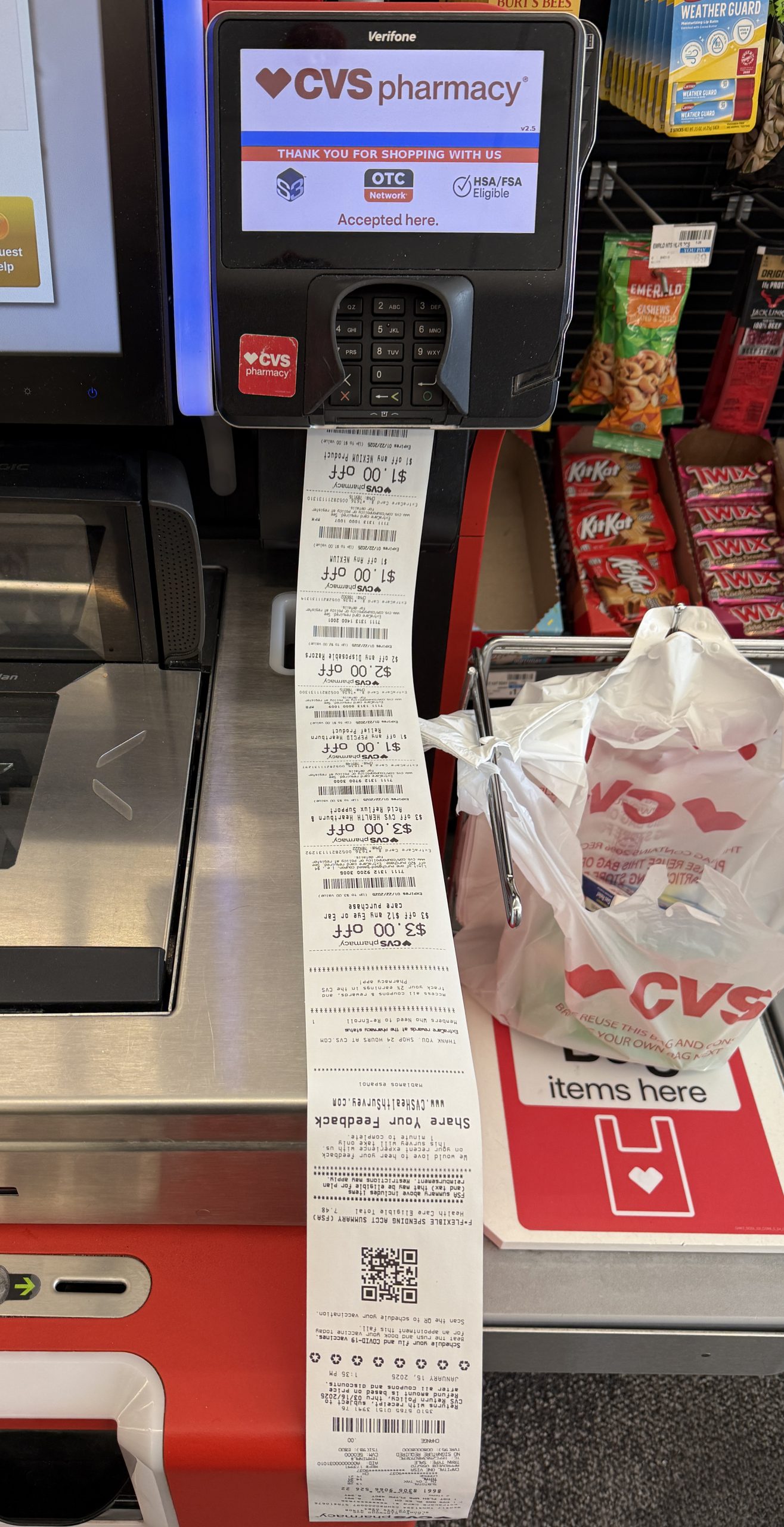
  • All the yard-long receipts, such as this one:

And the app!

OMFG,  all we really need the damned app for is the one CVS function our life depends on: the pharmacy.

To be fair, the app doesn’t suck at the basics (list of meds, what needs to be refilled, etc.). But it does suck at helping you take advantage of CVS’s greatest strength: that there are so many of them. Specifically,

While that’s down a bit from the peak in 2021, CVS is still the Starbucks of pharmacies. And while they are busy laying off people while investing in tech, you’d think they would at least make it easy to move your prescription from one store to another, using the app.  But noooo.

What the app is best for is promotional crap. For example, this:

Look at the small gray type in the red oval: 198 coupons!

After I scroll down past the six Extrabucks Rewards (including the two above), I get these:

First, who wants a full-priced item when it seems damn near everything is discounted?

Second, you’d think after all these years of checking out with my Extracare barcode, and the app shows me (under “Buy It Again”) all the stuff I’ve purchased recently, that CVS would know I am a standard-issue dude with no interest in cosmetics. So why top the list of coupons with that shit? I suppose it’s to make me scroll down through the other 178 coupons to find other stuff I might want at a cheaper price.

I just did that and found nothing. Why? Because most of the coupons are for health products I already bought or don’t need. (I’m not sick right now.) Also, almost all of the coupons (as you see) expire three days from now.

Now think about the cognitive and operational overhead required to maintain that whole program at CVS. Good gawd.

And is it necessary? At all? When you’re the Starbucks of pharmacies?

Without exception, all loyalty programs like this one are coercive. They are about trapping and milking customers.

But do stores need them? Do customers? Does CVS?  Really? When its customers are already biased by convenience.

Pro Tip: Real loyalty is earned, not coerced.

Want your store, or your chain, to be loved? Take some lessons from the most loved chain in the country: Trader Joe’s. In a chapter of The Intention Economy called “The Dance,” I list some reasons why TJ’s is loved by its customers. My main source for that list is Doug Rauch, the retired president of TJ’s, where he worked for 31 years. Here are the top few:

  1. They never use the word “consumer.” They call us “customers,” “persons,” or “individuals.”
  2. They have none of what Doug calls “gimmicks.” No loyalty programs, ads, promotions, or anything else that manipulates customers, raises cognitive overhead or insults anyone’s intelligence. In other words, none of what marketing obsesses about. “Those things are a huge part of retailing today, and have huge hidden costs,” Doug says. (I think the company’s biggest marketing expense is its float in the Rose Parade.)
  3. They never discount anything, or say anything is “on sale.” Those kinds of signals add more cognitive overhead. TJ’s wants customers not just to assume, but to know. A single price takes care of that.
  4. They have less than no interest in industry fashion. TJ’s goes to no retail industry meetings or conferences, belongs to no associations, and avoids all settings where the talk is about gaming customers. That’s not TJ’s style because that’s not its substance.
  5. They believe, along with Cluetrain, that markets are conversations—with customers. Doug told me his main job, as president of the company, was “shopping along with customers.” That’s how he spent most of his time. “We believe in honesty and directness between human beings…We do this by engaging with the whole person, rather than just with the part that ‘consumes….We’ll even open packages with customers to taste and talk about the goods.” As a result, “There’s nothing sold at Trader Joe’s that customers haven’t improved.”

Then there’s what Walmart CEO Lee Scott told me in 2000 (at this event) when I asked him “What happened to K-Mart?” From The Intention Economy:

His answer, in a word, was “Coupons.” As Lee explained it, K-Mart overdid it with coupons, which became too big a hunk of their overhead, while also narrowing their customer base toward coupon-clippers. They had other problems, he said, but that was a big one. By contrast, Wal-Mart minimized that kind of thing, focusing instead on promising “everyday low prices,” which was a line of Sam Walton’s from way back. The overhead for that policy rounded to zero.

Which brings me to trust.

We trust Trader Joe’s and Walmart to be what they are. In simple and fundamental ways, they haven’t changed. The ghosts of Joe Coloumbe and Sam Walton still run Trader Joe’s and Walmart. TJ’s is still the “irreverent but affordable” grocery store Joe built for what (in his book) Joe called “the overeducated and underpaid,” and based in Los Angeles. Walmart is still Sam’s five-and-dime from Bentonville, Arkansas. (Lee Scott told me that.)

CVS’s equivalent to Joe and Sam was Ralph Hoagland, a good friend of good friends of ours in Santa Barbara. All of us also shared history around Harvard and Cambridge, where Ralph lived when he co-founded CVS, which stood for Consumer Value Store, in 1963. In those days CVS mostly sold health and beauty products, cheaply. I remember Ralph saying the store’s main virtue was just good prices on good products. Hence the name.

CVS can do a much better job of signaling bargain prices by just making them as low as possible, on the model of Trader Joe’s and Walmart.

I think there is also a good Health position for CVS: one that bridges its health & beauty origins and its eminence as the leading pharmacy chain in the U.S. And it could rest on trust.

I’m thinking now about tech. Specifically, FPCs, for First-Person Credentials. Read what Jamie Smith says about them in his Customer Futures newsletter under the headline The most important credentials you’ve never heard of. Also check out—

  • What I wrote last year about Identity as Root
  • What DIF is doing
  • What Ayra is doing
  • Other stuff you’ll be hearing about first-person credentials (but isn’t published yet) when you come to the next IIW (April 8-10).
  • What you’ll be learning soon about re-basing everything (meaning every SKU, as well as every person) on a new framework that is far more worthy of trust than any of the separate collections of records, databases, and namespaces that currently divides a digital world that desperately needs unity and interop—especially around health. And:::
  • MyTerms, which is the new name for IEEE P7012, the upcoming standard (for which I am the working group chair) that should become official later this year, though nothing prevents anyone from putting its simple approach to work.

MyTerms can be huge and world-changing because it flips around the opt-out consent mechanisms that have been pro forma since industry won the industrial revolution and metastasized in the Digital Age. With MyTerms, the sites and services of the world agree to your terms, not the other way around. With MyTerms, truly trusting relationships can be established between customers and companies. This is why I immodestly call it the most important standard in development today.

So I have five simple recommendations for CVS, all to de-enshittify corporate operations and customer experiences:

  1. Drop the whole loyalty thing. Completely. Cold turkey. Hell, fire the marketing department. Put the savings into employees you incentivize to engage productively (not promotionally) with customers. And publicize the hell out of it. Should be fun.
  2. Confine your research to what your human employees learn directly from their human customers.
  3. Be the best version of what you are: a great pharmacy/convenience store chain that’s still long in health and beauty products.
  4. Simplify the app by eliminating all the promotional shit, and by making it as easy as possible for customers to move prescriptions from one  CVS store to another.
  5. Watch what’s happening with first-person credentials and MyTerms. Getting on board with those will make CVS a leader, rather than a follower.

Coupon-clipping addicts may feel some pain at first, but if you market the new direction well—making clear that you have “everyday low prices” rather than annoying and labor-intensive discounts (many of which expire in three days), customers will come to love you.

Blocking Tracking ≠ Blocking Ads

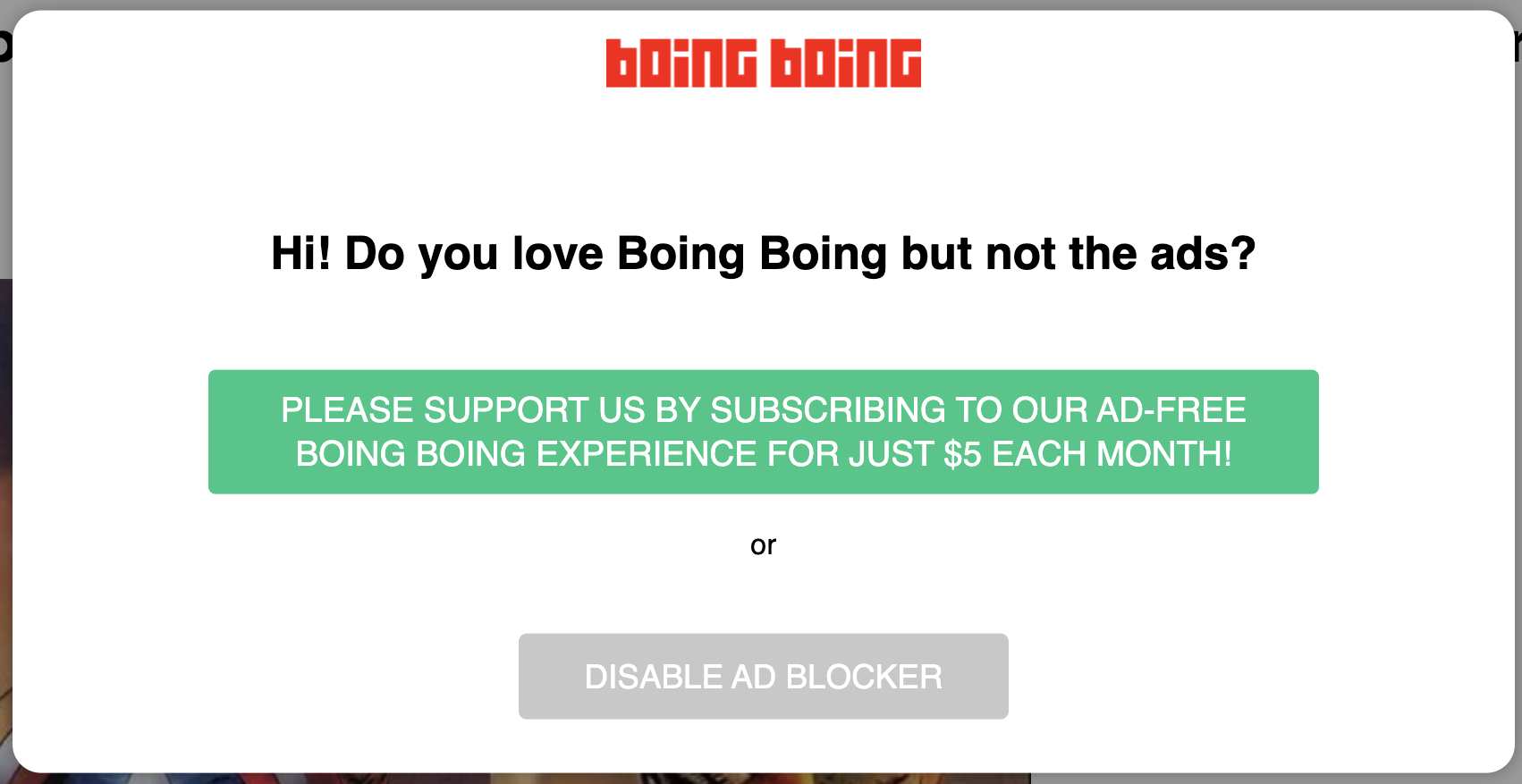
I started reading BoiongBoing when it was a ‘zine back in the last millennium. I stopped when I began hitting this:

boingboing popover

In fact I don’t block ads. I block tracking, specifically with Privacy Badger, from the EFF.

But BoingBoing, like countless other websites, confuses tracking protection with ad blocking. This is because they are in the surveillance-aimed advertising business, aka adtech.

It’s essential to know that adtech is descended from the junk mail business, euphemistically called “direct response marketing.” As I put it in Separating Advertising’s Wheat and Chaff,

Remember the movie “Invasion of the Body Snatchers?” (Or the remake by the same name?) Same thing here. Madison Avenue fell asleep, direct response marketing ate its brain, and it woke up as an alien replica of itself.

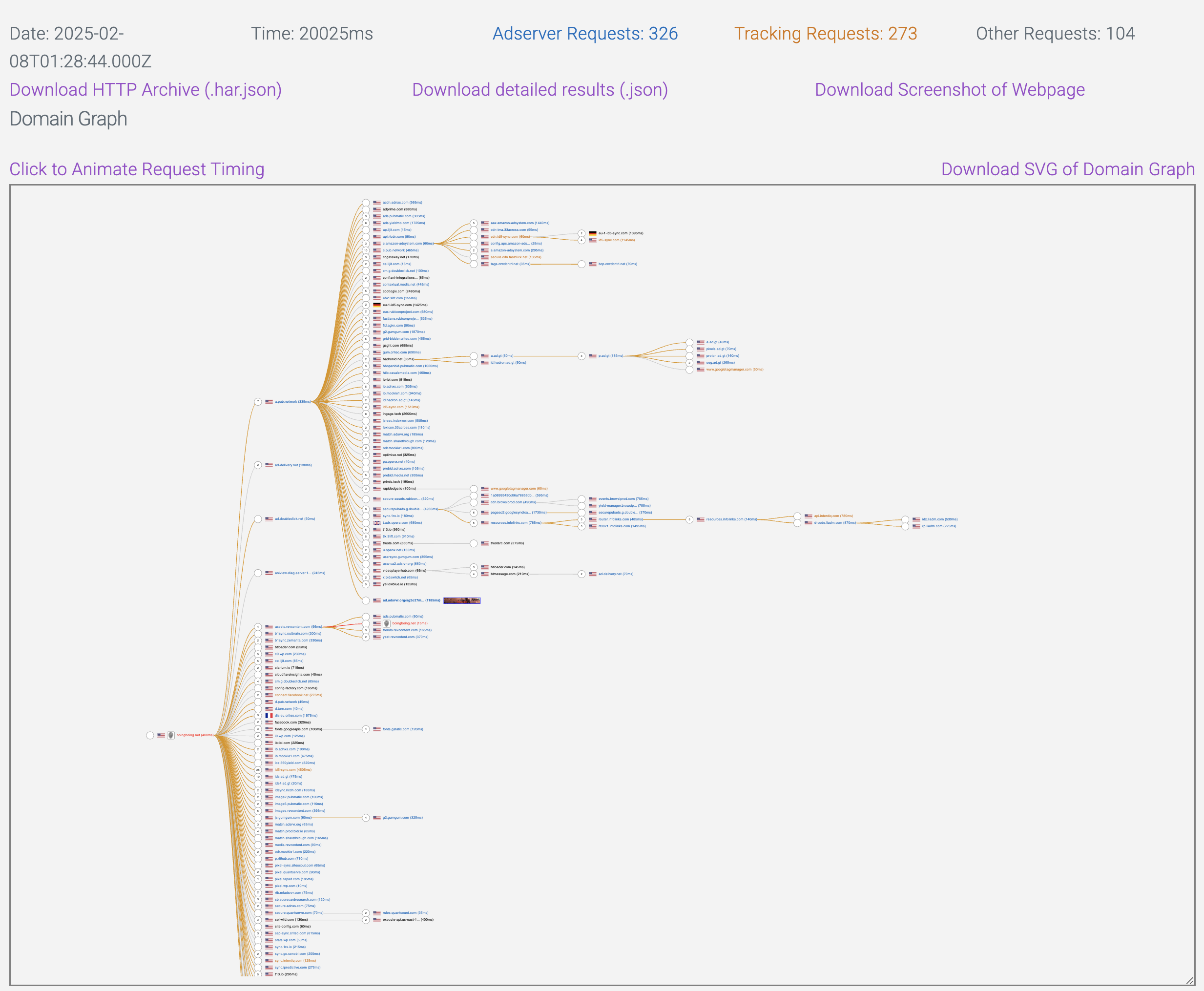
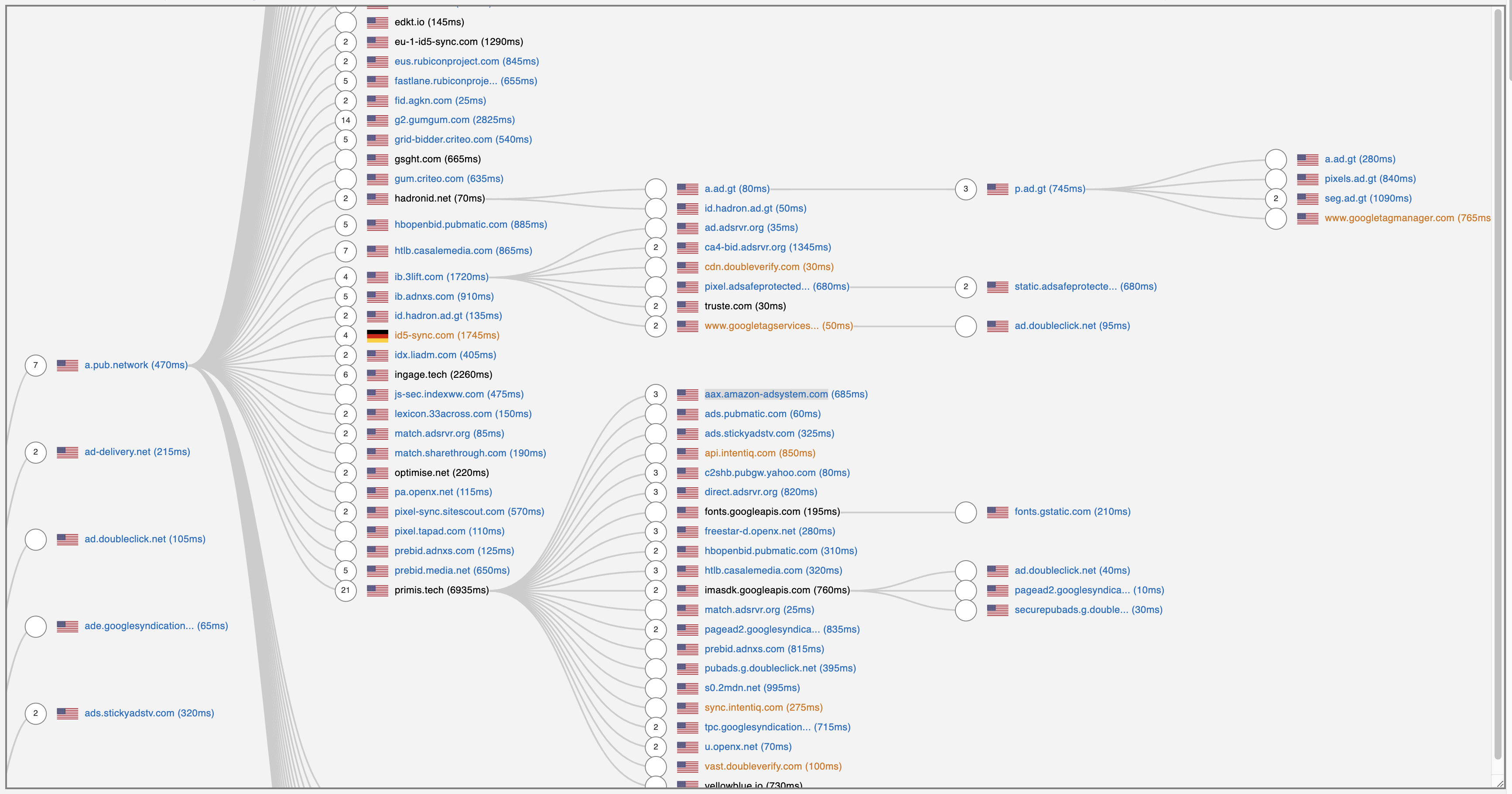
As surveillance-based publications go, BoingBoing is especially bad. Here is a PageXray of BoingBoing.net:

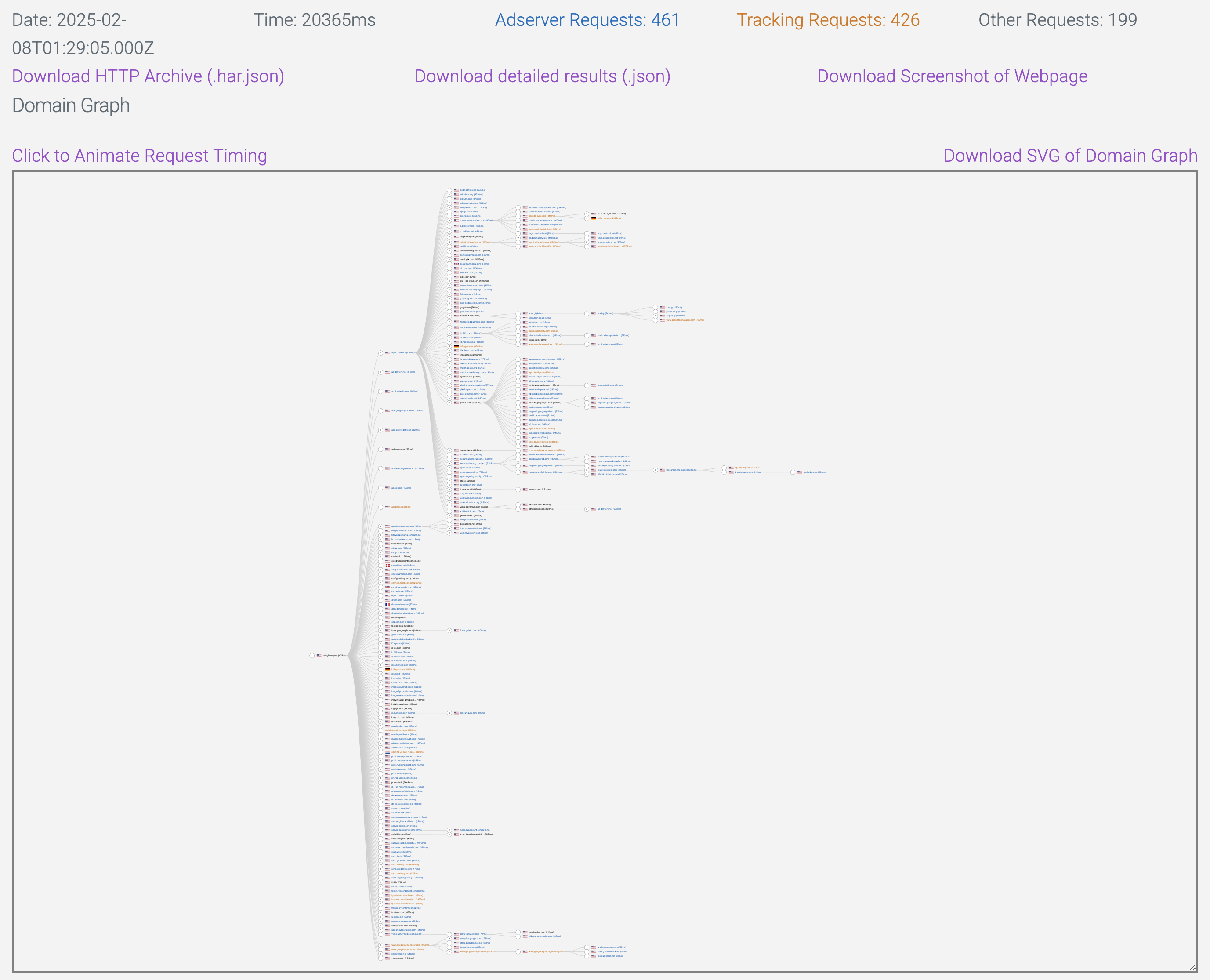
And here is a PageXray of the same page’s URL, to which  tracking cruft from the email I opened was appended:


Look at that: 461 adserver requests, 426 tracking requests, and 199 other requests, which BoingBoing is glad to provide. (Pro tip: always strip tracking cruft from URLs that feature a “?” plus lots of alphanumeric jive after the final / of the URL itself. Take out the “?” and everything after it. )

Here is a close-up of one small part of that vast spread of routes down which data about you flows:

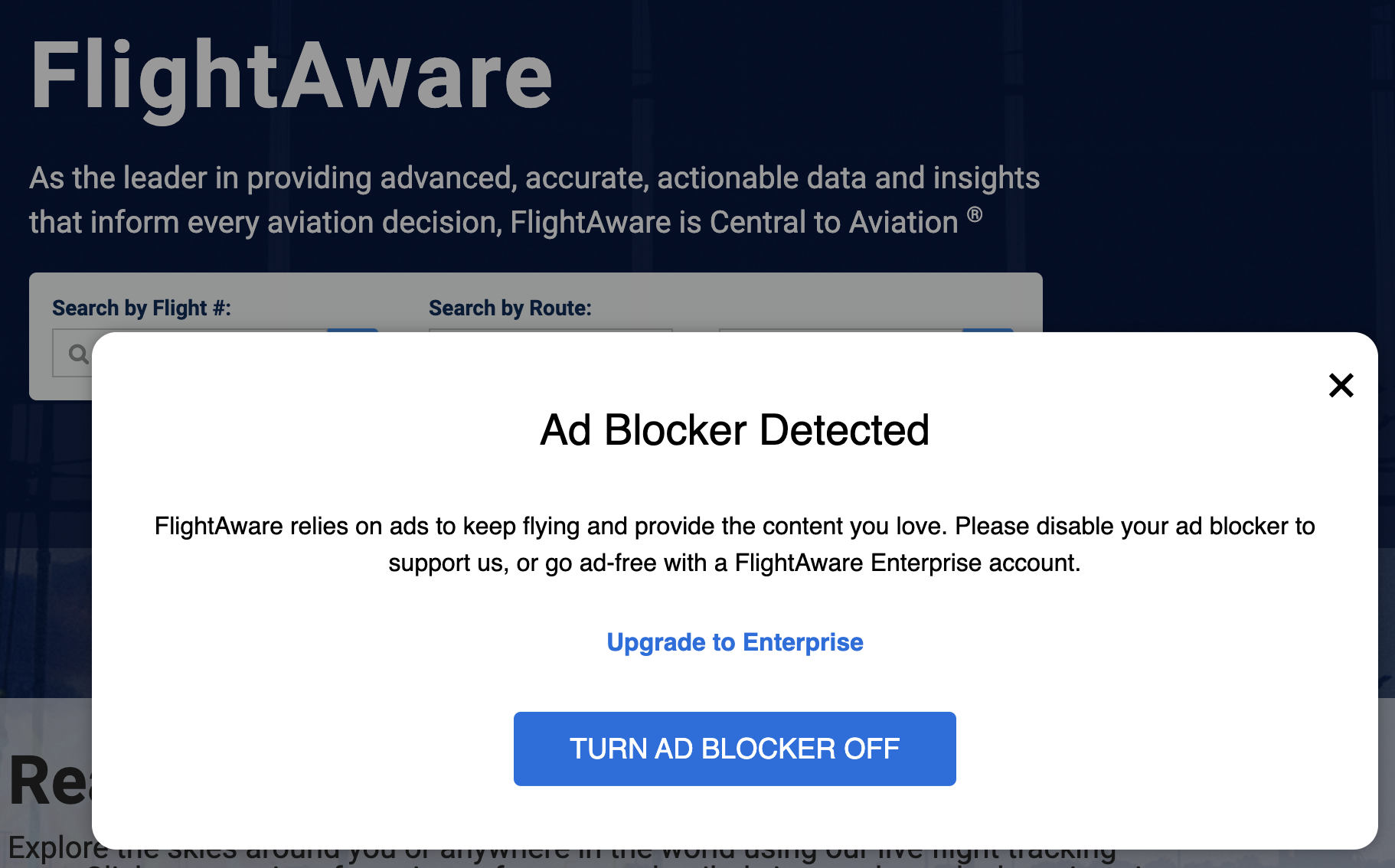
Some sites, such as FlightAware, interrupt your experience with a notice that kindly features an X in a corner, so you can make it go away:

flightaware notice
Which I do.

But BoingBoing doesn’t. Its policy is “Subscribe or pay with lost privacy.”  So I go away.

Other sites use cookie notices that give you options such as these from a Disney company (I forget which):

Nice that you can Reject All. Which I do.

This one from imgur let’s you “manage” your “options.” Those, if they are kept anywhere (you can’t tell), are in some place you can’t reach or use to see what your setting was, or if they haven’t violated your privacy:

imgur notice
This one at Claude defaults to no tracking for marketing purposes (analytics and marketing switches are set to Off):

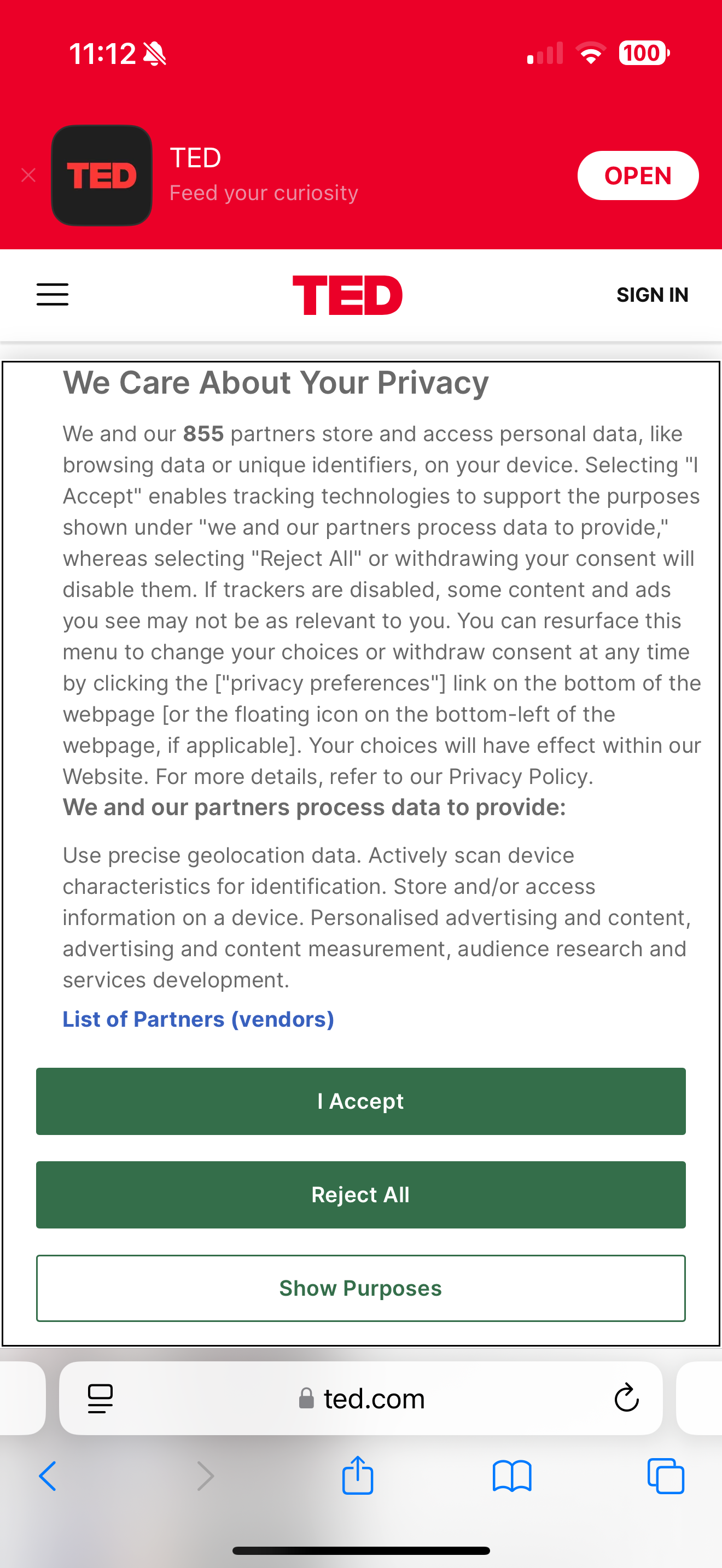
TED here also lets you Accept All or Reject All:

ted-cookie

I’ve noticed that Reject All tends to be a much more prominent option lately. This makes me think a lot of these sites should be ready for IEEE P7012, nicknamed MyTerms, which we expect to become a working standard sometime this year. (I chair the working group.) I believe MyTerms is the most important standard in development today because it gets rid of this shit—at least for sites that respect the Reject All signal, plus the millions (perhaps billions?) of sites that don’t participate in the surveillance economy.

With MyTerms, sites and services agree to your terms—not the other way around. And it’s a contract. Also, both sides record the agreement, so either can audit compliance later.

Your agent (typically your browser, through an extension or a header) will choose to proffer one of a small list of contractual agreements maintained by a disinterested nonprofit. Customer Commons was created for this purpose (as a spin-off of ProjectVRM). It will be for your terms what Creative Commons is for your copyright licenses.

Customer Commons also welcomes help standing up the system—and, of course, getting it funded. If you’re interested in working on either or both, talk to me. I’m first name at last name dot com. Thanks!


Derailing the Customer Journey

This came in the mail today:

Everything they list is something I don’t want to do. I’d rather just accumulate the miles. But I can’t, unless I choose one of the annoyances above, or book a flight in the next three months.

So my customer journey with American is now derailed.

There should be better ways for customers and companies to have journeys together.

Hmm… Does United have one?

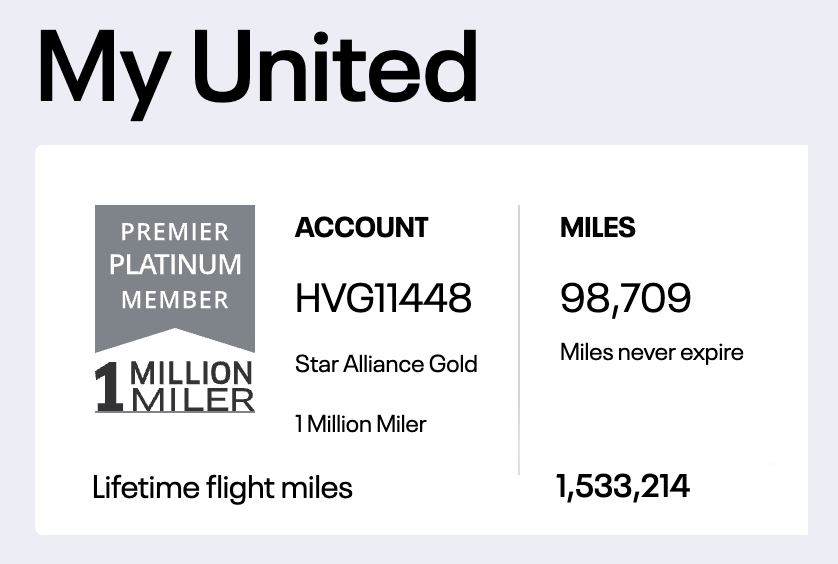
Here’s a picture of my customer journey with United Airlines, as of today:

I’m also a lifetime member of the United Club, thanks to my wife’s wise decision in 1990 to get us both in on that short-lived deal.

Premier Platinum privileges include up to three checked bags, default seating in Economy Plus (more legroom than in the rest of Economy), Premium lines at the ticket counter and Security, and boarding in Group One. There are more privileged castes, but this one is a serious tie-breaker against other airlines. Also, in all our decades of flying with United, we have no bad stories to tell, and plenty of good ones.

But now we’re mostly based in Bloomington, Indiana, so Indianapolis (IND) is our main airport. (And it’s terrific. We recommend it highly.) It is also not a hub for any of the airlines. The airline with the most flights connecting to IND is American, and we’ve used them. I joined their frequent flier program, got their app, and started racking up miles with them too.

So here is one idea, for every airline: having respect for one’s established status with other airlines means something. Because that status (or those stati) are credentials: They say something about me as a potential passenger. It would be nice also if what I carry, as an independent customer, is a set of verifiable preferences—such as that I always prefer a window seat, never tow a rolling bag on board (I only have a backpack), and am willing to change seats so a family can sit together. Little things that might matter.

I bring all this up because fixing “loyalty” programs shouldn’t be left up only to the sellers of the world. They’ll all do their fixes differently, and they’ll remain deaf to good input that can only come from independent customers with helpful tools of their own.

Developing those solutions to the loyalty problem is one of our callings at ProjectVRM. I also know some that are in the works. Stay tuned. 🙂

The Independent Customer

How dow we get from this—

To this—

?

By making customers independent.

Hmm… maybe The Independent Customer should be the title of my follow-up to The Intention Economy.

Because, to have an Intention Economy, one needs independent customers: ones who are in charge of their own lives in the digital world:

  • Who they are—to themselves, and to all the entities they know, including other people, and organizations of all kinds, including companies.
  • What they know about their lives (property, health, relationships, plans, histories)—and the lives of others with whom they have relationships.
  • Their plans—for everything.: what they will do, what they will buy, where they will go, what tickets they hold, you name it.

Add whatever you want to that list. It can be anything. Eventually it will be everything that has a digital form.

What will hold all that information, and what will make that information safely engageable with other people and entities?

A wallet.

Not a digital version of the container for cash and cards we carry in our purses and pockets. Apple and Google think they own that space already, which is fine, because that space is confined by the mobile app model. Wallets will be bigger and deeper than that.

Wallets will embody two A’s: archives and abilities. Among those abilities is AI: your AI. Personal AI. One that is agentic for you, and not just for the sellers of the world.

Interesting harbinger: Inrupt now calls Solid podswallets.” (Discussion.)

Wallets are how we move e-commerce from a world of accounts to a world of independent customers with personal agency. With AI agents working for them and not just for sellers.

In his latest newsletter, titled ‘A-Commerce’ will be the biggest disruption since the web, and Digital Wallets are the new accounts, Jamie Smith says this:

The Web3 crowd say digital wallets are about transferrable digital assets and ownership without a central authority. And they are right.

But there’s more.

Many payments and identity experts will say that digital wallets are really about identity. Proving who you are and what you are entitled to do (tickets, access). Maybe even with fancy selective disclosure features.

They are also right. But that’s not the whole picture.

A pioneering group of others believe that digital wallets are really about the portability of any verifiable information, and digital authenticity.

And they too are right. We’re now getting much, much closer to what I’m talking about. But there’s still more.

Once individuals can show up independently, with their own digital tools – digital wallets with verifiable, data, identity and digital assets – then we have something new, something special.

It’s a New. Customer. Channel.

Once a business asks for some data from a customer’s digital wallet, they have the opportunity to form a new digital connection with that customer.

A persistent one.

A verifiable one.

A private one.

An auditable, secure and intelligent one.

My goodness, what business wouldn’t want that? Imagine plugging that customer connection directly into business systems and processes, like CRM.

Yes, digital wallets can hold and manage assets. And identity. And portable, verifiable, authentic data.

But with the narrower ‘data and assets’ framing, we risk missing the larger market opportunity.

Digital wallets become the new account.

For everything.

OK so what is an account?

With money, it’s a shared and trusted record of all your transactions. Who did what, who paid what, and who owes who.

With business, it’s a shared record of all your products and interactions. It’s a critical customer channel and interface. The place people come to check things. To ask things. To ‘do business’.

Each customer account has a number. A unique identifier. It has a way to message customers. A way to record what’s been sent to, and received from, the customer.

Ring a bell?

Digital wallets will be able to do all this and much more.

They will also be more secure. More private. More flexible. And more portable.

So it’s possible – I’d even argue more likely – that digital wallets may be more disruptive than browsers were in the 1990s.

But like browsers, they will first be misunderstood.

Digital wallets will become the new account.

For business? For government? For banking? For health? For travel?

For life.

I have said for over a decade that the only 360° view of the customer, is the customer.

Just imagine, once a customer can bring their own wallet – their own account – to each business:

  • The economics change. Why would a business maintain a complex and proprietary account platform when digital interactions can be handled – indeed automated – via a verifiable digital wallet that’s available on every smart device?
  • The data flows change. Why would a business store unnecessary customer data when they can just ask for it on demand, with consent, from the customer’s digital wallet? Then delete it again once used?
  • The risks change. What if we could reduce fraud and account takeover to near zero, when every customer interaction has to be authenticated via the customer’s digital wallet (likely with biometrics)?

The very fabric of the customer relationship changes.

This is just a glimpse of what‘s possible, and what’s coming. Especially when you tie it to digital AI agents….

When you look closely, you’ll see that digital wallets aren’t even The Thing. They are ‘below the surface’ of the customer channel.

Lots to be written about that. Coming soon.

For now, it’s a simple switch: when you hear ‘account’, just think ‘wallet’.

Here is the challenge: making wallets a must-have: an invention that mothers necessity.

We’ve had those before, with—

  • PCs
  • word processors and spreadsheets
  • the Net and the Web,
  • graphical browsers
  • personal publishing and syndication
  • smartphones and apps
  • streams and podcasts.

Wallets need to be like all of those: must-haves that transform and not just disrupt.

It’s a tall order, but—given the vast possibilities—one that is bound to be filled.
As for why this won’t be something one of the bigs (e.g. Apple and Google) do for themselves, consider these five words you hear often online:

“Wherever you get your podcasts.”

Those five words were made possible by RSS.

It’s why all of the things in the bullet list above are NEA:

  • Nobody owns them
  • Everybody can use them
  • Anyone can improve them

When we have wallets with those required features, and they become inventions that mother necessity, we will have truly independent customers.

And we will finally prove ProjectVRM’s prime thesis: that free customers are more valuable than captive ones—to themselves and to the marketplace.

ONDC, Beckn, and VRM

This is important. Be there.

If we want VRM to prove out globally, we have to start locally. That’s what’s happening right now in India, using ONDC (the Open Network for Digital Commerce), which runs on the Beckn protocol.

ONDC is a happening thing:

One big (and essential) goal for VRM is individual customer scale across many vendors.  ONDC and Beckn are for exactly that. Here is how kaustubh yerkade explains it in Understanding Beckn Protocol: Revolutionizing Open Networks in E-commerce:

Beckn protocol in the Real World
The Beckn Protocol is part of a larger movement toward creating open digital ecosystems, particularly in India. For example, the ONDC (Open Network for Digital Commerce) initiative in India is built using the Beckn protocol, aiming to democratize e-commerce and bring small retailers into the digital economy. The Indian government supports ONDC for making digital commerce more accessible and competitive.

Here are some practical examples of how the Beckn Protocol can be used in different industries:

1. Ride-Hailing and Mobility Services
Example: Imagine a city with multiple ride-hailing services (e.g., Uber, Ola, Rapido). Instead of using individual apps for each service, a user can use one app powered by the Beckn Protocol. This app aggregates all available ride-hailing services, showing nearby cars, prices, and estimated arrival times from multiple providers. The user can choose the best option, book the ride, and pay directly through the unified app.

Benefit: Service providers gain broader visibility, and users can easily compare services in one place without switching between apps.

https://becknprotocol.io/imagining-mobility-with-beckn/

2. Food Delivery Services
Example: A consumer uses a food delivery app that leverages Beckn to show restaurants from multiple food delivery services (like Zomato, Swiggy, and local food delivery providers). Instead of sticking to just one platform, the user sees menus from different services and can order based on price, availability, or delivery time.

Benefit: Restaurants get listed on more platforms, increasing their exposure, and users can find more options without hopping between different apps.

3. E-Commerce and Local Retail
Example: A shopper is looking for a product (like a phone charger) and uses an app built on the Beckn Protocol. The app aggregates inventory from big e-commerce players (like Amazon or Flipkart) as well as small local retailers. The user can compare prices and delivery times from both big platforms and nearby local stores, then make a purchase from the most convenient provider.

Benefit: Small businesses and local stores can compete with larger e-commerce platforms and reach a wider audience without needing their own app or website.

4. Healthcare Services
Example: A patient needs to book a doctor’s appointment but doesn’t want to manually search through different healthcare platforms. A healthcare app using Beckn shows available doctors and clinics across multiple platforms (like Practo, 1mg, or even independent clinics). The patient can choose a doctor based on location, specialization, and availability, all in one place.

Benefit: Patients get access to a larger pool of healthcare providers, and doctors can offer their services on multiple platforms through a single integration.

5. Logistics and Courier Services
Example: An online seller wants to ship products to customers but doesn’t want to manage multiple courier services. With an app built on Beckn, they can see delivery options from multiple logistics providers (like FedEx, Blue Dart, and local couriers) and choose the best one based on cost, speed, or reliability.

Benefit: Businesses can streamline shipping operations by comparing various logistics providers through one interface, optimizing for cost and delivery time.

6. Public Transportation
Example: A commuter is planning a trip using public transit in a city. Using a Beckn-powered app, they can view transportation options from multiple transit services (like metro, bus, bike-sharing services, or even ride-hailing). The app provides real-time schedules, available options, and payment methods across different transport networks.

Benefit: The commuter has a unified experience with multiple transportation modes, improving convenience and access to more options.

7. Local Services (Home Services, Repair, Cleaning)
Example: A user needs a home repair service (e.g., a plumber or electrician). Instead of browsing different service provider platforms (like UrbanClap or Housejoy), a Beckn-enabled app aggregates professionals from multiple service providers. The user can compare prices, reviews, and availability and book a service directly from the app.

Benefit: Service providers get access to more customers, and consumers can quickly find professionals based on location, reviews, and price.

8. Travel and Hospitality
Example: A traveler uses a travel booking app based on Beckn to find accommodations. The app aggregates listings from various hotel chains, Airbnb, and local guesthouses. The traveler can filter by price, location, and amenities, then book the best option without switching between platforms.

Benefit: Smaller accommodation providers can compete with big brands, and travelers get access to more choices across different platforms in one app.

9. Government Services and Civic Engagement
Example: A citizen uses a Beckn-enabled app to access multiple government services. They can apply for a driver’s license, pay taxes, and book a health checkup at a government hospital—all from one platform that integrates services from different government departments and third-party providers.

Benefit: Governments can offer a unified experience across various services, and citizens get easier access to public services without visiting multiple websites or offices.

He adds,

The ONDC (Open Network for Digital Commerce) initiative in India is built using the Beckn protocol, aiming to democratize e-commerce and bring small retailers into the digital economy. The Indian government supports ONDC for making digital commerce more accessible and competitive.

While it is nice to have government support, anyone anywhere can deploy open and decentralized tech, or integrate it into their apps and services.

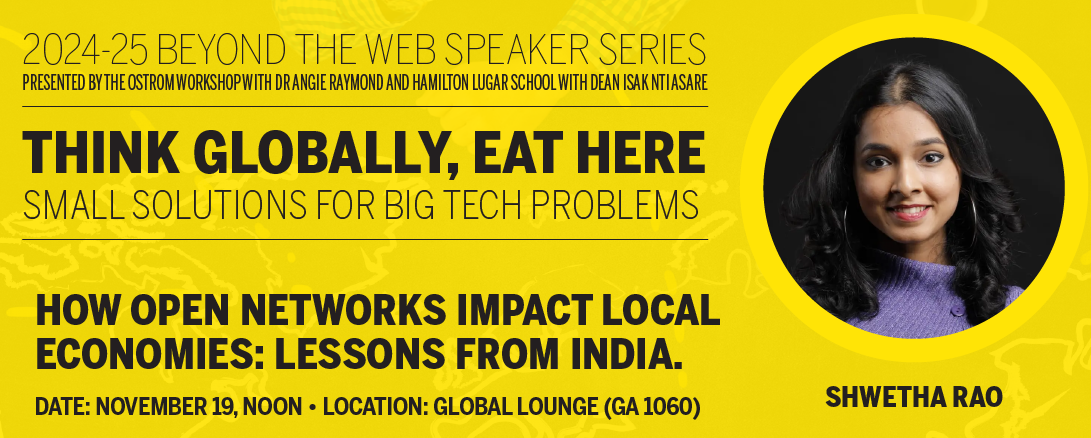
On Tuesday we’ll have a chance to talk about all this at our latest salon at Indiana University and live on Zoom. Our speaker, Shwetha Rao, will be here in person, which always makes for a good event—even for those zooming in.

So please be there. As a salon, it will be short on lecture and long on dialog, so bring your questions. The Zoom link is here.


VRM Day and IIW next week

A pano from VRM Day in April 2015

VRM Days always happen the day before IIW starts, twice each year. Usually, we have about 50 registered and 30 showing up. (Some are online, though we’d rather have their bodies in the room.)  For the VRM Day this coming Monday, we’re expecting more than 100 people. So, like Sheriff Brody said in Jaws, we need a bigger room.

And we have one. So that’s good. Logistics will be challenging, but we’re on top of them.

IIW is also close to sold out. Last I checked, there were just nine tickets left.

Here is copy from our Eventbrite page as it now stands:

The Main Thing

At this VRM Day, Ben Moskowitz, VP Innovation and Ginny Fahs, Director of Product R&D at Consumer Reports will lead discussion of some of their early R&D concepts around a new approach to customer service: one in which personal AI agents represent customers’ best interests.

This is CX (Customer Experience) re-imagined and re-implemented in ways that are no less real and human but far more intelligent, mutually informative, and useful than what all of us have experienced thus far in the Digital Age. CR is looking for feedback and collaboration as they move forward. They plan to participate in IIW as well.

As usual, everyone who wants to share what they’re working on in the VRM space will have time to present, discuss, and prep for IIW.

Schedule

Morning:

  • 9am – Noon. Consumer Reports presentation and discussion (on the above)

Lunch

  • Noon – 1:30 (Sports Page or Zareen’s (diagonal across the intersection)

Afternoon

  1. Adrian Gropper on HIE of One, Medical AI Assistant (MAIA) and personal AI in health care
  2. Joe Andrieu on the Digital Fiduciary Initiative
  3. Cryptid / KwaaiNet demo
  4. Iain Henderson on Data Pal
  5. Richard Whitt on GliaNet Alliance
  6. Customer Commons on IEEE P7012
  7. Paul Trevithick (Mee.Foundation) on Private Advertising
  • Discussion on any or all of the above

  • Listing planned IIW sessions

Subject to change, of course.

Since we have a lot to cover, please be there at 9am sharp, and be back from lunch at 1:30.

Note that there are only three lunch places nearby. Cucina Venti is good but relatively expensive and service is slow. Sports Page is makes good sandwiches and has lots of picnic tables. It’s where most of us usually go. Haven’t tried Zareen’s, behind the Sports Page, where Sunny Bowl and other restaurants used to be. It has “familiar & innovative halal spins on Indian & Pakistani cooking.”


On Intentcasting

The cover page of the Weekend Review section of The Wall Street Journal, July 20, 2012

On July 9, 2012, not long after The Intention Economy came out, I got word from Gary Rosen of The Wall Street Journal that the paper’s publisher, Robert Thomson, loved the book and wanted “an excerpt/adaptation” from the book for the cover story of  the WSJ’s Weekend Review section. The image above is the whole cover of that section, which appeared later that month.

In the article I described a new way to shop:

An “intentcast” goes out to the marketplace, revealing only what’s required to attract offers. No personal information is revealed, except to vendors with whom you already have a trusted relationship.

I also said that this form of shopping—

…can be made possible only by the full empowerment of individuals—that is, by making them both independent of controlling organizations and better able to engage with them. Work toward these goals is going on today, inside a new field called VRM, for vendor relationship management. VRM works on the demand side of the marketplace: for you, the customer, rather than for sellers and third parties on the supply side.

The scenario I described was set ten years out: in 2022, a future now two years in the past. In the meantime, many approaches to intentcasting have come and gone. The ones that have stayed are Craigslist, Facebook Marketplace, Instacart, TaskRabbit, Thumbtack, and a few others. (Thumbtack participated in the early days of ProjectVRM.) We include them in our list of intentcasting services because they model at least some of what we’d like intentcasting to be. What they don’t model is the full empowerment of individuals as independent actors: ones whose intentions can scale across whole markets and many sellers:

Scale gives the customer single ways to deal with many companies. For example, she should be able to change her address or last name with every company she deals with in one move—or to send an intention-to-buy “intentcast” to a whole market.

Should we call the sum of it “i-commerce“? Just a thought.

Back to the Wall Street Journal article. It is clear to me now that The Customer as a God would have been a much better title for my book than The Intention Economy, which needs explaining and sounds too much like The Attention Economy, which was the title of the book that came out ten years earlier. (I’ve met people who have read that one and thought it was mine—or worse, called my book “The Attention Economy” and sent readers to the wrong one.)

Of course, calling customers gods is hyperbole: exaggeration for effect.  VRM has always been about customers coming to companies as equals. The “revolution in personal empowerment” in the subhead of “The Customer as a God” is about equality, not supremacy. For more on that, see the eleven posts before this one that mention the R-button:

That symbol (or pair of symbols) is about two parties who attract each other (like two magnets) and engage as equals. It’s a symbol that only makes full sense in open markets where free customers prove more valuable than captive ones. Not markets where customers are mere “targets” to “acquire,” “capture,” “manage,” “control” or “lock in” as if they were slaves or cattle.

The stage of Internet growth called Web 2.0 was all about those forms of capture, control, and coerced dependency. We’re still in it. (What’s being called Web3 is, while “decentralized” (note: not distributed), it is also based on tokens and blockchain. ) Investment in customer independence rounds to nil.

And that’s probably the biggest reason intentcasting as we imagined it in the first place has not taken off. It is very hard, inside industrial-age business norms (which we still have) to see customers as equals, or as human beings who should be equipped to lead in the dance between buyers and sellers, or demand and supply, in truly open marketplaces. It’s still easier to see us as mere consumers (which Jerry Michalski calls “gullets with wallets and eyeballs”).

So, where is there hope?

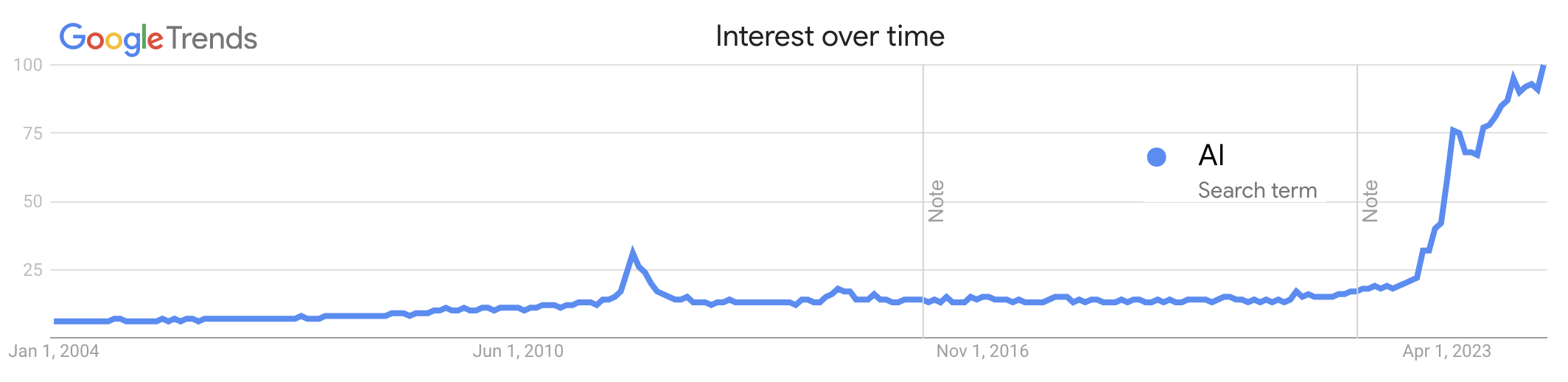
How about AI? It’s at the late end of its craze stage, but still here to stay, and hot as ever:

Can AI provide the “revolution in personal empowerment” we’ve been looking for here since 2006? Can it prove our thesis—that free customers are more valuable than captive ones—to themselves and to the marketplace?

Only if it’s personal.

If it is, then the market is a greenfield.

Some of us here are working at putting AI on both sides of intentcasting ceremonies. If you have, or know about, one or more of those approaches (or any intentcasting approaches), please share what you know, or what you’re got, in the comments below. And come to VRM Day on October 28. I’ll be putting up the invite for that shortly.


Up Starting

Not finishing up, or starting up, but up starting.unfinished stairs

Hell, we’ve been up and starting for one month short of eighteen years. Across that whole time, we’ve been pushing the idea that free customers are more valuable—to themselves, to sellers, to the whole marketplace—than captive ones.

And I’m more optimistic than ever that we’ll prove that idea in the next few years.

Toward that ambition, here are some links in tabs I’m closing:

That’s it for now.
The Personal AI Greenfield

What forms of pAI—personal AI—are Apple, Mozilla, Google, Meta, Microsoft and the rest not doing?

Let’s look at those first two because they’re at the top of the news LIFO buffer.

Apple Intelligence (“coming in beta this fall*“), announced yesterday, will help you with writing and creating images while giving you less lame answers from Siri. (Which they should re-name. Siri is Apple’s Clippy.) It “can draw on larger server-based models, running on Apple silicon, to handle more complex requests for you while protecting your privacy.” The “larger models” will be white-labeled ChatGPT, plus Apple’s own small language models (SLMs).

Mozilla, which got $400+ million a year from Google (for search in the Firefox browser) starting in 2020, announce on June 3 that they will be Building open, private AI with the Mozilla Builders Accelerator. Jive:

This program is designed to empower independent AI and machine learning engineers with the resources and support they need to thrive. It aims to cultivate a more innovative AI ecosystem, and it’s one of Mozilla’s key initiatives to make AI meaningfully impactful — alongside efforts like Mozilla.ai, the Responsible AI Challenge and the Rise25 Awards.

The Mozilla Builders Accelerator’s inaugural theme is local AI, which involves running AI models and applications directly on personal devices like laptops, smartphones, or edge devices rather than depending on cloud-based services…

We chose Local AI as the theme for the Accelerator’s first cohort because it aligns with our core values of privacy, user empowerment, and open source innovation. This method offers several benefits including:

  • Privacy: Data stays on the local device, minimizing exposure to potential breaches and misuse.
  • Agency: Users have greater control over their AI tools and data.
  • Cost-effectiveness: Reduces reliance on expensive cloud infrastructure, lowering costs for developers and users.
  • Reliability: Local processing ensures continuous operation even without internet connectivity.

Looks to me like both of these are Big AI writ small. It’s “local,” not personal. It’s made to serve your needs with what BigAI offers through APIs. It is still essentially AIaaS (AI as a Service), rather than truly personal AI (pAI): personalized more than personal.

That’s also what I see when I read between the lines at Mozilla’s AI job openings. Take platform engineer. This person will (among other things), “assist in managing and orchestrating workloads across multiple cloud providers.” That’s fine. I’m sure true pAIs will do that too. But most of pAI will be more personal than that. It will deal with the mundanities of your everyday life. Not with coughing up answers that can only come from AIaaSes.

The problem with personalizing AI giant offerings is that they are large language models (LLM) trained on everything that can be crawled on the Internet, plus who knows what else. Not on your truly personal stuff. This is why “prompt engineering” worthy of the noun is ” not for anybody:

Prompt engineering is crucial for deploying LLMs but is poorly understood mathematically. We formalize LLM systems as a class of discrete stochastic dynamical systems to explore prompt engineering through the lens of control theory. We investigate the reachable set of output token sequences $R_y(\mathbf x_0)$ for which there exists a control input sequence $\mathbf u$ for each $\mathbf y \in R_y(\mathbf x_0)$ that steers the LLM to output $\mathbf y$ from initial state sequence $\mathbf x_0$. We offer analytic analysis on the limitations on the controllability of self-attention in terms of reachable set, where we prove an upper bound on the reachable set of outputs $R_y(\mathbf x_0)$ as a function of the singular values of the parameter matrices. We present complementary empirical analysis on the controllability of a panel of LLMs, including Falcon-7b, Llama-7b, and Falcon-40b. Our results demonstrate a lower bound on the reachable set of outputs $R_y(\mathbf x_0)$ w.r.t. initial state sequences $\mathbf x_0$ sampled from the Wikitext dataset. We find that the correct next Wikitext token following sequence $\mathbf x_0$ is reachable over 97% of the time with prompts of $k\leq 10$ tokens. We also establish that the top 75 most likely next tokens, as estimated by the LLM itself, are reachable at least 85% of the time with prompts of $k\leq 10$ tokens. Intriguingly, short prompt sequences can dramatically alter the likelihood of specific outputs, even making the least likely tokens become the most likely ones. This control-centric analysis of LLMs demonstrates the significant and poorly understood role of input sequences in steering output probabilities, offering a foundational perspective for enhancing language model system capabilities.

But all that stuff applies mostly when we’re prompting a big LLM system.

What about using AI in our own lives, where the data that matters most are in our calendars, contacts, financial and health records, our travels, our correspondence (email, chat, whatever)? And how about all the location data we might get from our cars, phone apps, and phone companies? These should be much easier for a pAI to gather, examine, and help us do useful things. Caring about much less data also means a pAI will be less likely to give wrong (hallucinated) answers.

Today the mental frame almost everybody uses for AI is the Big kind, ingesting everything they can get their crawlers on, and munching all of it in giant compute farms. Those systems are great for lots of stuff, but they still don’t deal with personal data listed in the last paragraph.

Not yet, anyway.

Look at it this way. For each of us, there are three data pools:

  1. The entire Net, which is what gets crawled by all the giant LLM operators, plus whatever else they can get their claws on.
  2. One’s personal life, some of which is digitized in useful form (contacts, calendar, mail, stuff in folders inside PCs and attached drives).
  3. Personal data that is in the hands of giants, but is rightfully ours. These include our driving record and driving practices (,recorded by our late model cars and snitched to insurance companies and others), our location data (kept and shared by car and phone carriers to the likes of Google and the feds), our TV viewing habits, (gathered by Google, Amazon, Roku, Apple, etc.).

The pAI greenfield is with the last two.

Tell us who is working on what there, preferably with open source, and not sitting on walled garden silicon.

[Later… ] Since readers told me I had small language models (SLMs) wrong in one of the paragraphs above, and I’m not sure I had them right, I rewrote them out of the piece. I invite readers to post comments to further correct and expand on the subject of pAIs and what they can do.

Personal AI +/vs Corporate AI

Are they going to shake hands or fight? We’ll answer that question after personal AI exists and operates as a powerful personal agent.

You’re reading this on a machine with an operating system: Linux, Windows, MacOS, iOS, or Android.

But that’s not your OS. It’s your machine’s.

How about one for you, that runs on your machine but is entirely yours? Let’s call it a Personal OS, or a POS.

The POS will have a kernel onto which abilities (not just applications) can be added. An extreme example of how this might work is Neo learning ju jitsu in The Matrix:

That OS amplified Neo’s own intelligence, in his own head. We’re far from that today. But we can at least add abilities to a POS of our own. Those too can give us more agency of many kinds.

To my knowledge, there is only one POS so far. It’s called pAI-OS (Github code), and it’s led by Kwaai.* To my knowledge, pAI-OS is the first and only truly personal operating system. (If others do the same, let me know and I’ll talk those up too.) And it is built to run our own AIs. Let’s call them PAIs, where the A can mean amplified or augmented (sourcing Doug Englebart for the latter).

So, what kind of abilities are we talking about?

Let’s start with something that could hardly be more mundane and important: memory.

In Laws of Media, Marshall McLuhan (five decades ago) said that computing promises “perfect memory—total and exact.” For many millennia, our species has been outboarding memory through speech, and the written word, and collecting all of that in libraries and museums. And now, in the digital age that dawned with microcircuits and the Internet, we now occupy a digital world where everybody can publish whatever they want. To peruse that, we made search engines. Those ruled from the late ’90s until approximately yesterday, when AIs took over servicing our interest in answers to questions. Google, Microsoft, ChatGPT, Perplexity.ai, and others have moved into a space we might call AI answerware.

Running all that answerware are corporate AIs. Let’s call them CAIs. Nothing wrong with CAIs, but also nothing personal, because they are not ours. I explain the difference in Personal vs. Personalized AI. Here’s a graphic from that post showing a bit of what abilities might run on your PAI:

PAIs can extend our own memories by accumulating personal stuff we need to know better, and our ability to meet, access, and use the external abilities of the CAI world. So we’ll have our agents + their agents, working together.

For an example of how that might work, take a look at The most important standard in development today: P7012: Standard for Machine Readable Personal Privacy Terms, which “identifies/addresses the manner in which personal privacy terms are proffered and how they can be read and agreed to by machines.” After seven years with a working group, it is now in the IEEE editing and approval mill, edging toward becoming a finished standard by next year. It works like this:

Here your agent (a PAI, represented by the ⊂ symbol) proffers your privacy terms (here is one example) to a corporate agent (which might or might not be a CAI, but is still represented with the reciprocal symbol ⊃. (This should be familiar to ProjectVRM veterans as the r-button. We may finally get to use it!)

The ceremony here is the exact reverse of what we have today with the cookie popovers on most website home pages. This can and should be done ⊂ to ⊃. So should signing and recording the agreement, or the choice of the site, should it tell you to screw off. (An agent running on your PAI will record that diss.)

I also bring this up because it will be a key required ability—not just for you and me but for the world, starting with Europe, where the GDPR lists six lawful bases for processing personal data. They begin—

(a) Consent: the individual has given clear consent for you to process their personal data for a specific purpose.
(b) Contract: the processing is necessary for a contract you have with the individual, or because they have asked you to take specific steps before entering into a contract.

By now everyone knows that (a) Consent has failed. It’s an expensive and meaningless dance, with high cognitive (mostly cynical) overhead, and almost no accountability. Now they’re ready for (b) Contract, especially in ceremonies where the individual (not a mere “user”) takes the lead.

I believe there is less limit to what each of us can do with a PAI than there is to what we can do with a laptop or a phone. Because our PAI is our own. It runs on a deeper machine OS, but is not limited by that. Your PAI, running on your POS, may prove to be the first truly personal layer ever put on a machine OS.


*Full disclosure: I am now the Chief Intention Officer there. At this stage, it’s a voluntary position.

« Older posts Newer posts »

© 2026 ProjectVRM

Theme by Anders NorenUp ↑