
How dow we get from this—
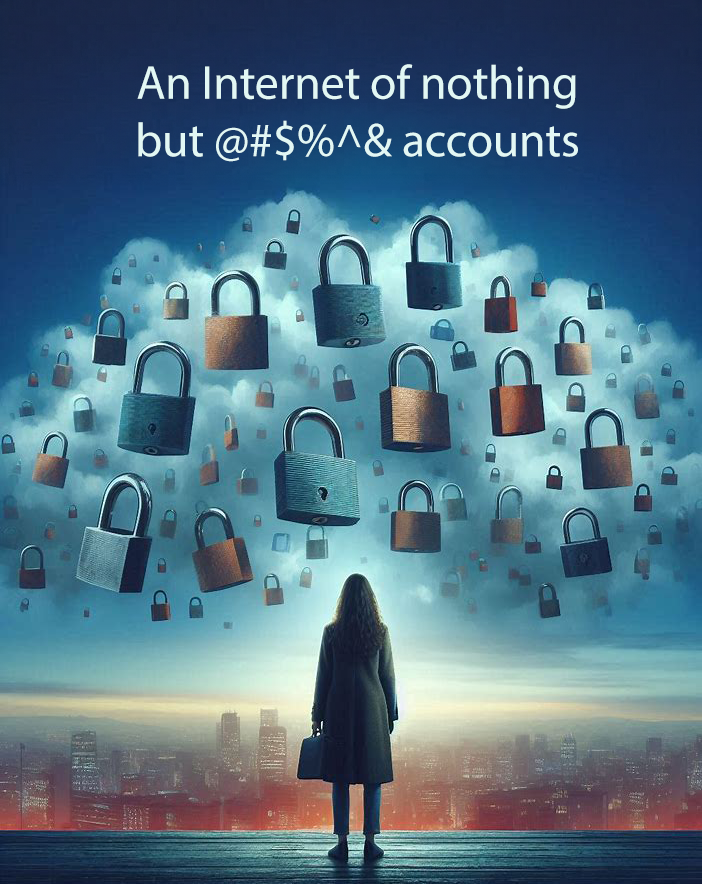
To this—

?
By making customers independent.
Hmm… maybe The Independent Customer should be the title of my follow-up to The Intention Economy.
Because, to have an Intention Economy, one needs independent customers: ones who are in charge of their own lives in the digital world:
- Who they are—to themselves, and to all the entities they know, including other people, and organizations of all kinds, including companies.
- What they know about their lives (property, health, relationships, plans, histories)—and the lives of others with whom they have relationships.
- Their plans—for everything.: what they will do, what they will buy, where they will go, what tickets they hold, you name it.
Add whatever you want to that list. It can be anything. Eventually it will be everything that has a digital form.
What will hold all that information, and what will make that information safely engageable with other people and entities?
A wallet.
Not a digital version of the container for cash and cards we carry in our purses and pockets. Apple and Google think they own that space already, which is fine, because that space is confined by the mobile app model. Wallets will be bigger and deeper than that.
Wallets will embody two A’s: archives and abilities. Among those abilities is AI: your AI. Personal AI. One that is agentic for you, and not just for the sellers of the world.
Interesting harbinger: Inrupt now calls Solid pods “wallets.” (Discussion.)
Wallets are how we move e-commerce from a world of accounts to a world of independent customers with personal agency. With AI agents working for them and not just for sellers.
In his latest newsletter, titled ‘A-Commerce’ will be the biggest disruption since the web, and Digital Wallets are the new accounts, Jamie Smith says this:
The Web3 crowd say digital wallets are about transferrable digital assets and ownership without a central authority. And they are right.
But there’s more.
Many payments and identity experts will say that digital wallets are really about identity. Proving who you are and what you are entitled to do (tickets, access). Maybe even with fancy selective disclosure features.
They are also right. But that’s not the whole picture.
A pioneering group of others believe that digital wallets are really about the portability of any verifiable information, and digital authenticity.
And they too are right. We’re now getting much, much closer to what I’m talking about. But there’s still more.
Once individuals can show up independently, with their own digital tools – digital wallets with verifiable, data, identity and digital assets – then we have something new, something special.
It’s a New. Customer. Channel.
Once a business asks for some data from a customer’s digital wallet, they have the opportunity to form a new digital connection with that customer.
A persistent one.
A verifiable one.
A private one.
An auditable, secure and intelligent one.
My goodness, what business wouldn’t want that? Imagine plugging that customer connection directly into business systems and processes, like CRM.
Yes, digital wallets can hold and manage assets. And identity. And portable, verifiable, authentic data.
But with the narrower ‘data and assets’ framing, we risk missing the larger market opportunity.
Digital wallets become the new account.
For everything.
OK so what is an account?
With money, it’s a shared and trusted record of all your transactions. Who did what, who paid what, and who owes who.
With business, it’s a shared record of all your products and interactions. It’s a critical customer channel and interface. The place people come to check things. To ask things. To ‘do business’.
Each customer account has a number. A unique identifier. It has a way to message customers. A way to record what’s been sent to, and received from, the customer.
Ring a bell?
Digital wallets will be able to do all this and much more.
They will also be more secure. More private. More flexible. And more portable.
So it’s possible – I’d even argue more likely – that digital wallets may be more disruptive than browsers were in the 1990s.
But like browsers, they will first be misunderstood.
Digital wallets will become the new account.
For business? For government? For banking? For health? For travel?
For life.
I have said for over a decade that the only 360° view of the customer, is the customer.
Just imagine, once a customer can bring their own wallet – their own account – to each business:
- The economics change. Why would a business maintain a complex and proprietary account platform when digital interactions can be handled – indeed automated – via a verifiable digital wallet that’s available on every smart device?
- The data flows change. Why would a business store unnecessary customer data when they can just ask for it on demand, with consent, from the customer’s digital wallet? Then delete it again once used?
- The risks change. What if we could reduce fraud and account takeover to near zero, when every customer interaction has to be authenticated via the customer’s digital wallet (likely with biometrics)?
The very fabric of the customer relationship changes.
This is just a glimpse of what‘s possible, and what’s coming. Especially when you tie it to digital AI agents….
When you look closely, you’ll see that digital wallets aren’t even The Thing. They are ‘below the surface’ of the customer channel.
Lots to be written about that. Coming soon.
For now, it’s a simple switch: when you hear ‘account’, just think ‘wallet’.
Here is the challenge: making wallets a must-have: an invention that mothers necessity.
We’ve had those before, with—
- PCs
- word processors and spreadsheets
- the Net and the Web,
- graphical browsers
- personal publishing and syndication
- smartphones and apps
- streams and podcasts.
Wallets need to be like all of those: must-haves that transform and not just disrupt.
It’s a tall order, but—given the vast possibilities—one that is bound to be filled.
As for why this won’t be something one of the bigs (e.g. Apple and Google) do for themselves, consider these five words you hear often online:
“Wherever you get your podcasts.”
Those five words were made possible by RSS.
It’s why all of the things in the bullet list above are NEA:
- Nobody owns them
- Everybody can use them
- Anyone can improve them
When we have wallets with those required features, and they become inventions that mother necessity, we will have truly independent customers.
And we will finally prove ProjectVRM’s prime thesis: that free customers are more valuable than captive ones—to themselves and to the marketplace.
0 Comments
1 Pingback