Category: Vertical ideas (Page 5 of 6)

Health Care Relationship Management

Health 2.0 is going on today and tomorrow in Boston. So is HealthCamp Boston. Says Mark Scrimshire, about the latter,

We are using CoverItLive as one of the methods of helping you track the event.

We are encouraging all participants to Blog, Tweet and upload photos and videos using the #HCBos and #SocPharm hashtags.

Click Here for the CoverItLive feed or follow the CoverItLive Feed on Mark Scrimshire’s EKIVE blog: http://ekive.blogspot.com/

The CoverItLive RSS Feed is here.

Wish I could be there. (Boston is our home during the academic year, but rigtht now we’re getting some R&R at our perma-home in Santa Barbara.) Meanwhile I suggest that everybody who cares about VRM consider the matter of HCRM — Health Care Relationship Management. (A term I just made up. HRM might be better if it wasn’t about HR.) Health 2.0’s concern is user-generated health care, its about page says. That puts it in VRM territory right there.

Here’s the agenda for Health 2.0. HealthCampBoston is more on the BarCamp model. A DIY agenda.

Among the biggest topics in HCRM in recent years has been PHR, for Personal Health Records. Search for that, with quotes, and you get over half a million results. Leave off the quotes and you get fifty-five million results. The more specific (and less confusing, with Physicians for Human Rights) EHR, for Electronic Health Records, gets nearly five million results.

This is a huge topic, of a degree of importance that verges on the absolute. It’s also perhaps the most sisyphean of VRM categories. I find that daunting, but there are many professionals in health care and related fields who have been doing a great job pushing big rocks long distances. These people are heroes, even if they don’t know or acknowledge that. Here are some links to get started:

Send me more, or comment below, and I’ll add them here.

Tags:

  • #ehr
  • #emr
  • #HealthcareIT
  • #health20con
  • #hrm

There’s much more, of course. To get thinking rolling among the VRMerati, consider this mind-bender at ePatients.net., and this follow-up, both by ePatientDave:

Imagine that for all your life, and your parents’ lives, your money had been managed by other people who had extensive training and licensing. Imagine that all your records were in their possession, and you could occasionally see parts of them, but you just figured the pros had it under control.

Imagine that you knew you weren’t a financial planner but you wanted to take as much responsibility as you could – to participate. Imagine that some money managers (not all, but many) attacked people who wanted to make their own decisions, saying “Who’s the financial planner here?”

Then imagine that one day you were allowed to see the records, and you found out there were a whole lot of errors, and the people carefully guarding your data were not as on top of things as everyone thought.

Also this piece of intelligence, about Twitter and hospitals.
The new business of journalism, cont’d

writes Why I dislike micropayments, don’t mind charity, but really have a better idea. He mentions VRM and his idea is VRM-like, in the sense that it involves relationships between the buyers and sellers of journalism, in which buyers are — at least to some degree (as I understand it) — in charge of their own side of the thing. An excerpt:

…let’s sum it up. Shifting the news relationship from reader-newspaper to user-creator increases potential trust, an economic good, and unlocks value, which people may pay for. But even the strongest value proposition does not a business model equal.

So let’s move to the concrete: the business model. How do we monetize this theoretical value tucked away in user-creator relationships?

You do it with an idea I’ve been flogging the past couple weeks. You do it with , in which users pay creators for “added convenience or increased interaction.” Note the elegant fit: increased interaction between one person and another is what fosters relationships and trust. Giving paying users otherwise exclusive twitter access to the creator could work. SMS updates could work, as could a permission only room on friendfeed. Even something as simple as a gold star on paying users’ comments—a symbol that they support the creator financially—would provide incentive for the creator to reply. Tiers of stars—bronze, silver, gold—are possible too.

Sounds to me like journals-as-clubs. Anyway, see whatcha think.

EmanciPay for Newspapers. And everything else that’s free.

I got a note saying that Walter Isaacson‘s latest Time Magazine piece — How To Save Newspapers — cries out for VRM. I agree. Here’s the exciting text amongst his closing paragraphs:

Under a micropayment system, a newspaper might decide to charge a nickel for an article or a dime for that day’s full edition or $2 for a month’s worth of Web access. Some surfers would balk, but I suspect most would merrily click through if it were cheap and easy enough.

The system could be used for all forms of media: magazines and blogs, games and apps, TV newscasts and amateur videos, porn pictures and policy monographs, the reports of citizen journalists, recipes of great cooks and songs of garage bands. This would not only offer a lifeline to traditional media outlets but also nourish citizen journalists and bloggers…

…The need to be valued by readers — serving them first and foremost rather than relying solely on advertising revenue — will allow the media once again to set their compass true to what journalism should always be about.

EmanciPay is what he’s calling for here. It’s not a micropayment system. Instead call it a microaccounting sysem. It will start with something essential that we don’t yet have: accounting for actual uses, including reading, listening and watching. Journalism, music and other currently free stuff is worth more than $zero. How much more? We need to be able to say.

PayChoice would also —

  1. Provide a single way and easy way that consumers of “content” can become customers of it — rather than the multiple (and often difficult) ways that the producers are currently coming up with. (I’ve never been able to pay for public radio on a station website in less than three minutes. That’s too much friction.)
  2. Provide ways for customers to look back through their media usage histories, inform themselves about what they have been enjoying, and how much of it — and to determine how much it is worth to them. The Copyright Arbitration Royalty Panel (CARP), and later the Copyright Royalty Board (CRB), both came up with “rates and terms that would have been negotiated in the marketplace between a willing buyer and a willing seller” — language that first appeared in the 1995 Digital Performance Royalty Act (DPRA), and tweaked in 1998 by the Digital Millennium Copyright Act (DMCA), under which both the CARP and the CRB operated.  The rates they came up with peaked at $.0001 per “performance” (a song or recording), per listener. PayChoice creates the “willing buyer” that the DRPA thought wouldn’t exist. And I can tell you, as a lover of music and radio, I am willing to pay far more than that rate. That’s why I came up with the EmanciPay idea. I want to be a customer of otherwise free stuff. And I believe the buy side can come up with that system — one that works the same way for all content providers — a helluva lot better (and faster) than the providers can. Hell, we came up with tipping. In the networked world we can do a lot better than that.
  3. Stigmatize non-payment for worthwhile media goods. This is where “social” will finally come to be something more than yet another tech buzzmodifier.

So, stay tuned.

EmanciPay: a new business model for newspapers

Rex Hammock is right to gripe about the newspaper turtles pulling their heads in their shells and complaining that readers aren’t paying for the goods papers offer for free online. In that post he runs down some of the drumbeats he’s been hearing:

Here’s the problem with all of those systems: they’ll all be different, silo’d, inconsistent with each other. And doomed to fail for all those reasons.

Here’s the solution: One new system that makes it as easy as possible for readers to pay for the goods, but voluntarily, on their own terms. This new system would turn consumers into customers by giving them the pricing gun. And here’s what’s also cool about it: We’re already working on it at ProjectVRM. It’s called EmanciPay. (Note: when this was written, it was still called “PayChoice”. DS – 1 September 2009)

It’s still early. But it will get a lot less early if some of these pubs stop complaining and put their shoulders (and their wallets) behind work that’s already going on.

What’s completely screwed about this picture

So I got an email today from Forbes, with the subject “You are Important to Us”. It says this:

Dear Subscriber:

Forbes values you as a customer and your opinions are very important to us.  We are conducting a study and would like to include your opinions.

The survey will take about 10 minutes to complete and we think you’ll find it interesting and enjoyable. Your responses will be used for research purposes only and will be held in the strictest confidence.

Simply click on the link below to visit our survey.

Click here to take the survey [The link goes to a long address that begins http://forbes.puresendmail.com/print.]

Again, we thank you so much for participation.

Sincerely,

Bruce Rogers, Chief Brand Officer – Forbes

You are receiving this email because you registered at Forbes.com LLC. and signed up to receive third party emails To manage your preferences or change your delivery address, please click here.

You may also email your opt-out request to privacy@forbes.net or send your request in the mail directly to:

Forbes.com LLC

Attn: Privacy Administrator
90 5th Ave. 6th Floor
New York, NY 10011

To review our privacy policy click here.

Copyright 2008 Forbes.com LLC TM

I thought, “Hey, I’m busy, but I like Forbes, and I’m inclined to cooperate, even if I hate most surveys and would rather relate to Forbes in a less one-sided and impersonal way. So I punched on “Click here to take the survey”.

The first step was one that asked me what my title was. I have several, but none of them are from the lexicon of corporate hierarchies. So, next to “other” I wrote “fellow”. Because that’s what I am, here at the Berkman Center. (I’m also Senior Editor of Linux Journal and President of my own small company, but I went with “fellow” because I get Forbes where I live near Berkman and not at my home office in California.)

The first survey page told me the thing would take about ten minutes. That’s a lot, but I thought, “Okay, I’m still game. Let’s see how fast we can make this.”

It was over in one second. Or however long it took for the survey server to send me to a page with the title “Thank You – InsightExpress.com”. Its entire contents were this:

Return to Your Originating Web Page

I hit the back button and it went nowhere. Then I clicked on the address in the email. That timed out. So did I.

This is the point at which one might be tempted to write to Bruce Rogers or the nameless  Privacy Administrator, but Forbes has gone out of its way here to avoid human contact (no email address for Bruce, a surface mail address for ATT:Privacy Administrator — both of which scream “WE ARE AVOIDING YOU. PLEASE COOPERATE.) But that would be weak and supplicating, and I have no interest in being either. I’d rather be the good Forbes subscriber that I’ve been for years and attempt to make constructive human contact instead.

I’ll do that three ways. First is with the headline above, plus links and other bait that might get the attention of Bruce Rogers or one of his factota. [Note: I posted this at 1:12pm, and Bruce responded personally at 1:56. Well done!] Second is with an email to some folks I know at Forbes. Third, and most importantly, I’ll try to explain the VRM angle on this.

VRM is Vendor Relationship Management. It’s how customers manage relationships with vendors. (Or with other individuals, or with organizations of any kind — such as churches or governments.)

Most vendors are familiar with CRM, for Customer Relationship Management. I can’t tell if a CRM system was involved in this little exchange, but a failure of this kind is certainly within the scope of CRM’s concerns. (To visit those, check out the CRM sites for SAP, Oracle, SalesForce, Amdocs and Microsoft, which are the top four companies in an $8+ billion business.)

Right now VRM is a $0 billion business. But in the long run it’ll be big, and it’ll improve the CRM business along with it, because it’ll give CRM something more substantial than mailing addresses to relate to.

A number of development communities are working on VRM solutions right now, but rather than talk about those I’ll just say what I’d like here. Not from Forbes, but from VRM developers. If Forbes or any CRM companies want to help with that, cool.

I would like a simple dashboard that tells me what I’m subscribed to and what I’m not — both for print publications such as Forbes and for email subscriptions of every kind. I would like to have global preferences that would govern how I relate to each of those publishers, and how they relate to me. For example, I would like to throw a switch that says “No” to all third party mailings, both to my font door and to my email addresses. When I establish a relationship with a new publisher, or publication, or supplier of any kind, I would like them all to know, as a matter of policy, that I don’t want them to waste their time, money and server cycles by sending me junk mail of any kind. And that I don’t appreciate having my own bandwidth, cycles, disk space, rods, cones and time wasted dealing with any of it. I might give a global or selective thumbs up to surveys, provided I also have a standard way to send error messages and other feedback to survey sources.

On the positive side, I would also like to open conduits through which productive interaction could take place with the publishers, authors and circulation officials whose “content” I pay to get. (And even those that I don’t pay.) I would like a simple, straightforward, universally understandable way to do this, across all “content providers”, so I don’t have to relate only inside each provider’s silo. (By the way, we’re already working on change-of-address, to pick just one subcategory of subscriber-publisher interaction that can be a pain in the butt for everybody. That last link is a working draft, by the way. More work is happening off-wiki.)

That’s just one part of what we’re doing at ProjectVRM. But it’s one I’d like the “content providers” and CRM folks out there to know about. Because it’s going to happen anyway, and I’d suggest getting interested, and perhaps also involved, sooner rather than later.

VRM in 2009

This blog is #19 and Chris Carfi’s Social Customer Manifesto is #7 on Chris Bucholtz’s Best CRM Blogs of 2008, at Inside CRM. About this blog, Chris wrote,

The bumpy economy has perhaps been unkind to forward-looking philosophies like vendor relationship management, but that has not curtailed Searls’ explorations of what will be when the business world finally understands that the customer is now running the show. He makes a convincing argument that companies are leaving dollars on the table already by refusing to admit that this is a consumer-driven world. As Searls wrote, “I’d rather have ‘-driven’ than ‘-centric.’ Because being ‘-centric’ doesn’t require you to relate. Being driven does.”

I never thought about this as a CRM blog, but to the degree that CRM and VRM will work together, it makes sense.

It will be interesting to see which CRM companies realize that customers are driving with VRM. Some are already waiting to see VRM tools show up in customer hands. At a recent ProjectVRM committee meeting, one of the attendees from a CRM company reported that the top honcho at his outfit said “Whoever wins at VRM wins at CRM.” That’s good to hear. VRM will give CRM much more to engage with.

Anyway, Larry Dignan seconds Paul Greenberg’s expectation that 2009 will be VRM’s breakout year. He adds this:

Simply put, a VRM tool would be something customers use to relate and manage multiple vendors. Greenberg thinks that 2009 will be the year in which VRM becomes more than just a concept. What’s ironic is that vendors that have the most tentacles into companies (Oracle, for instance) may become players. Just imagine the following: here’s a VRM tool from a big vendor so you can better manage it.

Well, if the tool only helps you manage one vendor, it’s not a VRM tool. But the irony risk is not small. That’s why I’m still not eager to promote VRM before we have working code and ways of demonstrating how VRM tools make you both independent of vendors and better able to engage with them.

May the best customers win.

Can we fix travel?

Two parts to my theory here.

One is that the airline business is sucky for reasons the airlines can’t fix by themselves.

The other is that only customers can fix it for them.

The reason airlines are sucky is that they treat customers as cargo rather than as human beings. Of course they don’t think and talk that way, but that’s what it comes down to. Cargo comes in a limited variety of shapes, sizes and routing needs, and passengers are treated accordingly.

The problem is that passengers are human beings. All human beingss are different. That’s why they look different, have different fingerprints, different DNA, different interests and proclivities, and so on.

There are certain identicalities that need to be factored in, of course. We’re all likely to be wearing clothes, able to communicate, and have to go to the toilet every once in awhile. We have minimum needs for comfort and service. But after that the variations go way up.

But big businesses such as airlines need to keep the variables down for the sake of efficiency alone. So they make templates of travelers and choices, and try to match those up. All businesses do this to some degree. (Even health care, as I discovered earlier this year.)

Some, such as I, are travelers (frequent in my case) who have peculiar needs that are actually not hard to fill. In particular I want a window seat away from the wing. I would like to be able to look for the seat I want on any airline.  I am willing to select an airline based on being able to get the seat I want, and I am willing to pay something extra for that, even if it’s with an airline I don’t frequently fly.

This “something extra” is money left on the table right now. I am certain there are plenty of flyers with requirements just a unusual as mine.

Today airlines are starting to charge extra for the variables they know well: food, for example, and seat changes. US Airways, which I flew a couple times recently, charges even for water, and for seat changes. While I’m unlikely to pay for those, I am likely to pay for getting the seat I want in the first place.

On United, where I am a IK (greater than 100,000 miles per year) flyer, I get some privileges, which I appreciate; but none of them include being able to upgrade to a seat I want on business class. Since in most cases I already have a seat chosen in economy class, I won’t put in for an upgrade, because I can’t specify seat preference. United assumes that all business class seating is desirable, so they don’t bother with that, unless you’re asking in person at the counter or the gate at the airport. So I usually go without the upgrade. The money left on the table here is what I’m willing to pay for a window seat in business class. It’s a lot more than nothing. It’s even more than the frequent-flying certificates I usually accumulate and spend for upgrades.

What we need to create are the means by which flyers store and publish their preferences, in forms that airlines can see and address if they like. This is just one example of what can be done with a combination of personal data stores, selective disclosure, and policies set personally rather than corporately — policies that can be read in a standard way and acted upon.

What’s key is that the customer needs to be the point of integration and origination for his or her own data, and that he or she have selective control over the disclosure of personal requests and requirements, with clear terms of use and service.

None of this would have come up for me if I hadn’t just had an unhappy experience talking with Lot Polish and Swiss airlines. I’ll be flying on both in the coming weeks. I booked them through United, which is a partner of theirs through Star Alliance. (I am “Star Alliance Gold”, for what that’s not worth.) But because I did not book with them, they refuse to give me any choice of seats except at the gate. This not only sucks, but makes me not want to fly on those airlines. I assume they do this stuff to subordinate flyers from other airlines to frequent flyers on their own. But I don’t know. All I know is that, given a choice in the future, I won’t be flying with them.

Anyway, I’ll be in the UK from Sunday to Wednesday, and will be talking with VRM folks over there about all kinds of stuff, including the ideas I’m floating here.

Looking forward to seeing many of you at the VRM Hub on Monday.

Building the Intention Economy

VRM is part of the Intention Economy I first wrote about here. The gist:

The Intention Economy grows around buyers, not sellers. It leverages the simple fact that buyers are the first source of money, and that they come ready-made. You don’t need advertising to make them.

The Intention Economy is about markets, not marketing. You don’t need marketing to make Intention Markets.

The Intention Economy is built around truly open markets, not a collection of silos. In The Intention Economy, customers don’t have to fly from silo to silo, like a bees from flower to flower, collecting deal info (and unavoidable hype) like so much pollen. In The Intention Economy, the buyer notifies the market of the intent to buy, and sellers compete for the buyer’s purchase. Simple as that.

The Intention Economy is built around more than transactions. Conversations matter. So do relationships. So do reputation, authority and respect. Those virtues, however, are earned by sellers (as well as buyers) and not just “branded” by sellers on the minds of buyers like the symbols of ranchers burned on the hides of cattle.

The Intention Economy is about buyers finding sellers, not sellers finding (or “capturing”) buyers.

So here’s SpringWise, telling us about , and its new service . Not sure it’s a breed of VRM, but since it’s in the same Intention marketplace, I thought it was worth a mention.

VRM catch-up

I just added VRM Hub Blog to the ‘roll on the right. Lots going on there, as in the Hub itself. Of special note are Ownership of data, privacy policies and other VRM creatures and Whose data is it anyway? In those Adriana unpacks some of what she’s slso been posting to the ProjectVRM list. Adriana also posts her own notes from the latest meeting.

Jay Deragon asks, Does Disequilibrium Precede Disruption?

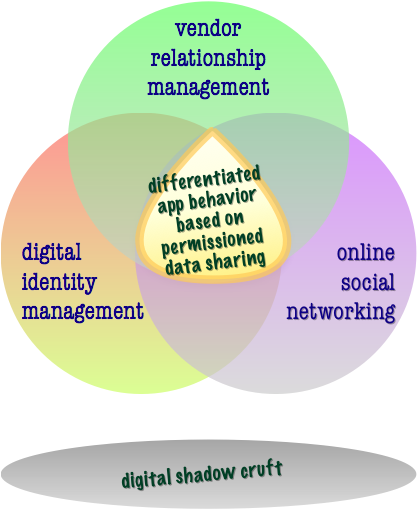
In Venn and the Art of Data Sharing, Eve Maler presents this useful graphic:

She explains,

VRM partly involves what could be called restriction of data flow — undoing vendors’ grip on users’ info in a way that’s familiar to proponents of privacy-enhanced and user-controlled IdM. But other VRM scenarios involve enhancement of individuals’ opportunities to share personal information, for example by issuing a personal RFP to potential vendors. As Doc Searls has said, VRM is “personal first and social second”, so it seems to have a closer kinship with digital identity but could provide new social opportunities as well.

Eve does a good job describing how VRM can get social while not subordinating to social networking, its scenarios or its technologies. The same goes for VRM and identity. This last point is especially significant in respect to a pair of upcoming identity events: next week’s Digital ID World (DIDW), and the Internet Identity Workshop () coming up on November 10-12 (and about which Phil Windley says more here). VRM can contribute to identity conversation and tech development — and even be part of that work — without being a subset of that work. I’ll be talking more about this in my keynote at DIDW this coming week.

By the way, mark your calendars for the next VRM Workshop (VRM2008b), scheduled for the day after IIW in the Bay Area. The location is not yet determined. (If you have any good ideas, suggest them.)

« Older posts Newer posts »

© 2026 ProjectVRM

Theme by Anders NorenUp ↑
