Category: freedom (Page 5 of 7)

Self-sovereign vs. administrative identity

You know who you are. So does the IRS, the DMV, and every website and service online where you have a login and a password for.

But none of those entities really knows you. What they know is what the techies call a namespace. That namespace is not your identity. Instead, it’s an identifier. That identifier is an administrative construction. It’s something created so bureaucracies and technical systems could do what they do.

Who you are isn’t just how you appear in the namespaces of administrative entities. Who you are isn’t even the name your parents gave you. It’s your single, unitary and sovereign self, which remains fixed at the source—you—no matter what you’re called.

The names that matter most to you are the one you were given at birth and the ones you choose to be called by. Neither is fixed. You can change your names without changing who you are. So can others, but managing how you are known is a self-sovereign power. Samuel Clemens used the pen name Mark Twain. Walt Whitman, the great author of Song of Myself, did not call himself Walter.

Yes, some names come about socially, but the choice to use them for ourselves is personal. Take my own example. The name my parents gave me was David. Many friends and relatives still call me David or Dave. Many more, however, call me Doc. That name is what remains of Doctor Dave, which is what I was called on the radio and in a humor column in North Carolina in the late ’70s. (That image above was how I appeared in the column. I was around 30 then. I actually look like that now.) My surname is one my father chose to spell the same as did his father, but not his grandparents.  (They went by Searles.)

The nickname Doc came along after I started a company with two other guys, one of whom was named David. He and the other guy (the late great Ray Simone, who also drew the Doctor Dave image above) called me Doctor Dave around the office, and with clients and suppliers. After awhile three syllables seemed too many, and they all just called me Doc. Also relevant: David was actually David’s middle name. His first was Paul.

Nicknames are often context-dependent. People who knew me through business called me Doc. Everybody else called me David or Dave.

That was in North Carolina, where I had lived for most of the two decades before our company opened an office in Silicon Valley and I went out there prospecting. That was in the Fall of ’85. I knew almost nobody in California, other than a few business contacts who called me Doc. But I wasn’t sure about keeping Doc as a nickname, since in a way I was starting over in a new place. So,  I market tested Doc vs. David when I went to the Comdex conference in October of that year in Las Vegas.  The test was simple. I had two badges made. One said David Searls and the other said Doc Searls. I was there four days and alternated between the two badges. Afterwards everybody remembered Doc and nobody remembered David. So I decided not to dump the nickname, and it stuck.

My point is that I still had control over what I chose to be called. I had sovereign authority over that.

The problem I’m trying to surface here is that we need full respect for self-sovereign identities, and identifiers, before we can solve the problem of highly fractured and incompatible administrative identifiers — a problem that has only become worse with the growth of the Web, where by design we are always the submissive and dependent party: calves to administrative cows.

MoxyTongue puts it this way:

You are a social ID-slave by default today.

I want a Human ID; a personal data construct with sovereign source authority.

Society uses a social construct to give me an Administrative ID.

The difference is origin.

I do not participate in Society primarily as an AdminID.

I am a Human ID by sovereign source authority, backed by American Rights that I know how to wield administratively and matriculate accordingly.

Structure yields results. Therefore, if we get the origin of ID correct, we can get the data administration framework oriented right.

A Human ID -led Society with embedded structural Rights and empowerments is the socio-economic game changer.

That is my NSTIC proposal. That’s my open proposal: a new data administration framework for identity.

Deployed across Society by opt-in opportunity structure.

Deployable across a global ecosystem by data design.

I see an ID as a door. The existence of the door is a social construct… a decision…

But once that decision is made, it is Human executed in every regard.

ID-slavery is what we have by administrative structure today. Our managerial intent in servicing it is flawed by design.

A Human ID comes with #vrm baked in. Such is the bi-directional transactional authority, multi-role nature of it.

And most important… we all approach the door on equal Terms… one door…infinite possibilities.

Self-driven socio-economic structure.

Call it whatever you want…it starts with your identity being structured right.

VRM for me grew out of two things:

  1. The unfinished work of Cluetrain. The ‘one clue to get’ there said “our reach exceeds your grasp.” But it didn’t, and it still doesn’t. Much of the grasp is administrative, and it has to do with defining, for us, who we are. That’s a bug, not a feature.
  2. The unfinished work of the digital identity development community, which I believe will remain unfinished as long as we try to solve one symptom with another one. The symptom we’re trying to solve is regarding administrative IDs as independent variables, rather than as dependent ones. Until we recognize that the only true independent variable is the soul of the independent self, we’ll continue to seek administrative solutions to the problem of administrative identity slavery.

Have you ever noticed that when somebody says “That’s a good question?” it’s usually because they don’t yet have an answer? That applies here. To the question of how we make sovereign-source identity the independent variable, I don’t have an answer. But I do want to work on it.

I’ll be doing that tomorrow at a meeting on identity in Silicon Valley. On May 1-3 in Mountain View we’ll be holding the Internet Identity Workshop again. It’s our fourteenth, and it’s a terrific unconference. If you care about this stuff, you should come. Your sovereign self would like that.

Your actual wallet vs./+ Google’s and Apple’s

Now comes news that Apple has been granted a patent for the iWallet. Here’s one image among many at that last link:

iwallet

Note the use of the term “rules.” Keep that word in mind. It is a Good Word.

Now look at this diagram from Phil Windley‘s Event Channels post:

event channels

Another term for personal event network is personal cloud. Phil visits this in An Operating System for Your Personal Cloud, where he says, “In contrast a personal event network is like an OS for your personal cloud. You can install apps to customize it for your purpose, it canstore and manage your personal data, and it provides generalized services through APIsthat any app can take advantage of.” One of Phil’s inventions is the Kinetic Rules Language, or KRL, and the rules engine for executing those rules, in real time. Both are open source. Using KRL you (or a programmer working for you, perhaps at a fourth party working on your behalf, can write the logic for connecting many different kinds of events on the Live Web, as Phil describes here).

What matters here is that you write your own rules. It’s your life, your relationships and your data. Yes, there are many relationships, but you’re in charge of your own stuff, and your own ends of those relationships. And you operate as  free, independent and sovereign human being. Not as a “user” inside a walled garden, where the closest thing you can get to a free market is “your choice of captor.”

Underneath your personal cloud is your personal data store (MyDex, et. al.), service (Higgins), locker (Locker Project / Singly), or vault (Personal.com). Doesn’t matter what you call it, as long as it’s yours, and you can move the data from one of these things into another, if you like, compliant with the principles Joe Andrieu lays out in his posts on data portability, transparency, self-hosting and service endpoint portability.

Into that personal cloud you should also be able to pull in, say, fitness data from Digifit and social data from any number of services, as Singly demonstrates in its App Gallery. One of those is Excessive Mapper, which pulls together checkins with Foursquare, Facebook and Twitter. I only check in with Foursquare, which gives me this (for the U.S. at least):

Excessive Mapper

The thing is, your personal cloud should be yours, not somebody else’s. It should contain your data assets. The valuable nature of personal data is what got the World Economic Forum to consider personal data an asset class of its own. To help manage this asset class (which has enormous use value, and not just sale value), a number of us (listed by Tony Fish in his post on the matter) spec’d out the Digital Asset Grid, or DAG…

DAG

… which was developed with Peter Vander Auwera and other good folks at SWIFT (and continues to evolve).

There are more pieces than that, but I want to bring this back around to where your wallet lives, in your purse or your back pocket.

Wallets are personal. They are yours. They are not Apple’s or Google’s or Microsoft’s, or any other company’s, although they contain rectangles representing relationships with various companies and organizations:

Still, the container you carry them in — your wallet — is yours. It isn’t somebody else’s.

But it’s clear, from Apple’s iWallet patent, that they want to own a thing called a wallet that lives in your phone. Does Google Wallet intend to be the same kind of thing? One might say yes, but it’s not yet clear. When Google Wallet appeared on the development horizon last May, I wrote Google Wallet and VRM. In August, when flames rose around “real names” and Google +, I wrote Circling Around Your Wallet, expanding on some of the same points.

What I still hope is that Google will want its wallet to be as open as Android, and to differentiate their wallet from Apple’s through simple openness.  But, as Dave Winer said a few days ago…

Big tech companies don’t trust users, small tech companies have no choice. This is why smaller companies, like Dropbox, tend to be forces against lock-in, and big tech companies try to lock users in.

Yet that wasn’t the idea behind Android, which is why I have a degree of hope for Google Wallet. I don’t know enough yet about Apple’s iWallet; but I think it’s a safe bet that Apple’s context will be calf-cow, the architecture I wrote about here and here. (In that architecture, you’re the calf, and Apple’s the cow.) Could also be that you will have multiple wallets and a way to unify them. In fact, that’s probably the way to bet.

So, in the meantime, we should continue working on writing our own rules for our own digital assets, building constructive infrastructure that will prove out in ways that require the digital wallet-makers to adapt rather than to control.

I also invite VRM and VRooMy developers to feed me other pieces that fit in the digital assets picture, and I’ll add them to this post.

How about using the ‘No Track’ button we already have?

left r-buttonright r-buttonFor as long as we’ve had economies, demand and supply have been attracted to each other like a pair of magnets. Ideally, they should match up evenly and produce good outcomes. But sometimes one side comes to dominate the other, with bad effects along with good ones. Such has been the case on the Web ever since it went commercial with the invention of the cookie in 1995, resulting in a calf-cow model in which the demand side — that’s you and me — plays the submissive role of mere “users,” who pretty much have to put up with whatever rules websites set on the supply side.

Consistent with Lord Acton’s axiom (“Power corrupts; absolute power corrupts absolutely”) the near absolute power of website cows over user calves has resulted in near-absolute corruption of website ethics in respect to personal privacy.

This has been a subject of productive obsession by Julia Anguin and her team of reporters at The Wall Street Journal, which have been producing the What They Know series (shortcut: http://wsj.com/wtk) since July 30, 2010, when Julia by-lined The Web’s New Gold Mine: Your Secrets. The next day I called that piece a turning point. And I still believe that.

Today came another one, again in the Journal, in Julia’s latest, titled Web Firms to Adopt ‘No Track’ Button. She begins,

A coalition of Internet giants including Google Inc. has agreed to support a do-not-track button to be embedded in most Web browsers—a move that the industry had been resisting for more than a year.

The reversal is being announced as part of the White House’s call for Congress to pass a “privacy bill of rights,” that will give people greater control over the personal data collected about them.

The long White House press release headline reads,

We Can’t Wait: Obama Administration Unveils Blueprint for a “Privacy Bill of Rights” to Protect Consumers Online

Internet Advertising Networks Announces Commitment to “Do-Not-Track” Technology to Allow Consumers to Control Online Tracking

Obviously, government and industry have been working together on this one. Which is good, as far as it goes. Toward that point, Julia adds,

The new do-not-track button isn’t going to stop all Web tracking. The companies have agreed to stop using the data about people’s Web browsing habits to customize ads, and have agreed not to use the data for employment, credit, health-care or insurance purposes. But the data can still be used for some purposes such as “market research” and “product development” and can still be obtained by law enforcement officers.

The do-not-track button also wouldn’t block companies such as Facebook Inc. from tracking their members through “Like” buttons and other functions.

“It’s a good start,” said Christopher Calabrese, legislative counsel at the American Civil Liberties Union. “But we want you to be able to not be tracked at all if you so choose.”

In the New York Times’ White House, Consumers in Mind, Offers Online Privacy Guidelines Edward Wyatt writes,

The framework for a new privacy code moves electronic commerce closer to a one-click, one-touch process by which users can tell Internet companies whether they want their online activity tracked.

Much remains to be done before consumers can click on a button in their Web browser to set their privacy standards. Congress will probably have to write legislation governing the collection and use of personal data, officials said, something that is unlikely to occur this year. And the companies that make browsers — Google, Microsoft, Apple and others — will have to agree to the new standards.

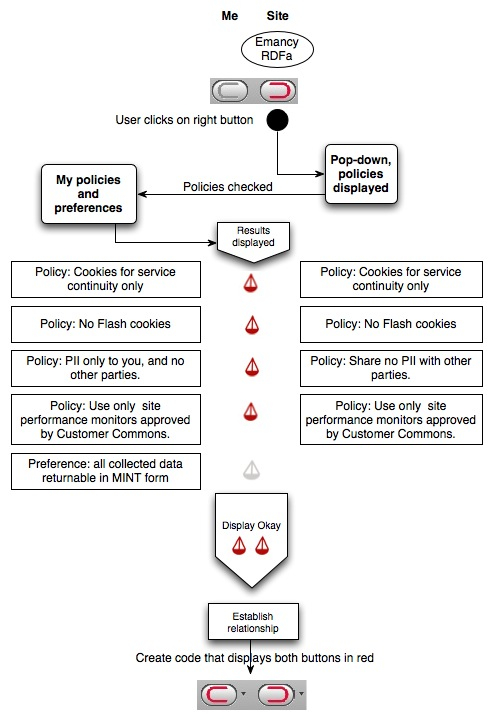
No they won’t. Buttons can be plug-ins to existing browsers. And work has already been done. VRM developers are on the case, and their ranks are growing. We have dozens of developers (at that last link) working on equipping both the demand and the supply side with tools for engaging as independent and respectful parties. In fact we already have a button that can say “Don’t track me,” plus much more — for both sides. Its calle the R-button, and it looks like this: ⊂ ⊃. (And yes, those symbols are real characters. Took a long time to find them, but they do exist.)

Yours — the user’s — is on the left. The website’s is on the right. On a browser it might look like this:

r-button in a browser

Underneath both those buttons can go many things, including preferences, policies, terms, offers, or anything else — on both sides. One of those terms can be “do not track me.” It might point to a fourth party (see explanations here and here) which, on behalf of the user or customer, maintains settings that control sharing of personal data, including the conditions that must be met. A number of development projects and companies are already on this case. All the above falls into a category we call EmanciTerm. Much has been happening as well around personal data stores (PDSes), also called “lockers,” “services” and “vaults.” These include:

Three of those are in the U.S., one in Austria, one in France, one in South Africa, and three in the U.K. (All helping drive the Midata project by the U.K. government, by the way.) And those are just companies with PDSes. There are many others working on allied technologies, standards, protocols and much more. They’re all just flying below media radar because media like to look at what big suppliers and governments are doing. Speaking of which… 🙂

Here’s Julia again:

Google is expected to enable do-not-track in its Chrome Web browser by the end of this year.

Susan Wojcicki, senior vice president of advertising at Google, said the company is pleased to join “a broad industry agreement to respect the ‘Do Not Track’ header in a consistent and meaningful way that offers users choice and clearly explained browser controls.”

White House Deputy Chief Technology Officer Daniel Weitzner said the do-not-track option should clear up confusion among consumers who “think they are expressing a preference and it ends up, for a set of technical reasons, that they are not.”

Some critics said the industry’s move could throw a wrench in a separate year-long effort by the World Wide Web consortium to set an international standard for do-not-track. But Mr. Ingis said he hopes the consortium could “build off of” the industry’s approach.

So here’s an invitation to the White House, Google, the 3wC, interested BigCos (including CRM companies), developers of all sizes and journalists who are interested in building out genuine and cooperative relationships between demand and supply::::

Join us at IIW — the Internet Identity Workshop — in Mountain View, May 1-3. This is the unconference where developers and other helpful parties gather to talk things over and move development forward. No speakers, no panels, no BS. Just good conversation and productive work. It’s our fourteenth one, and they’ve all been highly productive.

As for the r-button, take it and run with it. It’s there for the development. It’s meaningful. We’re past square one. We’d love to have all the participation we can get, from the big guys as well as the little ones listed above and here.

To help get your thinking started, visit this presentation of one r-button scenario, by Adam Marcus of MIT. Here’s another view of the same work, which came of of a Google Summer of Code project through ProjectVRM and the Berkman Center:

(Props to Oshani Seneviratne and David Karger, also both of MIT, and Ahmad Bakhiet, of Kings College London, for work on that project.)

If we leave fixing the calf-cow problem entirely up to the BigCos and BigGov, it won’t get fixed. We have to work from the demand side as well. In economies, customers are the 100%.

Here are some other stories, mostly gathered by Zemanta:

All look at the symptoms, and supply-side cures. Time for the demand side to demand answers from itself. Fortunately, we’ve been listening, and the answers are coming.

Oh, and by the way, Mozilla has been offering “do not track” for a long time. Other tools are also available:

Toward a new symbiosis between Demand and Supply

I’m listening and watching with fascination to Keith Scovell‘s Shopper Power videos. In these Keith describes progress being made in a VRM direction by retailers and their upstream suppliers, detailing efforts made by Starbucks, Hallmark, CVS, Tesco/Homeplus, Frito-Lay, Reese’s and other companies — all recognizing that customers’ range of control over interactions in retail environments is increasing dramatically, and will increase a great deal more.

I haven’t watched all of Keith’s videos yet, but I’m taking notes as I do, and I recommend that others do the same, if they’re interested in how increasingly empowered and independent customers relate to vendors — especially at the retail level in the brick & mortar world. And how clueful vendors are working on better ways of interacting with those customers.

It’s interesting that Keith is coming from the CPG — Consumer Packaged Goods — industry, and not CRM, which is most commonly posed as the counterpart to VRM. Yet I think that CPG, and retailing in general, is the more direct counterpart of VRM. Talking about where the rubber meets the road here. Keith talks about market signals, which go in both directions. One purpose of VRM is to provide better means for signaling, as well as for engaging over the longer term.

Four things are important to point out as developers on both sides get acquainted:

  1. Customers will become more independent. That is, they will have their own ways of expressing demand, loyalty, brand preferences and terms of engagement. Many of today’s solutions on the vendors’ side — loyalty cards, for example — are both coercive and inconvenient, as customers are required to carry around many of these things, all with their own proprietary and silo’d systems. New tools and systems will emerge on the customer’s side to provide both independence and better means of engagement. And those tools and systems will be personal, not just social.
  2. VRM tools will not only provide or support that independence, but common means for engaging many vendors the same way. For example, they will provide ways for a customer to change his or her address one time for many vendors rather than many times for many vendors.
  3. The new market ecosystem will be symbiotic one between demand and supply. Not a coercive or competitive one. That means the best customers and the best vendors will be caring about each other and watching out for each others’ best interests. This will actually reduce need on the vendors’ side for discounts, coupons and other gimmicks, which often clutter and confuse an otherwise smooth relationship with customers, and which have other hard costs as well.
  4. New user interface elements will be required.

For that last two reasons I’ve flanked the text above between two r-buttons. Keith visits QR codes and other handy signaling devices already being used in the retail environment. But it’s still early, so we still lack are user interface (UI) elements that represent actions and states within relationships between buyers and sellers. As work in the VRM development community goes on the demand side moves toward work Keith and others are doing on the supply side, the two magnets will place a new force field over the marketplace: one that brings mutual interests into alignment, even as competition and other familiar market interactions continue as they always have.

SOPA and Customer Commons

Imagine that Customer Commons had been created a year ago. To guide that imagining, here is the copy that matters from the placeholder page:

Customer Commons is about us.

  1. We are a com­mu­nity of customers.
  2. We are funded only by customers.
  3. We serve the inter­ests and aspi­ra­tions of customers.

We are the 100%

Customer Commons is a companion organization to ProjectVRM, and in the long run will be its successor. Think of ProjectVRM as the launch pad and rocket for getting VRM development and research into orbit — and of Customer Commons as the rest of the universe.

So the future is wide open.

SOPA, however, is about enclosing some of the Universe’s commons, which is essentially NEA:

  1. Nobody owns it
  2. Everybody can use it
  3. Anybody can improve it

What would we — the 100% who are customers — be doing about SOPA?

Customer Commons is just in the planning stages now. We want it up and running by the time The Intention Economy: When Customers Take Charge comes out in May. What should it be and how would it work?

All thoughts welcome.

P.S. ProjectVRM is a Berkman Center project, and therefore does not take an advocacy position on matters of public debate, such as SOPA — which is why this blog is not offline or blacked out today.

FWIW, my own (naturally optimistic) point of view is well expressed by Harold Feld in SOPABlackout And the “Internet Spring”.

Customers are personal, cont’d

There are so many excellent comments and questions following my last post, Consumers are social, Customers are personal, that I decided it would make more sense to address them in a new post than in comments under that one. So here goes.

Joshua Marsh, the CEO of Conversocial, writes,

I’m interested in your comment that social media is only semi-personal – could you expand on that point?

I think what you could be getting at is the current lack of tie up between social identity and customer records, which is a challenge (but one that can be overcome), and one we are working on. Or do you mean something else?

There can be additional benefits to customers for taking their customer service issues into social media over other channels. Once companies wake up to the fact that there are public complaints and issues on their Facebook pages, in tweets when people search for their company names etc, they will often start delivering better customer service over social than they do through other channels. The fully public nature of the issues and resolutions forces them to deliver the best service they can. I believe this will drive a virtuous circle – as companies deliver better service through social, more and more customers will begin to use it as a service channel.

First, I want to make clear that when we talk about “social media” today we mostly mean Facebook, Twitter, Google+, and other commercial services. Not telephony, email, texting, instant messaging and other social activities that have been around for a long time but tend not to get included in the “social media” category.

Three things make social media less than fully personal:

  1. As CRM Software said in another commment, “your conversations are personal yet public.”
  2. We don’t own social media. Yes, we use them, but they are not ours. They belong to Twitter, Facebook, Google or whomever. For what it’s worth (and it’s a lot), we can own domains on the Web and elsewhere. We can own email systems. We can own IM systems. We can be our own publishers, syndicate our own postings. Standards and protocols such as TCP/IP, HTTP, IMAP, POP3, SMTP, RSS and XMPP make that possible. Those standards and protocols give us independence, which is a founding virtue of the Net, of the Web, of blogging, of instant messaging. Those standards and protocols are used by social media, but we remain dependent rather than independent within social media environments. So it is critically important to remember and preserve the distinction between independence and dependence on the Net.
  3. Social media are designed to be personal, but in a social context. Facebook is for sharing with friends. Twitter is for following others and being followed. Linkedin is for sharing personal profiles. Google+ is for “real life sharing,” they say. Sure, we can get personal benefits out of social media, but as a collateral benefit more than as a core purpose.

The thing is, when all you’ve got are social hammers, even personal problems look like social nails. And this is what we are doing when we use social media to fix the problems of CRM and customer service, on either the vendor’s side or the customer’s. Yes, lots of progress has been made on the sCRM front, Conversocial is a leader in that movement, is clearly doing a good job, and should continue doing that. Yet, as individual customers we still lack a box of tools that are ours alone, and that help us relate personally with the companies whose goods and services we buy and use.

This is why a community of developers has been working on building out the tools called VRM, for Vendor Relationship Management, to work as customer-side counterparts of vendors CRM — Customer Relationship Management — systems.

About identity: yes, it’s critical. The quesitons around it are huge. For example, are we — as sovereign, independent and self-actualized human beings — who we say we are? Or are we reducible to our @-handles and “social identities” on the likes of Facebook? When Mark Zuckerberg introduced Facebook Connect in 2008, he said it would make it easy “for you to take your online identity with you all over the Web.” Note the presumption: that your handle with Facebook is “your online identity.” Sorry, but it isn’t. It’s handy as a shortcut, but it’s not who you are.

But in fact I was talking about something other than identity in that last post. I was talking about working on what’s personal in more than just social ways.

Louis Columbus writes,

1. The depth and breadth of personal information being shared on social media is creating advertised-based business models that will surpass Google AdWords’ revenue within five years or less. That’s coming thanks to the torrent of data that streams into social networks daily.

2. Improving customer service systems is indeed not enough because it still doesn’t strike to the center of what really needs to happen. Companies need to translate process efficiencies into more relevant, timely and focused customer experiences. The dividend of process efficiency needs to be spent on greater empathy for the customer. Profits will follow if a company can get its head around the concept of delivering an exceptional experience.

3. VRM shows potential to make each interaction more relevant, focused and over time, trusted.

Bottom line: the companies who will emerge stronger for all this turbulent change will stay focused on customer experience, empathy and intimacy as their compass and not waiver from that course.

Louis’ predictions about the future of advertising may be true. But remember: even highly personalized advertising is still guesswork. And no amount of personal data can empower any company, no matter how smart, to guess what I want or need next. Nor do I want that. First, most of the time I’m not buying anything. Second, when I am ready to buy something, I need instruments that help me express my intentions more than I need ones that are guessing what I might want and pushing something at me through a medium that’s paid to do the pushing.

This is why I believe what will emerge over the next five years is not a more personal attention economy (led by social media) but an intention economy, based on what customers actually want. This is why I wrote The Intention Economy: When Customers Take Charge, for Harvard Business Review Press, which is due to hit the shelves on May 1.

I agree with Louis’ second point about what companies need to do; and will add that the customer experience should be one for which the customer is at least partly responsible. Also that the experience of relationship should extend across many vendors in the same way, rather than working in isolation with each vendor. For example, I would like as a customer to experience changing my address with many vendors at once. No vendor working alone with one CRM system can deliver this experience. VRM is required for that, along with CRM systems that welcome simple and standard address-changing methods that work the same way across many different vendors.

I also agree with Louis’ bottom line: that vendors will have to be “focused on customer experience, empathy and intimacy.” And I believe this will require that customers welcome VRM tools when customers carry their own weight on their own sides of relationships.

Don Peppers writes,

One additional thought about the future of social media: Today, social media is funded by advertisers (the real “customers”), and provides a mechanism for giving them access to consumers. But this will almost certainly change as more and more social media services and platforms become open source. An open-source, community-developed platform for social interaction will unify consumers and customers, no?

When Twitter first appeared on the scene, for example, it took many months before the first commercial money began funding it. The consumers it served all worried that without some kind of external funding, the service might disappear. Sooner or later, we’ll find that IT and communications costs have become so low that very little, if any, commercial sponsorship will be required to sustain a genuinely consumer-oriented social media platform.

I believe we won’t get fully-developed one-to-one relationships (that link goes to the seminal work on the topic, buy Don Peppers and Martha Rogers) without significant contributions of code and standards from free and open source developers. You’ll find many in the roster of VRM developers and developments, but we need many more.

I also think we need to free ourselves from the knee-jerk belief that commercial sponsorship is the first-option business model for popular services on the Net. The successes of the Net, the Web, email, RSS and much else have long since disproven that belief.

In the long run far more economic activity will be supported by free and open standards, protocols and other building materials, than by commercial services paid for by advertising.

As for the promise of both social media “big data” for better customer relations, I like what Alan Mitchell said in his comment:

…there is a vast difference between the sharing of unstructured information on a one-to-many basis (social media), and the sharing of structured information on a one-to-one basis (VRM). As you point out, only the latter allows for real personalisation.

Alan has been a leading figure in VRM development, by the way.

Hanan Cohen writes,

Many people say that “Social media users are not customers of them, they are the product being sold.”

I think that we are the suppliers and try to prove it here;

http://info.org.il/english/The-Users-are-the-Suppliers.html

Can you please get in touch with an economics scholar you trust and ask her to sort out the difference in definitions?

It is quite true that we are upstream suppliers of valuable content to social media, and not just consumers of services, and Hanan makes many good points at that link.

As for distinctions between consumers and customers, I like what Doug Rauch — the former President of Trader Joe’s — told to me when I was working on my book: that consumers are “a statistical category.” “We believe in honesty and directness between human beings,” Doug said. “We do this by engaging with the whole person, rather than just with the part that ‘consumes.'”

Hope that helps.

Consumers are social, Customers are personal

Social media are a partial and temporary solution at best to a pair of linked problems that are essentially personal:

  1. dysfunctional customer relationship management on the vendor’s side; and
  2. minimal vendor relationship management on the customer’s side.

In the absence of solutions to both problems, vendors still see customers as consumers, and that too is a problem that hasn’t yet come to a head, because we still don’t fully grok the difference between consumers and customers. As a result, we think social media looks like a the good answer rather than a better question. That question is, How can we get companies and media to stop treating us as consumers and start treating us as real customers?

To see what needs to be done, check out Consumers Punish Companies that Ignore Them, by Eric Sass in MediaPost. In that piece Eric sources a pair of Conversocial studies that contain plenty of grist for social media and marketing mills. Here they are, from the Conversocial blog:

Here are some samplings from Eric’s gleanings:

  • “…more than 60% of complaints and question about retailers posted online on social media are ignored, in part because of the sheer volume of content created on sites like Twitter and Facebook.”
  • “30% of the retail chains surveyed don’t respond to any questions or complaints posted on social media, effectively choosing to ignore issues mentioned in these forums.”
  • “…78% believe that social media platforms will soon replace other means of customer service altogether or at least become one of the top ways to communicate with corporations.”
  • “…among the group which has communicated with companies via social media, 32.5% said they were either neglected or totally ignored; that works out to 16.5% of the total…This included ‘inadequate response times, unanswered queries, and overall unmet expectations.’
  • “What’s more, ‘respondents were also adamant that such corporate behaviors would have some or much effect on their future decision to do business with offending corporations.’
  • “27.3% of respondents said being ignored by companies on social media makes them ‘very angry,’ and 27.1% said they’d stop doing business with the offending company altogether.”
  • “88.3% of respondents said they’d be somewhat or far less likely to do business with a company that has visibly ignored other customers’ questions or complaints on social media. That includes 49.5% who said they would be ‘far less likely, and 38.8% who said they’d be ‘somewhat less likely.'”

Note that the blame here is on offending companies; not on social media, or on the absence of something better.

This is understandable because social media offer radically new and helpful avenues both for customer feedback one one side and customer support on the other. Also, social media is where Conversocial is coming from, and what MediaPost reports on. The problem for both — and for all of us thinking and talking about this stuff inside the social media framework — is that consumers are a statistical category while customers are individual human beings.

Individual human beings are all different. They are not categories, and they cannot be treated with full respect only by templates, which is what vendors — especially those serving mass markets — tend to use.

And, while social media do provide ways to get personal (say, though one’s @-handle on Twitter), they don’t have personal relationships with their users. That’s because social media users are not customers of them, because they don’t pay for them. And if you don’t pay, you’re the product being sold.

The actual customers of Facebook and Twitter are advertisers, not users. Because of this, social media has exactly the same un-visited problem that commercial broadcasting has had for the duration: its consumers and its customers are different populations. Financial accountability is to those that pay, which are advertisers, not users. Yes, there are moral and operational obligations to users, but economically speaking those obligations are lesser ones. They are those of a farmer to crops, not of a store to actual customers.

For now social media are a useful and popular way for customers to send messages to companies — and to route around inadequate customer service systems (or, in the vernacular of the trade, using sCRM routing around or to improve CRM) — the failures listed by Conversocial are not just those of companies ignoring social media, but of social media itself.

There is a structural problem as well, because social media are still only semi-personal. They are a weak substitute for direct contact — meaning that, in a person-to-person sense, even email and telephony are better.

Improving each company’s customer service systems and policies (which the Conversocial studies call for) also isn’t enough, because each company’s system is different, and all of them are silo’d. Thus the way you deal as a customer with Nordsrom, Safeway, Amazon and Apple are all different, and incompatible. If you want, say, to change your address or your phone number with all of them at once, you don’t have a single way to do that. You also don’t have a standard way to publish your own terms and conditions of engagement, to say for example “don’t track me outside of your own store or site” or “any data you collect is mine as well as yours, and should be available to me in the standard way I describe.”

Tools for doing that would have to live on your side of the relationship. Not the vendor’s, not the CRM cloud’s, and not Facebook’s. If you are a real customer, and not just a consumer or a user, you need your own tools. You need VRM — Vendor Relationship Management — tools, to work together with vendors CRM tools, not to replace them. The demand chain and the supply chain will work together.

The only case against VRM is that companies serving mass markets can’t afford to be personal, and just won’t go there. This was also the argument against PCs and the Internet. History and enterprising developers proved both cases wrong.

In fact enterprising developers in the VRM community have been working on personal tools for the last five years or more — tools that make customers both independent of vendors and better able to engage with vendors. It helps that the CRM community is aware of VRM developments, and has been awaiting them for some time. This is the year that wait will pay off. We’ll finally see VRM developments mature and start to become useful, both for customers and for vendors. So, watch the space.

Bonus link: Alan Mitchell’s comment below. I love how he says social media marketing is among “the grandest imperialist invasions of them all. The attempt to occupy day-to-day human interaction and turn it into a profit centre.” Indeed.

Also, to answer questions raised below, I have posted Customers are personal, cont’d.

GoDaddy VRooMed?

GoDaddy CEO Warren Adelman says “We listened to our customers. GoDaddy no longer supports SOPA.” (Here’s the GoDaddy blog post.)

Lauren Weinstein says that’s not the same as opposing SOPA: “they’re the same ethically vacuous firm as always, with their public facade changing like a chameleon, blowing in the wind of Internet public opinion.”

I still see it as a good sign when a company in a direct personal service business changes its mind because its customers made clear that change was required.

What I’d like to know now is what GoDaddy customers said to the company personally. (Not just that customers pulled their accounts in protest.) When I know that Warren Adelman and the company turned around because of direct personal pressure, in real conversation with paying customers who wished to remain so — and not just because of negative PR or customers bailing — then I’ll be glad to call it a full VRM move by customers.

Some links:

Signs of progress

The bottom line (literally) of this report on the Consumer Energy Summt in the UK is this piece of excellent news:

…energy companies have agreed to give consumers access to their data in electronic format as part of the government Midata programme.

Connect.me, a VRM company, gives us a way to construct “trust frameworks” among ourselves. They have worked to make this as game-free as possible. Check it out.

Twitter search for VRM.

Singly and Locker Project getting mojo as Jeremie presents at Web 2.o, on Day One. (Too bad  Web 2.0 co-happens on the calendar with IIW.)

Smári McCarthy: The End of Artificial Scarcity. Required reading.

Phil Windley on personal event networks.

In a session at IIW: EventedAPIs vs./+ ActivityStreams. Bonus link.

ProgrammableWeb’s directory of APIs.

Hypothes.is will be discussed this afternoon at IIW. “Peer review for the Internet.”

John Battelle wishes Tapestry existed. Connecting the dots. Recalling the database of intentions. Mentioning Singly and Locker Project.

e-Patient Dave: Is “Gimme my damn data” coming to radiology at last??

Vetted as VRM companies:

Bonus links:

Prototyping a new business model for everything

For IIW next week, and I have been working on a prototype demonstrating , using on the  app from .  The description at the EmanciPay link is minimal so far, but the model has a great deal of promise, because what it puts forward is a new business model for all kinds of stuff: easy voluntary payments from anybody for anything, to escrow accounts where the money can be picked up by the intended recipient with no strings attached. The first target is public radio (as it has been, ever since the earliest ProjectVRM meetings at the ), but it could easily apply to and other media as well.

We still need financial institutions to weigh in and take up a new business model for themselves, and it would be cool if some of them showed up at IIW next week for that, but in any case we’re taking one small step in the direction of a major sea change in the way markets for media work.

I’ve been making test contributions to different public radio stations, using the EmanciPay prototype. Craig has hacked a way for this to show up in my Twitter stream. You can see those here.

« Older posts Newer posts »

© 2026 ProjectVRM

Theme by Anders Noren — Up ↑