Category: freedom (Page 4 of 7)

Cracks in the walls of the online advertising castle

On the advice of @SteveLohr and @michikokakutani ‘s review in The New York Times, I just ordered Dave Eggers‘ The Circle — a tale of the dystopian present taken to its future extreme: a world where we are all fully devolved into data, and one big company serves us exactly the poop it knows — and helps — us want.

Provided, of course, that there is still money in it.

But there won’t be. The most vulnerable big money game in the commercial Web today is advertising — and it’s headed for a dive, if not a crash. That’s the case @TimHwang and @AdiKamdar make in The Theory of Peak Advertising and the Future of the Web. It’s also the one @DonMarti makes in Targeted Advertising Considered Harmful, and that I make too, in both The Intention Economy: When Customers Take Charge and Beyond the Advertising Bubble, a post I put up earlier today at Customer Commons.

In addition to the evidence compiled in those sources, there’s Flash Ad Takeovers Drive 55% of Consumers Away (by Tyler Loechner in MediaPost). The headline actually understates the case. Here’s the opener:

Adblade, a content-style ad network, commissioned a study carried out by research company Toluna which found that 82% of consumers feel that online ads are “detrimental” to their online experience at least some of the time. The report focused on questions revolving around the obtrusiveness of ads…

The emphasis is mine, not that it’s required. More stats:

When it comes to ads causing one to navigate away from content, an overwhelming majority (55%) of respondents said flash ad takeovers are most likely to do the trick. The ad type that is second-most likely to drive consumers away from a page are right-side banner ads (10.4%). Pre-roll (9%), top banner (8.5%), and middle-of-the-page ads (7.1%) round out the top five.

The source might be a bit self-serving, though. See here:

Over 66% of respondents believe middle-of-the-page ads to be the most obtrusive, compared to just 4% for end-of-article ads.

Adblade specializes in end-of-article ad placements, so those particular results play into their hands.

Still, we’re talking about least-aversive stuff here.

That’s always been an imperative of sub-optimal advertising, though not of advertising that actually appeals. And indeed, appealing advertising does exist. Every fat magazine testifies to the fact of advertising that appeals in some settings at least as much as does the editorial. Note that those ads are not personal, and depend not at all on surveillance of privacy invasions of any kind. They simply do a good job of sending strong signals — economic and otherwise — to populations that are interested in them.

The other breed of in-demand advertising, I would ad, are classifieds. The success of Craigslist and Google’s (search-results) Adwords  attest to that as well. Note that those don’t creep us out. At their best, they just work.

And that’s what always wins in the long run.

Leveraging Whitman

On the ProjectVRM list the conversation has once again drifted to identity.

Nearly all conversation about identity in development circles around stuff Devon Loffreto of Noizivy calls administrative. It’s a good term. That’s what we get from every card some company, school or government agency prints with our name on it and we stick in our wallet. It’s what we also get from “social” login shortcuts such as Facebook’s and Twitter’s.

Regardless of the conveniences these administrative things bestow on us, what they provide is not our true identity. It might be one we use, but it is not imbued with our fully human essence, which Devon calls sovereign. In Recalibrating Sovereignty he makes a strong connection between that personal essence and what we write large (in the U.S. at least) as a nation-state of free people. Or that’s the idea anyway.

I don’t see this as a Libertarian thing (though I am sure Libertarians will find it agreeable). I see it as an elementary expression of what makes us most human: our individuality. This is not in conflict with what also makes us social, or the social nature of political, cultural, economic, educational and other institutions. Rather it enriches all of them. Saying that each of us is sovereign goes deeper than saying each of us is unique. Because we are not merely different. Each of us brings our own genius into the world. (Read John Taylor Gatto on genius, which he considers “common as dirt.”) Even genetically identical twins possess profoundly individual souls. That individuality is at the core of identity.

Right now I’m reading Orson Scott Card‘s Tales of Alvin Maker. By the fourth book Alvin’s surname has changed from Miller (what Alvin’s father was) to Smith (what Alvin was trained to be) to Maker (what Alvin becomes), each one expressing his role in the world. The name Maker identifies Alvin’s sovereign nature — one that transcends the identifier and is rooted in his nature as a sovereign soul. (The Tales are set in an early stage of American history in which this kind of choice was a common one. Check your own surname for evidence of what some ancestor did for a living. Searls, as I understand it, is a variation of Searle, which likely descends from Serlo, a Germanic or Norman word for soldier.)

From slightly later than Alvin’s time comes Walt Whitman, the great American poet, and a tireless advocate of personal sovereignty — though I’m not aware that he ever put those two words together. Rather than explain Whitman, I’ll compress further the abridged Song of Myself that put up on the Web more than seventeen years ago:

I know I am solid and sound.
To me the converging objects of the universe
perpetually flow.
All are written to me,
and I must get what the writing means.
I know I am deathless.
I know this orbit of mine cannot be swept
by a carpenter’s compass,

I know that I am august,
I do not trouble my spirit to vindicate itself
or be understood.
I see that the elementary laws never apologize.

I exist as I am, that is enough.
If no other in the world be aware I sit content.
And if each and all be aware I sit content.

One world is aware, and by far the largest to me,
and that is myself.
And whether I come to my own today
or in ten thousand or ten million years,
I cheerfully take it now,
or with equal cheerfulness I can wait.

My foothold is tenoned and mortised in granite.
I laugh at what you call dissolution,
And I know the amplitude of time.

I speak the password primeval.
I give the sign of democracy.
By God, I will accept nothing which all cannot have
their counterpart on the same terms.

Encompass worlds but never try to encompass me.
I crowd your noisiest talk by looking toward you.

It is time to explain myself. Let us stand up.

I am an acme of things accomplished,
and I an encloser of things to be.
Rise after rise bow the phantoms behind me.
Afar down I see the huge first Nothing,
the vapor from the nostrils of death.
I know I was even there.
I waited unseen and always.
And slept while God carried me
through the lethargic mist.
And took my time.

Long I was hugged close. Long and long.
Infinite have been the preparations for me.
Faithful and friendly the arms that have helped me.

Cycles ferried my cradle, rowing and rowing
like cheerful boatmen;
For room to me stars kept aside in their own rings.
They sent influences to look after what was to hold me.

Before I was born out of my mother
generations guided me.
My embryo has never been torpid.
Nothing could overlay it.
For it the nebula cohered to an orb.
The long slow strata piled to rest it on.
Vast vegetables gave it substance.
Monstrous animals transported it in their mouths
and deposited it with care.

All forces have been steadily employed
to complete and delight me.
Now I stand on this spot with my soul.

I know that I have the best of time and space.
And that I was never measured, and never will be measured.

I tramp a perpetual journey.
My signs are a rainproof coat, good shoes
and a staff cut from the wood.

Each man and woman of you I lead upon a knoll.
My left hand hooks you about the waist,
My right hand points to landscapes and continents,
and a plain public road.

Not I, nor any one else can travel that road for you.
You must travel it for yourself.

It is not far. It is within reach.
Perhaps you have been on it since you were born
and did not know.
Perhaps it is everywhere on water and on land.

Shoulder your duds, and I will mine,
and let us hasten forth.

If you tire, give me both burdens and rest the chuff of your hand on my hip.
And in due time you shall repay the same service to me.

Long enough have you dreamed contemptible dreams.
Now I wash the gum from your eyes.
You must habit yourself to the dazzle of the light and of every moment of your life.

Long have you timidly waited,
holding a plank by the shore.
Now I will you to be a bold swimmer,
To jump off in the midst of the sea, and rise again,
and nod to me and shout,
and laughingly dash your hair.

I am the teacher of athletes.
He that by me spreads a wider breast than my own
proves the width of my own.
He most honors my style
who learns under it to destroy the teacher.

Do I contradict myself?
Very well then. I contradict myself.
I am large. I contain multitudes.

The spotted hawk swoops by and accuses me.
He complains of my gab and my loitering.
I too am not a bit tamed. I too am untranslatable.
I sound my barbaric yawp over the roofs of the world.

No administrative entity can make that barbaric yawp.

I don’t yet know how to create a Whitman-compliant identity system (or, whatever); though my hope persists that there is already one or more in the world. Should somebody produce that system (or whatever), I’ll gladly give them SpottedHawk.com, which I’ve held for many years (with other suffixes as well), waiting like Whitman:

The last scud of day holds back for me.
It flings my likeness after the rest and true as any
on the shadowed wilds,
It coaxes me to the vapor and the desk.

I depart as air.
I shake my white locks at the runaway sun.
I effuse my flesh in eddies and drift in lacy jags.

I bequeath myself to the dirt and grow
from the grass I love.
If you want me again look for me under your boot soles.

You will hardly know who I am or what I mean.
But I shall be good health to you nevertheless.
And filtre and fiber your blood.

Failing to fetch me at first keep encouraged.
Missing me one place search another
I stop some where waiting for you.

Freedom vs. Tracking

In The Mobile Customer as Data vs. Customer Data, Chuck Martin in MediaPost‘s Mobile Shop Talk says this:

The world of data tracking for mobile commerce is getting much more precise.

The phone knows where the phone goes, as we all know. And that knowledge can be used to help provide better services to those carrying them.

Any driver using Google Navigation, for example, gets the benefit of other phones being tracked to identify bottlenecks on roads ahead. The next step was for Navigation to automatically re-route your trip to avoid the traffic jam, so the benefit became seamless.

The tracking of phones at retail also is being used in efforts to provide a better shopping experience.

In these cases, the value comes from the data about the phone being tracked, not information about the person.

This is about the use of customers as data rather than data about the customer.

This data about phone movements already is being used at hundreds of stores ranging from small mom-and-pop shops to national chains and shopping centers.

He goes on to talk about Euclid, “a three-year-old California company that likens what it does to Google analytics but for the physical world.” And he explains what they do:

Rather than tracking phones by apps, sign-ins, GPS or cell tower, Euclid installs sensors at stores to capture MAC addresses, which are part of every smartphone.

The company doesn’t capture any information about the person, just the identification of smartphones that are on with Wi-Fi enabled.

The idea is to map shopper traffic and analyze how stores can become more effective. The large volume of aggregated data of phone traffic patterns is what provides the value.

Here is what I put in the comments below (with paragraph breaks and links added):

I am a customer. I am not data. I do not wish to yield personal data, even if anonymized, to anybody other than those with whom I have a fully consenting, non-coercive and respectful relationship.

I do not wish to receive offers as a matter of course, even if machines following me guess those offers might might be relevant — especially since what I am doing most of the time is not shopping.

I also don’t wish to have a “better experience” with advertising inundation, especially if the “experience” is “delivered” to me rather than something I have for myself.

Familiar with Trader Joes? People love them. Know why? They do none of this tracking jive. They just talk, as human beings, to customers. There’s no way to automate that, and they save the overhead of marketing automation as well.

Now think of the “mobile experience” we call driving a car, or riding a bike. Our phones need to be the same: fully ours. Not tracking devices.

I know mine is a voice in the wilderness here, but I’m not alone. It’s not for no reason that the most popular browser add-ons are ad and tracking blockers. That’s the market talking. Marketers need to listen.

In a commencement speech this past May, former presidential speechwriter @JonLovett says this (around 14:30): I believe we may have reached peak bullshit.

He continues: I believe those who push back against the noise and the nonsense, those who refuse to accept the untruths of politics and commerce and entertainment and government, will be rewarded. And that we are at the beginning of something important. He also pushes back on what he calls “a process that is inauthentic.” (Here’s a transcript.)

Here’s what’s real: For whatever reasons, we blew it by not building browsers to be cars and bikes in the first place. Same with smartphones and tablets. We gave wonderful powers to users, but greater powers to companies that would rather track us than respect us, who would rather “deliver”us the “experience” they want us to have than equip us to operate as fully human beings in the world — beings with independence and agency, able to engage in our own ways, and on our own terms.

So, what we’ve got now, nice as it is in many ways, is a feudal system. Not real freedom.

It’s a feudal system run by advertising money, and it is worse than broken: it looks to its masters like it isn’t working well enough. Those masters include lots of good people trying to do the Right Things. But they aren’t listening, because they are too busy talking to each other. The whole marketing ecosystem is an echo chamber now. And we, the users and customers of the world, are not in it, except as magnets for tracking beacons and MAC addresses sold to marketing mills.

There is now a line in the sand. On one side is industrial control of human beings, and systems that “allow” degrees of freedom. On the other side is freedom itself. On that side also lies the truly free marketplace.

Here’s a bet. A lot more money will be made equipping individual human beings with means for enjoying full agency than there is today in “delivering” better sales “experiences” to them through browsers and phones that aren’t really theirs at all.

And here’s betting we’ll get better social effects too: ones that arise from freedom of association in an open world, rather than inside giant mills built for selling us to advertisers.

Identity is personal

It’s as simple as that.

Identity is not corporate. That means no company is going to “win” at personal identity, any more than any company can win at being you or me. It makes no sense.

But meanwhile, there’s this big war going on over identity, that Mike Elgan of CultOfMac covers (from the Apple side) in Why the ‘i’ in iPhone Will Stand For ‘Identity’. Writes Mike,

Google honcho Eric Schmidt came right out and said it: “Google+ was created primarily as an identity service.”

And Om Malik nailed it when he said: “The real power of Facebook lies in controlling connected identity.”

Both Google and Facebook made big pushes to turn their social networks into solid identity services. And both those attempts have largely failed so far.

But Apple can win, Mike says. Here’s why:

I think Apple can succeed where the social networks failed.

The reason is that Apple has a better deal for users. The social network proposed both a small stick and a small carrot: Use one account and use your real name because then everything is better. That approach failed.

Apple’s proposition is much better: Use the Identity iPhone, and stop keying in passwords, credit card numbers, billing information and more. As you cruise through the Internet, all the doors will open for you and you can securely use and buy and access anything you want without any work.

How Apple Will Use the Identity iPhone

Once you’ve associated your actual fingerprint with your iPhone, your iPhone becomes you — better than a photo ID, better than a signature, better than a password.

Today, a swipe of the finger on an iPhone conjures up the 4-digit passcode lock. If you spend some quality time with the Passcode Lock page in Settings, you can see that you have an option to turn it on or off, require it immediately or after one, five or fifteen minutes or after one or four hours. It also allows you to access or not access Passbook and the ability to reply to a message when the phone is locked.

All those settings may be identical to the fingerprint scanning feature of the next iPhone….

I believe Apple intends to build both NFC and fingerprint readers into iMacs and iPads.

When you set your iPhone next to the keyboard of your iMac, all your online activity will identity you to various sites, which means that you’ll have an “E-Z Pass” right through password dialogs and credit card pages. You’ll just be able to log in as you and buy stuff without typing anything…

In the Real World, you’ll be able to authenticate purchases either via Bluetooth or NFC, skipping the line at the movie theater, department store and gas station. You’ll be billed, and be able to pay for your restaurant meal without the waiter’s involvement. (Letting a stranger take your credit card out of your sight is one of the weakest links in the way commerce works right now.)

As I wrote in Identity systems, failing to communicate,

What’s fucked up about identity is that every site and service has its own identity system. None are yours. All are theirs, all are silo’d, and all are different. For this we can thank the calf-cow model of client-server computing, and we are stuck in it. That’s why we are forced to remember how we identify ourselves, separately, as calves, to many different cows, each of which act like they’re the only damn cow in the world.

And I gotta say, Apple sucks at being an identity cow. I am three different calves to Apple right now. That is, three different AppleIDs. I have spoken to Apple people many times about their need to merge customer namespaces, and they give me the same answer every time: it’s too hard. Worse, they’ve screwed it up over and over. An Apple mail account that was once foo@mac.com then became foo@me.com is now also foo@icloud.com.  On that basis alone Apple amply demonstrates the namespace problem, which might be the oldest problem (that’s still with us) in all of computing.

Einstein said, No problem can be solved from the same level of consciousness that created it. The namespace problem was created — and worsened — by companies creating more namespaces. One more bigfoot creating one more way to leverage its own private namespace to the whole world is not a solution. It’s one more problem to solve.

The only way to solve the identity problem is where the most pain is felt: at the individual level.

This is a very hard fact for enterprise-level solution-makers to grok, because at their level the solution is always yet another namespace or yet another bigfoot company pushing yet another technical solution. That, in effect, is what Mike says Apple will do here. And they will fail, just like Facebook, Google, Microsoft (remember Hailstorm and Passport?) and every other bigfoot has failed. Because they can’t solve it.

Meanwhile, we’ve solved this kind of thing before at the personal level, over and over, and we will do it again.

If you want to help work on it, come to the Internet Identity Workshop next week in Mountain View. That’s where the real work is happening.


When consumers become media for themselves

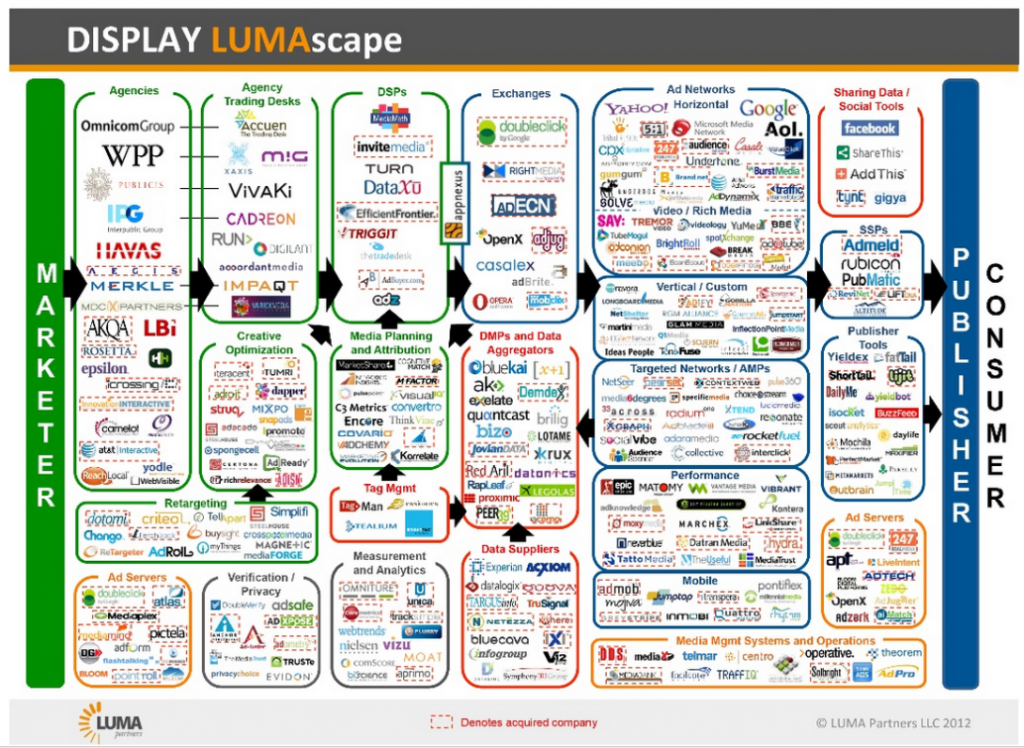
I was talking recently with Edi Immonen of Glome about the idea behind it: turning users into publishers. He used the word “media,” but I’m going with “publishers” for now, because that’s the word used in this graphic (one of many like it — all amazing and excellent) from LUMA partners:

That’s the marketer’s view. But how about yours, as the consumer over there on the right. In fact it’s actually more like this:

Because all you do is consume. You have no direct influence on all that intermediary stuff; so it just presses down on you.

But what if you become the publisher — a form of producer, and not just of consumer? Then the system, simplified, would look like this:

This is in alignment with what Tim Berners-Lee designed the Web to look like in the first place, but in in a commercial setting. (Remember that Sir Tim was then working in high energy physics at CERN, looking for ways to share and edit documents across the Internet as it existed at the turn of the ’90s.) It is also what blogging, as originally conceived, also did. If this blog were commercial (which it is not, on purpose), that would be me (or us) on the right.

Now, if we, as publishers, look at our data, or of our personal space — our state as a medium — as a platform for selling and buying stuff, including services, a whole new horizon opens up.

What Edi and his colleagues at Glome envision is a way for you, as a medium, to sell your space (however you chose to define that word) to:

  1. brands with which you already have a relationship;
  2. brands in which you have an interest; or
  3. brands in which you might have an interest.

From the traditional marketing perspective, #3 makes you “qualified lead,” for which the brand should be willing to pay. But that’s a far too reduced view of what you really are, or might be, to that brand.

Think of this marketplace frame from a CRM+VRM perspective. Between those two rectangles, inside the black two-pointed arrow, are cycles of buying and owning, of use and re-use, of live interactions and of long periods of idle time where neither is paying much attention to the other. Lots of stuff can go on within the boundaries of that two-way arrow.

What Glome proposes here is not zero-basing the marketplace, but instead to re-start our thinking, and our work, atop three well-understood existing roles: brand, publisher (or medium) and marketplace. The main re-characterization is of the individual, who is now a publisher or a medium, and not just a consumer.

Obviously much can get disintermediated here, including all the stuff between the marketer and the publisher in the graphic up top.

But much new intermediation is now possible, especially if the individual has a personal cloud through which one (or one’s fourth party) can program interactions, for the individual, among API-based services (in the manner of IFTTT, or using KRL) and the “Internet of things”. (For developers, I believe Singly fits in here too.)

So we are looking here at a whole new market for information and relationships, within the larger marketplace of everything else. This isn’t complicated, really. It’s actually what markets looked like in the first place:

This is the context we meant by “Markets are conversations” in The Cluetrain Manifesto.

LUMAscapes (such as the top one above) brilliantly depict the ecosystems of marketing as they have evolved so far, down different branches of discipline. The tree from which they branch, however, is the old advertising and direct marketing one, now operating inside the Internet . (“Big data” and analytics in marketing are hardly new. They were what direct mail was all about long before it evolved into direct marketing and then spread into online advertising.)

So this is a shout-to —

— as well as all the VRM developers in the world (and it seems there are more every day).

The last graphic above is our new frame. It helps that it’s also the oldest frame.

I also look forward to the day when Terence Kawaja and his colleagues at LUMA partners draw up VRM+CRM and other new ecosystems that are bound to evolve, once enough of us get our heads out of the old marketing frame and into the oldest marketplace one. So this is a shout-out to them too. 🙂

Toward a matrix of APIs

At  the 2006 O’Reilly Emerging Technology conference, Cal Henderson, then of Flickr, gave a long session called “Launching and scaling new Web services.” As I recall, among the many things he explained well were some principles behind the Flickr API. One of those principles was user access to data. The API should be one that allowed the user to haul all of her data out of the system, even if it was to federate that data into a competing system. That’s because Flickr believed that user data is the user’s first, and not just the company’s. Another principle was keeping the API stable, so as not to disrupt users and other services that depended on the API.

Cal left Flickr a couple years after that, but Flickr’s API remains a model of stability and utility — so much so that Dave Winer this morning suggested it be declared a national treasure.

Many of us depend in large ways to the APIs of companies great and small — and more get added to that collection every day. For a good picture of what’s going on with APIs, check out ProgrammableWeb.com. Between Dave’s respect for durable APIs like Flickr’s, and ProgrammableWeb’s roster of current and future dependencies, we start to see a matrix of APIs that Craig Burton compares to a city filled with buildings and relationships. Each API provider, like each building, exposes the provider’s core competencies in ways that can be engaged.

But what happens when we each have our own APIs — when our own core competencies become exposed in ways that can be engaged? And when we start managing our lives through relationships between our APIs and those in the rest of the world — especially in ways that are live and full-duplex (two ways at the same time, like a phone call)? And where each of us, or a trusted agent, can do the required IF, THEN, OR and other programming logic, between our own personal clouds and the clouds of others? What will we have then?

There is lots of blogging out loud about this, about both the downsides of dependency (as both Phil Windley and I have, toward Flickr in particular). But I think the upside deserves more than equal consideration, especially as companies begin to realize the importance of direct and engaged relationships with customers and users, which is what we’ll have when VRM and CRM (along with allied functions on both sides) fully engage. The result, I believe, will be a matrix of useful dependencies, based on APIs everywhere, thick with accountability and responsibility. The result will be far more opportunity, and boundless positive economic and social externalities based on the Net’s and the Web’s founding virtues. What will end, or at least be obsoleted, are Matrix-like worlds where users and customers are held captive.

Thus our goal for VRM: to prove that free customers are more valuable than captive ones — both to themselves and to everyone and everything else with which they engage.


Time for subscribers to fix the broken subscription business

I love the New York Times. I’ve been buying and reading the Times for most of my life, and consider it the best newspaper in the world. And, now that I’m spending more time in New York, I want to subscribe, to at least the digital edition. But trying to do that is a freaking ordeal.

First, when I go to http://ww.nytimes.com/access, I see this*:

NYTimes digital subscription first page

Note that this is only for “the first four weeks.” After that it’s what? It doesn’t say. While I’m sure the Times has analytics galore to rationalize hiding the full costs of subscriptions longer than four weeks (which the Times of course wants), it amounts to bait-and-switch.

But I want to subscribe, so I click on “continue.”

Up comes a pop-over form that wants me to re-enter my password or log out. My password guess fails, but I don’t want to log out, or go through the “don’t know your password” routine. So let’s count the frictions here:

  1. Popover. Hate them.
  2. Requiring logins and passwords. It’s 2012. This “system” was a kluge in 1995. That it’s still with us is one of the great fails of e-commerce. That it started modeling loyalty cards that same year is one of the great fails of retailing.
  3. Retrieving a forgotten password through email and re-logging only compounds the same fail.
  4. Logging out feels like pulling the lever on a trap door. I’m part-way there and don’t want to give up, says the brain, right before it says, Fuggit, I give up.

But I don’t give up, because I really want a damn subscription. So I log out, and find myself at https://myaccount.nytimes.com/gst/signout, where it says,

You are now logged out of NYTimes.com. Thanks for visiting.

Then adds,

And, over on in a column on the right, all this:

My Account Common Tasks

Contact Us

So where’s what it costs after four weeks? I have no idea. So I click on “Register a new account,” and see it’s a come-on to sign up for newsletters and stuff. I already get some of those. This tells me I need to go recover the password, unless I want to have two accounts rather than one. So I try logging in again.

This time I go through several tries using a variety of old passwords, and find one that works. Now I’m at http://www.nytimes.com/. At the top of the page, where it says Digital / Home Delivery, I click on the first link and find myself at the same page I show at the top.

This time when I click on “continue,” an ORDER SUMMARY page comes up. Here’s a screen shot of the parts that matter:

Note how the full costs — $15 every four weeks — are mumbled. According to Google’s calculator, the cost comes to 53.571428571¢ per day. I think that’s worth it, but I also think the system is worse than broken, and don’t wish to reward it.

But I don’t want just to complain. (Which I’ve done before anyway, to no effect.) I want to build a better system: one that works for both subcribers and publishers. This can only be done by developers and users working together, for all subscribers and all publishers. One thing should be clear, after seventeen years of failure here: the publishers can’t fix it from their side alone. The demand side needs to build the table at which every subscriber and publisher can sit. A zillion different tables for a zillion different publishers is exactly the kind of mess that the Internet and the Web are ideally positioned to solve. So let’s finish the job.

Subscribers know that information is free, but value wants to be paid for. The New York Times has enormous value. For people who value the content of its character and just its curb weight on streets and tablets, four bits a day is cheap. The Times doesn’t need to conceal that cost.

But as long as the Times and other papers remain stuck in the commercial Web’s antique calf-cow system — in which subscribers come as calves to the publishers’ cows for the milk of “content” and cookies they don’t want — everybody will be stuck in the wrong species and the market won’t evolve past the cattle industry stage.

So, at #IIW today, I will propose a #VRM session titled Fixing subscriptions from the customer’s side. Suggestions welcome. But they have to be VRM suggestions — ones that give us both independence and better means of engagement, for all publishers, and not each separately. Think of how today’s email system (SMTP, IMAP, POP3 and other protocols) fixed the problem of different proprietary email systems from MCI, Compuserve, Prodigy and for every company that could afford to mount its own internal systems. We need that kind of thing now for subscriptions. Asking for better behavior on the publishers’ side won’t work. Making better cows won’t work. We need something that makes us all peers, as email, the Web, and the Internet do. Let’s build that.

Bonus Link, two weeks later, from Dave Winer.

* [Later… When I first wrote this, I missed the “Regular Rate” column above, with the lines through the prices. This was clearly an oversight on my part, for which I was offered corrections aplenty in the comments below. Still, looking for what was also in plain sight sent me on the rest of this journey, which is why I am leaving it intact. I would also direct the reader (and the Times, if they’re reading this) to what Scott Adams says about confusopolies, of which the newspaper subscription business is one example. Thanks to the confusopolistic nature of that business, there is no reason to believe that the “regular” prices listed are the only long-term ones, or that the 99¢ prices are the only discounted ones. This too makes the rest of the journey I took — and this post as well — worthwhile… I hope.]

Can we each be our own Amazon?

The most far-out chapter in  is one set in a future when free customers are known to be more valuable than captive ones. It’s called “The Promised Market,” and describes the imagined activities of a family traveling to a wedding in San Diego. Among the graces their lives enjoy are these (in the order the chapter presents them):

  1. Customer freedom and intentions are not restrained by one-sided “agreements” provided only by sellers and service providers.
  2. — service organizations working as agents for the customer — are a major breed among user driven services.
  3. The competencies of nearly all companies are exposed through interactive that customers and others can engage in real time. These will be fundamental to what calls .
  4. s (now also called intentcasts), will be common and widespread means for demand finding and driving supply in the marketplace.
  5. Augmented reality views of the marketplace will be normative, as will mobile payments through virtual wallets on mobile devices.
  6. Loyalty will be defined by customers as well as sellers, in ways that do far more for both than today’s one-sided and coercive loyalty programs.
  7. Relationships between customers and vendors will be genuine, two-way, and defined cooperatively by both sides, which will each possess the technical means to carry appropriate relationship burdens. In other words, VRM and CRM will work together, at many touch-points.
  8. Customers will be able to proffer prices on their own, independently of intermediaries (though those, as fourth parties, can be involved). Something like EmanciPay will facilitate the process.
  9. Supply chains will become “empathic” as well as mechanical. That is, supply chains will be sensitive to the demand chain: signals of demand, in the context of genuine relationships, from customers and fourth parties.
  10. The advertising bubble of today has burst, because the economic benefits of knowing actual customer intention — and relating to customers as independent and powerful economic actors, worthy of genuine relationships rather than coercive — bob will have became obvious and operative. Advertising will continue to do what it does best, but not more.
  11. Search has evolved to become far more user-driven and interactive, involving agents other than search engines.
  12. Bob Frankston‘s will be taken for granted. There will still be businesses that provide connections, but nobody will be trapped into any one provider’s “plan” that excludes connection through other providers. This will open vast new opportunities for economic activity in the marketplace.

In , Sheila Bounford provides the first in-depth volley on that chapter, focusing on #4: personal RFPs. I’ll try to condense her case:

I’ve written recently of a certain frustration with the seemingly endless futurology discussions going on in the publishing world, and it’s probably for this reason that I had to fight my way through the hypothesis in this chapter. However on subsequent reflection I’ve found that thinking about the way in which Amazon currently behaves as a customer through its Advantage programme sheds light on Searls’ suggestions and projections…

What Searls describes as the future for individual consumers is in fact very close to the empowered relationship that Amazon currently enjoys with its many suppliers via Amazon Advantage…  Amazon is the customer – and a highly empowered one at that.

Any supplier trading with Amazon via Advantage (and that includes most UK publishing houses and a significant portion of American publishers) has to meet all of the criteria specified by Amazon in order to be accepted into Advantage and must communicate online through formats and channels entirely prescribed and controlled by Amazon…

Alone, an individual customer is never going to be able to exert the same kind of leverage over vendors in the market place as a giant like Amazon. However individual customers online are greater than the sum of their parts: making up a crucial market for retailers and service providers. Online, customers have a much louder voice, and a much greater ability to collect, organise and mobilise than offline. Searls posits that as online customers become more attuned to their lack of privacy and control – in particular of data that they consider personal – in current normative contracts of adhesion, they will require and elect to participate in VRM programmes that empower them as individual customers and not leave them as faceless, impotent consumers.

So? So Amazon provides us with a neat example of what it might look like if we, as individuals, could control our suppliers and set our terms of engagement. That’s going to be a very different online world to the one we trade in now.  Although I confess to frustration with the hot air generated by publishing futurology, it seems to me that the potential for the emergence VRM and online customer empowerment is one aspect of the future we’d all do well to work towards and plan for.

From the start of ProjectVRM, Iain Henderson (now of The Customer’s Voice) has been pointing to B2B as the future model for B2C. Not only are B2B relationships rich, complex and rewarding in ways that B2C are not today (with their simplifications through customer captivity and disempowerment), he says, but they also provide helpful modeling for B2C as customers obtain more freedom and empowerment, outside the systems built to capture and milk them.

Amazon Advantage indeed does provide an helpful example of where we should be headed as VRM-enabled customers. Since writing the book (which, except for a few late tweaks, was finished last December) I have become more aware than ever of Amazon’s near-monopoly power in the book marketplace, and possibly in other categories as well. I have heard many retailers complain about “scan and scram” customers who treat brick-and-mortar stores as showrooms for Amazon. But perhaps the modeling isn’t bad in the sense that we ought to have monopoly power over our selves. Today the norm in B2C is to disregard that need by customers. In the future I expect that need to be respected, simply because it produces more for everybody in the marketplace.

It is highly astute of Sheila to look toward Amazon as a model for individual customers. I love it when others think of stuff I haven’t, and add to shared understanding — especially of a subject as protean as this one. So I look forward to the follow-up posts this week on her blog.

Scaling business in parallel

Companies and customers need to be able to deal with each other in two ways: as individuals and as groups.

As of today companies can deal with customers both ways. They can get personal with customers, and they can deal with customers en masse. Without the latter capability, mass marketing would not be possible.

Customers, on the other hand, can only deal with companies as individuals, one at a time. Dealing with companies as groups is still a challenge. Consider the way you engage companies in the marketplace, both online and off. Your dealings with companies, on the whole, are separate and sequential. Nothing wrong with that, but it lacks scale. Hence: opportunity.

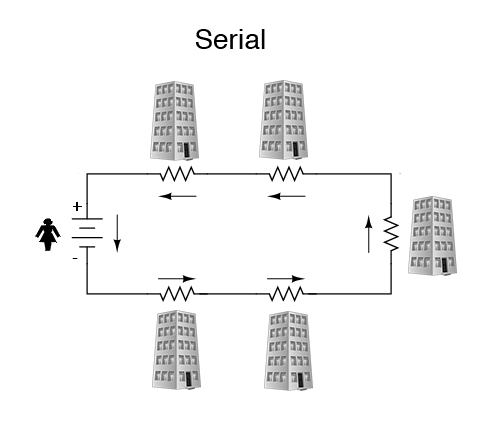
We can arrive at that opportunity space by looking at company and personal dealings, each with two kinds of engagement circuits: serial and parallel.

Start with a small company, say a store with customers who line up at the counter. That store  deals with customers in a serial way:

business, serial

The customers come to the counter, one after another, in a series. Energy in the form of goods goes out, and money comes back.

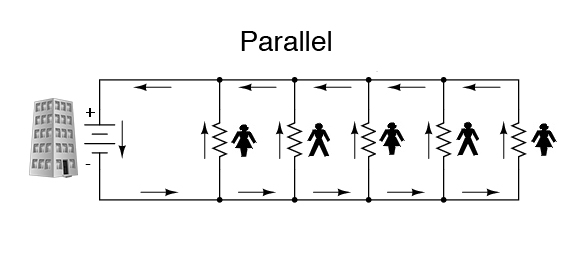
As companies scale up in size, however, they’d rather deal with many customers in parallel rather than in series. A parallel circuit looks like this:

business, parallel

Here customers are dealt with as a group: many at once, and in the same way. This, in an extremely simplified form, is a diagram of mass marketing. While it is still possible for a company to deal with customers individually, the idea is to deal with as many customers as possible at once and in the same ways.

I use electronic symbols in those circuits because resistance (the zig-zag symbol) adds up in series, while it goes down in parallel. This too is a virtue of mass marketing. Thus one-to-many works very well, and has proven so ever since Industry won the Industrial Revolution.

Over on the customers’ side, the marketplace on the whole looks like this:

customer, serial

The customer goes from one company to the next. This is not a problem on the vendors’ side, except to the degree that vendors would rather customers not shop elsewhere. This is why vendors come up with loyalty programs and other schemes to increase “switching costs” and to otherwise extract as much money and commitment as possible out of the customer.

But, from the customer’s side, it would also be cool if they could enjoy scale in parallel across many companies, like this:

In the physical world this is all but unthinkable. But the Internet makes it very thinkable, because the Net reduces nearly to zero the functional distance between any two entities, and presents an open space across which many connections can be made, at once if necessary, with few limits on the number or scope of possibilities. There is also no limit to the new forms of interaction that can happen here.

For example, a customer could scale in parallel by expressing demand to multiple vendors at the same time, or could change her contact information at once with many companies. In fact this is basically what VRM projects are about: scaling in parallel across many other entites. (Not just vendors, but also elected officials, government agencies, churches, clubs, and so on.)

It is easy to see how companies can feel threatened by this. For a century and a half we in business have made a virtue of “targeting,” “acquiring,” “capturing,” “managing,” “locking in” and “owning” customers. But think about the free market for a minute. Shouldn’t free customers be more valuable than captive ones? Wouldn’t it be better if customers and prospects could send many more, and better, signals to the marketplace, and to vendors as well, if they were capable of having their own native ways of dealing, consistently, across multiple vendors?

We have that now with email and other forms of messaging. But why stop there?

Naturally, it’s easy to ask, Could social media such as Facebook, Google+ and Twitter provide some of what we need here? Maybe, but the problem is that they are not ours, and they don’t work for us — in the sense that they are accountable to us. They work for advertisers. Email, IM and browsing aren’t owned by anybody. They are also substitutable. For example, you can move your mail from Gmail to your own server or elsewhere if you like. Google doesn’t own email’s protocols. No browser company owns HTTP, HTML or any of the Web’s protocols.

The other problem with social solutions is that they’re not personal. And that’s the scale we’re talking about here: adding parallel capabilities to individuals. Sure, aggregation is possible, and a good thing. (And a number of VRM projects are of the aggregating-demand sort.) But the fallow ground is under our own feet. That’s where the biggest market opportunity is located. Also where, still, it is most ignored. Except, of course, here.

[Continued in VRM/CX + CRM/CX.]

Let’s fix the car rental business

Lately Ron Lieber (@ronlieber), the Your Money editor and columnist for the New York Times, has been posting pieces that expose a dysfunction in the car rental marketplace — one that is punishing innovators that take the sides of customers. The story is still unfolding, which gives us the opportunity to visit and think through some VRM approaches to the problem.

Ron’s first piece is a column titled “A Rate Sleuth Making Rental Car Companies Squirm,” on February 17, and his second is a follow-up column, “Swatting Down Start-Ups That Help Consumers,” on April 6. Both stories are about , a start-up that constantly researches and re-books car rentals for you, until you get the lowest possible price from one of them. That company wins the business, at a maximized discount. The others all lose. This is good for the customer, if all the customer cares about is price. It’s bad for the agencies, since the winner is the one that makes the least amount of money on the rental.

In the second piece, Ron explains,

The customer paid nothing for the service, and AutoSlash got a commission from Travelocity, whose booking engine it rented. This was so delightful that it felt as if it might not last, and I raised the possibility that participating companies like Hertz and Dollar Thrifty would bail out, as Enterprise and the company that owns Avis and Budget already had. I encouraged readers to patronize the participants in the meantime to reward them for playing along. Well, they’ve stopped playing. In the last couple of weeks, Hertz and the company that owns both Dollar and Thrifty have turned their backs on AutoSlash — and for good reason, according to Hertz: AutoSlash seems to have been using discount codes that its customers were not technically eligible for.

On its site, AutoSlash put things this way (at that last link):

We’re disappointed that these companies have now chosen to reverse course and adopt this anti-consumer position, after having participated in this site since its launch in mid-2010. Apparently, with more customers booking reservations through our service, they felt they could no longer support our consumer-friendly model of automatically finding the best discount codes and re-booking when rates drop. AutoSlash will not waver in our objective to help people get a great deal on their rentals. We have exciting product plans on the horizon to make our site even more useful to you..

On the same day as his second column, Ron ran a blog post titled “AutoSlash, AwardWallet, MileWise and the Travel Bullies,” in which he points to airlines as another business with the same problems — and the same negative responses to rate-sleuths:

American Airlines and Southwest Airlines have made it clear that they do not want any third party Web site taking customers’ AAdvantage or Rapid Rewards frequent flier balances and putting them on a different site where people can view them alongside those from other loyalty programs. This comes at a loss of convenience to customers, and the airlines make all sorts of specious arguments about why this is necessary. Meanwhile, sites like ,  and  are less useful than they would be otherwise without a full lineup of airline account information available. But there’s a the bigger question here: Why can’t the big travel players simply fix their archaic business models and add these nifty features to their Web sites and stop spending energy ganging up on start-ups who unmask their flaws?

The answer comes from , of Dilbert fame. By Scott’s definition, the big travel players are a “confusopoly.” They see what Ron calls a “flaw” — burying the customer in a snowstorm of discounts intended both to entice and to confuse — as a feature, rather than a bug. Here’s Scott:

A confusopoly is any group of companies in a particular industry that intentionally confuses customers about their pricing plans and products. Confusopolies do this so customers don’t know which one of them is offering the best value. That way every company gets a fair share of the confused customers and the industry doesn’t need to compete on price. The classic examples of confusopolies are phone companies, insurance companies, and banks.

Car rental agencies are clearly confusopolies. So are airlines. Dave Barry explains how it is that no two passengers on one airplane pay the same price for a seat:

Q. So the airlines use these cost factors to calculate a rational price for my ticket?
A. No. That is determined by Rudy the Fare Chicken, who decides the price of each ticket individually by pecking on a computer keyboard sprinkled with corn. If an airline agent tells you that they’re having “computer problems, ” this means that Rudy is sick, and technicians are trying to activate the backup system, Conrad the Fare Hamster.

There are a few exceptions. One is , which competes through relatively simple seat pricing and unconfusing policies (e.g. no seat assignments and “bags fly free”). But even Southwest plays confusing games. For example, I just went to Southwest to make sure the URL was right (it used to be iflyswa.com, as I recall), and got intercepted by a promo offer, for a gift card. So, for research purposes, I filled it out. That got me to this page here:

Note that there is no place to take the last step. The “Your Info Below” space is blank. Everywhere I click, nothing happens. Fun. (Is it possible this isn’t from Southwest at all? Maybe somebody from Southwest can weigh in on that.)

So, a confusopoly.

What can we do? Governments fix monopolies by breaking them up. But confusopolies come pre-broken. That’s how they work. There is no collusion between Hertz and Budget, or between United and American. They are confusing on purpose, and independently so. No doubt they have their confusing systems fully rationalized, but that doesn’t make the confusion less real for the customer, or less purposeful for the company.

Let’s look a bit more closely at three problems endemic to the car rental business, and contribute to the confusopoly.

  1. Cars, like airlines and their seats, have become highly generic, and therefore commoditized. Even if there is a difference between a Chevy Cruze and a Ford Focus, the agencies mask it by saying what you’ll get is some model of some maker’s car, “or similar.” (I’ve always thought one of the car makers ought to just go ahead and make a car just for rentals, and brand it the “Similar.”)
  2. The non-price differentiators just aren’t different enough. For example, I noticed that Enterprise lately forces its workers to go out of their way to be extra-personal. They come out from behind the counter, shake your hand, call you by name, ask about your day, and so on. Which is all nice, but not nicer for most of us than a lower price than the next agency.
  3. The agencies’ CRM (Customer Relationship Management) systems don’t have enough to work with. While Enterprise is singled out here and here for having exceptional CRM, all these systems today operate entirely on the vendors’ side. Not on yours or mine. Each of is silo’d. How each of us relates to any one agency doesn’t work with the others. This is an inconvenience for us, but not for the agencies, at least as far as they know. And, outside their own silo’d systems, they can’t know much, except maybe through intelligence they buy from “big data” mills. But that data is also second-hand. No matter how “personalized” that data is, it’s about us, not directly by us or from us, by our own volition, and from systems we control.

A few years ago I began to see these problems as opportunities. I thought, Why not build new tools and systems for individual customers, so they can control their own relationships, in common and standard ways, with multiple vendors?  And, What will we call the result, once we have that control? My first answer to those questions came in a post for in March, 2006, titled The Intention Economy. Here are the money grafs from that one:

The Intention Economy grows around buyers, not sellers. It leverages the simple fact that buyers are the first source of money, and that they come ready-made. You don’t need advertising to make them. The Intention Economy is about markets, not marketing. You don’t need marketing to make Intention Markets. The Intention Economy is built around truly open markets, not a collection of silos. In The Intention Economy, customers don’t have to fly from silo to silo, like a bees from flower to flower, collecting deal info (and unavoidable hype) like so much pollen. In The Intention Economy, the buyer notifies the market of the intent to buy, and sellers compete for the buyer’s purchase. Simple as that. The Intention Economy is built around more than transactions. Conversations matter. So do relationships. So do reputation, authority and respect. Those virtues, however, are earned by sellers (as well as buyers) and not just “branded” by sellers on the minds of buyers like the symbols of ranchers burned on the hides of cattle.

The Intention Economy is about buyers finding sellers, not sellers finding (or “capturing”) buyers. In The Intention Economy, a car rental customer should be able to say to the car rental market, “I’ll be skiing in Park City from March 20-25. I want to rent a 4-wheel drive SUV. I belong to Avis Wizard, Budget FastBreak and Hertz 1 Club. I don’t want to pay up front for gas or get any insurance. What can any of you companies do for me?” — and have the sellers compete for the buyer’s business.

Thanks to work by the VRM (Vendor Relationship Management) development community, The Intention Economy is now a book, with the subtitle When Customers Take Charge, due out from Harvard Business Review Press on May 1. (You can pre-order it from Amazon, and might get it sooner that way.)

Having sellers compete for a buyer’s business (to serve his or her signaled intent) is what we now call a Personal RFP. (Scott Adams calls it “broadcast shopping.”) What it requires are two things that are now on their way. One is tools. The other is infrastructure. As a result of both, we will see emerge a new class of market participant: the . It’s a role AutoSlash can play, if it’s willing to play a new game rather than just gaming the old one.

The new game is serving as a real agent of customers, rather than just as a lead-generating system for third parties such as Travelocity, or a pest for second parties such as Hertz, Dollar and Thrifty. Fourth parties are businesses that side with customers rather than with vendors or third parties. Think of them as third parties that work for you and me. In this post, of (a VRM developer), represents the four parties graphically: Fourth parties can also serve as agents for improving actual relationships (rather than coercive ones). The two magnets are “r-buttons” (explained most recently here), which represent the buyer and the seller, and (as magnets) depict both attraction and openness to relationship. They are simple symbols one can also type, like this:  ⊂ ⊃. (The ⊂ represents you, or the buy side, while the ⊃ represents vendors and their allied third parties, or the sell side.) Here is another way of laying these out, with some names that have already come up: 4 parties As of today AutoSlash presents itself as an agent of the customer, but business-wise it’s an accessory to a third party, Travelocity. While Travelocity could be a fourth party as well, it is still too tied into the selling systems of the car rental agencies to make the move. (If I’m wrong, tell me how.) Now, what if AutoSlash were to join a growing young ecosystem of VRM companies and projects working on the customer’s side? Here is roughly how that looks today: AutoSlash is over there on the right, on the sell side. On the buy side, in the fourth party quadrant, are , , , MyDex, and . All provide ways for individuals to manage their own data, and (actually in some cases, potentially in others) relationships with second and third parties, on behalf of the customer. If you look at just the right two quadrants, on the ⊃ side, the car rental agencies fired AutoSlash for breaking their system. That’s one more reason for AutoSlash to come over to the ⊂ side and start operating unambiguously as a pure fourth party.
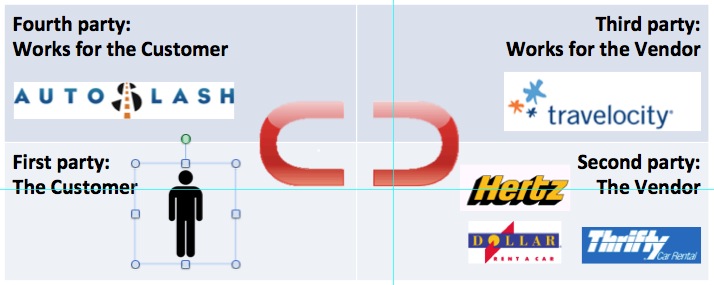
I believe that’s what already does. While their service is superficially similar to AutoSlash’s (they book you the lowest prices), they clearly work for you (⊂) as a fourth party and not for the agencies (⊃) as a third party. What makes them unambiguously a fourth party is the fact that you pay them. Here are their rates.

For controlling multiple relationships, however, you still need tools other than straightforward one-category services (such as AutoSlash and RentalCarMagic). One circle around those tools is what KuppingerCole calls Life Management Platforms. Another, from Peter Vander Auwera of SWIFT is The Programmable Me.  These (among much more) will be the subject of sessions at the European Identity and Cloud Conference (EIC) this week in Munich. (I’ll be flying there shortly from Boston.) I’ll be participating in those. So will Phil Windley of Kynetx, who has detailed a concept called the “Personal Event Network,” aka the “Personal Cloud.” Links, in chronological order:

  1. Ways, Not Places
  2. Protocols and Metaprotocols: What is a Personal Event Network?
  3. KRL, Data and Personal Clouds
  4. Personal Clouds as General Purpose Computers
  5. Personal Clouds Need a Cloud Operating System
  6. The Foundational Role of Identity in Personal Clouds
  7. Data Abstractions for Richer Cloud Experiences
  8. A Programming Model for Personal Clouds
  9. Federating Personal Clouds

This is thinking-in-progress about work-in-progress, by a Ph.D. computer scientist and college professor as well as an entrepreneur and a very creative inventor. (By the way, KRL and its rules engine are open source. That’s cool too.)

If I have time later I’ll unpack some of this, and start knitting the connections between what Phil’s talking about and what others (especially Martin Kuppinger of KuppingerCole, who will be writing and posting more about Life Management Platforms) are also bringing to the table here.

In particular I will bring up the challenge of fixing the car rental agency market. What can we do, not only for the customer and for his or her fourth parties (the ⊂ side) but for everybody on the third and second party (⊃) side?

And what changes will have to take place on the ⊃ side once they find they need to truly differentiate, in distinctive and non-gimmicky ways? What effect will that have on the car makers as well?

When I started down this path, back in 2006, I had a long conversation with a top executive at one of the car rental companies. What sticks with me is that these guys don’t have it easy. Among other things, he told me that the car companies mostly don’t like the car rental business because it turns drivers off to many of the cars they rent, and the car companies don’t make much money on the cars either. Can that be fixed too? I don’t know, but I’d like customers and their fourth parties to help.

How about through true personalization, in response to actual demand by individual customers, such as I suggested in 2006?

How about through new infrastructural approaches, such as the ?

Hertz, Budget’s and Enterprise’s own CRM and loyalty systems are not going to go away. Nor will the ways they all have of identifying us, and authenticating us. How can we embrace those, even as we work to obsolete them?

There are two worlds overlapping here: the one we have, and the one we’re building that will transcend and subsume the one we have.

The one we have is a “free market” with a “your choice of captor” model. It is for violating this model that AutoSlash was fired as a third party by the car rental agencies.

The one we’re building is a truly free market, in which free customers prove more valuable than captive ones. We need to make the pudding that proves that principle.

And we’re doing that. But it’s not a simple, an easy, or even a coordinated process. The good thing is, it’s already underway, and has been for some time.

Looking forward to seeing you at EIC in Munich, and/or at the other events that follow, in London and Mountain View:

Meanwhile, a last word, in respect to what Bart Stevens says below. Clearly the car rental business needs to move out of the confusopoly model, and to differentiate on more than price. To some degree they already do, but price is the primary driver for most customers. (And I’d welcome correction on that, if it’s wrong.) We have a lot to learn from each other.

« Older posts Newer posts »

© 2026 ProjectVRM

Theme by Anders Noren — Up ↑