Category: Personal Data (Page 7 of 8)

How about using the ‘No Track’ button we already have?

left r-buttonright r-buttonFor as long as we’ve had economies, demand and supply have been attracted to each other like a pair of magnets. Ideally, they should match up evenly and produce good outcomes. But sometimes one side comes to dominate the other, with bad effects along with good ones. Such has been the case on the Web ever since it went commercial with the invention of the cookie in 1995, resulting in a calf-cow model in which the demand side — that’s you and me — plays the submissive role of mere “users,” who pretty much have to put up with whatever rules websites set on the supply side.

Consistent with Lord Acton’s axiom (“Power corrupts; absolute power corrupts absolutely”) the near absolute power of website cows over user calves has resulted in near-absolute corruption of website ethics in respect to personal privacy.

This has been a subject of productive obsession by Julia Anguin and her team of reporters at The Wall Street Journal, which have been producing the What They Know series (shortcut: http://wsj.com/wtk) since July 30, 2010, when Julia by-lined The Web’s New Gold Mine: Your Secrets. The next day I called that piece a turning point. And I still believe that.

Today came another one, again in the Journal, in Julia’s latest, titled Web Firms to Adopt ‘No Track’ Button. She begins,

A coalition of Internet giants including Google Inc. has agreed to support a do-not-track button to be embedded in most Web browsers—a move that the industry had been resisting for more than a year.

The reversal is being announced as part of the White House’s call for Congress to pass a “privacy bill of rights,” that will give people greater control over the personal data collected about them.

The long White House press release headline reads,

We Can’t Wait: Obama Administration Unveils Blueprint for a “Privacy Bill of Rights” to Protect Consumers Online

Internet Advertising Networks Announces Commitment to “Do-Not-Track” Technology to Allow Consumers to Control Online Tracking

Obviously, government and industry have been working together on this one. Which is good, as far as it goes. Toward that point, Julia adds,

The new do-not-track button isn’t going to stop all Web tracking. The companies have agreed to stop using the data about people’s Web browsing habits to customize ads, and have agreed not to use the data for employment, credit, health-care or insurance purposes. But the data can still be used for some purposes such as “market research” and “product development” and can still be obtained by law enforcement officers.

The do-not-track button also wouldn’t block companies such as Facebook Inc. from tracking their members through “Like” buttons and other functions.

“It’s a good start,” said Christopher Calabrese, legislative counsel at the American Civil Liberties Union. “But we want you to be able to not be tracked at all if you so choose.”

In the New York Times’ White House, Consumers in Mind, Offers Online Privacy Guidelines Edward Wyatt writes,

The framework for a new privacy code moves electronic commerce closer to a one-click, one-touch process by which users can tell Internet companies whether they want their online activity tracked.

Much remains to be done before consumers can click on a button in their Web browser to set their privacy standards. Congress will probably have to write legislation governing the collection and use of personal data, officials said, something that is unlikely to occur this year. And the companies that make browsers — Google, Microsoft, Apple and others — will have to agree to the new standards.

No they won’t. Buttons can be plug-ins to existing browsers. And work has already been done. VRM developers are on the case, and their ranks are growing. We have dozens of developers (at that last link) working on equipping both the demand and the supply side with tools for engaging as independent and respectful parties. In fact we already have a button that can say “Don’t track me,” plus much more — for both sides. Its calle the R-button, and it looks like this: ⊂ ⊃. (And yes, those symbols are real characters. Took a long time to find them, but they do exist.)

Yours — the user’s — is on the left. The website’s is on the right. On a browser it might look like this:

r-button in a browser

Underneath both those buttons can go many things, including preferences, policies, terms, offers, or anything else — on both sides. One of those terms can be “do not track me.” It might point to a fourth party (see explanations here and here) which, on behalf of the user or customer, maintains settings that control sharing of personal data, including the conditions that must be met. A number of development projects and companies are already on this case. All the above falls into a category we call EmanciTerm. Much has been happening as well around personal data stores (PDSes), also called “lockers,” “services” and “vaults.” These include:

Three of those are in the U.S., one in Austria, one in France, one in South Africa, and three in the U.K. (All helping drive the Midata project by the U.K. government, by the way.) And those are just companies with PDSes. There are many others working on allied technologies, standards, protocols and much more. They’re all just flying below media radar because media like to look at what big suppliers and governments are doing. Speaking of which… 🙂

Here’s Julia again:

Google is expected to enable do-not-track in its Chrome Web browser by the end of this year.

Susan Wojcicki, senior vice president of advertising at Google, said the company is pleased to join “a broad industry agreement to respect the ‘Do Not Track’ header in a consistent and meaningful way that offers users choice and clearly explained browser controls.”

White House Deputy Chief Technology Officer Daniel Weitzner said the do-not-track option should clear up confusion among consumers who “think they are expressing a preference and it ends up, for a set of technical reasons, that they are not.”

Some critics said the industry’s move could throw a wrench in a separate year-long effort by the World Wide Web consortium to set an international standard for do-not-track. But Mr. Ingis said he hopes the consortium could “build off of” the industry’s approach.

So here’s an invitation to the White House, Google, the 3wC, interested BigCos (including CRM companies), developers of all sizes and journalists who are interested in building out genuine and cooperative relationships between demand and supply::::

Join us at IIW — the Internet Identity Workshop — in Mountain View, May 1-3. This is the unconference where developers and other helpful parties gather to talk things over and move development forward. No speakers, no panels, no BS. Just good conversation and productive work. It’s our fourteenth one, and they’ve all been highly productive.

As for the r-button, take it and run with it. It’s there for the development. It’s meaningful. We’re past square one. We’d love to have all the participation we can get, from the big guys as well as the little ones listed above and here.

To help get your thinking started, visit this presentation of one r-button scenario, by Adam Marcus of MIT. Here’s another view of the same work, which came of of a Google Summer of Code project through ProjectVRM and the Berkman Center:
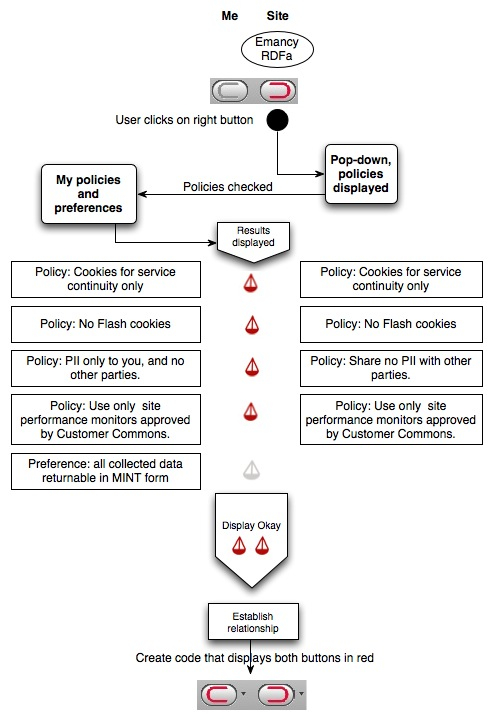
(Props to Oshani Seneviratne and David Karger, also both of MIT, and Ahmad Bakhiet, of Kings College London, for work on that project.)

If we leave fixing the calf-cow problem entirely up to the BigCos and BigGov, it won’t get fixed. We have to work from the demand side as well. In economies, customers are the 100%.

Here are some other stories, mostly gathered by Zemanta:

All look at the symptoms, and supply-side cures. Time for the demand side to demand answers from itself. Fortunately, we’ve been listening, and the answers are coming.

Oh, and by the way, Mozilla has been offering “do not track” for a long time. Other tools are also available:

Stop making cows. Quit being calves.

Emoji_u1f42e.svg The World Wide Web that invented in 1990 was a collection of linked documents. The Web we have today is a collection not just of documents (some of which we quaintly call pages), but of real estate we call sites. This Web is mostly a commercial one.

Even if most sites aren’t commercial (I don’t know), most search results bring up commercial sites anyway, thanks both to the abundance of commercial sites on the Web, and “search engine optimization” (SEO) by commercial site operators. Online ad spending in the U.S. alone will hit $40 billion this year, and much of that money river runs through Google and Bing.

But that’s a feature, not a bug. The bug is that we’ve framed our understanding of the Web around locations and not around the fabric of connections that define both the Net and the Web at the deepest level. That’s why nearly every new business idea starts with real estate: a site with an address. Or, in the ranching-based lingo of marketing, a brand.

The problem isn’t with the sites themselves, or even with the real estate model we use to describe and understand them. It’s with their underlying architecture, called client-server.

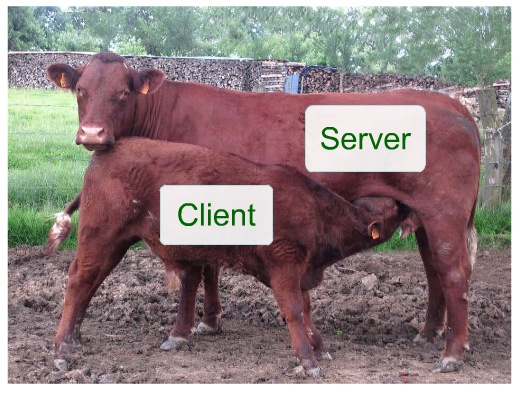
Client-server, by design, subordinates visitors to websites. It does this by putting nearly all responsibility on the server side, so visitors are just users or consumers, rather than participants with equal power and shared responsibility in truly two-way relationship between equals. Thus the client-server relationship is roughly that of calf to cow:

calf-cow

From the teats of the cow-server, the calf-client sucks the milk of HTML and Javascript, plus : text files deposited by a website’s server in a visitor’s browser. Their original purpose was to help both the site and the visitor (the cow and the calf) remember where they were last time they met, and to retain other helpful information, such as logins and passwords.

But cookies also became a way for commercial cows and their business friends (aka third parties) to keep track of their calves, reporting back where those calves traveled, the  cows they suckled, the stuff they click on. Based on what they learn from tracking, the cows can — alone or with assistance from third parties, produce “personalized” milk in the form of customized pages and ads. This motivation is all the rage today, especially around advertising.

Nearly all the investment on ‘relating’ is still on the sell side: the cow side, because that’s where all the power is concentrated, thanks to client-server. So we keep making better cows and cow-based systems, forgetting that the calves are actual human beings called customers. We also overlook opportunity in helping demand drive supply, rather than just in helping supply drive demand.

But some of us haven’t forgotten. One is Phil Windley, a Ph.D. computer scientist, former CIO of Utah, co-founder of , and the inventor and lead maintainer of a language called , plus the rules engine for executing KRL code. (Both are open source.) The rules are the individual’s own. The rules engine can go anywhere. No cow required.

To describe the box outside of which Phil thinks, he gives a great presentation on the history of e-commerce. It goes like this:

1995: Invention of the Cookie.
The End.

To describe where he’s going (along with Kynetx and the rest of the VRM development community), Phil wrote a new book, The Live Web (a term you might have first read about here), and has been publishing a series of blog posts that deal with what he calls . Think of your Personal Event Network as the Live Web that you, as a human being (rather than as a calf) operate. Live. In real time. Your own way. You can take advantage of services offered by the servers of the world (through APIs, for example). But it’s your network, and it’s built with your own relationships. It doesn’t replace client-server, but it gives servers lots to do besides being cows. In fact, the opportunities are boundless, because they’re in wide-open virgin territory.

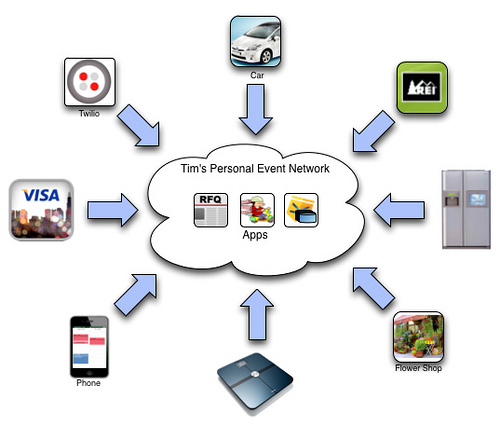
A Personal Event Network puts you at the center of your Live Web, with your own apps, and your own rules for what follows from events in your web of relationships. “Personal event networks interact with each other as equals,” Phil says. “They aren’t client server in nature.” Here’s how Phil draws one example:

Personal Event Network

Look at the three items indside the personal cloud:

  • At the center are apps. We’re already familiar with those on our computers and mobile devices. While they might have connections to outside services, they are personal tools of our own. They are neither calves nor cows.
  • On the left is an RFQ, or a Request For Quote, also called a .
  • On the right are rules, written in KRL.

Together those control how we interact with all the devices and services on the outside, on the Live Web. Note that those outside items are not functioning as cows, even though they also live in the commercial Web’s client-server world. They are being engaged outside the cow function, mostly through s.

Here’s how Phil explains how this works for a guy named Tim, who has a relationship with a flower shop, described here:

Tim’s personal event network has a number of apps installed. It’s also is listening on many event channels. These channels are carrying events about everything from Tim’s phone and appliances to merchants he frequents.

REI and the flowershop both have separate channels into Tim’s personal event network. Consequently, Tim can

  • Manage them independently. If REI starts spamming Tim with events he doesn’t like, he can simply delete the channel and they’re gone.
  • Permission them independently. Tim might want to get certain events from REI and other’s from the flowershop. Which events can be carried on which channels is up to Tim.
  • Respond to them independently. Tim might want to get notification events from the flowershop delivered to his phone today because it’s his wife’s birthday whereas normally merchant communications are sent to his mail box.

Tim is in charge of whether and how events are delivered. He manages the channel, delivery, and response while the publishers of these event choose the content.

This cannot be done within the bovine graces of any one company — not Apple, Facebook, Google or Microsoft — no matter how rich their services might be, and no matter how well they treat their users and customers. And not matter how much they might insist that they’re not really treating their users and customers as calves.

But they’re still playing the cow role, and we’re still stuck as calves. That’s why we keep looking for better cows.

For example take The Real Problem With Google’s New Privacy Policy, in . The subtitle explains, “The tech giant owes users better tools to manage their information.” Well, that might be true. But we also need our own tools for managing relationships with Google — and every other site and service on the Web. And we need those tools to work the same way with every company, rather than different ways with every company.

(We have this, for example, with email, thanks to open, standard and widely deployed protocols. Email is fully human, even if we submit to playing the half-calf role inside, say, Gmail. We can still take our whole email pile outside of Gmail and put it on any other server, or host it ourselves. Email’s protocols and standards support that degree of independence, and therefore of humanity as well.)

Another example is The Ecommerce Revolution is All About You, in . Here’s the closing paragraph:

So shoppers, be prepared to give up your data. In the coming year, we’re going to see many more retail sites ramping up data-driven discovery. And e-commerce sites who aren’t thinking about how to mine social and other forms of data are probably going to be left in the dust by the Amazons and Netflix’s of the next wave of personalization.

Credit where due to Amazon and Netflix: their personalization is best-of-breed. Their breed just happens to be bovine.

As it did in 1995, Amazon today provides their own milk and cookies for their own calf-customers. As a loyal Amazon customer, I have no problem being its calf. But I can’t easily take my data (preferences, history, reviews etc.) from Amazon and use it myself, in my own ways, and for my own purposes. It’s their data, not mine.

The problem with this — for both Amazon and me — is that Amazon isn’t the whole World Live Web. I don’t shop only at Amazon, and I would like better ways of interacting with all sellers than any one seller alone can provide, even if they’re the world’s best online seller. (Which Amazon, arguably, is.)

So sure, the Ecommerce Revolution is “about us.” But if it’s our revolution, why aren’t we getting more of our own tools and weapons? Why should we keep depending on sellers’ personalization systems to do all the work of providing relevance for us as shoppers? Should we give up our data to those companies just so they can raise the click-through rates of their messages from one in less than a hundred to one in ninety-eight — especially when many of the misses will now be creepily “personalized” as well?

Shouldn’t we know more about what to do with our data than any seller can guess at? And if we don’t know yet, why not create companies that help us buy at least as well as other companies are help sellers sell?

Well, those kinds of companies are being created, and you’ll find a pile of them listed here, Kynetx among them.

VCs need to start looking seriously at development on the demand side. Kynetx is one among dozens of companies that are flying below the radar of too many VCs just looking at better cows, and better ways to sell — or worse, to “target,” “capture,” “acquire,” “lock in” and “manage” customers as if they were slaves or cattle.

The idea that free markets are your-choice-of-captor is a relic of a dying mass-market-driven mentality from the pre-Internet age. Free markets need free customers. And we’ll get them, because we’ll be them.

We — the customers — are where the money that matters most comes from. Driving that money into the marketplace are our own intentions as sovereign and independent human beings.

In the next few years we’ll build an Intention Economy, driven by customers equipped with their own tools, and their own ways of interacting with sellers, including their own terms of engagement. This was the promise of the Net and the Web in the first place, and we’ve awaited delivery for long enough.

Time’s up. The age of captivity is ending. Start placing your bets on the demand side.

Consumers are social, Customers are personal

Social media are a partial and temporary solution at best to a pair of linked problems that are essentially personal:

  1. dysfunctional customer relationship management on the vendor’s side; and
  2. minimal vendor relationship management on the customer’s side.

In the absence of solutions to both problems, vendors still see customers as consumers, and that too is a problem that hasn’t yet come to a head, because we still don’t fully grok the difference between consumers and customers. As a result, we think social media looks like a the good answer rather than a better question. That question is, How can we get companies and media to stop treating us as consumers and start treating us as real customers?

To see what needs to be done, check out Consumers Punish Companies that Ignore Them, by Eric Sass in MediaPost. In that piece Eric sources a pair of Conversocial studies that contain plenty of grist for social media and marketing mills. Here they are, from the Conversocial blog:

Here are some samplings from Eric’s gleanings:

  • “…more than 60% of complaints and question about retailers posted online on social media are ignored, in part because of the sheer volume of content created on sites like Twitter and Facebook.”
  • “30% of the retail chains surveyed don’t respond to any questions or complaints posted on social media, effectively choosing to ignore issues mentioned in these forums.”
  • “…78% believe that social media platforms will soon replace other means of customer service altogether or at least become one of the top ways to communicate with corporations.”
  • “…among the group which has communicated with companies via social media, 32.5% said they were either neglected or totally ignored; that works out to 16.5% of the total…This included ‘inadequate response times, unanswered queries, and overall unmet expectations.’
  • “What’s more, ‘respondents were also adamant that such corporate behaviors would have some or much effect on their future decision to do business with offending corporations.’
  • “27.3% of respondents said being ignored by companies on social media makes them ‘very angry,’ and 27.1% said they’d stop doing business with the offending company altogether.”
  • “88.3% of respondents said they’d be somewhat or far less likely to do business with a company that has visibly ignored other customers’ questions or complaints on social media. That includes 49.5% who said they would be ‘far less likely, and 38.8% who said they’d be ‘somewhat less likely.'”

Note that the blame here is on offending companies; not on social media, or on the absence of something better.

This is understandable because social media offer radically new and helpful avenues both for customer feedback one one side and customer support on the other. Also, social media is where Conversocial is coming from, and what MediaPost reports on. The problem for both — and for all of us thinking and talking about this stuff inside the social media framework — is that consumers are a statistical category while customers are individual human beings.

Individual human beings are all different. They are not categories, and they cannot be treated with full respect only by templates, which is what vendors — especially those serving mass markets — tend to use.

And, while social media do provide ways to get personal (say, though one’s @-handle on Twitter), they don’t have personal relationships with their users. That’s because social media users are not customers of them, because they don’t pay for them. And if you don’t pay, you’re the product being sold.

The actual customers of Facebook and Twitter are advertisers, not users. Because of this, social media has exactly the same un-visited problem that commercial broadcasting has had for the duration: its consumers and its customers are different populations. Financial accountability is to those that pay, which are advertisers, not users. Yes, there are moral and operational obligations to users, but economically speaking those obligations are lesser ones. They are those of a farmer to crops, not of a store to actual customers.

For now social media are a useful and popular way for customers to send messages to companies — and to route around inadequate customer service systems (or, in the vernacular of the trade, using sCRM routing around or to improve CRM) — the failures listed by Conversocial are not just those of companies ignoring social media, but of social media itself.

There is a structural problem as well, because social media are still only semi-personal. They are a weak substitute for direct contact — meaning that, in a person-to-person sense, even email and telephony are better.

Improving each company’s customer service systems and policies (which the Conversocial studies call for) also isn’t enough, because each company’s system is different, and all of them are silo’d. Thus the way you deal as a customer with Nordsrom, Safeway, Amazon and Apple are all different, and incompatible. If you want, say, to change your address or your phone number with all of them at once, you don’t have a single way to do that. You also don’t have a standard way to publish your own terms and conditions of engagement, to say for example “don’t track me outside of your own store or site” or “any data you collect is mine as well as yours, and should be available to me in the standard way I describe.”

Tools for doing that would have to live on your side of the relationship. Not the vendor’s, not the CRM cloud’s, and not Facebook’s. If you are a real customer, and not just a consumer or a user, you need your own tools. You need VRM — Vendor Relationship Management — tools, to work together with vendors CRM tools, not to replace them. The demand chain and the supply chain will work together.

The only case against VRM is that companies serving mass markets can’t afford to be personal, and just won’t go there. This was also the argument against PCs and the Internet. History and enterprising developers proved both cases wrong.

In fact enterprising developers in the VRM community have been working on personal tools for the last five years or more — tools that make customers both independent of vendors and better able to engage with vendors. It helps that the CRM community is aware of VRM developments, and has been awaiting them for some time. This is the year that wait will pay off. We’ll finally see VRM developments mature and start to become useful, both for customers and for vendors. So, watch the space.

Bonus link: Alan Mitchell’s comment below. I love how he says social media marketing is among “the grandest imperialist invasions of them all. The attempt to occupy day-to-day human interaction and turn it into a profit centre.” Indeed.

Also, to answer questions raised below, I have posted Customers are personal, cont’d.

A bar(code) too high?

Two pieces in today’s worth checking out. Pun intended.

First is “Some markets bagging self-checkout: Cite problems and variables with system,” by Peggy Hernandez. Second is “Scan on a mission: Stop & Shop’s new smartphone app works as a super-fast self-checkout,” by Jane Dornbusch.

I’ve played quite a bit with self-check-out, and with Stop & Shop’s SCAN-IT! in particular. While I rarely find myself moving faster through check-out by doing it by myself, I do see the advantages for both customers and retailers. As Mike Grimes, CEO of Modiv told Peggy Hernandez, “Self-checkout is what you make of it. True customer service means choice. Albertsons and took that away from their customers. That is very likely not a good move.” Indeed, the report begins with news that Big Y is giving up on the self-checkout experiment. Didn’t work for them.

Stop & Shop seems quite committed to SCAN-IT. (I’m leaving off the exclamation mark, as I do with ) Their come with a metal holster for SCAN-IT’s scanning gun. And using the thing is almost entertaining.  (You can also scan with your or .) From the story:

Both the app and the hand-held scanners keep track of your purchases — and you. The app knows where you are in the store. The result is that coupons tailored to your preferences and location pop up on your device as you shop. This has a creepy Big Brother feeling, but you get to save 35 cents on the jar of mayonnaise on your list.

The problem is, guesses about what you might want are made not only by your location in the store, but on your purchase history. Meaning that the pile of crap food you bought for a school picnic last Summer still looks to the store’s system like something you’ll want to buy over and over again. So, up come the coupons.

One of these days I’ll put up the photo essay of my tours of stores, including Stop & Shop, for the book I just wrote. The book tells the story in text, but the pictures are also telling. Stay tuned for that.

Prototyping a new business model for everything

For IIW next week, and I have been working on a prototype demonstrating , using on the  app from .  The description at the EmanciPay link is minimal so far, but the model has a great deal of promise, because what it puts forward is a new business model for all kinds of stuff: easy voluntary payments from anybody for anything, to escrow accounts where the money can be picked up by the intended recipient with no strings attached. The first target is public radio (as it has been, ever since the earliest ProjectVRM meetings at the ), but it could easily apply to and other media as well.

We still need financial institutions to weigh in and take up a new business model for themselves, and it would be cool if some of them showed up at IIW next week for that, but in any case we’re taking one small step in the direction of a major sea change in the way markets for media work.

I’ve been making test contributions to different public radio stations, using the EmanciPay prototype. Craig has hacked a way for this to show up in my Twitter stream. You can see those here.

Circling Around Your Wallet

To get our heads all the way around Google+, it helps to remember Microsoft’s Hailstorm initiative from ten years ago. Think of Google+ as Hailstorm done right, or at least better. (That is, for Google.)

googlepluswallet

What Microsoft wanted with Hailstorm was less “social” than personal. (“Social” in 2001 was years away from getting buzzy.)  What Google wants with Google+ is very personal, or Google wouldn’t be so picky about the “real names” thing.

One difference from Hailstorm is that Google isn’t playing all its cards yet. Microsoft laid all theirs on the table with Hailstorm, and its identity service, Passport. What they wanted was to be the iDP, or IDentity Provider, for everybody. Is that what Google has in mind too? In 2005 John Battelle said Google was “angling to become the de facto marketplace for global commerce.” That might be a stretch, but it’s the vector that counts here, and Google+ points in that direction.

Let’s connect the dots.

  • Google’s “real names” policy (they actually say common names) for Google+ is freaking people out, sparking “nym wars“, on the other side of which are my.nameis.me, Kathy Gill, Kevin Marks, Skud (who unpacks the whole thing extensively) and many others. (Here’s the latest from Kaliya.)
  • Google+ has just started. The big type on the current index page says “A quick look at the first pieces of the project.” Brad Horowitz, who runs Google+, in an interview with Tim O’Reilly (Google’s main defender at this point) says the project is “unfinished”, in “limited field trial” and not “launch ready”, meaning some people aren’t being served, and getting going for others is still “hard”. Specifically, Google+ cannot serve “tranches” of users who, for example, a) work inside enterprises that “bet their businesses on Google”, b) are minors, c) are brands, and d) wish to use pseudonyms or otherwise uncommon names. (That last group includes many early adopters of Google+ who are now being rejected.)
  • The common names policy wasn’t there for Gmail or any (or many) of Google’s many other services. Why this one? An answer came from Eric Schmidt, who told Andy Carvin that Google+ was being built “primarily as an identity service.”
  • Google has many services, none of which are truly “finished,” and some of which are just getting started. On the finished end of that spectrum is Google Checkout. At just-started end is Google+. Not out yet but announced is Google Wallet. What matters is that they can all both iterate and connect.
  • Google makes most of its money from advertising. That’s different than being an “advertising company.” Google was launched as a search company, and found a way to make money through advertising. They surely wish to diversify their income streams. One way is to support actual commercial activities, at the point of engagement between buyer and seller: to support the Intention Economy that starts with buyer volition, and not just the Attention Economy of which advertising is a part. In other words, to work where the demand chain meets the supply chain.
  • The first source of revenue in markets is customers: ones that have real names on their drivers licenses and credit cards. Pseudonyms, handles and nicknames — such as IdentityWoman, @Skud, FactoryJoe and Doc — might appear on business cards, but not on the bank- or government-issued plastic cards in those folks’ wallets.
  • To Google, Twitter and Facebook, pseudonyms, handles and nicknames are for users. Real names, or common names, are for customers. And real names tend to be what we have on our credit cards and government-issued identification cards and documents, such as drivers licenses and passports. When a seller wishes to authenticate us, that’s what they ask for.
  • Note carefully: Most users don’t pay. All customers pay: that’s what makes them customers.
  • Facebook is already the de facto iDP for perhaps hundreds of millions of people. (Pete Touchner unpacks that nicely in a slide deck, especially starting here.) The ubiquitous Facebook Connect button testifies to that. (As does Marc Zuckerberg calling the name you use in Facebook “your online identity.” But…
  • Facebook Connect lacks infrastructural legs that Google can put under the market’s table — legs like Google Checkout, Android and Google Wallet, as well as Google’s own physical network, back-end processing power and engineering knowhow, spread across many more business and technical disciplines than Facebook can pull together.

Back in May, I posted Google’s Wallet and VRM here. In it I posed eleven reasons why Google Wallet is potentially a development of profound importance. Here’s one:

Reason #9: Now you can actually relate. When a customer has the ability to shop as well as to buy, right in his or her wallet — and to put shopping in the context of the rest of his or her life, which includes far more than shopping alone — retailers can discover advantages other than discounts, coupons and other gimmicks. Maybe you’ll buy from Store B because you like the people there better, because they’re more helpful in general, because they took your advice about something, or because they help your kid’s school. Many more factors can come into play.

Such as when your circles intersect.

The earliest thrust for Google Wallet has been NFC (Near Field Communication), for doing mobile payments. From a Google post back in May:

Because Google Wallet is a mobile app, it will do more than a regular wallet ever could. You’ll be able to store your credit cards, offers, loyalty cards and gift cards, but without the bulk. When you tap to pay, your phone will also automatically redeem offers and earn loyalty points for you. Someday, even things like boarding passes, tickets, ID and keys could be stored in Google Wallet.

At first, Google Wallet will support both Citi MasterCard and a Google Prepaid Card, which you’ll be able to fund with almost any payment card. From the outset, you’ll be able to tap your phone to pay wherever MasterCard PayPass is accepted. Google Wallet will also sync your Google Offers, which you’ll be able to redeem via NFC at participating SingleTap™ merchants, or by showing the barcode as you check out. Many merchants are working to integrate their offers and loyalty programs with Google Wallet.

With Google Wallet, we’re building an open commerce ecosystem, and we’re planning to develop APIs that will enable integration with numerous partners. In the beginning, Google Wallet will be compatible with Nexus S 4G by Google, available on Sprint. Over time, we plan on expanding support to more phones.

Two months after that, in July, Google acquired punchd, “a better solution for loyalty cards”. (More here.) And now it seems that one of the first retailers with the NFC devices required at checkout is going to be Radio Shack. (Google’s list of signed-up “single tap™” partners is quite long.)

Pause now to think about supply and demand.

Most of Google’s commercial work so far has been on the market’s supply side, especially with advertising. (Nearly all their customers are sellers, not buyers.) Google Wallet, however, works on the demand side, because it goes on your phone, which lives in your pocket or your purse.

Your electronic wallet is the point of contact between your demand chain and the sellers’ supply chain. With electronic wallets, we get many new ways for these two to dance. And, therefore, many more commercial opportunities.

Wallets are also instruments of independence. (As are, say, cars.) As the Intention Economy grows (and electronic wallets will help with that), so must the things we as individual customers can do with them — and behind them, back up our demand chain, in our personal data stores. This is where we need to be the point of integration for our own data, which should include data collected by and about us.

Don’t think about how and why we should sell our data, especially to marketing’s guesswork mills (of which Google is the largest). Think about what services we might buy, to help us apply intelligence to the use of our data.

Think about new and different ways in which we might save and spend our money — ways that have nothing to do with today’s defaulted vendor-run gimmicks (loyalty cards, “sales,” coupons, “rewards”…) meant to trap us, herd us and shake us down for more money. Think about having more control over how, why, and where we spend (or actually save — as in a bank) our money. That’s what we start to see when we think about electronic Wallets beyond the near horizons of point-of-sale connections and better come-ons from sellers. That’s what Google will start to see when they start talking with us, and not just with big companies looking for more and better ways to sell.

If our electronic wallets are to become instruments of independence, we need a choice of interchangeable ones that work the same with every seller — much as we have a choice of cars that work the same way with every driveway, highway, gas station and parking lot. This means Google’s can’t be the only wallet. (I’m sure they know and welcome that.)

Presumably, Google Wallet will be open source. In fact, that would be a good way to fight Isis, a new competitor to Google Wallet, funded by AT&T, Verizon and T-Mobile — and whatever Apple comes up with if it wishes to fight Google Wallet and/or Isis. Says Mashable (at that last link), “Isis was born last year, and aside from allowing mobile payments, it’ll also give you the ability to redeem coupons via their mobile payment service. It’s planned to debut in several unnamed major cities next year and will monetize by charging marketers a fee for sending offers to consumers’ phones.”

Earth to Big Boys: We’ll pay for value, including services that make our wallets serve us, and not just the marketing mills of the world.

When we have full independence, we will also have the ability to engage as equals in agreements and contracts. The legal dance online will need to resemble the legal dance offline, which is in the background. In the same way that we don’t need to “accept” a written “agreement” to enter and shop at most stores in the physical world, we shouldn’t need to do the same online. We should be able to bring agreeable terms with us, match them with those of sellers, electronically, without the intervention of lawyers or forms to sign, and do business. In other words, freedom of contract needs to obsolete contracts of adhesion, and the calf-cow system of asymmetrical non-relationships we’ve had online since the dawn of the cookie.

Listening to Brad Horowitz talk with Tim O’Reilly, I sense that Google is also tired of the old cookie-based paradigm of e-commerce. Helping make the customer independent, starting with his or her own wallet, is a great way to start breaking that paradigm.

The problem, as Google is discovering though the “nym wars”, is identity. People take that one personally.

To get a better angle on the issue, let’s look more closely at Microsoft’s Hailstorm. Here’s what I wrote about it at the time. Here’s a much longer piece by Clay Shirky, also from back then.

Microsoft saw Hailstorm as (among other things) a way to compete with AOL, which was the Facebook of its time. Hailstorm’s main feature was Passport: a then-new single-sign-on authentication service. The idea was to have Passport login buttons appear everywhere, like Facebook buttons do now (though far less securely than Passport, which didn’t spill your social guts by default). Such buttons provided Single Sign-On, or SSO.

Joe Wilcox’ unpacked Hailstorm and Passport in March 2001 for CNET. An excerpt:

HailStorm is a group of services, using Microsoft’s Passport authentication technology, meant to provide secure access to e-mail, address lists and other personal data from virtually anywhere via PCs, cell phones and PDAs (personal digital assistants). The catch? Users of the services will be required to pay a fee to use them. Analysts said that if the HailStorm model is widely adopted–and if people will pay a premium for security–the days of ad-subsidized Internet services, such as free e-mail and messaging, may be over.

“HailStorm is absolutely the test of can you make money on the Web,” saidGartner analyst Chris LeTocq. “But to get there, you have to offer people something they are willing to pay for. That will be the test for Microsoft.”

Microsoft executives are confident that the time is right for HailStorm. “There’s been a lot of stuff (on the Internet) in the last couple of years that was free and interesting, but people weren’t actually willing to pay for it,” said Charles Fitzgerald, director of business development in Microsoft’s platform strategy group. “We want to pursue a model that lets us deliver a lot more value in an economic fashion so that we all can get paid every two weeks like we’re used to.”

One big difference: Google isn’t looking to make money with fees here. In fact they say clearly that they are not. But Google is looking to make money their old-fashioned way, which is with “second and third order effects” that will manifest in due time.

Here’s what’s the same: Passport was an identity service. Which Eric Schmidt says Google+ is now.

Microsoft failed because they thought their platform (Window plus .Net) was bigger than the Net and the Web. (In the now-gone Hailstorm white paper, they talked about “moving the Web” in a new direction.) Google knows better.

Still, the game is the same. That game is turning users into customers.

In competitive terms, Facebook and Google will both have users. But Google will have the customers — even if they’re not customers of Google’s services directly. Google will be helping customers use their wallets, while Facebook will be stuck at SSO.

But Google vs. Facebook, or anybody vs. anybody, is the wrong way to look at the market opportunities opening up in the Intention Economy. Because the Intention Economy isn’t a supply-side game. It’s a demand-side game. The slate is fresh, but not blank. Two groups are already there:

  1. VRM developers, working to equip customers with tools of both independence and engagement. (Automobiles, rather than seats on railroad cars.)
  2. Fourth parties, working on behalf of customers, helping them build out their personal demand chains. These can include any service company an individual employs — that is, pays, to help work with the third and second parties of the world (numbered from the customer perspective). We’re talking here about banks, insurance companies and anything called an agency, plus all the new companies coming into the personal services and personal data store businesses. These might include parties the individual doesn’t pay, but that clearly are in business mainly to help individuals (first parties) rather than second and third parties. That qualifies Google, should they wish to join.

There is a lot happening with VRM here that we’re not ready to talk about yet. (No, none of it involves Google Wallet, at least not yet.) But demand chain (Craig Burton‘s term) hints strongly at where we’re going.

Investors take note.

Link roundup

The hot edge of VRM right now is in South Africa, where TrustFabric (@TrustFabric, also mention ed in the prior post) is answering that country’s approach to personal privacy concerns with TrustFabric Connect. Let’s help them out. Note also that they’re helping the rest of us by making their code free (GPL v2) and therefore also open source.

Also on the move is getable, based here in Boston, which has a personal RFP approach. Evan Pritchard points to it here. Commenters to that post correctly point out that Buyosphere and Zaarly are also in the space, though coming at it from different angles. Let’s help all them out too.

Jeremiah Owyang puts VRM squarely in the center of his radar with VRM Systems Put Power in Hands of Buyers –Disrupting Sellers.

Just ran across Sparksheet‘s Freeing the Customer with VRM Part I and Making Business More Human, a pair of interviews from last Fall. Haven’t changed my mind about anything since. (I also get a few seconds at the 3:09 point in the Future of Facebook trailer. Venessa Meimis and friends also give me the final word there, starting at 4:06.)

The older B2B meaning of VRM may start blurring with the newer C2B one, if we follow the thrust of Laura Cecere’s Spice it up? post at Supply Chain Shaman.

VRooMing along

A quick progress report on a number of VRM fronts.

First, lots of action around TrustFabric.org, a VRM company in South Africa. To get some background on context, start with KYC: Know Your Customer. This good-sense imperative takes on official qualities when banking is involved, or holes are left for criminals to slip through. In South Africa it takes form in the Financial Intelligence Centre Act, aka FICA (not to be confused with the U.S.’s Federal Insurance Contributions Act, which shows up on personal income taxes every year). Turns out FICA is a pain in the butt for honest folks. But with problems come opportunities. Joe Botha explains TrustFabric’s this way:

“Most of us who interact with banks, mobile phone companies and ISPs have come to fear the terms FICA and RICA. We know the pain involved in scanning and faxing copies of identity documents and proof of residence invoices. The endless duplication, which in the case of FICA often has to be repeated every three months can feel pointless and like a huge waste of our time,” says Joe Botha, CEO of TrustFabric.

TrustFabric has built a free service, which lets users securely store and selectively share their FICA documents.

Users create a TrustFabric Connect account and upload FICA documents to their Document Store. They create a unique link for each business that requires their documents. Connections to their Document Store are password protected. Users have the option to define an expiry date and receive notifications when their documents are accessed.

The Document Store service is an extension of the TrustFabric Connect service. TrustFabric Connect gives users a way to define how businesses are allowed to contact them via email, phone, text message and snail mail.

“TrustFabric is a Vendor Relationship Management (VRM) service. Businesses use CRM to manage relationships with their customers, while VRM provides customers with tools to manage relationships with businesses.” says Botha. “The new service is a natural extension of this ethos as it puts power back in the hands of the customer. It relieves both the business and the customer from the frustration, duplication and bureaucratic nightmare that is common to FICA processes.”

Here’s more on TrustFabric Connect. Here’s a story on Joe and TrustFabric. And here’s another explaining TrustFabric Connect as “a do-not-contact list that lets individuals opt-out of direct marketing, makes it easy for businesses to comply with legislation protecting customer rights and update existing customers.”

Next, relevantly, two stories on MyData in the U.K.: Consumers to have access to personal marketing data held by businesses—A new scheme, mydata, plans to “empower” consumers by giving them access to personal information held by businesses in the Guardian. Mydex is involved. I am also told that the U.K. government gets how big this is, and is taking the lead.

Gam Dias brings us vrm, fourth party and the empowered consumer, a long and thoughtful blog post. The key excerpt:

What appears to be missing is a service where vendors (manufacturers and retailers) are able to locate individuals looking for products that they might supply.Service Magic and Elance allow seekers to find providers in the Service space, yet nothing really exists yet in the consumer-product space.

vrm and the fourth party

The Fourth Party is a concept that has emerged from the VRM movement – it proposes a fourth party that acts on behalf of the Customer in the same way that a Third Party acts on behalf of the Vendor. If the Vendors are the hotel chains, airlines and car rental companies, then the third parties are Expedia, Orbitz andTravelocity and a fourth party might be the “agent” that negotiates with the travel aggregators to find the best deal.

The advantages to the customer of a four party system are huge and easily understandable. Booking my recent trip to Las Vegas involved a large number of parameters (flight times, airline options, hotel locations and star ratings, car rental companies and car sizes and above all the price parameters) – booking the trip took 3 hours and ended up with a deal for flight and hotel from Expedia and car from Hotwire. If there had been a service to whom I could have sent all the parameters and have them take care of it, then I would have paid for that and they would have probably got me a better deal if they do it all the time.

But wait… I remember a service like that from when I was a child, I think we called it a ‘Travel Agent’. But didn’t they become extinct a few years ago? Perhaps it’s time for them to re-emerge, but not only booking travel, but also handling all sorts of complex requirements, particularly bundles of goods and services. If enough people were able to publish their requests for things and there was a fee involved in finding a solution, a human outsource agent model is likely to emerge – something like the Dedicated Assistant service.

The fourth party also gets around the problem faced by Aggregators (such asKelkoo and Nextag) – to ensure that the consumer is presented with all the offers available. With a fourth party, their value will be to ensure this.

the future state

Once this starts to scale and requests are in millions and billions, then eventually the dedicated assistants will need to be augmented with more automated service that respond faster and are perhaps able to bid at auctions or take advantage of limited time / quantity deals, then my belief is that we will see Agent Technology doing our bidding online. I’ll be watching this space closely for many reasons.

David Dorf in Oracle’s Insight-Driven Retail Blog writes a nice post about VRM titled CRM vs. VRM. He calls VRM,

…a reverse CRM of sorts.  Instead of vendors managing their relationships with customers, customers manage their relationships with vendors.

Your shopping experience is not really controlled by you; rather, its controlled by the retailer and advertisers.  And unfortunately, they typically don’t give you a say in the matter.  Yes, they might tailor the content for “female age 25-35 interested in shoes” but that’s not really the essence of you, is it?  A better approach is to the let consumers volunteer information about themselves.  And why wouldn’t they if it means a better, more relevant shopping experience?  I’d gladly list out my likes and dislikes in exchange for getting rid of all those annoying cookies on my harddrive.

He adds,

The closest thing to VRM I can find is Buyosphere, a start-up that allows consumers to track their shopping history across many vendors, then share it appropriately.  Also, Amazon does a pretty good job allowing its customers to edit their profile, which includes everything you’ve ever purchased from Amazon.  You can mark items as gifts, or explicitly exclude them from their recommendation engine.  This is a win-win for both the consumer and retailer.

So here is my plea to retailers: Instead of trying to infer my interests from snapshots of my day, please just ask me.  We’ll both have a better experience in the long-run.

I should add that it’s been VRM+CRM from the start, though “vs” works in this case. (And we’re working on setting up the next VRM+CRM workshop. Hope David and some Oracle folks can make it.)

Alan Patrick writes VRM, Loopt and the Reverse-Groupon Effect. “…the thing that keeps me interested in VRM is that part of me thinks that if (i) the power of today’s web was harnessed (ii) with modular product design ansd (iii) the sheer numbers online now, it may become a reality.”

On Twitter @ScottEustace suggests that Seth Godin‘s Show me the (meta) data is a VRM post. Could be. Says Seth,

Who owns the trail of digital breadcrumbs you’re leaving behind?

Is understanding who you know and how you know them and where you visit and what you’re interested in and what you buy worth anything?

Perhaps you should own it. Richard Thaler’s provocative idea shouldn’t be that provocative, and it represents a significant business opportunity. He argues that you (not some company) ought to own your caller history, your credit card history, etc. If it was available to you as a machine-readable file, you could easily submit it to another company and see if there was a better deal available. You could make your preferences and your history (you, basically) portable, and others could bid for a chance to do better for you.

This is an idea that feels inevitable to me, and I think that entrepreneurs shouldn’t wait for the government to require it. There are already services that scrape financial pages (like Mint), but it could go further. We need software on our phones that can remember where we go and what we do, software for our browsers that can create profiles that save us time and money, and most of all, software for our email that gets ever smarter about who we are and who we’re connecting to.

Data about data is more important than ever, and being on the side of the person creating that data is a smart place to be.

Can’t get much more VRooMy than that.

In his Loyalty Blog, Mark Sage suggests that the Pizza Express app is a glimpse into the future of VRM. A long excerpt:

This is a really interesting feature that both Pizza Express and Square have in common – the provision of customer data back to the customer – and it is becoming increasingly common as customers begin to expect their data to be collected, but increasingly consider it “their” data. When I shop at Tesco I know they are tracking my purchases, however when I go online and see new products added to my favourites list it begins to actually feel like my data.

This trend of providing information back to customers and giving them access to and ownership of it is also gathering pace.

Within websites and applications for example you are increasingly given the option to login via social networks such as Facebook or Twitter. While you still login, connecting via a social network provides a subtle change. You are actually granting permission to that application to connect to you rather than the other way round. At any time, I can review my relationships with different applications and simply close them down by removing the authorisation. I can also look at the permissions I’ve granted to those applications and change what information they can see.

There has been a transfer of power within identity management. It’s now my identity and I can choose who has access to it, how much access they have and when I want to end it.

Imagine this trend being extended to all your interactions.

Within a supermarket loyalty programme for example you could link your purchase history to an app from a CPG manufacture like Unilever. You’d be doing this in the full knowledge that Unilever could then access your purchases and provide you with relevant offers (or reward points). You’d be choosing how to use your information for your benefit.

This is a really amazing thought and something that has been termed VRM or Vendor Relationship Management…

Google is also ahead of this curve, with its Data Liberation Front. Says the Data Liberation team,

The Data Liberation Front is an engineering team at Google whose singular goal is to make it easier for users to move their data in and out of Google products. We do this because we believe that you should be able to export any data that you create in (or import into) a product. We help and consult other engineering teams within Google on how to “liberate” their products. This is our mission statement:

Users should be able to control the data they store in any of Google’s products. Our team’s goal is to make it easier to move data in and out.

People usually don’t look to see if they can get their data out of a product until they decide one day that they want to leave. For this reason, we always encourage people to ask these three questions before starting to use a product that will store their data:

  1. Can I get my data out at all?
  2. How much is it going to cost to get my data out?
  3. How much of my time is it going to take to get my data out?

The ideal answers to these questions are:

  1. Yes.
  2. Nothing more than I’m already paying.
  3. As little as possible.

There shouldn’t be an additional charge to export your data. Beyond that, if it takes you many hours to get your data out, it’s almost as bad as not being able to get your data out at all.

We don’t think that our products are perfect yet, but we’re continuing to work at making it easier to get your data in and out of them. Visit our Google Moderator page to vote on and add suggestions on what you’d like to see liberated and why.

And that’s pretty darned VRooMy too.

IIW dev job: ListenLog

Craig Burton has a nice tutorial on developing VRM applications, using ListenLog as both an example and a challenge for next week at IIW.

ListenLog is the brainchild of Keith Hopper and the collaborative result of efforts by folks from NPR, PRX and other public radio institutions, as well as the Berkman Center and volunteers from the VRM community. It’s a form of self-tracking (see The Quantified Self for more on what that’s about), and also part of a larger effort that includes EmanciPay.

You’ll already find it on the Public Radio Player for iPhone, which is free and a great app. If you’re using an iPhone, download it, then go (as the tutorial says) to the settings and turn on logging. What you’ll have is your own growing pile of personal data, that you control. (No, it’s not yet in your all-purpose personal data store, locker or vault, but that’s another step and we can talk about that too. It is, for sure, in your Personal Data Ecosystem.)

Here’s where the tutorial pauses, for now:

to be done

One of our jobs next week is fulfilling those needs. This is light-duty hacking of the sort we can do around a table in one afternoon. (For those of us who can hack. Alas, the only code I know is Morse.)

Here’s where moving forward on this will lead:

  1. Better knowledge for listeners about what they actually value.
  2. Necessary groundwork for EmanciPay, which is a new listener-driven business model for public radio — and for everything else thats available for free but worth more than that.
  3. More money for public radio (because the old models won’t go away).
  4. More money for every business that produces free goods that are worth more than that. (For example music, newspapers, magazines, blogs and so on.)
  5. Experience and modeling for other similar projects.

Should be fun work.

Bonus thought: This might also work as something that ties in with the Knight-Mozilla News Innovation Challenge. (Keith will be there, I think.) Hey, let’s connect the two. Should be fun. Just tweeted this as well.

Personal leverage for personal data

VRM is starting to snowball. You can see it in the Twitter scroll there on the right, and in Twitter searches for #VRM. Gaining velocity lately is personal data. To look down that vector, I’ll connect several links.

The first is Show Us the Data. (It’s Ours, After All), by Richard H. Thaler in the . The gist:

The collection and dissemination of this information raises a host of privacy issues, of course, and the bipartisan team of Senators John Kerry and John McCain has proposed what it is calling the Commercial Privacy Bill of Rights to deal with many of them. Protecting our privacy is important, but the senators’ approach doesn’t tackle a broader issue: It doesn’t include the right to access data about ourselves. Not only should our data be secure; it should also be available for us to use for our own purposes. After all, it is our data.

Here is a guiding principle: If a business collects data on consumers electronically, it should provide them with a version of that data that is easy to download and export to another Web site. Think of it this way: you have lent the company your data, and you’d like a copy for your own use.

This month in Britain, the government announced an initiative along these lines called “mydata.” (I was an adviser on this project.) Although British law already requires companies to provide consumers with usage information, this program is aimed at providing the data in a computer-friendly way. The government is working with several leading banks, credit card issuers, mobile calling providers and retailers to get things started.

Here’s the long-form .pdf on mydata. What’s most important about it, especially for U.S. domestic purposes, is that its case is not just for protective legislation to keep customers safe from abuse by big bad companies, but for empowering customers in the marketplace. (When you dig into his work you see that this is Thaler’s case as well.) In this respect, mydata is a very VRM-ish move. But then, the U.K. government has been pro-VRM for awhile now. (Somewhere around here I have a link to a speech by a U.K. official that names VRM specifically. If it shows up, I’ll put it here.)

The good people at Ctrl-SHIFT, a U.K. company that’s highly active in the VRM movement, explains the mydata initiative:

The announcement is a first on two fronts:

1) Its ‘mydata’ programme encourages companies to release data they hold about individuals back to them, so that they can use this data for their own purposes. This is the first major Government initiative, globally, towards a changed personal data consensus: personal data is a personal asset, and individuals should have the right and ability to manage and use this asset to pursue their own goals.

2) The Government programme is also the first official recognition that there is a market for decision-making services (or ‘choice tools’ in Government parlance) that operates independently of existing markets for products and services – the market for what we call Personal Information Management Services (PIMS).

Want to know more?

Do you want to join your peers in debating this initiative and related issues? If so, then join our new Explorers Club on May 12 (in central London). It’s got a packed agenda including slots on both the Government’s new mydata initiative and on PIMS.

They also have a briefing paper on the topic.

Meanwhile, here in the U.S. we’ve been  focused more on prophylaxis than empowerment, at least at the federal level. This is a problem with our obsession with privacy as an issue in itself. Focus on privacy alone, and conversation inevitably veers toward policy. What new laws and regulations do we need to protect ourselves? we ask. That may be a good question, but it ignores answers that are already coming from the marketplace — answers that see today’s privacy problems as secondary effects of market dysfunction, and which pursue opportunities that marginalize and obsolete today’s privacy-threatening business practices.

Rex Hammock deals with this in his post, VRM: I’ll show you mine if you’ll show me yours, which begins with a response to the same NYTimes piece:

…the examples of initiatives the writer points to may lead the reader to believe that government-led initiatives are the best route to take. That may be the best route one day, if companies don’t, themselves, join in the types of initiatives Project VRM is trying to foster.

However, it is important to recognize there are lots of startups, non-profits, academic and open source / grassroots (note: where I’ll place my bets) and even big-company initiatives in this arena, as well. It is also important to note that this issue is not something that sprang forth last week: For as long as I can remember, there have been those who embrace the internet, but who believe relationships (and identity) should belong to the users and buyers, not just hosts and sellers.

I will be writing more on this topic in the future. I just wanted to post this to alert people that the next big thing is not going to be about what others are doing to collect your data and lock you into their data-protectorates. The next big thing is going to be about you having better ways to access and use the relationships and data that belong to you, in ways that recognizes that markets are conversations — not plantations.

That last link is mine, pointing to an earlier post that unpacks the agricultural metaphor behind Rex’s point.

In vrm, fourth party and the empowered consumer, Gam Das gives a terrific example of VRM’s potential for radically improving the way markets work:

What appears to be missing is a service where vendors (manufacturers and retailers) are able to locate individuals looking for products that they might supply. Service Magic and Elance allow seekers to find providers in the Service space, yet nothing really exists yet in the consumer-product space.

vrm and the fourth party

The Fourth Party is a concept that has emerged from the VRM movement – it proposes a fourth party that acts on behalf of the Customer in the same way that a Third Party acts on behalf of the Vendor. If the Vendors are the hotel chains, airlines and car rental companies, then the third parties are Expedia, Orbitz andTravelocity and a fourth party might be the “agent” that negotiates with the travel aggregators to find the best deal.

The advantages to the customer of a four party system are huge and easily understandable. Booking my recent trip to Las Vegas involved a large number of parameters (flight times, airline options, hotel locations and star ratings, car rental companies and car sizes and above all the price parameters) – booking the trip took 3 hours and ended up with a deal for flight and hotel from Expedia and car from Hotwire. If there had been a service to whom I could have sent all the parameters and have them take care of it, then I would have paid for that and they would have probably got me a better deal if they do it all the time.

But wait… I remember a service like that from when I was a child, I think we called it a ‘Travel Agent’. But didn’t they become extinct a few years ago? Perhaps it’s time for them to re-emerge, but not only booking travel, but also handling all sorts of complex requirements, particularly bundles of goods and services. If enough people were able to publish their requests for things and there was a fee involved in finding a solution, a human outsource agent model is likely to emerge – something like the Dedicated Assistant service.

The fourth party also gets around the problem faced by Aggregators (such asKelkoo and Nextag) – to ensure that the consumer is presented with all the offers available. With a fourth party, their value will be to ensure this.

the future state

Once this starts to scale and requests are in millions and billions, then eventually the dedicated assistants will need to be augmented with more automated service that respond faster and are perhaps able to bid at auctions or take advantage of limited time / quantity deals, then my belief is that we will see Agent Technology doing our bidding online. I’ll be watching this space closely for many reasons.

Fourth parties are just one of the many VRM topics being tee’d up for IIW in Mountain View next week. It’s also one of the reasons why for the first time we’re inviting investors along with developers, journalists and other usual suspects. (The Ctrl-SHIFT people and Gam will be there, by the way, as will I.)

By the way, I wish I had involved myself in the ‘s this week (hard to do everything while writing a book), because (one of those potential IIW topics, above) would have been a great candidate for the new business model contest. (It got through two rounds of the Knight News Challenge, for whatever that’s worth.) In any case, I highly recommend reading for the event. Here’s an idea to keep in mind: Once customers start driving the music industry bus, that industry will be much bigger than it ever was when the labels drove the thing.

And to loop back to the topic of this post, note the collection of entities in the Personal Data Ecosystem, which will also be well-represented at IIW next week.

« Older posts Newer posts »

© 2026 ProjectVRM

Theme by Anders Noren — Up ↑