Category: Personal Data (Page 6 of 8)

The right frame for relationship is personal, not social

The short answer to Brian Solis‘s headline question — Are Businesses Becoming the New Big Brother in Social Media? — is no, because they’re not that smart. In the body copy and graphics of his excellent post, Brian explains why. Here’s one sample:
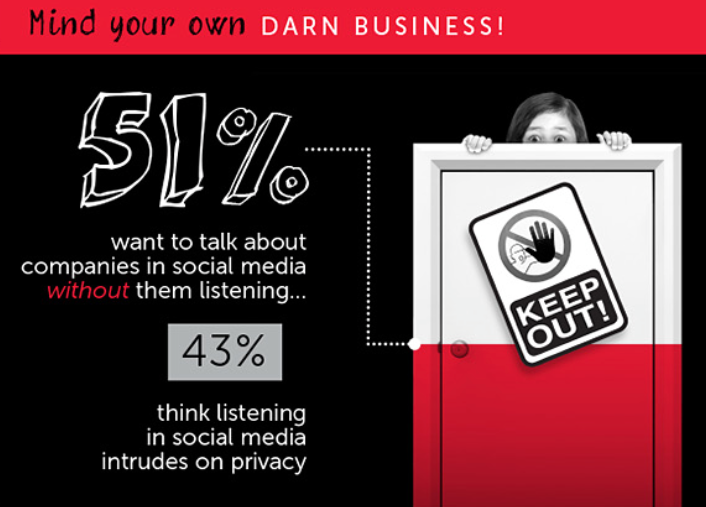
There are several other images like that, each of which says something we — as users and customers — have known all along, but companies spying on us (even for our own good) don’t. Or do, but have rationalized spying anyway, because that’s all they know how to do. So far.

Brian:

Considering that 58% want you to engage in times of need, 42% wish to hear from you in good times, 64% only want you listening to be at their beck and call, and half of all consumers don’t want you listening at all, what are you to do?

Obviously social media, and specifically social listening, isn’t going away. But it does take tactfulness, genuine intentions and diplomacy to listen, learn, and engage (directly or indirectly) in ways that consumers feel recognized and important. It’s hard to imagine that anyone who says something negative or positive only to have it appreciated and considered by an organization will feel anything other than thankful.

Agreed. Especially if the frame is still a social one, and the interplay happens on social media (meaning Facebook and Twitter, mostly).

But relationships of human beings are personal, not just social.

The problem I have with my car or my airline is not a social one. It’s personal. Obviously, I can make it social, and that’s how Social CRM works today: I complain on Twitter or Facebook. But why should I have to go through Facebook or Twitter to get a dialog going with a human being at a company providing me a product or service?

What we need is VRM. There is lots of VRM development going on, but we’re still missing VRM tools that match up with CRM tools. It’s as simple as that. Many are in progress, but they aren’t here yet, in the sense that any one of us knows we can use them, on our phones or computers, to get through to somebody on the other side, and to deal at a machine level with the stuff that machines handle best.

CRM can’t do it alone, and it’s wrong to expect it to do what it can’t. It takes two hands to clap. The missing hand for CRM, all along, has been VRM one.

What we need, I believe, at this point, is a few CRM-facing VRM companies and developers to get together with CRM developers who are ready to build out their side of VRM+CRM relationships. D2D: Developer to Developer.

Some of the VRM developers we need are on this list. Others will need to step up. And to do it soon, because it’s becoming clear at last that both SCRM and CRM can’t get it done alone.

VRM development work

I’ll be having a brown bag lunch today with a group of developers, talking about VRM and personal clouds, among other stuff that’s sure to come up. To make that easier, I’ve copied and pasted the current list from the VRM developers page of the ProjectVRM wiki. If you’d like to improve it in any way, please do — either on the wiki itself, or by letting us know what to change.

While there are entire categories that fit in the larger VRM circle — quantified self (QS) and personal health records (PHRs) are two that often come up — we’ve tried to confine this list to projects and companies that directly address the goals (as well as the principles) listed on the main page of the wiki.


Here is a partial list of VRM development efforts. (See About VRM). Some are organizations, some are commercial entities, some are standing open source code development efforts.

SOFTWARE and SERVICES
Intentcasting
AskForIt † – individual demand aggregation and advocacy
Body Shop Bids † – intentcasting for auto body work bids based on uploaded photos
Have to Have † – “A single destination to store and share everything you want online”
Intently † – Intentcasting “shouts” for services, in the U.K.
Innotribe Funding the Digital Asset Grid prototype, for secure and accountable Intentcasting infrastructure
OffersByMe † – intentcasting for local offers
Prizzm †- social CRM platform rewarding customers for telling businesses what they want, what they like, and what they have problems with
RedBeacon † – intentcasting locally for home services
Thumbtack † – service for finding trustworthy local service providers
Trovi intentcasting; matching searchers and vendors in Portland, OR and Chandler, AZ†
Übokia intentcasting†
Zaarly † intentcasting to community – local so far in SF and NYC
Browser Extensions
Abine † DNT+, deleteme, PrivacyWatch: privacy-protecting browser extentions
Collusion Firefox add-on for viewing third parties tracking your movements
Disconnect.me † browser extentions to stop unwanted tracking, control data sharing
Ghostery † browser extension for tracking the trackers
PrivacyScore † browser extensions and services to users and site builders for keeping track of trackers
Databases
InfoGrid – graph database for personal networking applications
ProjectDanube – open source software for identity and personal data services
Messaging Services and Brokers
Gliph †- private, secure identity management and messaging for smartphones
Insidr † – customer service Q&A site connecting to people who have worked in big companies and are willing to help when the company can’t or won’t
PingUp (was Getabl) †- chat utility for customers to engage with merchants the instant customers are looking for something
TrustFabric † – service for managing relationships with sellers
Personal Data and Relationship Management
Azigo.com † – personal data, personal agent
ComplainApp † – An iOS/Android app to “submit complaints to businesses instantly – and find people with similar complaints”
Connect.Me † – peer-to-peer reputation, personal agent
Geddup.com † – personal data and relationship management
Higgins – open source, personal data
The Locker Project – open source, personal data
Mydex †- personal data stores and other services
OneCub †- Le compte unique pour vos inscriptions en ligne (single account for online registration)
Paoga † – personal data, personal agent
Personal.com † – personal data storage, personal agent
Personal Clouds – personal cloud wiki
Privowny † – privacy company for protecting personal identities and for tracking use and abuse of those identities, building relationships
QIY † – independent infrastructure for managing personal data and relationships
Singly † – personal data storage and platform for development, with an API
Transaction Management
Dashlane † – simplified login and checkout
Trust-Based or -Providing Systems and Services
id3 – trust frameworks
Respect Network † – VRM personal cloud network based on OAuth, XDI, KRL, unhosted, and other open standards, open source, and open data initiatives. Respect Network is the parent of Connect.Me.
Trust.cc Personal social graph based fraud prevention, affiliated with Social Islands
SERVICE PROVIDERS OR PROJECTS BUILT ON VRM PRINCIPLES
First Retail Inc. † commodity infrastructure for bi-directional marketplaces to enable the Personal RFP
dotui.com † intelligent media solutions for retail and hospitality customers
Edentiti Customer driven verification of idenity
Real Estate Cafe † money-saving services for DIY homebuyers & FSBOs
Hover.com Customer-driven domain management†
Hypothes.is – open source, peer review
MyInfo.cl (Transitioning from VRM.cl) †
Neustar “Cooperation through trusted connections” †
NewGov.us – GRM
[1] † – Service for controlling one’s reputation online
Spotflux † malware, tracking, unwanted ad filtration through an encrypted tunnel
SwitchBook † – personal search
Tangled Web † – mobile, P2P & PDS
The Banyan Project– community news co-ops owned by reader/members
TiddlyWiki – a reusable non-linear personal Web notebook
Ting † – customer-driven mobile virtual network operator (MVNO – a cell phone company)
Tucows †
VirtualZero – Open food platform, supply chain transparency
INFRASTRUCTURE
Concepts
EmanciPay – dev project for customer-driven payment choices
GRM: Government Relationship Management – subcategory of VRM
ListenLog – personal data logging
Personal RFP – crowdsourcing, standards
R-button – UI elements for relationship members
Hardware
Freedom Box – personal server on free software and hardware
Precipitat, WebBox – new architecture for decentralizing the Web, little server
Standards, Frameworks, Code bases and Protocols
Datownia † – builds APIs from Excel spreadsheets held in Dropbox
Evented APIs – new standard for live web interactivity
KRL (Kinetic Rules Language) – personal event networks, personal rulesets, programming Live Web interactions
Kynetx † – personal event networks, personal rulesets
https://github.com/CSEMike/OneSwarm Oneswarm] – privacy protecting peer-to-peer data sharing
http://www.mozilla.org/en-US/persona/ Mozila Persona] – a privacy-protecting one-click email-based way to do single sign on at websites
TAS3.eu — Trusted Architecture for Securely Shared Services – R&D toward a trusted architecture and set of adaptive security services for individuals
Telehash – standards, personal data protocols
Tent – open decentralized protocol for personal autonomy and social networking
The Mine! Project – personal data, personal agent
UMA – standards
webfinger – personal Web discovery, finger over HTTP
XDI – OASIS semantic data interchange standard
PEOPLE
Analysts and Consultants
Ctrl-SHIFT † – analysts
Synergetics † – VRM for job markets
VRM Labs – Research
HealthURL – Medical
Consortia, Workgroups
Fing.org – VRM fostering organization
Information Sharing Workgroup at Kantara – legal agreements, trust frameworks
Pegasus – eID smart cards
Personal Data Ecosystem Consortium (PDEC) – industry collaborative
Meetups, Conferences, and Events
IIW: Internet Identity Workshop – yearly unconference in Mountain View
VRM Hub – meeting in LondonNOTES:
† Indicates companies. Others are organizations, development projects or both. Some development projects are affiliated with companies. (e.g. Telehash and The Locker Project with Singly, and KRL with Kynetx.)
A – creating standard
B – Using other standards
1 – EventedAPI

Toward a matrix of APIs

At  the 2006 O’Reilly Emerging Technology conference, Cal Henderson, then of Flickr, gave a long session called “Launching and scaling new Web services.” As I recall, among the many things he explained well were some principles behind the Flickr API. One of those principles was user access to data. The API should be one that allowed the user to haul all of her data out of the system, even if it was to federate that data into a competing system. That’s because Flickr believed that user data is the user’s first, and not just the company’s. Another principle was keeping the API stable, so as not to disrupt users and other services that depended on the API.

Cal left Flickr a couple years after that, but Flickr’s API remains a model of stability and utility — so much so that Dave Winer this morning suggested it be declared a national treasure.

Many of us depend in large ways to the APIs of companies great and small — and more get added to that collection every day. For a good picture of what’s going on with APIs, check out ProgrammableWeb.com. Between Dave’s respect for durable APIs like Flickr’s, and ProgrammableWeb’s roster of current and future dependencies, we start to see a matrix of APIs that Craig Burton compares to a city filled with buildings and relationships. Each API provider, like each building, exposes the provider’s core competencies in ways that can be engaged.

But what happens when we each have our own APIs — when our own core competencies become exposed in ways that can be engaged? And when we start managing our lives through relationships between our APIs and those in the rest of the world — especially in ways that are live and full-duplex (two ways at the same time, like a phone call)? And where each of us, or a trusted agent, can do the required IF, THEN, OR and other programming logic, between our own personal clouds and the clouds of others? What will we have then?

There is lots of blogging out loud about this, about both the downsides of dependency (as both Phil Windley and I have, toward Flickr in particular). But I think the upside deserves more than equal consideration, especially as companies begin to realize the importance of direct and engaged relationships with customers and users, which is what we’ll have when VRM and CRM (along with allied functions on both sides) fully engage. The result, I believe, will be a matrix of useful dependencies, based on APIs everywhere, thick with accountability and responsibility. The result will be far more opportunity, and boundless positive economic and social externalities based on the Net’s and the Web’s founding virtues. What will end, or at least be obsoleted, are Matrix-like worlds where users and customers are held captive.

Thus our goal for VRM: to prove that free customers are more valuable than captive ones — both to themselves and to everyone and everything else with which they engage.


Driving VRM with car data and APIs

Go read OnStar gives Volt owners what they want: their data, in the cloud, by Sean Gallagher, in Ars Technica. It’s a VRM story. The vendor is Chevrolet, the vended product is the Volt, and the relationship management is a DIY hack by one customer. The story begins,

You probably don’t think of your car as a developer platform, but Mike Rosack did. A few days after buying his Chevy Volt, Rosack started slowly mining his driving data. But he eventually revved up his efforts and created a community platform for drivers to track their own efficiency. Today more than 1,800 Volt owners compare stats with each other, jockeying for position on Rosack’s Volt Stats leader board.

volt dash with r-buttonThe Volt uses OnStar, a GM subsidiary known through its advertising for providing a way for drivers to call for roadside assistance; but which is actually a sophisticated cell-based data system through which cars communicate constantly with the mother ship’s cloud. While OnStar generously shares data back to customers through an app called RemoteLink, much more can be done with it, since it’s data and comes out through an API. Now here is where the story gets VRooMy:

Rosack initially wanted to do more with his own driving data than just view it on his phone. So he built what eventually became Volt Stats to capture this data, then started sharing it with other Volt owners. There was just one small problem: Volt Stats relied on Rosack’s reverse engineering of an interface for OnStar’s RemoteLink mobile application (iOS and Android). When OnStar moved to shut down the Web services interface Rosack had plugged into in mid-October, Volt Stats arrived at a screeching halt.

Rather than leaving Volt Stats stalled on the roadside, GM and OnStar accelerated efforts to give developers a new public Web API to create services on top of OnStar data. The companies even worked with Rosack to get him onboard and get Volt Stats re-launched. Now, Volt Stats is back online and other would-be car data hackers will soon be able to connect their Web applications to GM owners’ vehicle data (provided, of course, that they have privacy policies that meet with the approval of GM and OnStar lawyers).

OnStar had already developed an API for GM partners such as the car-sharing service RelayRides, who need to get access to some of the remote control and telematics elements of the service. But this new interface takes advantage of technologies such as OAuth and JAX-RS and it’s a step toward turning OnStar into a broader platform for the “Internet of things.” It’s also a way to give car enthusiasts a new kind of access to something they’ve always thought of as their own—their cars’ data.

Now come the VRM questions:

  • Where and how might customers store that data? Are current PDS (personal data stores) compatible and ready for it?
  • How might customers use that data — especially outside and between multiple vendors’ apps, APIs and relationship silos?
  • Might we see an  ⊂ (r-button) on the dashboards of car? How might that work? And if it does, how do we make it standard?
  • What usage and new market-driving scenarios might we start to imagine here?
  • How might customers assert their own privacy policies and terms as demand begins to drive supply?
  • What other interfaces do cars have that might be brought into the picture?
  • How can what happens here model what we do with the rest of the “Internet of things?”
  • What are the meshy wireless things we can do among ourselves and our cars, outside any vendor’s box? (Would love Robin Chase‘s thinking here.)

These are questions especially for VRM developers. Look for answers (and more questions) here and on various blogs.

VRM happenings in the U.K.

The tweets have been rolling in…

Identity Assurance: Mydex’s unique contribution. An interview with @dejalexander @MydexCIC http://www.ctrl-shift.co.uk/news/2012/11/15/identity-assurance-mydexs-unique-contribution/ …

@321CtrlShift interview with my colleague @dejalexander on @MydexCIC and #IDAssurance http://is.gd/7yyiZk  #VRM

Very thoughtful @SimonTucker blog post about today’s DWP announcement http://is.gd/zRslHa  #IDAssurance #VRM

williamheath@williamheath‏

For those who wondered how #VRM would first break in the popular press: http://bit.ly/107SqT9  #DailyMirror #Midata #CtrlShift

So let’s unpack those.

First, the DWP (Department for Work and Pensions) announcement. What Mydex and others will provide is online identity assurance. (Note: not “providing” an identity.) To explain, Out-Law.com gives us Online identity scheme providers selected to design new DWP framework for verifying claims by benefits seekers.

This is one step in a march of reform led by the U.K. government, and moving in a generally VRooMy direction through the Midata program. Here are some links, starting in late 2011, and listed roughly chronologically:

The piece in the Mirror focuses on health and retail discounts. VRM is much broader than that, but it’s a good start.

[Later…] More below, from William Heath.

IIW XV

The XVth IIW is coming up on October 23-25 at the Computer History Museum in Mountain View, and VRM will be, as usual, a big topic — or collection of topics — there.

IIW stands for Internet Identity Workshop, but the topical range is much wider than identity alone. Front and center for the last several IIWs has been personal data (a special concern not only of many VRM development efforts, but of the Personal Data Ecosystem Consortium).

IIW is an unconference that Kaliya Hamlin, Phil Windley and I have been putting on twice a year since 2005. It could hardly be less formal or conference-like. There are no panels, no speakers, no keynotes. There are just participants. All the sessions are breakouts, and all the topics are chosen by participants, who come up with them at the start of each day, vetting whatever they like with the rest of the crowd. Some of the sessions are technical, many others are not. All of them are interesting, lively, and move things forward.

As in IIWs past, we have a VRM planning day on Monday, just before IIW. That’s the 22nd. Everybody is welcome. The purpose is to discuss what we’d like to make happen over the following three days. Unlike IIWs past, this planning day is also at the Computer History Museum. It’ll run from 9 to 5.

Here are some topics currently being vetted on the ProjectVRM list:

  1. Demonstrations of progress on various VRM fronts
  2. Relationship management tools, including UI elements such as r-buttons: ⊂ ⊃.
  3. Personal data store/locker/vault/cloud etc. efforts
  4. Personal operating systems (including personal cloud)
  5. Intentcasting, aka personal RFPs
  6. Turning DNT (Do Not Track) into DNT-D (Do Not Track + Dialog)
  7. Cooperation + competition among and between different VRM development efforts
  8. FOSS (free and open source software) and VRM
  9. Creating and working with APIs
  10. Standards and protocols old and new (e.g. XDI, RDF, tent.io)
  11. Role of governments (e.g. Midata in the UK, and privacy ministries in various countries)
  12. Legal / terms of service and engagement, and expression of preferences and policies
  13. Trust frameworks
  14. Working with industry verticals, such as banks and retail
  15. Matching up with QS (Quantified Self ) and self-hacking movements and interests (especially around personal data)
  16. Matching up VRM and CRM/sCRM
  17. Subject-based VRM, such as with the “subscription economy”
  18. VCs and other investors
  19. Relationships with other .orgs, e.g. PDE.Cc, Customer Commons
  20. Discovering and encouraging more VRM and VRooMy development efforts
  21. Alignment of talking points when evangelizing VRM
  22. Intention Economy
  23. Relationship Economy (and overlaps with the above)
  24. Identity-related matters, including NSTIC

I numbered them not in order of importance, but just to make them easier to discuss at the meeting. (e.g. “Let’s look at number 13”). Look forward to seeing you there.

Here are some photos from IIWs past. The photo up top is of a slab of metal covering a hole in pavement on a street in Manhattan. Saw it and couldn’t resist shooting it with my phone.

Let’s turn Do Not Track into a dialog

Do Not Track (DNT), by resembling Do Not Call in name, sounds like a form of prophylaxis.  It isn’t. Instead it’s a request by an individual with a browser not to be tracked by a website or its third parties. As a request, DNT also presents an interesting opportunity for dialogue between user and site, shopper and retailer, or anybody and anything. I laid out one possibility recently in my Inkwell conversation at The Well. Here’s a link to the page, and here’s the text of the post:

The future I expect is one in which buyers have many more tools than they have now, that the tools will be theirs, and that these will enable buyers to work with many different sellers in the same way.

One primitive tool now coming together is “Do Not Track” (or DNT): http://en.wikipedia.org/wiki/Do_Not_Track It’s an HTTP header in a user’s browser that signals intention to a website. Browser add-ons or extensions for blocking tracking, and blocking ads, are also tools, but neither constitute a social protocol, because they are user-side only. The website in most cases doesn’t know ad or tracking blocking being used, or why. On the other hand, DNT is a social gesture. It also isn’t hostile. It just expresses a reasonable intention (defaulted to “on” in the physical world) not to be followed around.

But DNT opens the door to much more. Think of it as the opening to dialog:

User: Don’t track me.
Site: Okay, what would you like us to do?
User: Share the data I shed here back to me in a standard form, specified here (names a source).
Site: Okay. Anything else?
User: Here are my other preferences and policies, and means for matching them up with yours to see where we can agree.
Site: Good. Here are ours.
User: Good. Here is where they match up and we can move forward.
Site: Here are the interfaces to our CRM (Customer Relationship Management) system, so your VRM (Vendor Relationship Management) system can interact with it.
User: Good. From now on my browser will tell me we have a working relationship when I’m at your site, and I can look at what’s happening on both sides of it.

None of this can be contemplated in relationships defined entirely by the sellers, all of which are silo’d and different from each other, which is what we’ve had on the commercial Web since 1995. But it can be contemplated in the brick & mortar world, which we’ve had since Ur. What we’re proposing with VRM is nothing more than bringing conversation-based relationships that are well understood in the brick-and-mortar world into the commercial Web world, and weaving better marketplaces in the process.

A bit more about how the above might work:
http://blogs.law.harvard.edu/vrm/2012/02/23/how-about-using-the-no-track-button-we-already-have/

And a bit more about what’s wrong with the commercial Web (so far, and it’s not hard to fix) here:
http://blogs.law.harvard.edu/vrm/2012/02/21/stop-making-cows-stop-being-calves /

So, to move forward, consider this post a shout-out to VRM developers, to the Tracking Protection Working Group at the W3C, to browser developers, to colleagues at Berkman (where Chris Soghoian was a fellow, about at the time he helped think up DNT) — and to everybody with the will and the ways to move forward on this thing.

And hey: it’s also our good luck that the next IIW is coming up at the Computer History Museum in Mountain View, from October 23rd to 25th. IIW is the perfect place to meet and start hashing out DNT-D (I just made that up: DNT-Dialog) directions. IIW is an unconference: no keynotes, panelists or vendor booths. Participants vet and choose their own topics and break out into meeting rooms and tables. It’s an ideal venue for getting stuff done, which always happens, and why this is the 15th of them.

Meanwhile, let’s get in touch with each other and start making it happen.

Scaling business in parallel

Companies and customers need to be able to deal with each other in two ways: as individuals and as groups.

As of today companies can deal with customers both ways. They can get personal with customers, and they can deal with customers en masse. Without the latter capability, mass marketing would not be possible.

Customers, on the other hand, can only deal with companies as individuals, one at a time. Dealing with companies as groups is still a challenge. Consider the way you engage companies in the marketplace, both online and off. Your dealings with companies, on the whole, are separate and sequential. Nothing wrong with that, but it lacks scale. Hence: opportunity.

We can arrive at that opportunity space by looking at company and personal dealings, each with two kinds of engagement circuits: serial and parallel.

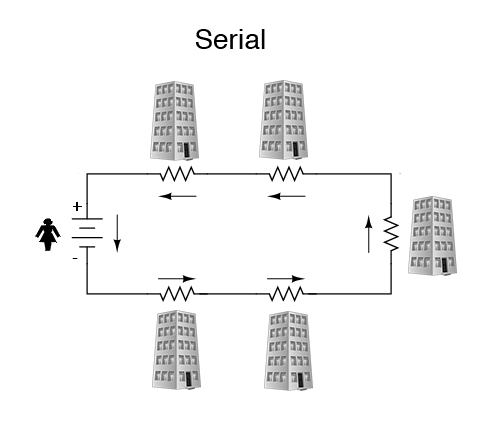
Start with a small company, say a store with customers who line up at the counter. That store  deals with customers in a serial way:

business, serial

The customers come to the counter, one after another, in a series. Energy in the form of goods goes out, and money comes back.

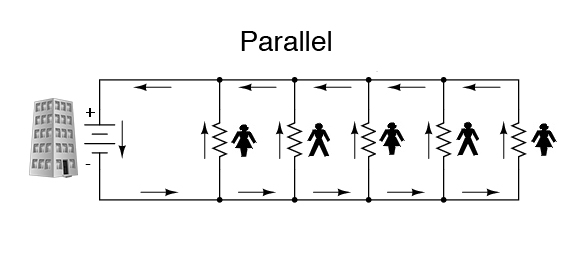
As companies scale up in size, however, they’d rather deal with many customers in parallel rather than in series. A parallel circuit looks like this:

business, parallel

Here customers are dealt with as a group: many at once, and in the same way. This, in an extremely simplified form, is a diagram of mass marketing. While it is still possible for a company to deal with customers individually, the idea is to deal with as many customers as possible at once and in the same ways.

I use electronic symbols in those circuits because resistance (the zig-zag symbol) adds up in series, while it goes down in parallel. This too is a virtue of mass marketing. Thus one-to-many works very well, and has proven so ever since Industry won the Industrial Revolution.

Over on the customers’ side, the marketplace on the whole looks like this:

customer, serial

The customer goes from one company to the next. This is not a problem on the vendors’ side, except to the degree that vendors would rather customers not shop elsewhere. This is why vendors come up with loyalty programs and other schemes to increase “switching costs” and to otherwise extract as much money and commitment as possible out of the customer.

But, from the customer’s side, it would also be cool if they could enjoy scale in parallel across many companies, like this:

In the physical world this is all but unthinkable. But the Internet makes it very thinkable, because the Net reduces nearly to zero the functional distance between any two entities, and presents an open space across which many connections can be made, at once if necessary, with few limits on the number or scope of possibilities. There is also no limit to the new forms of interaction that can happen here.

For example, a customer could scale in parallel by expressing demand to multiple vendors at the same time, or could change her contact information at once with many companies. In fact this is basically what VRM projects are about: scaling in parallel across many other entites. (Not just vendors, but also elected officials, government agencies, churches, clubs, and so on.)

It is easy to see how companies can feel threatened by this. For a century and a half we in business have made a virtue of “targeting,” “acquiring,” “capturing,” “managing,” “locking in” and “owning” customers. But think about the free market for a minute. Shouldn’t free customers be more valuable than captive ones? Wouldn’t it be better if customers and prospects could send many more, and better, signals to the marketplace, and to vendors as well, if they were capable of having their own native ways of dealing, consistently, across multiple vendors?

We have that now with email and other forms of messaging. But why stop there?

Naturally, it’s easy to ask, Could social media such as Facebook, Google+ and Twitter provide some of what we need here? Maybe, but the problem is that they are not ours, and they don’t work for us — in the sense that they are accountable to us. They work for advertisers. Email, IM and browsing aren’t owned by anybody. They are also substitutable. For example, you can move your mail from Gmail to your own server or elsewhere if you like. Google doesn’t own email’s protocols. No browser company owns HTTP, HTML or any of the Web’s protocols.

The other problem with social solutions is that they’re not personal. And that’s the scale we’re talking about here: adding parallel capabilities to individuals. Sure, aggregation is possible, and a good thing. (And a number of VRM projects are of the aggregating-demand sort.) But the fallow ground is under our own feet. That’s where the biggest market opportunity is located. Also where, still, it is most ignored. Except, of course, here.

[Continued in VRM/CX + CRM/CX.]

VRM at IIW

VRM was a hot topic at IIW last week, with at least one VRM or VRM-related breakout per session — and that was on top of the VRM workshop held at Ericsson on Monday, April 30, the day before IIW started. (Thanks to Nitin Shah and the Ericsson folks for making the time and space available, in a great facility.) Here’s a quick rundown from the #IIW14 wiki:

Tuesday, May 1, Session 1

Tuesday, May 1,Session 2

Tuesday, May 1, Session 3

Tuesday, May 1,Session 4

Tuesday, May 1,Session 5

Wednesday, May 2, Session 1

Wednesday, May 2,Session 2

Wednesday, May 2,Session 3

Wednesday, May 2,Session 4

Wednesday, May 2,Session 5

Thurssday, May 3,Sessions 1-5

On Friday, May 4, I also visited with Jeremie Miller, Jason Cavnar and the Locker Project / Singly team in San Francisco. Very impressed with what they’re up to as well.

Bonus IIW linkage:

Your actual wallet vs./+ Google’s and Apple’s

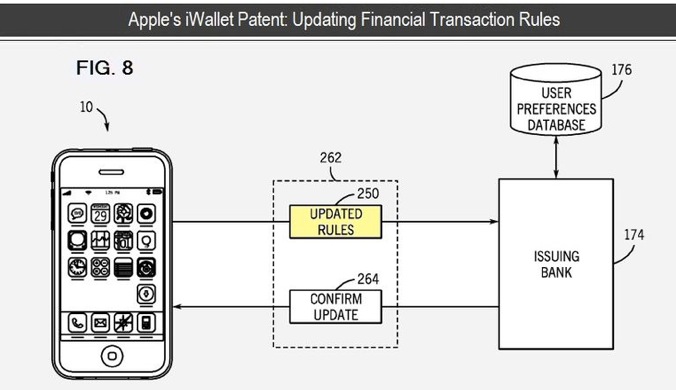
Now comes news that Apple has been granted a patent for the iWallet. Here’s one image among many at that last link:

iwallet

Note the use of the term “rules.” Keep that word in mind. It is a Good Word.

Now look at this diagram from Phil Windley‘s Event Channels post:

event channels

Another term for personal event network is personal cloud. Phil visits this in An Operating System for Your Personal Cloud, where he says, “In contrast a personal event network is like an OS for your personal cloud. You can install apps to customize it for your purpose, it canstore and manage your personal data, and it provides generalized services through APIsthat any app can take advantage of.” One of Phil’s inventions is the Kinetic Rules Language, or KRL, and the rules engine for executing those rules, in real time. Both are open source. Using KRL you (or a programmer working for you, perhaps at a fourth party working on your behalf, can write the logic for connecting many different kinds of events on the Live Web, as Phil describes here).

What matters here is that you write your own rules. It’s your life, your relationships and your data. Yes, there are many relationships, but you’re in charge of your own stuff, and your own ends of those relationships. And you operate as  free, independent and sovereign human being. Not as a “user” inside a walled garden, where the closest thing you can get to a free market is “your choice of captor.”

Underneath your personal cloud is your personal data store (MyDex, et. al.), service (Higgins), locker (Locker Project / Singly), or vault (Personal.com). Doesn’t matter what you call it, as long as it’s yours, and you can move the data from one of these things into another, if you like, compliant with the principles Joe Andrieu lays out in his posts on data portability, transparency, self-hosting and service endpoint portability.

Into that personal cloud you should also be able to pull in, say, fitness data from Digifit and social data from any number of services, as Singly demonstrates in its App Gallery. One of those is Excessive Mapper, which pulls together checkins with Foursquare, Facebook and Twitter. I only check in with Foursquare, which gives me this (for the U.S. at least):

Excessive Mapper

The thing is, your personal cloud should be yours, not somebody else’s. It should contain your data assets. The valuable nature of personal data is what got the World Economic Forum to consider personal data an asset class of its own. To help manage this asset class (which has enormous use value, and not just sale value), a number of us (listed by Tony Fish in his post on the matter) spec’d out the Digital Asset Grid, or DAG…

DAG

… which was developed with Peter Vander Auwera and other good folks at SWIFT (and continues to evolve).

There are more pieces than that, but I want to bring this back around to where your wallet lives, in your purse or your back pocket.

Wallets are personal. They are yours. They are not Apple’s or Google’s or Microsoft’s, or any other company’s, although they contain rectangles representing relationships with various companies and organizations:

Still, the container you carry them in — your wallet — is yours. It isn’t somebody else’s.

But it’s clear, from Apple’s iWallet patent, that they want to own a thing called a wallet that lives in your phone. Does Google Wallet intend to be the same kind of thing? One might say yes, but it’s not yet clear. When Google Wallet appeared on the development horizon last May, I wrote Google Wallet and VRM. In August, when flames rose around “real names” and Google +, I wrote Circling Around Your Wallet, expanding on some of the same points.

What I still hope is that Google will want its wallet to be as open as Android, and to differentiate their wallet from Apple’s through simple openness.  But, as Dave Winer said a few days ago…

Big tech companies don’t trust users, small tech companies have no choice. This is why smaller companies, like Dropbox, tend to be forces against lock-in, and big tech companies try to lock users in.

Yet that wasn’t the idea behind Android, which is why I have a degree of hope for Google Wallet. I don’t know enough yet about Apple’s iWallet; but I think it’s a safe bet that Apple’s context will be calf-cow, the architecture I wrote about here and here. (In that architecture, you’re the calf, and Apple’s the cow.) Could also be that you will have multiple wallets and a way to unify them. In fact, that’s probably the way to bet.

So, in the meantime, we should continue working on writing our own rules for our own digital assets, building constructive infrastructure that will prove out in ways that require the digital wallet-makers to adapt rather than to control.

I also invite VRM and VRooMy developers to feed me other pieces that fit in the digital assets picture, and I’ll add them to this post.

« Older posts Newer posts »

© 2026 ProjectVRM

Theme by Anders Noren — Up ↑