Category: CX

Shooting for the World

There is no organisation on Earth with a more audacious purpose than this one:
From Customer Commons’ current index page.

This isn’t shooting for the Moon. It’s shooting for the whole world of business.

What Customer Commons wants to restore isn’t just what was lost when the Internet got real. (For example, privacy.) Customer Commons also wants to restore personal agency that was lost when Industry won the Industrial Revolution. That’s when jobs replaced work, labour replaced teams, and customers became consumers.

That last shift, Jerry Michalski explains, was from human beings to “gullets with wallets and eyeballs.” After that shift, freedom of contract in marketplaces was enjoyed only by businesses. Not by gullets.

Customer Commons was created to change that. It was spun out of ProjectVRM as a 501(c)3 nonprofit in 2013, shortly after Harvard Business Review Press published  The Intention Economy: When Customers Take Charge. That book specifically gave Customer Commons the job of doing for personal privacy terms what Creative Commons did for personal copyright.  And to do it by making privacy a contract between customers and businesses, rather than a “consent” to whatever the hell businesses wanted to shove down our gullets. (For example, with interruptive cookie “choices” that really aren’t and leave no audit trail.)

Work on that began in 2017, when the IEEE approached Customer Commons with an offer to host development of a standard for machine-readable personal privacy terms. That standard, officially called IEEE 7012-2025, and nicknamed MyTerms, was published this past January, concluding nine years of work.

Now what?

MyTerms is a great start toward completing Customer Commons’ audacious mission. Here are some goals we will achieve when that mission is accomplished:

  1. VRM will be a business category, welcomed and engaged by CRM and CX functions on the sell sides of markets.
  2. We will have proof that free customers are worth more than captive ones—to companies they engage, to whole markets, and to themselves. This was ProjectVRM’s original mission in 2006.
  3. The intention economy will materialize when voluntary signaling from customers to companies outperforms and obsolesces surveillance as the primary means for companies to obtain data about customers.

MyTerms is required for all three, because a contract is the only way for companies to commit to respecting personal privacy, and MyTerms is the standard for doing that.

So the first challenge is to make Customer Commons viable as the first mover in establishing MyTerms in the world.

The second challenge is to make Customer Commons substantial enough to lead work toward all three of the challenges listed above. Customer Commons won’t be the only entity working on those. In the U.S., Consumer Reports has already stepped forward as a natural ally.  MyData Global is partnering with Customer Commons in standing up the MyTerms Alliance, which is HQ’d in Europe. There are many other potential partners, such as Mozilla and the EFF.

There is development work on MyTerms already. You can learn more about those at VRM Day, IIW, and AIW, which run M-F through the last week of this month (April 27 to May 1) at the Computer History Museum in Silicon Valley.

Here are other ideas that have been floated in the past for Customer Commons:

  1. Customers Union. Being for customers what the AARP is for retired people. Only bigger, because it would include everybody who is a customer of anything. This isn’t far from Consumers Union, which begat Consumer Reports, and is now its advocacy group.
  2. CustomerCon. A trade show with company booths run by customers, to which companies are invited as guests. Key feature: no complaining. Guest companies are treated only to positive and constructive ideas. HT to Tim Hwang for helping come up with that one.
  3. Omie. A tablet with apps free of Google and Apple. HT to Iain Henderson.
  4. The ByWay, a new path for local e-commerce.
  5. The Free Customer Award. This would be given to companies that value free customers and do nothing to entrap them. The canonical example described in The Intention Economy is Trader Joe’s. But there are others. In-N-Out Burger, for example.

I share those only to give you an idea of how big and influential Customer Commons might be, and how it’s possible to have fun making a new and better economy happen.

We’re not at Square One. Customer Commons is an extant nonprofit, has an energetic board, and a huge accomplishment by getting MyTerms finished. What it needs now is to build out a working organisation. How can we do that?

Let’s look at how Creative Commons got rolling in 2002 and kept moving after that. Here is what I’ve found in diggings so far—

  • The History of Creative Commons in Wired (December 2011) says, “An hour after the court’s decision was announced, the William and Flora Hewlett Foundation presented Creative Commons with $1,000,000 to launch the movement.” The case was Eldred v. Ashcroft.
  • In 2008, there was a successful funding challenge from Hewlett: “The 5×5 challenge, issued in honor of Creative Commons’ fifth birthday, called for the organization to find five funders to each promise five years of support at $500,000 per year. In addition to the Hewlett Foundation, Creative Commons received pledges of $500,000 in yearly support for five years from Omidyar Network, as well as from an anonymous European trust. Google has pledged $300,000 in support renewable for five years, while Mozilla and Red Hat have each pledged to contribute $100,000 annually for five years. The final block of support comes from the board of Creative Commons, which has promised to personally raise or contribute $500,000 to the organization annually for five years.”(Source: Creative Commons Newsletter No.5, February 2008)
  • A Creative Commons  announcement in April 2008 said, “We’re thrilled about a major new grant of $4 million from the William and Flora Hewlett Foundation, consisting of $2.5 million to provide general support to Creative Commons over five years, as well as $1.5 million to support ccLearn.”
  • A MacArthur grant search reports a total of $3,225,000 provided between 2002 and 2022:
    • $750,000 in 2005 to support general operations for three years
    • $500,000 in 2007 to support Science Commons for two years
    • $700,000 in2008 to support general operations and an endowment campaign for three years
    • $25,000 in 2015 to provide travel and other support for attendees of the Creative Commons Global Summit in South Korea, for two months. The meeting was also funded in part by the Institute for Museu m and Library Services and th e Gates Foundation, and by the Korean Ministry of Culture, Sports and Tourism ($25,000), Mozilla ($10,000), and the Wikimedia Foundation ($10,000).
    • $50,000 in 2022 to support dedicated programming on open journalism issues at the 2023 Global Summit, “which is an annual event that brings together educators, artists, technologists, legal experts, and activists to promote the power of open licensing and global access.”

So, by inference, the phases were roughly this:

  • Launch (2001–2002) $1M of initial funding
  • Early build-out (2002–2004) +$1–3M with  additional foundation support
  • Continuous operations (2005 onward) at ~$1–3M/year

That gives us an idea of what we need to raise. (Given inflation, multiply those numbers by 1.5x.)

I’ll tell you more when I find out more. Meanwhile, watch this space. Better yet, jump in and help out.



The Cluetrain Will Run from Customers to Companies

For the good of both.

Customers need privacy, respect, and the ability to provide good and helpful information to the companies they deal with. The good clues customers bring can include far more than what companies get today from their CRM systems and from surveillance of customer activities. For example, market intelligence that flows both ways can happen on a massive scale.

But only if customers set the terms.

Now they can, using a new standard from the IEEE called P7012, aka MyTerms. It governs machine readability of personal privacy terms. These are terms that customers proffer as first parties, and companies agree to as second parties. Lots of business can be built on top of those terms, which at the ground level start with service provision without surveillance or unwanted data sharing by the company with other parties. New agreements can be made on top of that, but MyTerms are where genuine and trusting (rather than today’s coerced and one-sided) relationships can be built.

When companies are open to MyTerms agreements, they don’t need cookie notices. Nor do they need 10,000-word terms and conditions or privacy policies because they’ll have contractual agreements with customers that work for both sides.

On top of that foundation, real relationships can be built by VRM systems on the customers’ side and CRM systems on the corporate side. Both can also use AI agents: personal AI for customers and corporate AI for companies. Massive businesses can grow to supply tools and services on both sides of those new relationships. These are businesses that can only grow atop agreements that customers bring to the table, and at scale across all the companies they engage.

This is the kind of thing that four guys (me included)† had in mind when they posted The Cluetrain Manifesto* on the Web in April 1999. A book version of the manifesto came out in early 2000 and became a business bestseller that still sells in nine languages. Above the manifesto’s 95 theses is this master clue**, written by Christopher Locke:

MyTerms is the only way we (who are not seats or eyeballs or end users or consumers) finally have reach that exceeds corporate grasp, so companies can finally deal with the kind of personal agency that the Internet promised in the first place.

The MyTerms standard requires that a roster of possible agreements be posted at a disinterested nonprofit.  The individual chooses one, the company agrees to it (or not). Both sides keep an identical record of the agreement.

The first roster will be at Customer Commons, which is ProjectVRM’s 501(c)3 nonprofit spinoff. It was created to do for personal privacy terms what Creative Commons does for personal copyright licenses. (It was Customer Commons, aka CuCo, that the IEEE approached with the idea of creating the MyTerms standard.)

Work on MyTerms started in 2017 and is in the final stages of IEEE approval process. While it is due to be published early next year, what it specifies is simple:

  • Individuals can choose a term posted at Customer Commons or the equivalent
  • Companies can agree to the individual’s choice or not
  • The decision can be recorded identically by both sides
  • Data about the decision can be recorded by both sides and kept for further reference, auditing, or dispute resolution
  • Both sides can know and display the state of agreement or absence of agreement (for example, the state of a relationship, should one come to exist)

MyTerms not a technical spec, so implementations are open to whatever. Development on any of those can start now. So can work in any of the six areas listed above.

The biggest thing MyTerms does for customers—and people just using free services—is getting rid of cookie notices, which are massively annoying and not worth the pixels they are printed on.  If a company really does care about personal privacy, it’ll respect personal privacy requirements. This is how things work in the natural world, where tracking people like marked animals has been morally wrong for millennia. In the digital world, however, agreements need to be explicit, so programming and services can be based on them. MyTerms does that.

For business, MyTerms has lots of advantages:

  • Reduced or eliminated compliance risk
  • Competitive differentiation
  • Lower customer churn
  • Grounds for real rather than coerced relationships (CRM+VRM)
  • Grounds for better signaling (clues!) going in both directions
  • Reduced or eliminated guesswork about what customers want, how they use products and services, and  how both might be improved

Lawyers get a new market for services on both the buy and sell sides of the marketplace. Companies in the CMP (consent management platform) business (e.g. Admiral and OneTrust) have something new and better to sell.

Lawmakers and Regulators can start looking at the Net and the Web as places where freedom of contract prevails, and contracts of adhesion (such as what you “agree” to with cookie notices) are obsolesced.

Developers can have a field day (or decade). Look for these categories to emerge

  • Agreement Management Platforms – Migrate from today’s much-hated consent management platforms (hello OneTrust, Admiral, and the rest).
  • Vendor Relationship Management (VRM) Tools and services – Fill the vacuum that’s been there since the Web got real in 1995.
  • Customer Relationship Management (CRM) – Make its middle name finally mean something.
  • Customer Data Return (CDR) – Give, sell back, or share with customers the data you’ve been gathering without their permission since forever. Talking here to car companies, TV makers, app makers, and every other technology product with spyware onboard for reporting personal activity to parties unknown.
  • Platform Relief –  Free customers from the walled gardens of Apple, Microsoft, Amazon, and every other maker of hardware and software that currently bears the full burden of providing personal privacy to customers and users. Those companies can also embrace and help implement MyTerms for both sides of the marketplace.
  • Personal AI (pAI)– Till and plant a vast new greenfield for countless companies, old and new. This includes Apple (which can make Apple Intelligence truly “AI for the rest of us” rather than Siri in AI drag), Mozilla (with its Business Accelerator for personal AI) , Kwaai (for open source personal AI), and everyone else who wants to jump on the train.
  • Big meshes of agents, such as what these developers are all working on.

In the marketplace, we can start to see all these things:

  • Predictions made by The Intention Economy: When Customers Take Charge finally come true.
  • New dances between customers and companies, demand and supply. (“The Dance” is a closing chapter of The Intention Economy.)
  • New commercial ecosystems can grow around a richer flow of clues in both directions, based on shared interest and trust between demand and supply.
  • Surveillance capitalism will be obsolesced — and replaced by an economy aligned with personal agency and respect from customers’ corporate partners.
  • A new distributed P2P fabric of personally secure and shared data processing and storage — See what KwaaiNet + Verida, for example, might do together.

All aboard!


†Speaking for myself in this post. I invite the other two surviving co-authors to weigh in if they like.

*At this writing, the Cluetrain website, along with many others at its host, is offline while being cured of an infection.  To be clear, however, it will be back on the Web. Meanwhile, I’m linking to a snapshot of the site in the Internet Archive—a service for which the world should be massively grateful.

**The thesis that did the most to popularize Cluetrain was “Markets are conversations,” which was at the top of Cluetrain’s ninety-five theses. Imagining that this thesis was just for them, marketers everywhere saw marketing, rather than markets, as “conversations.” Besides misunderstanding what Cluetrain meant by conversation (that customers and companies should both have equal and reciprocal agency, and engage in human ways), marketing gave us “conversational” versions of itself that were mostly annoying.  And now (thank you, marketing), every damn topic is now also a fucking “conversation”—the “climate conversation,” the “gender conversation,” the “conversation about data ownership.” I suspect that making “conversation” a synonym for “topic” was also a step toward making every piece of propaganda into a “narrative.” But I digress. Stop reading here and scroll back to read the case for MyTerms. And please, hope that it also doesn’t become woefully misunderstood.

Derailing the Customer Journey

This came in the mail today:

Everything they list is something I don’t want to do. I’d rather just accumulate the miles. But I can’t, unless I choose one of the annoyances above, or book a flight in the next three months.

So my customer journey with American is now derailed.

There should be better ways for customers and companies to have journeys together.

Hmm… Does United have one?

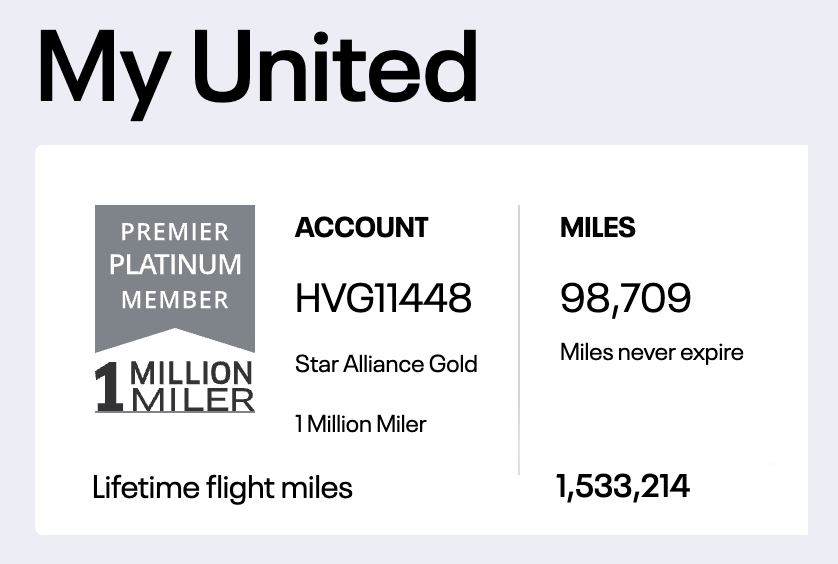
Here’s a picture of my customer journey with United Airlines, as of today:

I’m also a lifetime member of the United Club, thanks to my wife’s wise decision in 1990 to get us both in on that short-lived deal.

Premier Platinum privileges include up to three checked bags, default seating in Economy Plus (more legroom than in the rest of Economy), Premium lines at the ticket counter and Security, and boarding in Group One. There are more privileged castes, but this one is a serious tie-breaker against other airlines. Also, in all our decades of flying with United, we have no bad stories to tell, and plenty of good ones.

But now we’re mostly based in Bloomington, Indiana, so Indianapolis (IND) is our main airport. (And it’s terrific. We recommend it highly.) It is also not a hub for any of the airlines. The airline with the most flights connecting to IND is American, and we’ve used them. I joined their frequent flier program, got their app, and started racking up miles with them too.

So here is one idea, for every airline: having respect for one’s established status with other airlines means something. Because that status (or those stati) are credentials: They say something about me as a potential passenger. It would be nice also if what I carry, as an independent customer, is a set of verifiable preferences—such as that I always prefer a window seat, never tow a rolling bag on board (I only have a backpack), and am willing to change seats so a family can sit together. Little things that might matter.

I bring all this up because fixing “loyalty” programs shouldn’t be left up only to the sellers of the world. They’ll all do their fixes differently, and they’ll remain deaf to good input that can only come from independent customers with helpful tools of their own.

Developing those solutions to the loyalty problem is one of our callings at ProjectVRM. I also know some that are in the works. Stay tuned. 🙂

© 2026 ProjectVRM

Theme by Anders NorenUp ↑