Category: VRM Day

Finally Fixing Health Care

Source: ChatGPT

Interesting how old posts get new traffic. The heaviest traffic this morning is to Health Care Relationship Management, which ran almost nineteen years ago. That post concerned a Steve Lohr story in the NY Times titled Google and Microsoft Look to Change Health Care.  The gist:

The Google and Microsoft initiatives would give much more control to individuals, a trend many health experts see as inevitable. “Patients will ultimately be the stewards of their own information,” said John D. Halamka, a doctor and the chief information officer of the Harvard Medical School.

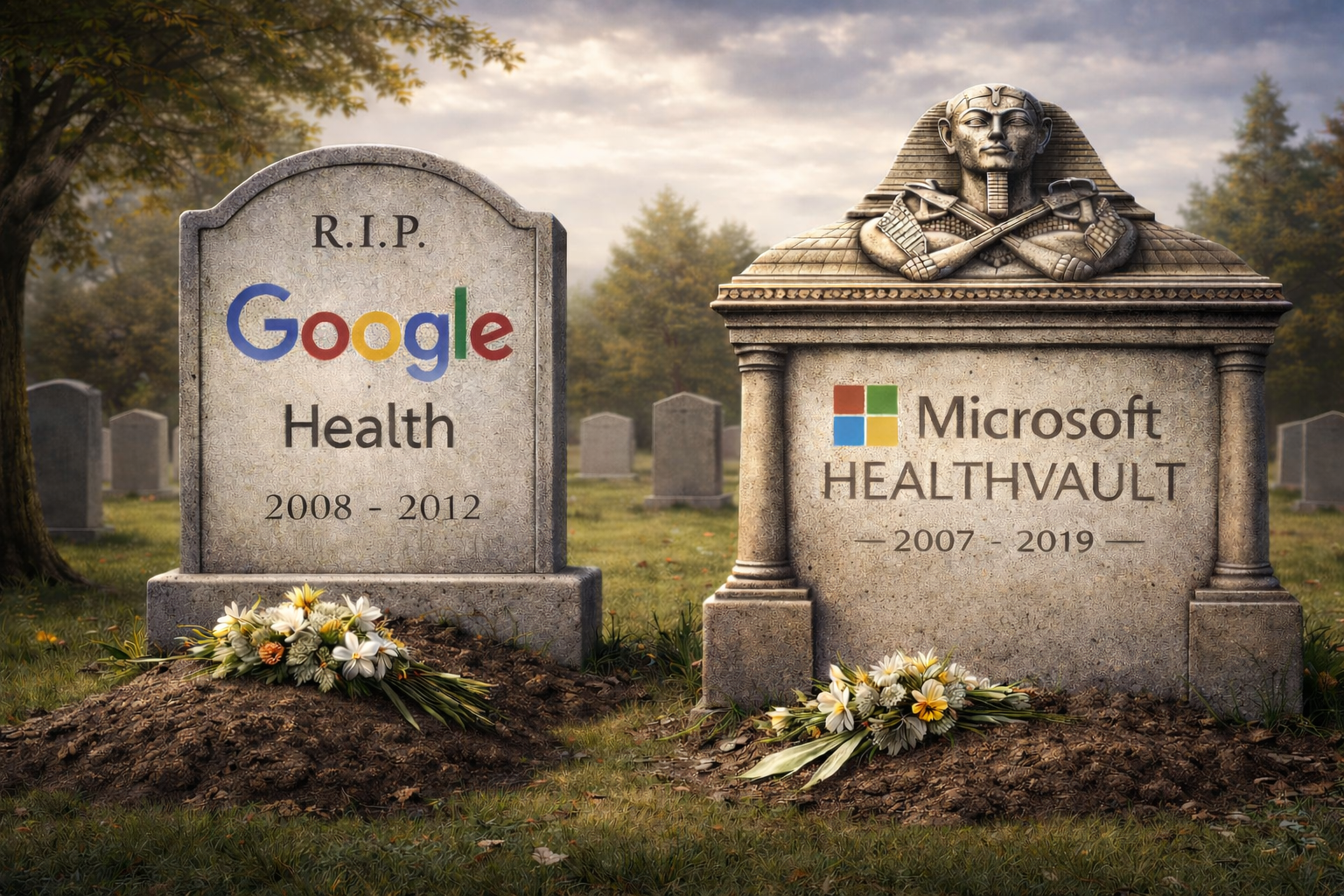
The initiatives were Google Health  and Microsoft Healthvault. Never mind why they died. Those links will tell you. What matters more is what I said way back then: The key, as with all VRM projects, is that the solution needs to be anchored on the customer side — in this case the patient side — of the relationship.

As it happens, Adrian Gropper, techie and MD, was on this case long before Google and Microsoft showed up to waste $billions failing to solve a problem they could only compound. And he’s still at it, with HIE of One and related efforts. Here is his Substack. These subjects will be on the floor at VRM Day and IIW later this month. VRM for healthcare will save the world $billions, in addition to countless lives.

Here’s Adrian’s latest.

Shooting for the World

There is no organisation on Earth with a more audacious purpose than this one:
From Customer Commons’ current index page.

This isn’t shooting for the Moon. It’s shooting for the whole world of business.

What Customer Commons wants to restore isn’t just what was lost when the Internet got real. (For example, privacy.) Customer Commons also wants to restore personal agency that was lost when Industry won the Industrial Revolution. That’s when jobs replaced work, labour replaced teams, and customers became consumers.

That last shift, Jerry Michalski explains, was from human beings to “gullets with wallets and eyeballs.” After that shift, freedom of contract in marketplaces was enjoyed only by businesses. Not by gullets.

Customer Commons was created to change that. It was spun out of ProjectVRM as a 501(c)3 nonprofit in 2013, shortly after Harvard Business Review Press published  The Intention Economy: When Customers Take Charge. That book specifically gave Customer Commons the job of doing for personal privacy terms what Creative Commons did for personal copyright.  And to do it by making privacy a contract between customers and businesses, rather than a “consent” to whatever the hell businesses wanted to shove down our gullets. (For example, with interruptive cookie “choices” that really aren’t and leave no audit trail.)

Work on that began in 2017, when the IEEE approached Customer Commons with an offer to host development of a standard for machine-readable personal privacy terms. That standard, officially called IEEE 7012-2025, and nicknamed MyTerms, was published this past January, concluding nine years of work.

Now what?

MyTerms is a great start toward completing Customer Commons’ audacious mission. Here are some goals we will achieve when that mission is accomplished:

  1. VRM will be a business category, welcomed and engaged by CRM and CX functions on the sell sides of markets.
  2. We will have proof that free customers are worth more than captive ones—to companies they engage, to whole markets, and to themselves. This was ProjectVRM’s original mission in 2006.
  3. The intention economy will materialize when voluntary signaling from customers to companies outperforms and obsolesces surveillance as the primary means for companies to obtain data about customers.

MyTerms is required for all three, because a contract is the only way for companies to commit to respecting personal privacy, and MyTerms is the standard for doing that.

So the first challenge is to make Customer Commons viable as the first mover in establishing MyTerms in the world.

The second challenge is to make Customer Commons substantial enough to lead work toward all three of the challenges listed above. Customer Commons won’t be the only entity working on those. In the U.S., Consumer Reports has already stepped forward as a natural ally.  MyData Global is partnering with Customer Commons in standing up the MyTerms Alliance, which is HQ’d in Europe. There are many other potential partners, such as Mozilla and the EFF.

There is development work on MyTerms already. You can learn more about those at VRM Day, IIW, and AIW, which run M-F through the last week of this month (April 27 to May 1) at the Computer History Museum in Silicon Valley.

Here are other ideas that have been floated in the past for Customer Commons:

  1. Customers Union. Being for customers what the AARP is for retired people. Only bigger, because it would include everybody who is a customer of anything. This isn’t far from Consumers Union, which begat Consumer Reports, and is now its advocacy group.
  2. CustomerCon. A trade show with company booths run by customers, to which companies are invited as guests. Key feature: no complaining. Guest companies are treated only to positive and constructive ideas. HT to Tim Hwang for helping come up with that one.
  3. Omie. A tablet with apps free of Google and Apple. HT to Iain Henderson.
  4. The ByWay, a new path for local e-commerce.
  5. The Free Customer Award. This would be given to companies that value free customers and do nothing to entrap them. The canonical example described in The Intention Economy is Trader Joe’s. But there are others. In-N-Out Burger, for example.

I share those only to give you an idea of how big and influential Customer Commons might be, and how it’s possible to have fun making a new and better economy happen.

We’re not at Square One. Customer Commons is an extant nonprofit, has an energetic board, and a huge accomplishment by getting MyTerms finished. What it needs now is to build out a working organisation. How can we do that?

Let’s look at how Creative Commons got rolling in 2002 and kept moving after that. Here is what I’ve found in diggings so far—

  • The History of Creative Commons in Wired (December 2011) says, “An hour after the court’s decision was announced, the William and Flora Hewlett Foundation presented Creative Commons with $1,000,000 to launch the movement.” The case was Eldred v. Ashcroft.
  • In 2008, there was a successful funding challenge from Hewlett: “The 5×5 challenge, issued in honor of Creative Commons’ fifth birthday, called for the organization to find five funders to each promise five years of support at $500,000 per year. In addition to the Hewlett Foundation, Creative Commons received pledges of $500,000 in yearly support for five years from Omidyar Network, as well as from an anonymous European trust. Google has pledged $300,000 in support renewable for five years, while Mozilla and Red Hat have each pledged to contribute $100,000 annually for five years. The final block of support comes from the board of Creative Commons, which has promised to personally raise or contribute $500,000 to the organization annually for five years.”(Source: Creative Commons Newsletter No.5, February 2008)
  • A Creative Commons  announcement in April 2008 said, “We’re thrilled about a major new grant of $4 million from the William and Flora Hewlett Foundation, consisting of $2.5 million to provide general support to Creative Commons over five years, as well as $1.5 million to support ccLearn.”
  • A MacArthur grant search reports a total of $3,225,000 provided between 2002 and 2022:
    • $750,000 in 2005 to support general operations for three years
    • $500,000 in 2007 to support Science Commons for two years
    • $700,000 in2008 to support general operations and an endowment campaign for three years
    • $25,000 in 2015 to provide travel and other support for attendees of the Creative Commons Global Summit in South Korea, for two months. The meeting was also funded in part by the Institute for Museu m and Library Services and th e Gates Foundation, and by the Korean Ministry of Culture, Sports and Tourism ($25,000), Mozilla ($10,000), and the Wikimedia Foundation ($10,000).
    • $50,000 in 2022 to support dedicated programming on open journalism issues at the 2023 Global Summit, “which is an annual event that brings together educators, artists, technologists, legal experts, and activists to promote the power of open licensing and global access.”

So, by inference, the phases were roughly this:

  • Launch (2001–2002) $1M of initial funding
  • Early build-out (2002–2004) +$1–3M with  additional foundation support
  • Continuous operations (2005 onward) at ~$1–3M/year

That gives us an idea of what we need to raise. (Given inflation, multiply those numbers by 1.5x.)

I’ll tell you more when I find out more. Meanwhile, watch this space. Better yet, jump in and help out.



Gathering the MyTerms Troops

MyTerms (IEEE P7012) is on track to be ProjectVRM’s biggest achievement—and maybe the biggest thing on the Net since the Web. I’m biased, but I believe it.

And that track runs through three events next week:

  1. VRM Day, on Monday October 20.
  2. IIW, the Internet Identity Workshop, from Tuesday to Thurdsday, October 21 to 23.
  3. AIW, the Agentic Identity Workshop, on Friday, October 24.

All three are at the Computer History Museum in Silicon Valley. Register at those links. VRM Day is free. The others are relatively inexpensive.

Here is some of what’s going on around MyTerms.

Iain and Nitin will also be at the events next week. So will others from the MyTerms working group, Kwaai, and other allied efforts.

We plan to have VRM Day online by Zoom (or the equivalent—we’ll let you know); but we’ll get the best results if you’re there in person.

Hope you can make it, and see you soon.


The MyTerms PAR

With MyTerms, the person (and their electronic agent) is the first party, and the corporate entity (with its agent) is the second party. This is essential for assuring full respect for personal privacy in the digital world.

Every IEEE standard starts with a PAR: a Project Authorization Request.

Here is the PAR for EEE P7012 (nicknamed MyTerms—much as IEEE 802.11 is nicknamed Wi-Fi). It launched a working group in 2017 (that I now chair), and is expected to go from draft to done by early 2026.

Because what the standard will do is plainly laid out in the PAR, I’m breaking its paragraph into separate sentences to make reading it easier:

This draft standard covers contractual interactions and agreements between individuals and the service providers they engage on a network, including websites.

It describes how individuals, acting as first parties, can proffer their privacy requirements as contractual terms and arrive at agreements recorded and kept by both sides.

These terms shall be chosen from a collection of standard-form agreements in a roster kept by an independent and neutral non-business entity.

Computing devices and software performing as agents for both first and second parties shall engage using any protocol that serves the purpose.

The first party shall point to a preferred agreement, or a set of agreements, from which the second party shall accept one.

Party-to-party negotiations over terms in any of these contracts or other agreements are outside the scope of this standard. If both parties agree, the chosen contract or agreement shall be signed electronically by both parties or their agents.

A matching record shall be kept by both sides in a form that can be retrieved, audited, or disputed, if necessary, at some later time–and which is available to do so easily.*

I can’t share the draft before the final version is published, but I can say that what it says is about as simple as what you read above. It also does not specify what tech or protocol to use. This is to leave development as open as possible.

The main thing is that MyTerms obsolesces notice-and-consent by basing privacy agreements on contracts that individuals proffer as first parties, and sites and services agree to as second parties.

Never mind that this hardly seems thinkable to the status quo. The same was once said of the Internet, the Web, email, and other free and open graces we take for granted today.

Putting each of us in charge of our privacy online is what makes MyTerms the most important standard in development today. But only if we make it so.

If you want to get involved, help us build out Customer Commons, so it can play the same role for personal privacy terms that Creative Commons plays for personal copyright.


*Shall is  IEEE-speak for will or must. The purpose of that rule is to make clear that it does not mean shouldcould, or any other modal auxiliary verb.

VRM Day and IIW next week

A pano from VRM Day in April 2015

VRM Days always happen the day before IIW starts, twice each year. Usually, we have about 50 registered and 30 showing up. (Some are online, though we’d rather have their bodies in the room.)  For the VRM Day this coming Monday, we’re expecting more than 100 people. So, like Sheriff Brody said in Jaws, we need a bigger room.

And we have one. So that’s good. Logistics will be challenging, but we’re on top of them.

IIW is also close to sold out. Last I checked, there were just nine tickets left.

Here is copy from our Eventbrite page as it now stands:

The Main Thing

At this VRM Day, Ben Moskowitz, VP Innovation and Ginny Fahs, Director of Product R&D at Consumer Reports will lead discussion of some of their early R&D concepts around a new approach to customer service: one in which personal AI agents represent customers’ best interests.

This is CX (Customer Experience) re-imagined and re-implemented in ways that are no less real and human but far more intelligent, mutually informative, and useful than what all of us have experienced thus far in the Digital Age. CR is looking for feedback and collaboration as they move forward. They plan to participate in IIW as well.

As usual, everyone who wants to share what they’re working on in the VRM space will have time to present, discuss, and prep for IIW.

Schedule

Morning:

  • 9am – Noon. Consumer Reports presentation and discussion (on the above)

Lunch

  • Noon – 1:30 (Sports Page or Zareen’s (diagonal across the intersection)

Afternoon

  1. Adrian Gropper on HIE of One, Medical AI Assistant (MAIA) and personal AI in health care
  2. Joe Andrieu on the Digital Fiduciary Initiative
  3. Cryptid / KwaaiNet demo
  4. Iain Henderson on Data Pal
  5. Richard Whitt on GliaNet Alliance
  6. Customer Commons on IEEE P7012
  7. Paul Trevithick (Mee.Foundation) on Private Advertising
  • Discussion on any or all of the above

  • Listing planned IIW sessions

Subject to change, of course.

Since we have a lot to cover, please be there at 9am sharp, and be back from lunch at 1:30.

Note that there are only three lunch places nearby. Cucina Venti is good but relatively expensive and service is slow. Sports Page is makes good sandwiches and has lots of picnic tables. It’s where most of us usually go. Haven’t tried Zareen’s, behind the Sports Page, where Sunny Bowl and other restaurants used to be. It has “familiar & innovative halal spins on Indian & Pakistani cooking.”


© 2026 ProjectVRM

Theme by Anders NorenUp ↑