Category: Companies (Page 6 of 11)

Let’s fix the car rental business

Lately Ron Lieber (@ronlieber), the Your Money editor and columnist for the New York Times, has been posting pieces that expose a dysfunction in the car rental marketplace — one that is punishing innovators that take the sides of customers. The story is still unfolding, which gives us the opportunity to visit and think through some VRM approaches to the problem.

Ron’s first piece is a column titled “A Rate Sleuth Making Rental Car Companies Squirm,” on February 17, and his second is a follow-up column, “Swatting Down Start-Ups That Help Consumers,” on April 6. Both stories are about , a start-up that constantly researches and re-books car rentals for you, until you get the lowest possible price from one of them. That company wins the business, at a maximized discount. The others all lose. This is good for the customer, if all the customer cares about is price. It’s bad for the agencies, since the winner is the one that makes the least amount of money on the rental.

In the second piece, Ron explains,

The customer paid nothing for the service, and AutoSlash got a commission from Travelocity, whose booking engine it rented. This was so delightful that it felt as if it might not last, and I raised the possibility that participating companies like Hertz and Dollar Thrifty would bail out, as Enterprise and the company that owns Avis and Budget already had. I encouraged readers to patronize the participants in the meantime to reward them for playing along. Well, they’ve stopped playing. In the last couple of weeks, Hertz and the company that owns both Dollar and Thrifty have turned their backs on AutoSlash — and for good reason, according to Hertz: AutoSlash seems to have been using discount codes that its customers were not technically eligible for.

On its site, AutoSlash put things this way (at that last link):

We’re disappointed that these companies have now chosen to reverse course and adopt this anti-consumer position, after having participated in this site since its launch in mid-2010. Apparently, with more customers booking reservations through our service, they felt they could no longer support our consumer-friendly model of automatically finding the best discount codes and re-booking when rates drop. AutoSlash will not waver in our objective to help people get a great deal on their rentals. We have exciting product plans on the horizon to make our site even more useful to you..

On the same day as his second column, Ron ran a blog post titled “AutoSlash, AwardWallet, MileWise and the Travel Bullies,” in which he points to airlines as another business with the same problems — and the same negative responses to rate-sleuths:

American Airlines and Southwest Airlines have made it clear that they do not want any third party Web site taking customers’ AAdvantage or Rapid Rewards frequent flier balances and putting them on a different site where people can view them alongside those from other loyalty programs. This comes at a loss of convenience to customers, and the airlines make all sorts of specious arguments about why this is necessary. Meanwhile, sites like  and  are less useful than they would be otherwise without a full lineup of airline account information available. But there’s a the bigger question here: Why can’t the big travel players simply fix their archaic business models and add these nifty features to their Web sites and stop spending energy ganging up on start-ups who unmask their flaws?

The answer comes from , of Dilbert fame. By Scott’s definition, the big travel players are a “confusopoly.” They see what Ron calls a “flaw” — burying the customer in a snowstorm of discounts intended both to entice and to confuse — as a feature, rather than a bug. Here’s Scott:

A confusopoly is any group of companies in a particular industry that intentionally confuses customers about their pricing plans and products. Confusopolies do this so customers don’t know which one of them is offering the best value. That way every company gets a fair share of the confused customers and the industry doesn’t need to compete on price. The classic examples of confusopolies are phone companies, insurance companies, and banks.

Car rental agencies are clearly confusopolies. So are airlines. Dave Barry explains how it is that no two passengers on one airplane pay the same price for a seat:

Q. So the airlines use these cost factors to calculate a rational price for my ticket?
A. No. That is determined by Rudy the Fare Chicken, who decides the price of each ticket individually by pecking on a computer keyboard sprinkled with corn. If an airline agent tells you that they’re having “computer problems, ” this means that Rudy is sick, and technicians are trying to activate the backup system, Conrad the Fare Hamster.

There are a few exceptions. One is , which competes through relatively simple seat pricing and unconfusing policies (e.g. no seat assignments and “bags fly free”). But even Southwest plays confusing games. For example, I just went to Southwest to make sure the URL was right (it used to be iflyswa.com, as I recall), and got intercepted by a promo offer, for a gift card. So, for research purposes, I filled it out. That got me to this page here:

Note that there is no place to take the last step. The “Your Info Below” space is blank. Everywhere I click, nothing happens. Fun. (Is it possible this isn’t from Southwest at all? Maybe somebody from Southwest can weigh in on that.)

So, a confusopoly.

What can we do? Governments fix monopolies by breaking them up. But confusopolies come pre-broken. That’s how they work. There is no collusion between Hertz and Budget, or between United and American. They are confusing on purpose, and independently so. No doubt they have their confusing systems fully rationalized, but that doesn’t make the confusion less real for the customer, or less purposeful for the company.

Let’s look a bit more closely at three problems endemic to the car rental business, and contribute to the confusopoly.

  1. Cars, like airlines and their seats, have become highly generic, and therefore commoditized. Even if there is a difference between a Chevy Cruze and a Ford Focus, the agencies mask it by saying what you’ll get is some model of some maker’s car, “or similar.” (I’ve always thought one of the car makers ought to just go ahead and make a car just for rentals, and brand it the “Similar.”)
  2. The non-price differentiators just aren’t different enough. For example, I noticed that Enterprise lately forces its workers to go out of their way to be extra-personal. They come out from behind the counter, shake your hand, call you by name, ask about your day, and so on. Which is all nice, but not nicer for most of us than a lower price than the next agency.
  3. The agencies’ CRM (Customer Relationship Management) systems don’t have enough to work with. While Enterprise is singled out here and here for having exceptional CRM, all these systems today operate entirely on the vendors’ side. Not on yours or mine. Each of is silo’d. How each of us relates to any one agency doesn’t work with the others. This is an inconvenience for us, but not for the agencies, at least as far as they know. And, outside their own silo’d systems, they can’t know much, except maybe through intelligence they buy from “big data” mills. But that data is also second-hand. No matter how “personalized” that data is, it’s about us, not directly by us or from us, by our own volition, and from systems we control.

A few years ago I began to see these problems as opportunities. I thought, Why not build new tools and systems for individual customers, so they can control their own relationships, in common and standard ways, with multiple vendors?  And, What will we call the result, once we have that control? My first answer to those questions came in a post for in March, 2006, titled The Intention Economy. Here are the money grafs from that one:

The Intention Economy grows around buyers, not sellers. It leverages the simple fact that buyers are the first source of money, and that they come ready-made. You don’t need advertising to make them. The Intention Economy is about markets, not marketing. You don’t need marketing to make Intention Markets. The Intention Economy is built around truly open markets, not a collection of silos. In The Intention Economy, customers don’t have to fly from silo to silo, like a bees from flower to flower, collecting deal info (and unavoidable hype) like so much pollen. In The Intention Economy, the buyer notifies the market of the intent to buy, and sellers compete for the buyer’s purchase. Simple as that. The Intention Economy is built around more than transactions. Conversations matter. So do relationships. So do reputation, authority and respect. Those virtues, however, are earned by sellers (as well as buyers) and not just “branded” by sellers on the minds of buyers like the symbols of ranchers burned on the hides of cattle.

The Intention Economy is about buyers finding sellers, not sellers finding (or “capturing”) buyers. In The Intention Economy, a car rental customer should be able to say to the car rental market, “I’ll be skiing in Park City from March 20-25. I want to rent a 4-wheel drive SUV. I belong to Avis Wizard, Budget FastBreak and Hertz 1 Club. I don’t want to pay up front for gas or get any insurance. What can any of you companies do for me?” — and have the sellers compete for the buyer’s business.

Thanks to work by the VRM (Vendor Relationship Management) development community, The Intention Economy is now a book, with the subtitle When Customers Take Charge, due out from Harvard Business Review Press on May 1. (You can pre-order it from Amazon, and might get it sooner that way.)

Having sellers compete for a buyer’s business (to serve his or her signaled intent) is what we now call a Personal RFP. (Scott Adams calls it “broadcast shopping.”) What it requires are two things that are now on their way. One is tools. The other is infrastructure. As a result of both, we will see emerge a new class of market participant: the . It’s a role AutoSlash can play, if it’s willing to play a new game rather than just gaming the old one.

The new game is serving as a real agent of customers, rather than just as a lead-generating system for third parties such as Travelocity, or a pest for second parties such as Hertz, Dollar and Thrifty. Fourth parties are businesses that side with customers rather than with vendors or third parties. Think of them as third parties that work for you and me. In this post, of (a VRM developer), represents the four parties graphically: Fourth parties can also serve as agents for improving actual relationships (rather than coercive ones). The two magnets are “r-buttons” (explained most recently here), which represent the buyer and the seller, and (as magnets) depict both attraction and openness to relationship. They are simple symbols one can also type, like this:  ⊂ ⊃. (The ⊂ represents you, or the buy side, while the ⊃ represents vendors and their allied third parties, or the sell side.) Here is another way of laying these out, with some names that have already come up: 4 parties As of today AutoSlash presents itself as an agent of the customer, but business-wise it’s an accessory to a third party, Travelocity. While Travelocity could be a fourth party as well, it is still too tied into the selling systems of the car rental agencies to make the move. (If I’m wrong, tell me how.) Now, what if AutoSlash were to join a growing young ecosystem of VRM companies and projects working on the customer’s side? Here is roughly how that looks today: AutoSlash is over there on the right, on the sell side. On the buy side, in the fourth party quadrant, are , , , MyDex, and . All provide ways for individuals to manage their own data, and (actually in some cases, potentially in others) relationships with second and third parties, on behalf of the customer. If you look at just the right two quadrants, on the ⊃ side, the car rental agencies fired AutoSlash for breaking their system. That’s one more reason for AutoSlash to come over to the ⊂ side and start operating unambiguously as a pure fourth party.
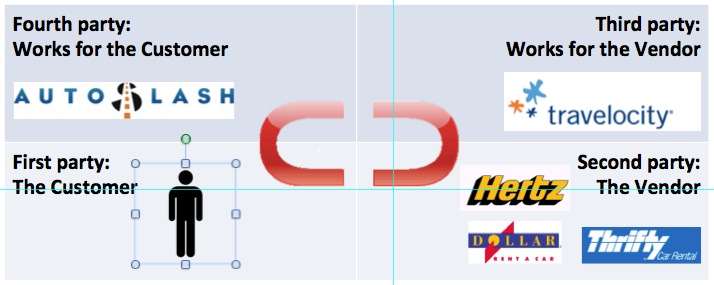
I believe that’s what already does. While their service is superficially similar to AutoSlash’s (they book you the lowest prices), they clearly work for you (⊂) as a fourth party and not for the agencies (⊃) as a third party. What makes them unambiguously a fourth party is the fact that you pay them. Here are their rates.

For controlling multiple relationships, however, you still need tools other than straightforward one-category services (such as AutoSlash and RentalCarMagic). One circle around those tools is what KuppingerCole calls Life Management Platforms. Another, from Peter Vander Auwera of SWIFT is The Programmable Me These (among much more) will be the subject of sessions at the European Identity and Cloud Conference (EIC) this week in Munich. (I’ll be flying there shortly from Boston.) I’ll be participating in those. So will Phil Windley of Kynetx, who has detailed a concept called the “Personal Event Network,” aka the “Personal Cloud.” Links, in chronological order:

  1. Ways, Not Places
  2. Protocols and Metaprotocols: What is a Personal Event Network?
  3. KRL, Data and Personal Clouds
  4. Personal Clouds as General Purpose Computers
  5. Personal Clouds Need a Cloud Operating System
  6. The Foundational Role of Identity in Personal Clouds
  7. Data Abstractions for Richer Cloud Experiences
  8. A Programming Model for Personal Clouds
  9. Federating Personal Clouds

This is thinking-in-progress about work-in-progress, by a Ph.D. computer scientist and college professor as well as an entrepreneur and a very creative inventor. (By the way, KRL and its rules engine are open source. That’s cool too.)

If I have time later I’ll unpack some of this, and start knitting the connections between what Phil’s talking about and what others (especially Martin Kuppinger of KuppingerCole, who will be writing and posting more about Life Management Platforms) are also bringing to the table here.

In particular I will bring up the challenge of fixing the car rental agency market. What can we do, not only for the customer and for his or her fourth parties (the ⊂ side) but for everybody on the third and second party (⊃) side?

And what changes will have to take place on the ⊃ side once they find they need to truly differentiate, in distinctive and non-gimmicky ways? What effect will that have on the car makers as well?

When I started down this path, back in 2006, I had a long conversation with a top executive at one of the car rental companies. What sticks with me is that these guys don’t have it easy. Among other things, he told me that the car companies mostly don’t like the car rental business because it turns drivers off to many of the cars they rent, and the car companies don’t make much money on the cars either. Can that be fixed too? I don’t know, but I’d like customers and their fourth parties to help.

How about through true personalization, in response to actual demand by individual customers, such as I suggested in 2006?

How about through new infrastructural approaches, such as the ?

Hertz, Budget’s and Enterprise’s own CRM and loyalty systems are not going to go away. Nor will the ways they all have of identifying us, and authenticating us. How can we embrace those, even as we work to obsolete them?

There are two worlds overlapping here: the one we have, and the one we’re building that will transcend and subsume the one we have.

The one we have is a “free market” with a “your choice of captor” model. It is for violating this model that AutoSlash was fired as a third party by the car rental agencies.

The one we’re building is a truly free market, in which free customers prove more valuable than captive ones. We need to make the pudding that proves that principle.

And we’re doing that. But it’s not a simple, an easy, or even a coordinated process. The good thing is, it’s already underway, and has been for some time.

Looking forward to seeing you at EIC in Munich, and/or at the other events that follow, in London and Mountain View:

Meanwhile, a last word, in respect to what Bart Stevens says below. Clearly the car rental business needs to move out of the confusopoly model, and to differentiate on more than price. To some degree they already do, but price is the primary driver for most customers. (And I’d welcome correction on that, if it’s wrong.) We have a lot to learn from each other.


How about using the ‘No Track’ button we already have?

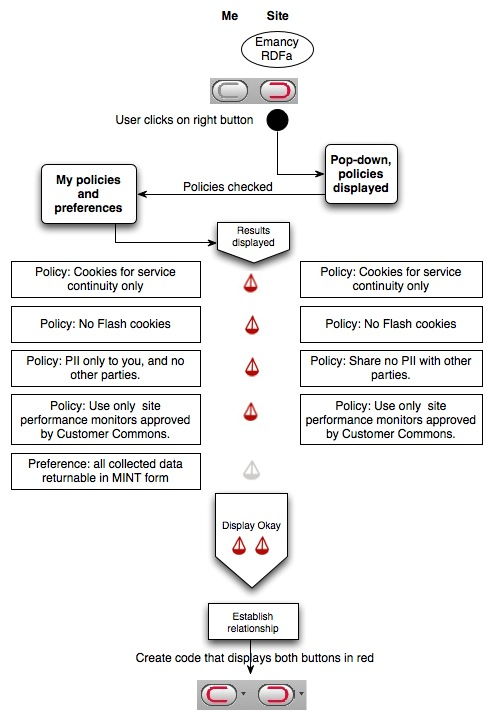
left r-buttonright r-buttonFor as long as we’ve had economies, demand and supply have been attracted to each other like a pair of magnets. Ideally, they should match up evenly and produce good outcomes. But sometimes one side comes to dominate the other, with bad effects along with good ones. Such has been the case on the Web ever since it went commercial with the invention of the cookie in 1995, resulting in a calf-cow model in which the demand side — that’s you and me — plays the submissive role of mere “users,” who pretty much have to put up with whatever rules websites set on the supply side.

Consistent with Lord Acton’s axiom (“Power corrupts; absolute power corrupts absolutely”) the near absolute power of website cows over user calves has resulted in near-absolute corruption of website ethics in respect to personal privacy.

This has been a subject of productive obsession by Julia Anguin and her team of reporters at The Wall Street Journal, which have been producing the What They Know series (shortcut: http://wsj.com/wtk) since July 30, 2010, when Julia by-lined The Web’s New Gold Mine: Your Secrets. The next day I called that piece a turning point. And I still believe that.

Today came another one, again in the Journal, in Julia’s latest, titled Web Firms to Adopt ‘No Track’ Button. She begins,

A coalition of Internet giants including Google Inc. has agreed to support a do-not-track button to be embedded in most Web browsers—a move that the industry had been resisting for more than a year.

The reversal is being announced as part of the White House’s call for Congress to pass a “privacy bill of rights,” that will give people greater control over the personal data collected about them.

The long White House press release headline reads,

We Can’t Wait: Obama Administration Unveils Blueprint for a “Privacy Bill of Rights” to Protect Consumers Online

Internet Advertising Networks Announces Commitment to “Do-Not-Track” Technology to Allow Consumers to Control Online Tracking

Obviously, government and industry have been working together on this one. Which is good, as far as it goes. Toward that point, Julia adds,

The new do-not-track button isn’t going to stop all Web tracking. The companies have agreed to stop using the data about people’s Web browsing habits to customize ads, and have agreed not to use the data for employment, credit, health-care or insurance purposes. But the data can still be used for some purposes such as “market research” and “product development” and can still be obtained by law enforcement officers.

The do-not-track button also wouldn’t block companies such as Facebook Inc. from tracking their members through “Like” buttons and other functions.

“It’s a good start,” said Christopher Calabrese, legislative counsel at the American Civil Liberties Union. “But we want you to be able to not be tracked at all if you so choose.”

In the New York Times’ White House, Consumers in Mind, Offers Online Privacy Guidelines Edward Wyatt writes,

The framework for a new privacy code moves electronic commerce closer to a one-click, one-touch process by which users can tell Internet companies whether they want their online activity tracked.

Much remains to be done before consumers can click on a button in their Web browser to set their privacy standards. Congress will probably have to write legislation governing the collection and use of personal data, officials said, something that is unlikely to occur this year. And the companies that make browsers — Google, Microsoft, Apple and others — will have to agree to the new standards.

No they won’t. Buttons can be plug-ins to existing browsers. And work has already been done. VRM developers are on the case, and their ranks are growing. We have dozens of developers (at that last link) working on equipping both the demand and the supply side with tools for engaging as independent and respectful parties. In fact we already have a button that can say “Don’t track me,” plus much more — for both sides. Its calle the R-button, and it looks like this: ⊂ ⊃. (And yes, those symbols are real characters. Took a long time to find them, but they do exist.)

Yours — the user’s — is on the left. The website’s is on the right. On a browser it might look like this:

r-button in a browser

Underneath both those buttons can go many things, including preferences, policies, terms, offers, or anything else — on both sides. One of those terms can be “do not track me.” It might point to a fourth party (see explanations here and here) which, on behalf of the user or customer, maintains settings that control sharing of personal data, including the conditions that must be met. A number of development projects and companies are already on this case. All the above falls into a category we call EmanciTerm. Much has been happening as well around personal data stores (PDSes), also called “lockers,” “services” and “vaults.” These include:

Three of those are in the U.S., one in Austria, one in France, one in South Africa, and three in the U.K. (All helping drive the Midata project by the U.K. government, by the way.) And those are just companies with PDSes. There are many others working on allied technologies, standards, protocols and much more. They’re all just flying below media radar because media like to look at what big suppliers and governments are doing. Speaking of which… 🙂

Here’s Julia again:

Google is expected to enable do-not-track in its Chrome Web browser by the end of this year.

Susan Wojcicki, senior vice president of advertising at Google, said the company is pleased to join “a broad industry agreement to respect the ‘Do Not Track’ header in a consistent and meaningful way that offers users choice and clearly explained browser controls.”

White House Deputy Chief Technology Officer Daniel Weitzner said the do-not-track option should clear up confusion among consumers who “think they are expressing a preference and it ends up, for a set of technical reasons, that they are not.”

Some critics said the industry’s move could throw a wrench in a separate year-long effort by the World Wide Web consortium to set an international standard for do-not-track. But Mr. Ingis said he hopes the consortium could “build off of” the industry’s approach.

So here’s an invitation to the White House, Google, the 3wC, interested BigCos (including CRM companies), developers of all sizes and journalists who are interested in building out genuine and cooperative relationships between demand and supply::::

Join us at IIW — the Internet Identity Workshop — in Mountain View, May 1-3. This is the unconference where developers and other helpful parties gather to talk things over and move development forward. No speakers, no panels, no BS. Just good conversation and productive work. It’s our fourteenth one, and they’ve all been highly productive.

As for the r-button, take it and run with it. It’s there for the development. It’s meaningful. We’re past square one. We’d love to have all the participation we can get, from the big guys as well as the little ones listed above and here.

To help get your thinking started, visit this presentation of one r-button scenario, by Adam Marcus of MIT. Here’s another view of the same work, which came of of a Google Summer of Code project through ProjectVRM and the Berkman Center:

(Props to Oshani Seneviratne and David Karger, also both of MIT, and Ahmad Bakhiet, of Kings College London, for work on that project.)

If we leave fixing the calf-cow problem entirely up to the BigCos and BigGov, it won’t get fixed. We have to work from the demand side as well. In economies, customers are the 100%.

Here are some other stories, mostly gathered by Zemanta:

All look at the symptoms, and supply-side cures. Time for the demand side to demand answers from itself. Fortunately, we’ve been listening, and the answers are coming.

Oh, and by the way, Mozilla has been offering “do not track” for a long time. Other tools are also available:

Stop making cows. Quit being calves.

Emoji_u1f42e.svg The World Wide Web that invented in 1990 was a collection of linked documents. The Web we have today is a collection not just of documents (some of which we quaintly call pages), but of real estate we call sites. This Web is mostly a commercial one.

Even if most sites aren’t commercial (I don’t know), most search results bring up commercial sites anyway, thanks both to the abundance of commercial sites on the Web, and “search engine optimization” (SEO) by commercial site operators. Online ad spending in the U.S. alone will hit $40 billion this year, and much of that money river runs through Google and Bing.

But that’s a feature, not a bug. The bug is that we’ve framed our understanding of the Web around locations and not around the fabric of connections that define both the Net and the Web at the deepest level. That’s why nearly every new business idea starts with real estate: a site with an address. Or, in the ranching-based lingo of marketing, a brand.

The problem isn’t with the sites themselves, or even with the real estate model we use to describe and understand them. It’s with their underlying architecture, called client-server.

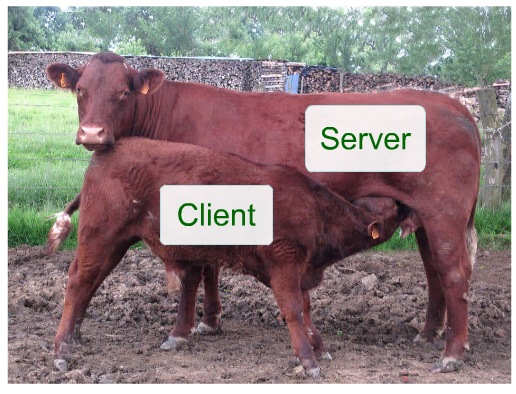
Client-server, by design, subordinates visitors to websites. It does this by putting nearly all responsibility on the server side, so visitors are just users or consumers, rather than participants with equal power and shared responsibility in truly two-way relationship between equals. Thus the client-server relationship is roughly that of calf to cow:

calf-cow

From the teats of the cow-server, the calf-client sucks the milk of HTML and Javascript, plus : text files deposited by a website’s server in a visitor’s browser. Their original purpose was to help both the site and the visitor (the cow and the calf) remember where they were last time they met, and to retain other helpful information, such as logins and passwords.

But cookies also became a way for commercial cows and their business friends (aka third parties) to keep track of their calves, reporting back where those calves traveled, the  cows they suckled, the stuff they click on. Based on what they learn from tracking, the cows can — alone or with assistance from third parties, produce “personalized” milk in the form of customized pages and ads. This motivation is all the rage today, especially around advertising.

Nearly all the investment on ‘relating’ is still on the sell side: the cow side, because that’s where all the power is concentrated, thanks to client-server. So we keep making better cows and cow-based systems, forgetting that the calves are actual human beings called customers. We also overlook opportunity in helping demand drive supply, rather than just in helping supply drive demand.

But some of us haven’t forgotten. One is Phil Windley, a Ph.D. computer scientist, former CIO of Utah, co-founder of , and the inventor and lead maintainer of a language called , plus the rules engine for executing KRL code. (Both are open source.) The rules are the individual’s own. The rules engine can go anywhere. No cow required.

To describe the box outside of which Phil thinks, he gives a great presentation on the history of e-commerce. It goes like this:

1995: Invention of the Cookie.
The End.

To describe where he’s going (along with Kynetx and the rest of the VRM development community), Phil wrote a new book, The Live Web (a term you might have first read about here), and has been publishing a series of blog posts that deal with what he calls . Think of your Personal Event Network as the Live Web that you, as a human being (rather than as a calf) operate. Live. In real time. Your own way. You can take advantage of services offered by the servers of the world (through APIs, for example). But it’s your network, and it’s built with your own relationships. It doesn’t replace client-server, but it gives servers lots to do besides being cows. In fact, the opportunities are boundless, because they’re in wide-open virgin territory.

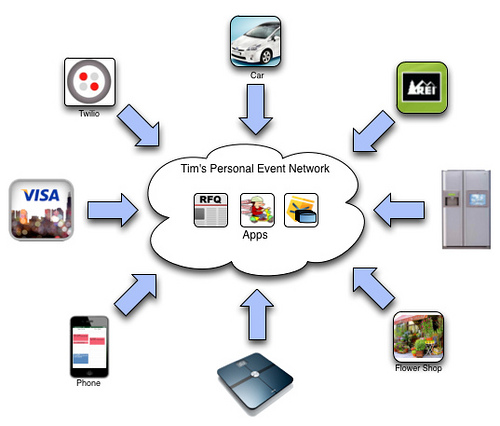
A Personal Event Network puts you at the center of your Live Web, with your own apps, and your own rules for what follows from events in your web of relationships. “Personal event networks interact with each other as equals,” Phil says. “They aren’t client server in nature.” Here’s how Phil draws one example:

Personal Event Network

Look at the three items indside the personal cloud:

  • At the center are apps. We’re already familiar with those on our computers and mobile devices. While they might have connections to outside services, they are personal tools of our own. They are neither calves nor cows.
  • On the left is an RFQ, or a Request For Quote, also called a .
  • On the right are rules, written in KRL.

Together those control how we interact with all the devices and services on the outside, on the Live Web. Note that those outside items are not functioning as cows, even though they also live in the commercial Web’s client-server world. They are being engaged outside the cow function, mostly through s.

Here’s how Phil explains how this works for a guy named Tim, who has a relationship with a flower shop, described here:

Tim’s personal event network has a number of apps installed. It’s also is listening on many event channels. These channels are carrying events about everything from Tim’s phone and appliances to merchants he frequents.

REI and the flowershop both have separate channels into Tim’s personal event network. Consequently, Tim can

  • Manage them independently. If REI starts spamming Tim with events he doesn’t like, he can simply delete the channel and they’re gone.
  • Permission them independently. Tim might want to get certain events from REI and other’s from the flowershop. Which events can be carried on which channels is up to Tim.
  • Respond to them independently. Tim might want to get notification events from the flowershop delivered to his phone today because it’s his wife’s birthday whereas normally merchant communications are sent to his mail box.

Tim is in charge of whether and how events are delivered. He manages the channel, delivery, and response while the publishers of these event choose the content.

This cannot be done within the bovine graces of any one company — not Apple, Facebook, Google or Microsoft — no matter how rich their services might be, and no matter how well they treat their users and customers. And not matter how much they might insist that they’re not really treating their users and customers as calves.

But they’re still playing the cow role, and we’re still stuck as calves. That’s why we keep looking for better cows.

For example take The Real Problem With Google’s New Privacy Policy, in . The subtitle explains, “The tech giant owes users better tools to manage their information.” Well, that might be true. But we also need our own tools for managing relationships with Google — and every other site and service on the Web. And we need those tools to work the same way with every company, rather than different ways with every company.

(We have this, for example, with email, thanks to open, standard and widely deployed protocols. Email is fully human, even if we submit to playing the half-calf role inside, say, Gmail. We can still take our whole email pile outside of Gmail and put it on any other server, or host it ourselves. Email’s protocols and standards support that degree of independence, and therefore of humanity as well.)

Another example is The Ecommerce Revolution is All About You, in . Here’s the closing paragraph:

So shoppers, be prepared to give up your data. In the coming year, we’re going to see many more retail sites ramping up data-driven discovery. And e-commerce sites who aren’t thinking about how to mine social and other forms of data are probably going to be left in the dust by the Amazons and Netflix’s of the next wave of personalization.

Credit where due to Amazon and Netflix: their personalization is best-of-breed. Their breed just happens to be bovine.

As it did in 1995, Amazon today provides their own milk and cookies for their own calf-customers. As a loyal Amazon customer, I have no problem being its calf. But I can’t easily take my data (preferences, history, reviews etc.) from Amazon and use it myself, in my own ways, and for my own purposes. It’s their data, not mine.

The problem with this — for both Amazon and me — is that Amazon isn’t the whole World Live Web. I don’t shop only at Amazon, and I would like better ways of interacting with all sellers than any one seller alone can provide, even if they’re the world’s best online seller. (Which Amazon, arguably, is.)

So sure, the Ecommerce Revolution is “about us.” But if it’s our revolution, why aren’t we getting more of our own tools and weapons? Why should we keep depending on sellers’ personalization systems to do all the work of providing relevance for us as shoppers? Should we give up our data to those companies just so they can raise the click-through rates of their messages from one in less than a hundred to one in ninety-eight — especially when many of the misses will now be creepily “personalized” as well?

Shouldn’t we know more about what to do with our data than any seller can guess at? And if we don’t know yet, why not create companies that help us buy at least as well as other companies are help sellers sell?

Well, those kinds of companies are being created, and you’ll find a pile of them listed here, Kynetx among them.

VCs need to start looking seriously at development on the demand side. Kynetx is one among dozens of companies that are flying below the radar of too many VCs just looking at better cows, and better ways to sell — or worse, to “target,” “capture,” “acquire,” “lock in” and “manage” customers as if they were slaves or cattle.

The idea that free markets are your-choice-of-captor is a relic of a dying mass-market-driven mentality from the pre-Internet age. Free markets need free customers. And we’ll get them, because we’ll be them.

We — the customers — are where the money that matters most comes from. Driving that money into the marketplace are our own intentions as sovereign and independent human beings.

In the next few years we’ll build an Intention Economy, driven by customers equipped with their own tools, and their own ways of interacting with sellers, including their own terms of engagement. This was the promise of the Net and the Web in the first place, and we’ve awaited delivery for long enough.

Time’s up. The age of captivity is ending. Start placing your bets on the demand side.

VRM and CCOs

In The Rise Of The Chief Customer OfficerPaul Hagen of Forrester begins,

Over the past five years Forrester Research has observed an increase in the number of companies with a single executive leading customer experience efforts across a business unit or an entire company. These individuals often serve as top executives, with the mandate and power to design, orchestrate and improve customer experiences across every customer interaction. And whether firms call them Chief Customer Officers (CCOs) or give them some other label, these leaders sit at high levels of power at companies as diverse as Allstate, Dunkin’ BrandsOracle and USAA.

Other titles meaning roughly the same thing are Chief Client Officer and Chief Experience Officer. All, Paul writes, “are charged with improving the customer experience.”

From the VRM perspective, that’s all we need to know. We’re the customers, and we’re charged with improving our experience too.

So I dug around a bit, and came up with a few leads and links that I’ll post here as a shout-out to the folks and disciplines involved.

First is the Chief Customer Officer Council, founded and led by Curtis Bingham (whom I see by LinkedIn is, like me, in the Boston area). Next are (via the CCOC),

These are people VRM-equipped customers are going to meet in the new middle. This small post is toward making the acquaintance.

Ting rings the opening bell

Here, according to the ProjectVRM wiki, are the ideal characteristics of VRM tools:

  1. VRM tools are personal. As with hammers, wallets, cars and mobile phones, people use them as individuals,. They are social only in secondary ways.
  2. VRM tools help customers express intent. These include preferences, policies, terms and means of engagement, authorizations, requests and anything else that’s possible in a free market, outside any one vendor’s silo or ranch.
  3. VRM tools help customers engage. This can be with each other, or with any organization, including (and especially) its CRM system.
  4. VRM tools help customers manage. This includes both their own data and systems and their relationships with other entities, and their systems.
  5. VRM tools are substitutable. This means no source of VRM tools can lock users in

Note “mobile phones” in #1. Like a car or a wallet, a mobile phone is personal. Ir also supports our independence, helps us express intent, and is substitutable. Bearing all these things (and more) in mind, Ting.com has come to market with the clear intent of doing the best it can to support customers’ VRM intentions.

Go down Joe Andrieu’s list of user driven services

  1. Impulse from the User
  2. Control
  3. Transparency
  4. Data Portability
  5. Service Endpoint Portability
  6. Self Hosting
  7. User Generativity
  8. Improvability
  9. Self-managed Identity
  10. Duty of Care

… and you’ll find that Ting comes about as close as any mobile phone company can come to respecting all those things.

Ting is an MVNO — a Mobile Virtual Network Operator. That means it operates as a phone company, but does not own facilities. Instead it re-sells the raw base offerings (minutes, texts, quantities of data) that it buys from a carrier with facilities. In this case, Sprint. It works everywhere in the U.S. that Sprint does, but it has a much more friendly and sensible set of offerings and pricings than any of the major mobile phone companies. It’s about as gimmick-free as you can get. That is, Ting is the very opposite of what Scott Adams in The Dilbert Future calls a “confusopoly.” Sez Scott,

A confusopoly is a situation in which companies pretend to compete on price, service, and features but in fact they are just trying to confuse customers so no one can do comparison shopping.

Cell [mobile] phone companies are the best example of confusopolies. The average consumer finds it impossible to decipher which carrier has the best deal, so carriers don’t have normal market pressure to lower prices. It’s a virtual cartel without the illegal part.

Ting is a VRM company. Its management and other personnel have been involved in many VRM discussions and events, and a number of VRM folk have been involved in Ting’s beta as well. Our family, for example. So far we’re loving it. The data service especially is surprisingly good. At our kid’s high school in rural New Hampshire, both voice and data service is pretty much perfect.

Here are some of the stories about the Ting launch that have hit so far:

Plus these from Zemanta:

Consumers are social, Customers are personal

Social media are a partial and temporary solution at best to a pair of linked problems that are essentially personal:

  1. dysfunctional customer relationship management on the vendor’s side; and
  2. minimal vendor relationship management on the customer’s side.

In the absence of solutions to both problems, vendors still see customers as consumers, and that too is a problem that hasn’t yet come to a head, because we still don’t fully grok the difference between consumers and customers. As a result, we think social media looks like a the good answer rather than a better question. That question is, How can we get companies and media to stop treating us as consumers and start treating us as real customers?

To see what needs to be done, check out Consumers Punish Companies that Ignore Them, by Eric Sass in MediaPost. In that piece Eric sources a pair of Conversocial studies that contain plenty of grist for social media and marketing mills. Here they are, from the Conversocial blog:

Here are some samplings from Eric’s gleanings:

  • “…more than 60% of complaints and question about retailers posted online on social media are ignored, in part because of the sheer volume of content created on sites like Twitter and Facebook.”
  • “30% of the retail chains surveyed don’t respond to any questions or complaints posted on social media, effectively choosing to ignore issues mentioned in these forums.”
  • “…78% believe that social media platforms will soon replace other means of customer service altogether or at least become one of the top ways to communicate with corporations.”
  • “…among the group which has communicated with companies via social media, 32.5% said they were either neglected or totally ignored; that works out to 16.5% of the total…This included ‘inadequate response times, unanswered queries, and overall unmet expectations.’
  • “What’s more, ‘respondents were also adamant that such corporate behaviors would have some or much effect on their future decision to do business with offending corporations.’
  • “27.3% of respondents said being ignored by companies on social media makes them ‘very angry,’ and 27.1% said they’d stop doing business with the offending company altogether.”
  • “88.3% of respondents said they’d be somewhat or far less likely to do business with a company that has visibly ignored other customers’ questions or complaints on social media. That includes 49.5% who said they would be ‘far less likely, and 38.8% who said they’d be ‘somewhat less likely.'”

Note that the blame here is on offending companies; not on social media, or on the absence of something better.

This is understandable because social media offer radically new and helpful avenues both for customer feedback one one side and customer support on the other. Also, social media is where Conversocial is coming from, and what MediaPost reports on. The problem for both — and for all of us thinking and talking about this stuff inside the social media framework — is that consumers are a statistical category while customers are individual human beings.

Individual human beings are all different. They are not categories, and they cannot be treated with full respect only by templates, which is what vendors — especially those serving mass markets — tend to use.

And, while social media do provide ways to get personal (say, though one’s @-handle on Twitter), they don’t have personal relationships with their users. That’s because social media users are not customers of them, because they don’t pay for them. And if you don’t pay, you’re the product being sold.

The actual customers of Facebook and Twitter are advertisers, not users. Because of this, social media has exactly the same un-visited problem that commercial broadcasting has had for the duration: its consumers and its customers are different populations. Financial accountability is to those that pay, which are advertisers, not users. Yes, there are moral and operational obligations to users, but economically speaking those obligations are lesser ones. They are those of a farmer to crops, not of a store to actual customers.

For now social media are a useful and popular way for customers to send messages to companies — and to route around inadequate customer service systems (or, in the vernacular of the trade, using sCRM routing around or to improve CRM) — the failures listed by Conversocial are not just those of companies ignoring social media, but of social media itself.

There is a structural problem as well, because social media are still only semi-personal. They are a weak substitute for direct contact — meaning that, in a person-to-person sense, even email and telephony are better.

Improving each company’s customer service systems and policies (which the Conversocial studies call for) also isn’t enough, because each company’s system is different, and all of them are silo’d. Thus the way you deal as a customer with Nordsrom, Safeway, Amazon and Apple are all different, and incompatible. If you want, say, to change your address or your phone number with all of them at once, you don’t have a single way to do that. You also don’t have a standard way to publish your own terms and conditions of engagement, to say for example “don’t track me outside of your own store or site” or “any data you collect is mine as well as yours, and should be available to me in the standard way I describe.”

Tools for doing that would have to live on your side of the relationship. Not the vendor’s, not the CRM cloud’s, and not Facebook’s. If you are a real customer, and not just a consumer or a user, you need your own tools. You need VRM — Vendor Relationship Management — tools, to work together with vendors CRM tools, not to replace them. The demand chain and the supply chain will work together.

The only case against VRM is that companies serving mass markets can’t afford to be personal, and just won’t go there. This was also the argument against PCs and the Internet. History and enterprising developers proved both cases wrong.

In fact enterprising developers in the VRM community have been working on personal tools for the last five years or more — tools that make customers both independent of vendors and better able to engage with vendors. It helps that the CRM community is aware of VRM developments, and has been awaiting them for some time. This is the year that wait will pay off. We’ll finally see VRM developments mature and start to become useful, both for customers and for vendors. So, watch the space.

Bonus link: Alan Mitchell’s comment below. I love how he says social media marketing is among “the grandest imperialist invasions of them all. The attempt to occupy day-to-day human interaction and turn it into a profit centre.” Indeed.

Also, to answer questions raised below, I have posted Customers are personal, cont’d.

Occupying the Internet

As he so often does, Dave Winer nails it, this time with The Un-Internet. Some pull-quotes:

At issue is this: Control.

For whatever reason, the people who run the tech companies want it. But eventually the users take it.

Either the companies learn how to take the lead from their users, or they will be sidelined. Unless the laws of technology are repealed, and I don’t think laws like that can be repealed.

It’s the Internet vs the Un-Internet. And the Internet, it seems, always prevails.

The Internet is each and all of us. It is no more reducible to the companies that try to control us than time is reducible to clocks.

I believe 2012 will be the year that Net-based companies (which are most of them at this point) will discover that free customers are more valuable than captive ones.

Here’s the deal: the Internet is already occupied: by all of us. This is why the Internet will beat the Un-Internet.

We occupy the Un-Internet as well, which is why we’re going to take charge of that too, and bring it in alignment with the free marketplace that the Internet provides in a remarkably pure form.

But we won’t be a crazy herd. We’ll be sources of help as well as money. And we’ll have our own ways of providing that help. The demand chain and the supply chain will start working together. Just watch.

GoDaddy VRooMed?

GoDaddy CEO Warren Adelman says “We listened to our customers. GoDaddy no longer supports SOPA.” (Here’s the GoDaddy blog post.)

Lauren Weinstein says that’s not the same as opposing SOPA: “they’re the same ethically vacuous firm as always, with their public facade changing like a chameleon, blowing in the wind of Internet public opinion.”

I still see it as a good sign when a company in a direct personal service business changes its mind because its customers made clear that change was required.

What I’d like to know now is what GoDaddy customers said to the company personally. (Not just that customers pulled their accounts in protest.) When I know that Warren Adelman and the company turned around because of direct personal pressure, in real conversation with paying customers who wished to remain so — and not just because of negative PR or customers bailing — then I’ll be glad to call it a full VRM move by customers.

Some links:

Say howdy to Insidr and Glome

One is , which is “rewriting the Rules of ” by giving you a way to “connect directly to real people who have worked in big companies and are willing to help when the company can’t or won’t.” You post a question, offer a bounty for an answer, and get an answer from an insider at the company. So far those include (copied and pasted from Insidr’s about/learn page):

I asked a question regarding , with which I’ve flown .82 million miles so far. The question had nothing to do with customer service, but rather with looking for a connection inside the airline, with whom I might talk about publishing a book of aerial photos (such as these) taken from United planes, timed to publish about the time  come into service. It’s a long shot, but a fun one.

I think Insidr qualifies as a fourth party (as described this blog post and this ProjectVRM wiki article). That is, one working primarily for the customer, rather than for the vendor. That Insidr is paid by places it on the side of customers financially, which is significant — and novel, in an age when most new Web-based businesses still look for revenue coming from sellers “targeting” customers rather than customers expressing their own intentions, in their own ways.

about Insidr. (I was given a heads-up that TechCrunch might call to get the VRM angle, but that didn’t happen.)

[Update…] I spoke with Antony Brydon, Insidr’s CEO. He made it clear that the term “Insider” is not limited to people working for the company, and in fact is refers to the collection of experts who are proximal to the company rather than inside the company — though it might include those too. He also begs our indulgence of Insidr’s learning process. They’re just getting started.

The other new VRM entry is .  “Stop being a product” says the main copy on the index page. @glomeinc‘s Twitter page says,

Glome Inc@GlomeInc Helsinki, Finland
Media startup aiming to change the way advertisers connect with customers online. Buzzwords: VRM, User controlled data, online privacy, open API:s

The first and only tweet so far there says,

Glome Inc. is officially founded. Stay tuned for private beta invite instructions. #glomeinc #vrm #privacy #changetheworld

I tweeted back,

@GlomeInc Tell us more about your #VRMwork. DM me if you need to keep it private for now.

We’ll see how that goes. Meanwhile, it’s good to know that both companies fly the #VRM flag.

Here’s Zemanta‘s list of Related Articles:

A bar(code) too high?

Two pieces in today’s worth checking out. Pun intended.

First is “Some markets bagging self-checkout: Cite problems and variables with system,” by Peggy Hernandez. Second is “Scan on a mission: Stop & Shop’s new smartphone app works as a super-fast self-checkout,” by Jane Dornbusch.

I’ve played quite a bit with self-check-out, and with Stop & Shop’s SCAN-IT! in particular. While I rarely find myself moving faster through check-out by doing it by myself, I do see the advantages for both customers and retailers. As Mike Grimes, CEO of Modiv told Peggy Hernandez, “Self-checkout is what you make of it. True customer service means choice. Albertsons and took that away from their customers. That is very likely not a good move.” Indeed, the report begins with news that Big Y is giving up on the self-checkout experiment. Didn’t work for them.

Stop & Shop seems quite committed to SCAN-IT. (I’m leaving off the exclamation mark, as I do with ) Their come with a metal holster for SCAN-IT’s scanning gun. And using the thing is almost entertaining.  (You can also scan with your or .) From the story:

Both the app and the hand-held scanners keep track of your purchases — and you. The app knows where you are in the store. The result is that coupons tailored to your preferences and location pop up on your device as you shop. This has a creepy Big Brother feeling, but you get to save 35 cents on the jar of mayonnaise on your list.

The problem is, guesses about what you might want are made not only by your location in the store, but on your purchase history. Meaning that the pile of crap food you bought for a school picnic last Summer still looks to the store’s system like something you’ll want to buy over and over again. So, up come the coupons.

One of these days I’ll put up the photo essay of my tours of stores, including Stop & Shop, for the book I just wrote. The book tells the story in text, but the pictures are also telling. Stay tuned for that.

« Older posts Newer posts »

© 2026 ProjectVRM

Theme by Anders NorenUp ↑