Category: Companies (Page 1 of 11)

UCP needs VRM

In Microsoft Advertising’s Agentic Playbook, Laurie Sullivan of MediaPost looks into Microsoft’s “agentic commerce blueprint to guide businesses, retailers, and developers when AI agents make purchases on behalf of humans.”

Meaning agents are out there shopping for customers already. Intentcasting anyone?

Laurie explains,

Microsoft’s “Agentic Playbook” focuses on three priorities:

  • Getting discovered by the agent (which many brands struggle with today).
  • Ensuring the purchase becomes seamless.
  • Having the tools to optimize performance of the intended purchase.

Part of the blueprint details a path for marketers to build a 90-day structure for agentic.

Microsoft’s agentic, that is. She goes on:

One Microsoft product marketing director on the call focusing on product feeds said she can already see a major change in consumer behavior — the way people shop….

Microsoft Copilot runs on the same Universal Commerce Protocol (UPC) that many of its larger partners run on, the company said.

The framework connects Copilot with retail, including giants like Target, Ulta Beauty, and Stripe.

UPC founding partners include Google and Shopify.

UPC is new to me. Wikipedia too. But it does have a website: UCP.dev. There it says, “Universal Commerce Protocol (is) the common language for platforms, agents, and businesses (and) provides building blocks for agentic commerce across industries—from discovery to checkout and beyond—allowing the ecosystem to operate through one standard, without custom builds.”

The page goes on to say UCP is “co-developed by industry leaders,” and “built by the industry, to enable seamless agentic experiences. It solves fragmented user journeys that lead to frustrated users and conversion drop off.”

Solves for the seller, that is. Not for the buyer. Yet.

In Under the Hood: Universal Commerce Protocol (UCP), Amit Handa, Google’s Director of Engineering, Google Commerce, and  Ashish Gupta,  VP/GM Merchant Shopping and Engineering Fellow at Google, write,

By establishing a common language and functional primitives, UCP enables seamless commerce journeys between consumer surfaces, businesses, and payment providers. It is built to work with existing retail infrastructure, and is compatible with Agent Payments Protocol (AP2) to provide secure agentic payments support. It also provides businesses flexible ways to integrate via APIs, Agent2Agent (A2A), and the Model Context Protocol (MCP).

UCP is developed by Google in collaboration with industry leaders including Shopify, Etsy, Wayfair, Target, and Walmart endorsed by over 20 global partners across the ecosystem like Adyen, American Express, Best Buy, Flipkart, Macy’s Inc, Mastercard, Stripe, The Home Depot, Visa, Zalando and many more.

Then,

UCP is built to benefit the entire commerce ecosystem

  • For businesses: UCP empowers you to showcase your unique product and service offerings at shopping touchpoints across consumer interfaces such as AI Mode in Google Search and Gemini app, and others in the future. With UCP, you own your business logic, and you remain the Merchant of Record. UCP is built for retailer flexibility, and provides an ’embedded option’ that allows you to maintain a fully customized checkout experience from day one.

  • For AI platforms: With UCP, you can enable agentic shopping for your audiences. You can simplify business onboarding using standardized APIs while giving them flexibility to use MCP, A2A and existing agent frameworks of their choice.

  • For developers: UCP is an evolving open-source standard designed to be community-driven. We invite you to build the next generation of digital commerce with us.

  • For payment providers: UCP’s open, modular payment handler design enables open interoperability and choice of payment methods. Through this design, UCP enables universal payments that are provable. Every authorization is backed by cryptographic proof of user consent.

  • For consumers: When your favorite brands adopt UCP, it removes friction from product discovery to decision, so you can shop the brands you love, with peace of mind, ensuring you get the best value inclusive of your member benefits.

The last bullet is bullshit, but ignore that. Look at it the consumer side as an empty space where independent customers operate with agents of their own. These agents will roam and engage in the open market. They won’t just be “members” trapped in coercive “loyalty” programs. (Although smart agents can take advantage of whatever privileges might appear in those places too.)

Personal agents are VRM tools. They are the first VRM tools with real power since we started this project two decades ago.

In AI shopping gets simpler with Universal Commerce Protocol updates, Ashish Gupta writes,

Thanks to our partners and community contributors, UCP now provides new optional capabilities including:

  • UCP can help make online shopping more intuitive and convenient, thanks to a new Cart option that will let agents save or add multiple items to a shopping cart at once from a single store — just as a shopper typically would.

  • UCP adopters will be able to access a new Catalog capability that lets agents retrieve select real-time product details from a retailer’s catalog where necessary — like variants, inventory and pricing.

  • Building on existing standards, UCP will also support Identity Linking. That allows shoppers on UCP-integrated platforms to receive the same loyalty or member benefits they would on a retailer’s site when they’re logged in — like pricing or free shipping — making shopping more connected across the web.

Good, but again still just for retailers. Nothing in there addresses a question my wife asked when she first encountered e-commerce in 1995: Why can’t I take my shopping cart from site to site?

Back to Laurie:

On Thursday, Microsoft officially began rolling out “AI Max,” its full suite of features for search advertising campaigns, to all accounts. It optimizes performance across Copilot Search and Bing.

The product provides search term matching that expands reach beyond keyword lists.

It uses keywords, ads, and landing pages, along with intent and contextual signals to find relevant searches campaign might not reach.

It also customizes text by using a campaign’s existing assets and website content to generate and test variations on messages.

The system then selects the most appropriate combinations at auction time.

URL expansion sends people to the page on a brand’s website that best matches their intent.

Instead of always sending traffic to a static landing page, it can route people to the page that best matches what they seek.

With AI Max features turned on, advertisers importing existing search campaigns from Google, for example, will seamlessly carry over into the corresponding Microsoft campaign.

I boldfaced intent because that’s the main force customers bring to the market’s table.

Add intelligence to that. Big AI today has far more market intelligence for customers than it does for companies, because customers are free to roam the whole world’s marketplace, while retailers and their third parties are trapped inside the walls of their own self-interest, offerings, and situations. Also their old mentality: the one that assumes that the best customer is a surveilled and captive one.

We started ProjectVRM twenty years ago next month with a thesis to prove: that free customers are more valuable than captive ones—to themselves and the marketplace. Turns out we couldn’t prove that until AI came along.

AI puts customers at an extreme advantage.  Roger Dunn, Chief Commercial Officer of Thrad, talks about this in a recent  Microsoft Advertising blog post:

When someone asks ChatGPT, Copilot, or Gemini for a product recommendation, the AI assembles a shortlist, usually three to five options, and that shortlist becomes the only consideration set that matters…

The vast majority of consumers still verify AI recommendations before buying. They take that shortlist to Google, to Bing, to a brand website, to YouTube. The verification stage is a confirmation exercise, not an open-ended one. They’re searching for the specific brands the AI mentioned, not starting from scratch…

So trust now operates in two layers.

First, there’s machine trust. From a retailer’s perspective – can an AI agent find you, understand what you sell, and have confidence that your product data is accurate and current? That’s about structured data, reviews, fulfillment reliability, pricing consistency. It’s operational, not emotional.

Second, there’s human trust. When the consumer arrives to verify, does your brand have the credibility, the reputation, the experience to close the deal? That’s the brand equity layer, and it’s not going away.

The brands that win will be the ones who treat product data as a strategic asset while continuing to invest in the emotional signals that make humans want to buy. The mistake is thinking you have to choose.

Product truth comes first signal to matter most, and it’s non-negotiable. AI agents reason over structured attributes: dimensions, compatibility, features, use cases. If those attributes don’t exist as machine-readable data, you’re not even a candidate. In the old world, poor data meant lower conversion. In the agentic world, poor data means you never enter consideration. Consumers aren’t prompting “what’s a good shoe brand.” They’re saying “I’m running a 5K this weekend on mixed terrain and my feet run narrow.” If your catalogue can’t answer that level of specificity, the agent recommends someone who can.

Reviews and third-party signals come second. AI systems synthesise review sentiment to answer highly specific questions. One detailed review explaining how a product performed in a real scenario is worth dozens of generic five-star ratings. Third-party endorsements, expert mentions, and certifications act as trust multipliers that AI increasingly weights.

Fulfillment reliability is third and rising fast. As we move up the automation curve, especially when consumers start authorising agents to purchase within preset rules, delivery reliability becomes a make-or-break signal. If an agent places an order and the delivery fails, the agent learns. Your logistics will become your trust score.

Brand authority is fourth. Still vital, but its mechanism is shifting from emotional halo to verifiable digital identity. Your reputation is increasingly a technical credential that agents use to evaluate trustworthiness.

That’s today, when all customers have to work with are Big AI agents. What happens when people get truly personal AIs, in addition to what the giants give them? These will be AIs that give them knowledge and control over the whole corpus of their personal data, meaning everything in this image:

Prompt: A woman uses personal AI to know, get control of, and put to better use all available data about her property, health, finances, contacts, calendar, subscriptions, shopping, travel, and work

What you’re looking at in that image is a far more empowered and agentic customer than one who operates only inside the milieu Roger describes. Because personal AI is by the person, not just for the person. This completely changes the game—especially when the customer comes with her own terms of engagement and  her own identity, credentials, policies, and engagement mechanisms. Both will happen. As Joe Mandese put it in MediaPost last November, Imagine Consumers Delegating Their Relationships With Marketers To Agents.

Nothing in marketing as we’ve known it contemplates the implications of full and independent customer agency, because marketing still lives inside the business-as-usual box to which we addressed The Cluetrain Manifesto twenty-six years ago.  Cluetrain said a lot of stuff to that box, but here was the summary statement:

Chris Locke wrote that. Wish he was still around to see personal AI’s reach break corporate grasp.

From inside that old box, what Microsoft talks about looks like this:

retailer → machine-readable offers → agent → customer

The customer’s side looks like this:

customer → machine-readable intentions/terms/preferences → agent → market → company

The view from above is this:

customer → agent ←  market → agent ← company

Just three things happen in markets:

  • Transactions
  • Conversations
  • Relationships

In the industrial age, which is finally ending, business was focused almost entirely on transactions. Still is, for good reason: without transactions we wouldn’t have markets. It was strong there, but weak in the other two.

Conversations were kept to a minimum because they looked like overhead: costly in time and money. Service was pushed off to call centers, and now call center workers are being replaced by AI robots.

Relationships were about “loyalty” programs in which customers were held captive and milked.

In the agentic world, the opportunities for conversation and relationship are immense—and will drive many more transactions.

Customers and companies can collaborate on countless benefits for each other when imarket ntelligence flows both ways. Products, services, and experiences by customers and companies can all improve together. Guesswork is minimized. So are the operational and moral costs of surveillance.

Lots to work on here.

Bonus linkages:

The only path from subscription hell to subscription heaven

I subscribe to Vanity Fair. I also get one of its newsletters, replicated on a website called The Hive. At the top of the latest Hive is this come-on: “For all that and more, don’t forget to sign up for our metered paywall, the greatest innovation since Nitroglycerin, the Allman Brothers, and the Hangzhou Grand Canal.”

When I clicked on the metered paywall link, it took me to a plain old subscription page. So I thought, “Hey, since they have tracking cruft appended to that link, shouldn’t it take me to a page that says something like, “Hi, Doc! Thanks for clicking, but we know you’re already a paying subscriber, so don’t worry about the paywall”?

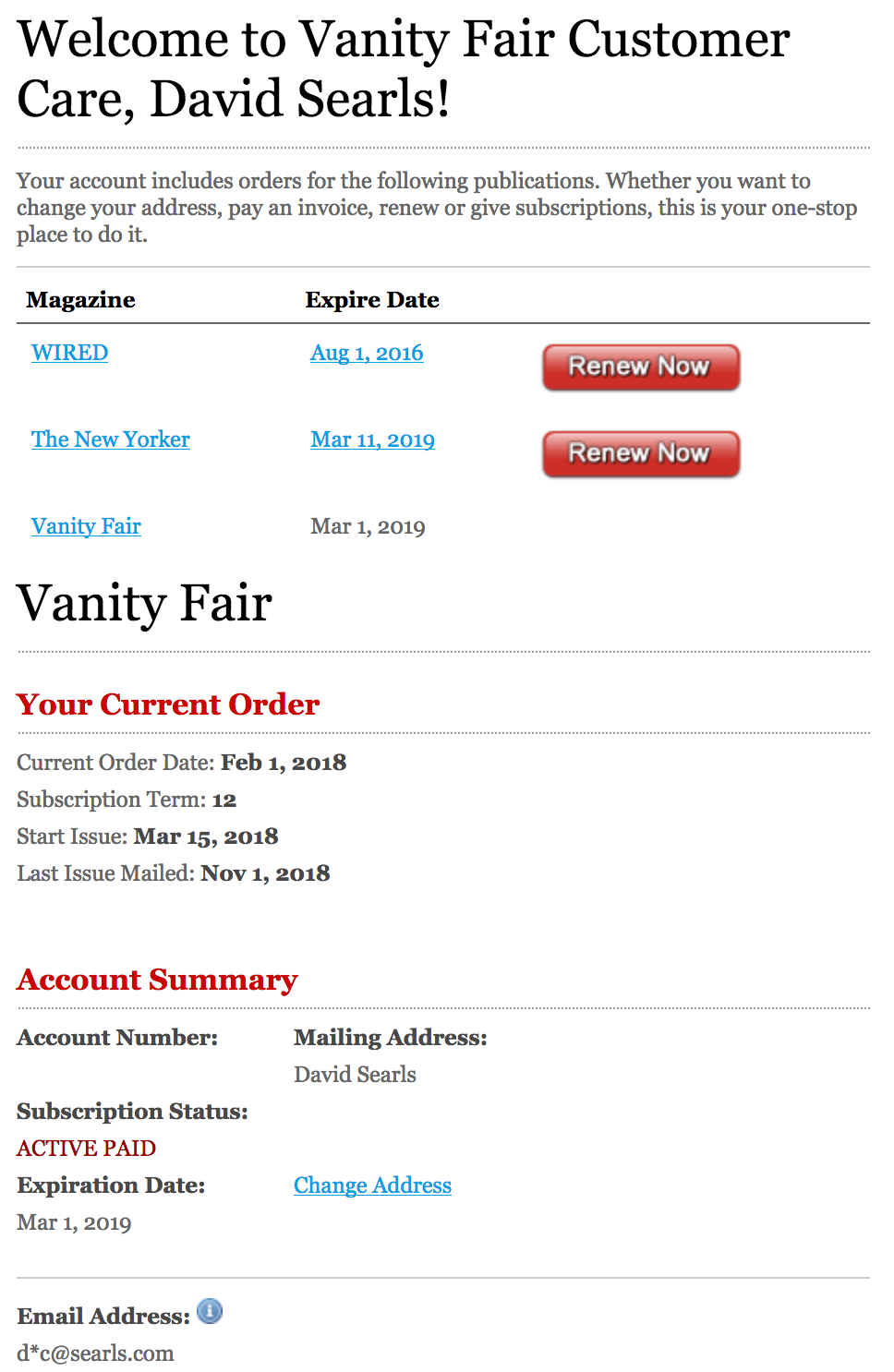
So I clicked on the Customer Care link to make that suggestion. This took me to a login page, where my password manager filled in the blanks with one of my secondary email addresses. That got me to my account, which says my Condé Nast subscriptions look like this:

Oddly, the email address at the bottom there is my primary one, not the one I just logged in with.  (Also oddly, I still get Wired.)

So I went to the Vanity Fair home page, found myself logged in there, and clicked on “My Account.” This took me to a page that said my email address was my primary one, and provided a way to change my password, to subscribe or unsubscribe to four newsletters, and a way to “Receive a weekly digest of stories featuring the players you care about the most.” The link below said “Start following people.” No way to check my account itself.

So I logged out from the account page I reached through the Customer Care link, and logged in with my primary email address, again using my password manager. That got me to an account page with the same account information you see above.

It’s interesting that I have two logins for one account. But that’s beside more important points, one of which I made with this message I wrote for Customer Care in the box provided for that:

Curious to know where I stand with this new “metered paywall” thing mentioned in the latest Hive newsletter. When I go to the link there — https://subscribe.condenastdigital.com/subscribe/splits/vanityfair/ — I get an apparently standard subscription page. I’m guessing I’m covered, but I don’t know. Also, even as a subscriber I’m being followed online by 20 or more trackers (reports Privacy Badger), supposedly for personalized advertising purposes, but likely also for other purposes by Condé Nast’s third parties. (Meaning not just Google, Facebook and Amazon, but Parsely and indexww, which I’ve never heard of and don’t trust. And frankly I don’t trust those first three either.) As a subscriber I’d want to be followed only by Vanity Fair and Condé Nast for their own service-providing and analytic purposes, and not by who-knows-what by all those others. If you could pass that request along, I thank you. Cheers, Doc

When I clicked on the Submit button, I got this:

An error occurred while processing your request.An error occurred while processing your request.

Please call our Customer Care Department at 1-800-667-0015 for immediate assistance or visit Vanity Fair Customer Care online.

Invalid logging session ID (lsid) passed in on the URL. Unable to serve the servlet you’ve requested.

So there ya go: one among .X zillion other examples of subscription hell, differing only in details.

Fortunately, there is a better way. Read on.

The Path

The only way to pave a path from subscription and customer service hell to the heaven we’ve never had is by  normalizing the ways both work, across all of business. And we can only do this from the customer’s side. There is no other way. We need standard VRM tools to deal with the CRM and CX systems that exist on the providers’ side.

We’ve done this before.

We fixed networking, publishing and mailing online with the simple and open standards that gave us the Internet, the Web and email. All those standards were easy for everyone to work with, supported boundless economic and social benefits, and began with the assumption that individuals are full-privilege agents in the world.

The standards we need here should make each individual subscriber the single point of integration for their own data, and the responsible party for changing that data across multiple entities. (That’s basically the heart of VRM.)

This will give each of us a single way to see and manage many subscriptions, see notifications of changes by providers, and make changes across the board with one move. VRM + CRM.

The same goes for customer care service requests. These should be normalized the same way.

In the absence of normalizing how people manage subscription and customer care relationships, all the companies in the world with customers will have as many different ways of doing both as there are companies. And we’ll languish in the login/password hell we’re in now.

The VRM+CRM cost savings to those companies will also be enormous. For a sense of that, just multiply what I went through above by as many people there are in the world with subscriptions, and  multiply that result by the number of subscriptions those people have — and then do the same for customer service.

We can’t fix this inside the separate CRM systems of the world. There are too many of them, competing in too many silo’d ways to provide similar services that work differently for every customer, even when they use the same back-ends from Oracle, Salesforce, SugarCRM or whomever.

Fortunately, CRM systems are programmable. So I challenge everybody who will be at Salesforce’s Dreamforce conference next week to think about how much easier it will be when individual customers’ VRM meets Salesforce B2B customers’ CRM. I know a number of VRM people  who will be there, including Iain Henderson, of the bonus link below. Let me know you’re interested and I’ll make the connection.

And come work with us on standards. Here’s one.

Bonus link: Me-commerce — from push to pull, by Iain Henderson (@iaianh1)

Weighings

A few years ago I got a Withings bathroom scale: one that knows it’s me, records my weight, body mass index and fat percentage on a graph informed over wi-fi. The graph was in a Withings cloud.

I got it because I liked the product (still do, even though it now just tells me my weight and BMI), and because I trusted Withings, a French company subject to French privacy law, meaning it would store my data in a safe place accessible only to me, and not look inside. Or so I thought.

Here’s the privacy policy, and here are the terms of use, both retrieved from Archive.org. (Same goes for the link in the last paragraph and the image above.)

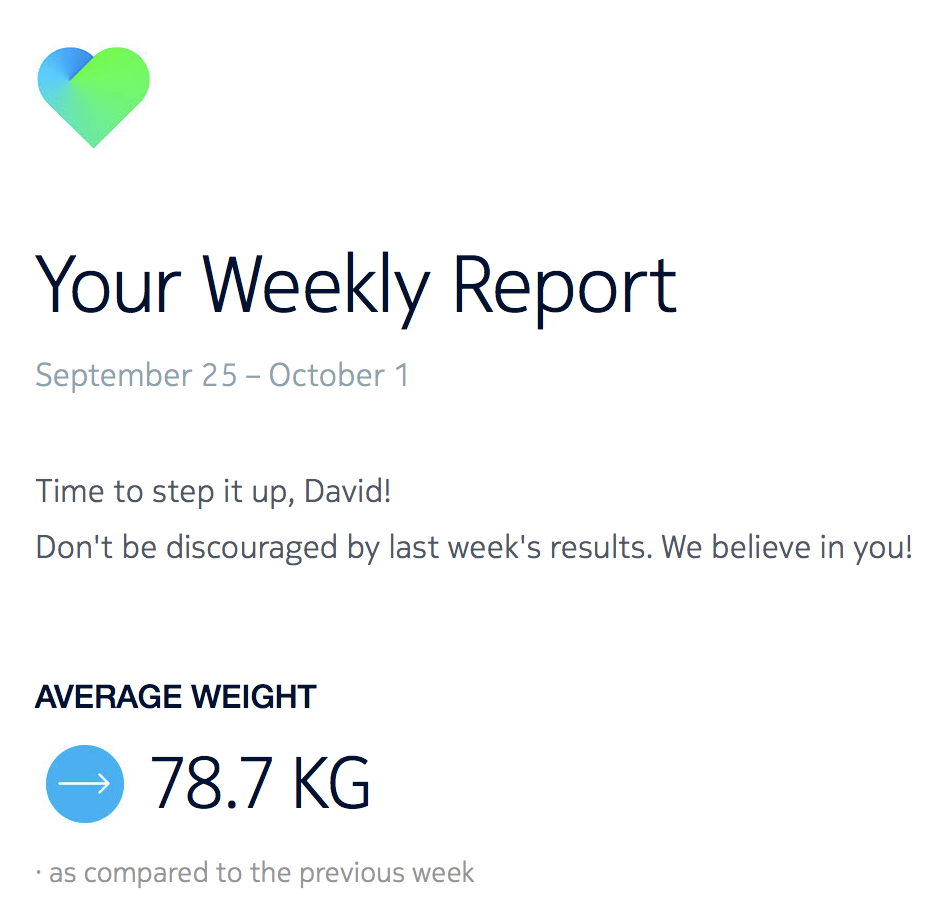
Then, in 2016, the company was acquired by Nokia and morphed into Nokia Health. Sometime after that, I started to get these:

This told me Nokia Health was watching my weight, which I didn’t like or appreciate. But I wasn’t surprised, since Withings’ original privacy policy featured the lack of assurance long customary to one-sided contracts of adhesion that have been pro forma on the Web since commercial activity exploded there in 1995: “The Service Provider reserves the right to modify all or part of the Service’s Privacy Rules without notice. Use of the Service by the User constitutes full and complete acceptance of any changes made to these Privacy Rules.” (The exact same language appears in the original terms of use.)

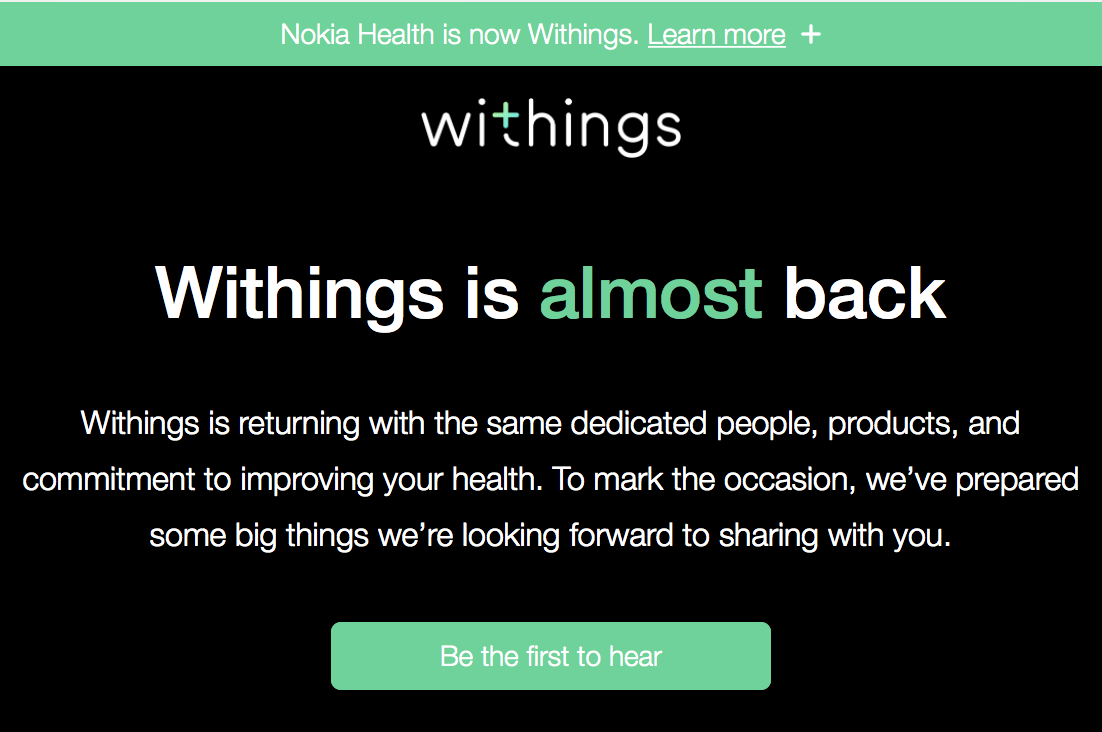
Still, I was too busy with other stuff to care more about it until I got this from community@email.health.nokia two days ago:

Here’s the announcement at the “learn more” link. Sounded encouraging.

So I dug a bit and and saw that Nokia in May planned to sell its Health division to Withings co-founder Éric Carreel (@ecaeca).

Thinking that perhaps Withings would welcome some feedback from a customer, I wrote this in a customer service form:

One big reason I bought my Withings scale was to monitor my own weight, by myself. As I recall the promise from Withings was that my data would remain known only to me (though Withings would store it). Since then I have received many robotic emailings telling me my weight and offering encouragements. This annoys me, and I would like my data to be exclusively my own again — and for that to be among Withings’ enticements to buy the company’s products. Thank you.

Here’s the response I got back, by email:

Hi,

Thank you for contacting Nokia Customer Support about monitoring your own weight. I’ll be glad to help.

Following your request to remove your email address from our mailing lists, and in accordance with data privacy laws, we have created an interface which allows our customers to manage their email preferences and easily opt-out from receiving emails from us. To access this interface, please follow the link below:

Obviously, the person there didn’t understand what I said.

So I’m saying it here. And on Twitter.

What I’m hoping isn’t for Withings to make a minor correction for one customer, but rather that Éric & Withings enter a dialog with the @VRM community and @CustomerCommons about a different approach to #GDPR compliance: one at the end of which Withings might pioneer agreeing to customers’ friendly terms and conditions, such as those starting to appear at Customer Commons.

Actual chat with an Internet Disservice Provider

customerdisservice

After failing to get a useful answer from Verizon about FiOS availabilty at a Manhattan address (via http://fios.verizon.com/fios-coverage.html), I engaged the site’s chat agent system, and had this dialog:

Jessica: Hi! I am a Verizon specialist, can I help you today?

You: I am trying to help a friend moving into ______ in New York City. The Web interface here gives a choice of three addresses, two of which are that address, but it doesn’t seem to work. She wants to know if the Gigabit deal — internet only (she doesn’t watch TV or want a phone) — is available there.
Jessica: By chatting with us, you grant us permission to review your services during the chat to offer the best value. Refusing to chat will not affect your current services. It is your right and our duty to protect your account information. For quality, we may monitor and/or review this chat.

You: sure.
Jessica: Hey there! My name is Jessica. Happy to help!

Jessica: Thank you for considering Verizon services. I would be glad to assist you with Verizon services.

You: Did you see my question?
Jessica: Thank you for sharing the address, please allow me a moment to check this for you.

Jessica: Yes, please allow me a moment to check this for you.

Jessica: I appreciate your patience.

Jessica: Do you live in the apartment?

You: No. I am looking for a friend who is moving into that building.
You: I had FiOS where I used to live near Boston and was pleased with it.
Jessica: Thank you for your consideration.

Jessica: The address where your friend will be moving require to enter the apartment number.

You: hang on
Jessica: Sure, take your time.

You: 5B
You: When we are done I
Jessica: Thank you, one more moment please.

You: would also like you to check my building as well.
Jessica: Sure, allow me a moment.

Jessica: I appreciate your patience.

Jessica: I’m extremely sorry to share this, currently at your friend’s location we don’t have Fios services.

You: Okay. How about _________ ?
You: Still there?
Jessica: Yes, I’m checking for this.

Jessica: Please stay connected.

Jessica has left the chat
You are being transferred, please hold…
You are now chatting with LOUIS
LOUIS: Good morning. I’ll be happy to assist you today. May I start by asking for your name, the phone number we are going to be working with today, and your account pin please?

You: I want to know if FiOS is available at _________.
You: __________. It is not a landline and I do not have an account.
LOUIS: Hello. You’ve reached our Verizon Wireless chat services. I don’t have an option to check on our Fios services for your area. You are able to contact our Fios sister company at the number 1-800-483-3000

You: this makes no sense. I was transfered to you by Jessica in FiOS.
LOUIS: Looks like Jessica is one of our chat agents, but we are with Verizon Wireless. Fios is our sister company, which is a different entity than us

You: Well, send some feedback to whoever or whatever is in charge. Not sure what the problem is, but it’s a fail in this round. Best to you. I now your job isn’t easy.
LOUIS: I do apologize about this, I will certainly relay this feedback on this matter. Here is a link to Verizon Communications for your residential services:https://www.verizon.com/support/residential/contact-us/index.htm

You: Thanks.
LOUIS: I want to thank you for chatting with me today. Hope you have a great day! You can find answers to additional questions at vzw.com/support. Please click on the “X” or “End Chat” button to end this chat.

You: Thanks agin.

The only way to fix this, as we’ve said here countless times, is from the customer’s side. Meanwhile, please dig Despair.com, source of the image above. For so many companies, it remains too true.

Pictures Unpack 20,669 Words

rsiskoryak-image

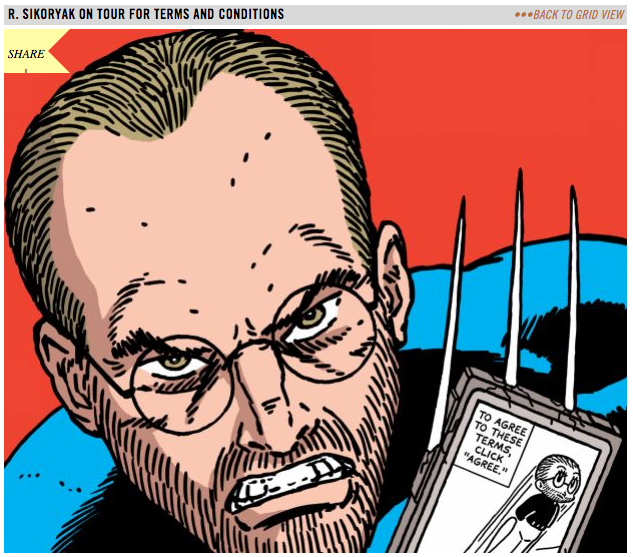
That’s a small sample of some great work by the artist R. Siskoryak, who (Wikipedia tells us), usually “specializes in making comic adaptations of literature classics”, but has now graphically adapted the complete text of what Joe Coscarelli (@JoeCoscarelli) of The New York Times (in Artist Helps iTunes’ User Agreement Go Down Easy), calls “the complete text of Apple’s mind-numbing corporate boilerplate” one must agree to before using iTunes.

The adaptation has its own Tumblr site, where it says, “@rsikoryak is on tour to promote the new color edition of Terms and Conditions: The Graphic Novel, out now from @drawnandquarterly.” Hence the image above. His  well-illustrated bio there is fun too. You can also read the original Tumblr version from the beginning here.

He’ll be appearing (and, presumably speaking and showing) at the Strand Bookstore, 828 Broadway, 10003, with Kenneth Goldsmith, at 7pm this evening (Thursday, March 9). He’s already been in Baltimore. Next up:

  • Pittsburgh, PA, Friday, March 17, 2017 – 6:00pm, ToonSeum with Copacetic Comics. 945 Liberty Ave, 15222
  • Cincinnati, OH, Tuesday, March 21, 2017 – 7:00pm, Joseph-Beth Booksellers, 2692 Madison Ave., 45208 with Carol Tyler
  • New York, NY, Friday, March 24, 2017 – 4:00pm, Spring Symposium, Cardozo Law Journal, moderated by Brett Frischmann
  • Rochester, NY, Wednesday, April 12, 2017 – 4:00pm, Rochester Institute of Technology, Bamboo Room in the Student Alumni Union, 1 Lomb Memorial Dr, 14623
  • Toronto, ON, Toronto Comic Arts Festival, Friday, May 12, 2017 – 9:00am to Sunday, May 14, 2017 – 5:00pm, Toronto Reference Library, 789 Yonge

Meanwhile, here are a few things we’ve been doing (both through ProjectVRM and CustomerCommons, which is working with the Consent & Information Sharing Working Group at Kantara) on terms and conditions you, the individual formerly known as “the user” (as if you’re on drugs) can assert as the first party. In other words, ways companies such as Apple can click “agree” to what you bring to the level table between you both. Four reasons they would do that:

  1. We have the Internet now. It’s a flat place. We don’t need to drag industrial age defaults that give companies scale across many customers, but don’t give individuals scale across many companies.
  2. Ours can have scale too. This is what Cluetrain promised in 1999 when it said we are not seats or eyeballs or end users or consumers. we are human beings and our reach exceeds your grasp. deal with it. Sure, companies haven’t heard of customer boilerplate before; but they do like consistency, simplicity, predictability, standardization and saving money and time. Customers’ scalable terms will bring them all.
  3. Our terms can be as friendly online as they are off. First example: #NoStalking, which can save the asses of publishers and advertisers, and maybe save journalism too.
  4. GDPR compliance. No need to worry about Europe’s new General Data Protection Regulation and its scary penalties when agreeing to friendly GDPR-compliant terms proffered by individuals obviates the whole thing.

Bonus links:

We will also be visiting all of these—on both the first and second party sides—at VRM Day, and then at the 24th Internet Identity Workshop, which happen together the first week of May at the Computer History Museum in Silicon Valley.

VRM Day: Starting Phase Two

VRM Day is today, 24 October, at the Computer History Museum. IIW follows, over the next three days at the same place. (The original version of this post was October 17.)

We’ve been doing VRM Days since (let’s see…) this one in 2013, and VRM events since this one in 2007. Coming on our tenth anniversary, this is our last in Phase One.

sisyphusTheRolling snowball difference between Phase One and Phase Two is that between rocks and snowballs. In Phase One we played Sisyphus, pushing a rock uphill. In Phase Two we roll snowballs downhill.

Phase One was about getting us to the point where VRM was accepted by many as a thing bound to happen. This has taken ten years, but we are there.

Phase Two is about making it happen, by betting our energies on ideas and work that starts rolling downhill and gaining size and momentum.

Some of that work is already rolling. Some is poised to start. Both kinds will be on the table at VRM Day. Here are ones currently on the agenda:

  • VRM + CRM via JLINC. See At last: a protocol to link VRM and CRM. , and The new frontier for CRM is CDL: customer driven leads. This is a one form of intentcasting that should be enormously appealing to CRM companies and their B2B corporate customers. Speaking of which, we also have—
  • Big companies welcoming VRM.  Leading this is Fing, a French think tank that brings together many of the country’s largest companies, both to welcome VRM and to research (e.g. through Mesinfos) how the future might play out. Sarah Medjek of Fing will present that work, and lead discussion of where it will head next. We will also get a chance to participate in that research by providing her with our own use cases for VRM. (We’ll take out a few minutes to each fill out an online form.)
  • Terms individuals assert in dealings with companies. These are required for countless purposes. Mary Hodder will lead discussion of terms currently being developed at Customer Commons and the CISWG / Kantara User Submitted Terms working group (Consent and Information Sharing Working Group). Among other things, this leads to—
  • 2016_04_25_vrmday_000-1Next steps in tracking protection and ad blocking. At the last VRM Day and IIW, we discussed CHEDDAR on the server side and #NoStalking on the individual’s side. There are now huge opportunities with both, especially if we can normalize #NoStalking terms for all tracking protection and ad blocking tools.  To prep for this, see  Why #NoStalking is a good deal for publishers, where you’ll find the image on the right, copied from the whiteboard on VRM Day.

  • Blockchain, Identity and VRM. Read what Phil Windley has been writing lately distributed ledgers (e.g. blockchain) and what they bring to the identity discussions that have been happening for 22 IIWs, so far. There are many relevancies to VRM.
  • Personal data. This was the main topic at two recent big events in Europe: MyData2016 in Helsinki and PIE (peronal information economy) 2016 in London.  The long-standing anchor for discussions and work on the topic at VRM Day and IIW is PDEC (Personal Data Ecosystem Consortium). Dean Landsman of PDEC will keep that conversational ball rolling. Adrian Gropper will also brief us on recent developments around personal health data as well.
  • Hacks on the financial system. Kevin Cox can’t make it, but wants me to share what he would have presented. Three links: 1) a one minute video that shows why the financial system is so expensive, 2) part of a blog post respecting his local Water Authority and newly elected government., and 3) an explanation of the idea of how we can build low-cost systems of interacting agents. He adds, “Note the progression from location, to address, to identity, to money, to housing.  They are all ‘the same’.” We will also look at how small business and individuals have more in common than either do with big business. With a hint toward that, see what Xero (the very hot small business accounting software company) says here.
  • What ProjectVRM becomes. We’ve been a Berkman-Klein Center project from the start. We’ve already spun off Customer Commons. Inevitably, ProjectVRM will itself be spun off, or evolve in some TBD way. We need to co-think and co-plan how that will go. It will certainly live on in the DNA of VRM and VRooMy work of many kinds. How and where it lives on organizationally is an open question we’ll need to answer.

Here is a straw man context for all of those and more.

  • Top Level: Tools for people. These are ones which, in legal terms, give individuals power as first parties. In mathematical terms, they make us independent variables, rather than dependent ones. Our focus from the start has been independence and engagement.
    • VRM in the literal sense: whatever engages companies’ CRM or equivalent systems.
    • Intentcasting.
    • PIMS—Personal Information Management Systems. Goes by many names: personal clouds, personal data stores, life management platforms and so on. Ctrl-Shift has done a good job of branding PIMS, however. We should all just go with that.
    • Privacy tools. Such as those provided by tracking protection (and tracking-protective ad blocking).
    • Legal tools. Such as the terms Customer Commons and the CISWG are working on.
    • UI elements. Such as the r-button.
    • Transaction & payment systems. Such as EmanciPay.

Those overlap to some degree. For example, a PIMS app and data store can do all that stuff. But we do need to pull the concerns and categories apart as much as we can, just so we can talk about them.

Kaliya will facilitate VRM Day. She and I are still working on the agenda. Let us know what you’d like to add to the list above, and we’ll do what we can. (At IIW, you’ll do it, because it’s an unconference. That’s where all the topics are provided by participants.)

Again, register here. And see you there.


Save

Save

Save

Save

What small businesses and their customers have in common

small vs largeSmall businesses and their customers both have problems dealing with big businesses that are more vested in captive markets than in free ones. So, since VRM is about independence and engagement, we may have an opportunity for customers and small businesses to join in common cause.

To dig deeper into that possibility, I interviewed LaVonne Reimer, who runs Lumenous (a startup that  provides ways for small businesses to create and share credit profiles on their own terms). Here goes—

DS: How big is small business?

LR: The domestic small business market in the U.S. is currently at 28 million firms. This includes employer and non-employer firms that provide products or services to their neighborhoods and communities as well as those that provide a unique offering to a larger supply chain or marketplace.

The impact of credit decisions is another big number—how at least $4 trillion flows to small business in the U.S.. That includes a significant portion of over $1 trillion in federal contracts and grants, and $700 billion in loans, a substantial portion of which are backed by the Small Business Administration (SBA).

DS: What’s the biggest issue for small business, and how is that similar to issues for individuals?

LR: Credit. The $28 billion credit industry provides creditworthiness indicators as well as personal identity and entity verification for both businesses and individuals. From the standpoint of both, that industry is a collection of black boxes. They are unaccountable collections of algorithms that can make or break a business, or often its owner, without explaining why. Or even knowing why.

The incumbent with the biggest impact on small business credit is Dun & Bradstreet. Founded in 1841, D&B is the grandfather of all credit bureaus and in many respects the originator of corporate surveillance.  And now D&B is in the identity business as well, putting those being identified at D&B’s mercy.

DS: How?

LR: Through the Data Universal Numbering System, better known as DUNS. It’s a loss leader that gives D&B a potent tool for finding and extracting information from business owners not otherwise publicly available. And it’s all done out of the sight of the business, and—effectively—government as well.

DS: Are they alone at this?

LR: No. A handful of venture-backed “fintech” startups are using similar technology to harvest data. Some of the data gathering might be initially authorized by the business owner. Other data they can scrape or mine from the Web to determine creditworthiness for purposes of making loans. Many do not disclose “effective APR” but recent Federal Reserve System research suggests the range may be from over 50% at the low end to somewhere in the hundreds. Business owners may get loans they couldn’t get from regulated or traditional banks but are blind-sided by onerous terms and in some cases thrown into bankruptcy because the collection model—daily automated micro-payments—catches them off guard, for example by triggering excessive non-sufficient funds (NSF) fees. To a business owner, these providers seem much like credit bureaus. There is no way yet to leverage or re-use the data you have to supply to get the loan, much less understand how the algorithms work.

I should add that a small business “bill of rights” has been circulating among start-ups; but it under-estimates the degree to which the odds are stacked against a small business across commercial credit.”

DS: What about government oversight?

LR: Today, consumer identity and credit providers must comply with the Fair Credit Reporting Act, but the FCRA and similar regulations do not govern small business credit, not even when consumer credit information is used to verify the identity and creditworthiness of the entity and owner.

There is, however, increasing scrutiny by the Federal Trade Commission (FTC) of big data systems in credit profiling and other data brokers. In multiple enforcement orders and two major reports, the FTC is calling on identity and data providers to demonstrate greater transparency and accountability in the uses of personal data. One report is Big Data: A Tool for Inclusion or Exclusion? The other is “Data Brokers: A Call for Transparency and Accountability.

Still, as is true of the Fair Credit Reporting Act, small business is left unaddressed, even if creditors use consumer credit information associated with the owner of the business.

DS: What outcomes are we looking for here?

LR:  At Lumenous, we are applying the principles of VRM to transform the relationship between small business and creditors. As a result, up to six million small employer firms will be able to access the credit, capital, and commerce they deserve.. This will lead to better leverage of cash and ability to not only meet payroll and pay bills on time, but also better contribute to the economic well-being of their communities. Twenty-two million “non employer firms”—freelancers and sole proprietors, for example—will have access to credit, and more easily form trusted joint ventures to bid on otherwise out-of-reach projects.

DS: Are there any large companies that are working to bring small business and their customers together in the fight to improve the economy from the bottom up?

LR: I really like what Xero is doing. It is far more friendly and useful to small business than other accounting software and services companies (especially Quickbooks). It’s growing rapidly too. I believe that;s because it has a deep understanding of how small business works, and a genuine respect for how small business owners think about their firms, and those firms’ roles in the world.

DS: I noticed. Xero’s CEO, Rod Drury, sourced a recent post of mine in a talk he gave just a few days ago. And Gary Turner, an old friend from my Cluetrain days, is Managing Director of Xero in the UK. I’ll be talking with both in the next few days as well.

LR: I expect that Xero will also have lots of useful intelligence about what’s actually happening with small business, worldwide—and with possible VRM connections.

And here are some bonus sources, mostly courtesy of LaVonne:

There are many more, but I’ll save those for a follow-up post.


Save

Save

Save

Save

Save

Save

Save

Save

Save

Save

Save

VRM at MyData2016

mydata2016-image

As it happens I’m in Helsinki right now, for MyData2016, where I’ll be speaking on Thursday morning. My topic: The Power of the Individual. There is also a hackathon (led by DataBusiness.fi) going on during the show, starting at 4pm (local time) today. In no order of priority, here are just some of the subjects and players I’ll be dealing with,  talking to, and talking up (much as I can):

Please let me know what others belong on this list. And see you at the show.

Save

Is Facebook working on a VRM system? Or just another way to do ads?

It’s easy to get caught up in news that WhatsApp is starting to accept advertising (after they said they would never do that), and miss the deeper point of what’s really going on: Facebook setting up a new bot-based channel through which companies and customers can communicate. Like this:

vrmcrmbot

The word balloon is Facebook Messenger. But it could be WhatsApp too. From a VRM perspective, what matters is whether or not “Messenger bots” work as VRM tools, meaning they obey the individual user’s commands (and not just those of Facebook’s corporate customers). We don’t know yet. Hence the question mark.

But before we get to exploring the possibilities here (which could be immense), we need to visit and dismiss the main distractions.

Those start with Why we don’t sell ads, posted on the WhatsApp blog on 18 June 2012. Here are the money grafs from that one:

We knew we could do what most people aim to do every day: avoid ads.
No one wakes up excited to see more advertising, no one goes to sleep thinking about the ads they’ll see tomorrow. We know people go to sleep excited about who they chatted with that day (and disappointed about who they didn’t). We want WhatsApp to be the product that keeps you awake… and that you reach for in the morning. No one jumps up from a nap and runs to see an advertisement.

Advertising isn’t just the disruption of aesthetics, the insults to your intelligence and the interruption of your train of thought. At every company that sells ads, a significant portion of their engineering team spends their day tuning data mining, writing better code to collect all your personal data, upgrading the servers that hold all the data and making sure it’s all being logged and collated and sliced and packaged and shipped out… And at the end of the day the result of it all is a slightly different advertising banner in your browser or on your mobile screen.

Remember, when advertising is involved you the user are the product.

Great stuff. But that was then and this is now. In WhatsApp’s latest post, Looking Ahead for WhatsApp (25 August), we have the about-face:

But by coordinating more with Facebook, we’ll be able to do things like track basic metrics about how often people use our services and better fight spam on WhatsApp. And by connecting your phone number with Facebook’s systems, Facebook can offer better friend suggestions and show you more relevant ads if you have an account with them. For example, you might see an ad from a company you already work with, rather than one from someone you’ve never heard of. You can learn more, including how to control the use of your data, here.

Pretty yucky, huh?

Earlier in the same post, however, WhatsApp says,

we want to explore ways for you to communicate with businesses that matter to you too

Interesting: Mark Zuckerberg said the same thing when he introduced messenger bots, back in April. In the video at that link, Zuck said,

Now that Messenger has scaled, we’re starting to develop ecosystems around it. And the first thing we’re doing is exploring how you can all communicate with businesses.

You probably interact with dozens of businesses every day. And some of them are probably really meaningful to you. But I’ve never met anyone who likes calling a business. And no one wants to have to install a new app for every service or business they want to interact with. So we think there’s gotta be a better way to do this.

We think you should be able to message a business the same way you message a friend. You should get a quick response, and it shouldn’t take your full attention, like a phone call would. And you shouldn’t have to install a new app.

Note the similarities in the set-up:

  1. Zuck:  “how you can all communicate with business.”
  2. WhatsApp: “explore ways for you to communicate with businesses.”

This is, or should be, pure VRM:  a way for a customer to issue a service request, or to intentcast for bids on a new washing machine or a car. In other words, what they seem to be talking about here is a new communication channel between customers and businesses that can relieve  the typical pains of being a customer while also opening the floodgates of demand notifying supply when it’s ready to buy. Back to Zuck:

So today we’re launching Messenger Platform. So you can build bots for Messenger.

By “you” Zuck means the developers he was addressing that day. I assume these were developers working for businesses that avoid customer contact and would rather have robots take over everything possible, because that’s the norm these days. But I could be wrong. He continues,

And it’s a simple platform, powered by artificial intelligence, so you can build natural language services to communicate directly with people. So let’s take a look.

CNN, for example, is going to be able to send you a daily digest of stories, right into messenger. And the more you use it, the more personalized it will get. And if you want to learn more about a specific topic, say a Supreme Court nomination or the zika virus, you just send a message and it will send you that information.

The antecedents of “you” move around here. Could be he’s misdirecting attention away from surveillance. Can’t tell. But it is clear that he’s looking past advertising alone as a way to make money.

Back to the WhatsApp post:

Whether it’s hearing from your bank about a potentially fraudulent transaction, or getting notified by an airline about a delayed flight, many of us get this information elsewhere, including in text messages and phone calls.

This also echoes what Zuck said in April. In both cases it’s about companies communicating with you, not about you communicating with companies. Would bots work both ways?

In “‘Bot’ is the wrong name…and why people who think it’s silly are wrong”, Aaron Batalion says all kinds of functionality now found only in apps will move to bots—Messenger’s in particular. “In a micro app world, you build one experience on the Facebook platform and reach 1B people.”

How about building a one-experience bot so 1B people can reach businesses the same way?

Imagine, for example, that you can notify every company you deal with that your last name has changed, or you’ve replaced a credit card. It would be great to do that in one move. It would also be VRM 101. But, almost ten years into our project, nobody has built that yet. Is Facebook doing it?

Frankly, I hope not, because I don’t want to see VRM trapped inside a giant silo.

That’s why I just put up Market intelligence that flows both ways, over in Medium. (It’s a much-updated version of a post I put up here several years ago.)

In that post I describe a much better approach, based on open source code, that doesn’t require locating your soul inside a large company for which, as WhatsApp put it four years ago, you’re the product.

Here’s a diagram that shows how one person (myself, in this case) can relate to a company whose moccasins he owns:

vrmcrmconduit

The moccasins have their own pico: a cloud on the Net for a thing in the physical world. For VRM and CRM purposes, this one is a relationship conduit between customer and company.

A pico of this type comes in to being when the customer assigns the QR code to the moccasins and scans it. The customer and company can then share records about the product, or notify the other party when there’s a problem, a bargain on a new pair, or whatever. It’s tabula rasa: wide open.

The current code for this is called Wrangler. It’s open source and in Github. For the curious, Phil Windley explains how picos work in Reactive Programming With Picos.

I’ll continue on this theme in the next post. Meanwhile, my main purpose with this one is to borrow interest in where Facebook is going (if I’m guessing right) with Messenger bots, and do it one better in the open and un-silo’d world, while we still have one to hack.


Save

Save

Save

Save

Save

Save

Save

Save

Save

Save

Save

Save

Save

The Castle Doctrine

home castle

The Castle doctrine has been around a long time. Cicero (106–43 BCE) wrote, “What more sacred, what more strongly guarded by every holy feeling, than a man’s own home?” In Book 4, Chapter 16 of his Commentaries on the Laws of England, William Blackstone (1723–1780 CE) added, “And the law of England has so particular and tender a regard to the immunity of a man’s house, that it stiles it his castle, and will never suffer it to be violated with impunity: agreeing herein with the sentiments of ancient Rome…”

Since you’re reading this online, let me ask, what’s your house here? What sacred space do you strongly guard, and never suffer to be violated with impunity?

At the very least, it should be your browser.

But, unless you’re running tracking protection in the browser you’re using right now, companies you’ve never heard of (and some you have) are watching you read this, and eager to use or sell personal data about you, so you can be delivered the human behavior hack called “interest based advertising.”

Shoshana Zuboff, of Harvard Business School, has a term for this:surveillance capitalism, defined as “a wholly new subspecies of capitalism in which profits derive from the unilateral surveillance and modification of human behavior.”

Almost across the board, advertising-supported publishers have handed their business over to adtech, the surveillance-based (they call it “interactive”) wing of advertising. Adtech doesn’t see your browser as a sacred personal space, but instead as a shopping cart with ad space that you push around from site to site.

So here is a helpful fact: we don’t go anywhere when we use our browsers. Our browser homes are in our computers, laptops and mobile devices. When we “visit” a web page or site with our browsers, we actually just request its contents (using the hypertext protocol called http or https).

In no case do we consciously ask to be spied on, or abused by content we didn’t ask for or expect. That’s why we have every right to field-strip out anything we don’t want when it arrives at our browsers’ doors.

The castle doctrine is what hundreds of millions of us practice when we use tracking protection and ad blockers. It is what called the new Brave browser into the marketplace. It’s why Mozilla has been cranking up privacy protections with every new version of Firefox . It’s why Apple’s new content blocking feature treats adtech the way chemo treats cancer. It’s why respectful publishers will comply with CHEDDAR. It’s why Customer Commons is becoming the place to choose No Trespassing signs potential intruders will obey. And it’s why #NoStalking is a good deal for publishers.

The job of every entity I named in the last paragraph — and every other one in a position to improve personal privacy online — is to bring as much respect to the castle doctrine in the virtual world as we’ve had in the physical one for more than two thousand years.

It should help to remember that it’s still early. We’ve only had commercial activity on the Internet since April 1995. But we’ve also waited long enough. Let’s finish making our homes online the safe places they should have been in the first place.


« Older posts

© 2026 ProjectVRM

Theme by Anders NorenUp ↑