
Category: AI (Page 2 of 2)

Personal AI +/vs Corporate AI

Are they going to shake hands or fight? We’ll answer that question after personal AI exists and operates as a powerful personal agent.

You’re reading this on a machine with an operating system: Linux, Windows, MacOS, iOS, or Android.

But that’s not your OS. It’s your machine’s.

How about one for you, that runs on your machine but is entirely yours? Let’s call it a Personal OS, or a POS.

The POS will have a kernel onto which abilities (not just applications) can be added. An extreme example of how this might work is Neo learning ju jitsu in The Matrix:

That OS amplified Neo’s own intelligence, in his own head. We’re far from that today. But we can at least add abilities to a POS of our own. Those too can give us more agency of many kinds.

To my knowledge, there is only one POS so far. It’s called pAI-OS (Github code), and it’s led by Kwaai.* To my knowledge, pAI-OS is the first and only truly personal operating system. (If others do the same, let me know and I’ll talk those up too.) And it is built to run our own AIs. Let’s call them PAIs, where the A can mean amplified or augmented (sourcing Doug Englebart for the latter).

So, what kind of abilities are we talking about?

Let’s start with something that could hardly be more mundane and important: memory.

In Laws of Media, Marshall McLuhan (five decades ago) said that computing promises “perfect memory—total and exact.” For many millennia, our species has been outboarding memory through speech, and the written word, and collecting all of that in libraries and museums. And now, in the digital age that dawned with microcircuits and the Internet, we now occupy a digital world where everybody can publish whatever they want. To peruse that, we made search engines. Those ruled from the late ’90s until approximately yesterday, when AIs took over servicing our interest in answers to questions. Google, Microsoft, ChatGPT, Perplexity.ai, and others have moved into a space we might call AI answerware.

Running all that answerware are corporate AIs. Let’s call them CAIs. Nothing wrong with CAIs, but also nothing personal, because they are not ours. I explain the difference in Personal vs. Personalized AI. Here’s a graphic from that post showing a bit of what abilities might run on your PAI:
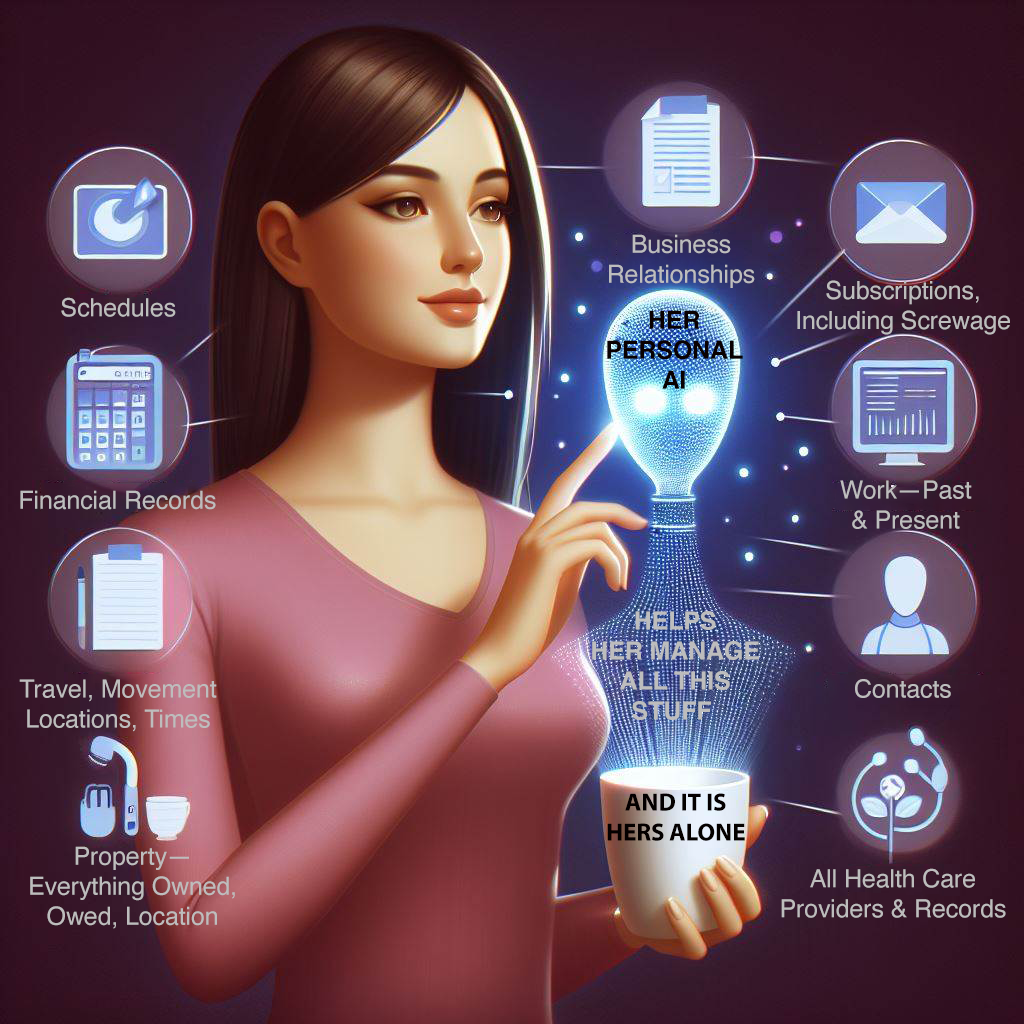
PAIs can extend our own memories by accumulating personal stuff we need to know better, and our ability to meet, access, and use the external abilities of the CAI world. So we’ll have our agents + their agents, working together.

For an example of how that might work, take a look at The most important standard in development today: P7012: Standard for Machine Readable Personal Privacy Terms, which “identifies/addresses the manner in which personal privacy terms are proffered and how they can be read and agreed to by machines.” After seven years with a working group, it is now in the IEEE editing and approval mill, edging toward becoming a finished standard by next year. It works like this:
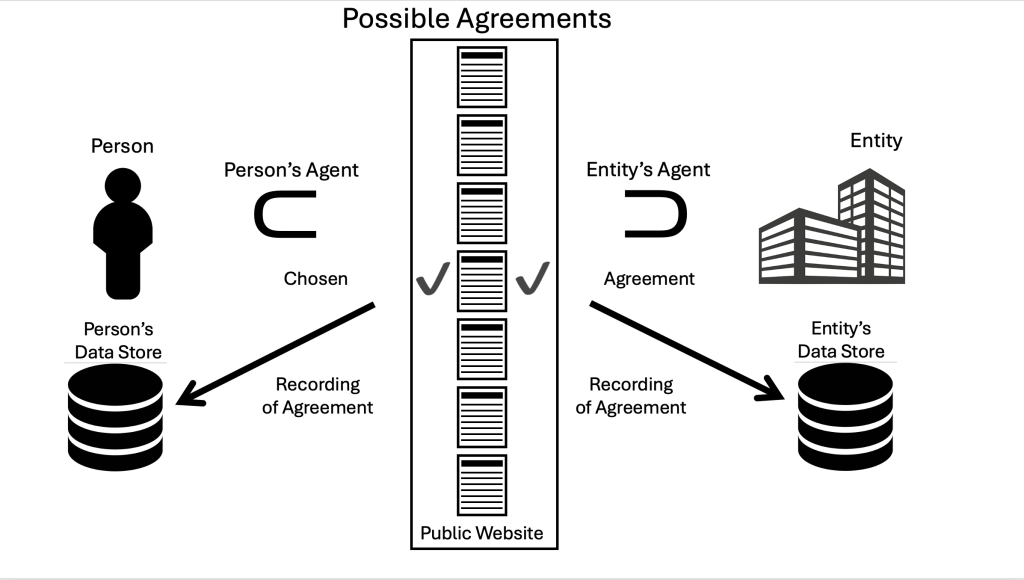
Here your agent (a PAI, represented by the ⊂ symbol) proffers your privacy terms (here is one example) to a corporate agent (which might or might not be a CAI, but is still represented with the reciprocal symbol ⊃. (This should be familiar to ProjectVRM veterans as the r-button. We may finally get to use it!)

The ceremony here is the exact reverse of what we have today with the cookie popovers on most website home pages. This can and should be done ⊂ to ⊃. So should signing and recording the agreement, or the choice of the site, should it tell you to screw off. (An agent running on your PAI will record that diss.)

I also bring this up because it will be a key required ability—not just for you and me but for the world, starting with Europe, where the GDPR lists six lawful bases for processing personal data. They begin—

(a) Consent: the individual has given clear consent for you to process their personal data for a specific purpose.
(b) Contract: the processing is necessary for a contract you have with the individual, or because they have asked you to take specific steps before entering into a contract.

By now everyone knows that (a) Consent has failed. It’s an expensive and meaningless dance, with high cognitive (mostly cynical) overhead, and almost no accountability. Now they’re ready for (b) Contract, especially in ceremonies where the individual (not a mere “user”) takes the lead.

I believe there is less limit to what each of us can do with a PAI than there is to what we can do with a laptop or a phone. Because our PAI is our own. It runs on a deeper machine OS, but is not limited by that. Your PAI, running on your POS, may prove to be the first truly personal layer ever put on a machine OS.


*Full disclosure: I am now the Chief Intention Officer there. At this stage, it’s a voluntary position.

Personal AI at VRM Day and IIW

Prompt: A woman uses personal AI to know, get control of, and put to better use all available data about her property, health, finances, contacts, calendar, subscriptions, shopping, travel, and work. Via Microsoft Copilot Designer, with spelling corrections by the author.

Most AI news is about what the giants (OpenAI/Microsoft, Meta, Google/Apple, Amazon, Adobe, Nvidia) are doing (seven $trillion, anyone?), or what AI is doing for business (all of Forbes’ AI 50). Against all that, personal AI appears to be about where personal computing was in 1974: no longer an oxymoron but discussed more than delivered.

For evidence, look up “personal AI.” All the results will be about business (see here and here) or “assistants” that are just suction cups on the tentacles of giants (Siri, Google Assistant, Alexa, Bixby), or wannabes that do the same kind of thing (Lindy, Hound, DataBot).

There may be others, but three exceptions I know are Kin, Personal AI and Pi.

Personal AI is finding its most promoted early uses on the side of business more than the side of customers. Zapier, for example, explains that Personal AI “can be used as a productivity or business tool.”

Kin and Pi are personal assistants that help you with your life by surveilling your activities for your own benefit. I’ve signed up for both, but have only experienced Pit,” or “just vent,” when I ask it to help me with the stuff outlined in (and under) the AI-generated image above, it wants to hook me up with a bunch of siloed platforms that cost money, or to do geeky things (PostgreSQL, MongoDB, Python on my own computer. Provisional conclusion: Pi means well, but the tools aren’t there yet. [Later… Looks like it’s going to morph into some kind of B2B thing, or be abandoned outright, now that Inflection AI’s CEO, Mustafa Suleyman is gone to Microsoft. Hmm… will Microsoft do what we’d like in this space?]

Open source approaches are out there: OpenDAN, Khoj, Kwaai , and Llama are four, and I know at least one will be at VRM Day and IIW.

So, since personal AI may finally be what pushes VRM into becoming a Real Thing, we’ll make it the focus of our next VRM Day.

As always, VRM Day will precede IIW in the same location: the Boole Room of the Computer History Museum in Mountain View, just off Highway 101 in the heart of Silicon Valley. It’ll be on Monday, 15 April, and start at 9am. There’s a Starbucks across the street and ample parking because the museum is officially closed on Mondays, but the door is open. We lunch outdoors (it’s always clear) at the sports bar on the other corner.

Registration is open now at this Eventbrite link:

https://vrmday2024a.eventbrite.com

You can also just show up, but registering gives us a rough headcount, which is helpful for bringing in the right number of chairs and stuff like that.

See you there!


Individual Empowerment and Agency on a Scale We’ve Never Seen Before

I was listening to the latest Pivot Podcast when Kara Swisher played a clip from Sam Altman‘s keynote at OpenAI’s Developers Day, earlier this week. Spake Sam (at the 35:18 mark),

We believe that AI will be about individual empowerment and agency on a scale we’ve never seen before

Whoa! That’s what we’ve been working toward here at ProjectVRM since 2006. It’s what John Battelle called for last April:

Imagine a GPT chatbot that you own, trust, and control. Let’s call it a genie, because honestly, that’s the most appropriate word for this new entity. This genie has access to everything you do on your phone, your computer, and sure, why not – your Alexa, your car, basically every digital surface with which you interact. Imagine it’s bounded by immutable rules that state you and you alone can tell it what to do, what information to share, what services to connect to, on what terms, and so on. Now imagine you can ask that genie to perform all manner of magic on your behalf – pretty much any question you can think of, it will figure out an answer.

Genie is good. Dare we try riffing off what Sam said, with IEASWNSB? (Pronounced “Eewasnib,” perhaps?) We might have better luck with that than we’ve had with VRM, Me2B, and other initialisms and acronyms.

For fun, I asked Bing Image Create, which uses OpenAI’s DALL-E to produce images, to make art with its boss’s words. It gave me the images above. Here’s the link.

Those are a little too Ayn Randy for me. So I tried just “Empowered individuals,” and got this—

—which is the Ayn Rand translated to Woke.

But never mind that. Let’s talk about individual empowerment with AI help. Here’s my personal punch list:

  1. Health. Make sense of all my health data. Suck it in from every medical care provider I’ve ever had, and help me make decisions based on it. Also, help me share it on an as-needed basis with my current providers. (On my own terms, about which more below.)
  2. Finances. Pull in and help me make sense of my holdings, obligations, recurring payments, incomes, whatever. Match my orders and shipments from Amazon and other retailers with the cryptic entries (always in ALL CAPS) on my credit card bills. I want to run every receipt I collect through a scanner that does OCR for my AI, which will know what receipt is for what, where it goes in the books it helps me keep, and yearly helps me work through my taxes. The list can go on.
  3. Property. What have I got? I want to point my phone camera at everything that a good AI can recognize, and make sense of all that too. Know all the books on my shelves by reading their spines. Know my furniture, the stuff in my basement. Help me keep records of my car’s history after I give it the VIN number I photographed under the windshield, and run all the records I’ve kept in the glove box through the same scanner I mentioned above. Whatever. Why not?
  4. Correspondence. I have half a million emails here, going back to 1995. (Wish it went back farther.) Lots of texts too, in lots of systems. Help me do a better job of looking back through those than my various clients do. Help me cross-reference those with events I attended and other stuff that may be relevant to some current inquiry.
  5. Contacts. Who do I have in my various directories? How many entries are wrong in one way or another? Go through and correct them, AI butler, using whatever clever new algorithm works for that, supplied by corporate entities whose knowledge of me remains as close to zero as I allow.
  6. Crumb trail. What did I buy from Amazon (or anybody) and when? Where do Google and Apple know I’ve been and what I’ve been doing? How about my late model car, which at the very least knows lots about my driving, and may even know what I’ve said, to whom, or even if sexual activity was going on? How about my TV, the maker of which gets paid to snitch on what I’ve watched and when—and may even be watching me and others, sitting and staring at it. All that information is far more useful to me than it is to them.
  7. Calendar. Tell me where I was on a given day, what I was doing, and who I was with. Knowing all that other personal data (above) will help too.
  8. Business relationships. Look into all my subscriptions and help me fight the fuckery behind nearly all of them. Make better sense of all the “loyalty” programs I’m involved with, and help me unfuck those too since most of them are about entrapment rather than real loyalty. (Bonus links here and here.)
  9. Other involvements. What associations do I belong to? How deeply am I involved with any or all of them? Can we drop some? Add some? Have some insights into how those are going, or should go?
  10. Travel. I have 1.6 million miles with United Airlines alone. Where did I go? When? Why? What did I pay? Are there ways to improve my relationships with airlines and other entities (e.g. car rental agencies, Uber/Lyft, Airbnb, cruise lines)? Are there ways I can help them that don’t require enduring yet another of those annoying surveys that seem to follow every contact with them?
  11. Shopping. We’ve been talking about (and working toward) intentcasting since the late aughts, with lots of developers on the case, but not big breakthroughs. But with AI it’s easy to imagine countless possibilities that begin with one’s intent to buy rather than retailers’ intent to sell. Words to wise sellers: A) Make it as easy as possible for customers’ personal and privacy-guarding AI agents to find what you’ve got and know as much about it as possible, and B) Fire every marketer and marketing system that wants in any ways to trap, milk, coerce, and otherwise fuck over customers. Meanwhile, customers should have AI capacities that keep them from getting screwed, to know when the screwing happens, and to help do something about it.
  12. My own personal data collection. There have been many of these, by many names, tried over the years. The current leading candidate (IMHO) is Sir Tim Berners-Lee‘s Solid project.

John Battelle (see above) adds,

How about remembering the password you used once to log into your healthcare provider three years ago? How about negotiating a way better deal with that service by threatening to move to competitors? Done! Once you’re happy with that healthcare provider, can you ask your genie to file  all your claims and make sure you get reimbursed by checking your bank statements? Why yes you can! Your wish has been granted!

Our lives are packed with too much data for our meat brains alone to comprehend fully and put to use. AI is good for that. So bring it on.

And don’t bet that any of the bigs, including OpenAI, will give you anything on the punch list above*. They’re too big, too centralized, too stuck in a mainframe paradigm. They look for what only they can do for you, rather than what you can do for yourself—or do better with your own damn AI.

Personal AI today is where personal computing was fifty years ago. We don’t yet have the Apple II, the Osborne, the TRS-80, the Commodore PET, much less the IBM  PC or the Macintosh. We just have big companies with big everything and hooks for developers.

Real personal AI is a huge greenfield. Going there is also, to switch metaphors, a blue ocean strategy. Wrote about that here.


*Except by pouring all that data into their LLM. Not yours.

Newer posts »

© 2026 ProjectVRM

Theme by Anders Noren — Up ↑