Tag: VRM (Page 5 of 8)

Hot Fodder for next week’s VRM Workshop

A few weeks ago I was interviewed by Neil Davey of MyCustomer.com, a major voice in the CRM (Customer Relationship Management) field. The results are up at Doc Searls: Customers will use ID data to force CRM change. Much of what Neil sources for that piece come from my new chapter (“Markets are Relationships”) in the latest edition of The Cluetrain Manifesto (Now with 30% more clues!). In that chapter, Neil says,

Searls sticks the boot into customer relationship management. And even though CRM has become accustomed to bruising encounters, some of these blows hurt – perhaps because there are some painful truths being delivered. CRM, as Searls sees it, would rather have captive customers rather than free ones. To demonstrate this, we only have to examine the language organisations use when referring to customers – how they try to ‘lock in’ customers and ‘retain’ them after they have been ‘acquired’.

Later this week, after I’ve looked more closely at what did and didn’t make it into Neil’s piece (what I said to him, by emai, was quite long), I’ll post some of what was missed.

Meanwhile, a little summary for VRM newbies arriving from the lands of CRM…

The purpose of VRM is to improve markets by enlarging what customers can do, not just what vendors can do. The latter is necessary too; but that’s what all good sellers have always been doing. And there’s a limit to how far that can go.

Better selling alone can’t make better buying. Better marketing alone can’t make better markets. Better CRM alone can’t make better customers. At a certain point customers have to do that for themselves.

That point came when the Internet arrived. It was announced by Chris Locke in The Cluetrain Manifesto, with this very graphic:

notThere was an equipment problem with that statement. Customers were not yet self-equipped with the means for reaching beyond the grasp of old-school marketers and sellers—a school that is still very much in session.

VRM (Vendor Relationship Management) is about equipping customers with their own ways of of relating to vendors. In the larger sense, it’s also for equipping individuals with their own ways of relating to any organization.

Thats the mission of ProjectVRM.org, which I lead as a fellow at Harvard’s Berkman Center. It’s also the mission of a variety of related projects and companies: The Mine! Project, PAOGA, The Banyan Project, MyDex, ListenLog, EmanciPay, Scanaroo, Kynetx, r-button and SwitchBook, to name a subset of the whole community.

Adriana Lukas, who started The Mine! Project, has something new at Market RIOT (Relationships on Individuals’ Own Terms): MINT, for My Information, Not Theirs. She calls it “a movement to redress the balance of market power between vendors and customers, institutions and individuals, web services/platforms and users.” Its obectives:

  • “to create an ecosystem where customer data belongs to the customer, is freely available to individual customer or user, in open formats
  • ‘to help the individual to become the point of integration for his or her transactional data
  • “to encourage development of applications that enable individuals to enjoy the value they can add by managing and analysing their own data (buying behaviour, purchasing patterns and preferences) and potentially benefit vendors, when such information is voluntarily shared by customers.”

This should bring up plenty of discussion at the VRM East Coast Workshop next Monday and Tuesday at Harvard Law School. It’s free. The agenda will be set by participants (on the “open space” model). In addition I am working right now on lining up an opening panel on Tuesday to lead off discussion of user control of data. Stay tuned for more on that.

Meanwhile, if you haven’t signed up already, go here to register for the workshop.

East Coast VRM Workshop coming up

VRooM Boston 2009 is coming up soon — on 12-13 October, at Harvard Law School in Cambridge, MA. It’s hosted by the Berkman Center and ProjectVRM at the Center.

As with earlier VRM workshops, it’s a free unconference, organized on the open space model. Participants choose the topics, move those topics forward in open discussion, and share progress with the whole group at the end of each day.

You can get a sense of the energy in a VRM gathering from photo galleries here, here, here, here and here.

Sign up for the workshop here.

For those of you not familiar with VRM, the letters stand for Vendor Relationship Management, and it’s about the tools that developers and friends are creating to provide individuals with tools of independence form organizations that wish to control them — and better means for engaging with those organizations. In other words, it’s about blowing up silos and walled gardens, and creating a better system: one in which individuals are the collection centers for their own data, and the ones controlling what gets done with that data.

There are many projects and topics already moving forward that should get a boost from participation at the workshop. Here in the UK this week I met with folks involved in MyDex and The Mine! Project — the latter in a VRM Hub meeting last night overlooking the Thames and Blackfriars Bridge.

In Boston I’m looking forward to a lot of discussion on a topic we might call HCRM, or Health Care Relationship Management. The Boston area is a hotbed of forward thinking about patients controlling their own health care data, and reforming the health care from the individual side of the relationshp with the systems in control of it. Here is an excerpt from the link above:

Among the biggest topics in HCRM in recent years has been PHR, for Personal Health Records. Search for that, with quotes, and you get over half a million results. Leave off the quotes and you get fifty-five million results. The more specific (and less confusing, with Physicians for Human Rights) EHR, for Electronic Health Records, gets nearly five million results.

This is a huge topic, of a degree of importance that verges on the absolute. It’s also perhaps the most sisyphean of VRM categories. I find that daunting, but there are many professionals in health care and related fields who have been doing a great job pushing big rocks long distances. These people are heroes, even if they don’t know or acknowledge that. Here are some links to get started:

I could (and should) write more, but I’m in London waiting for a plane, lucky to have any connectivity at all. (Which, if I’d had enough at my hotel this week, this would have been posted much earlier.)

In the next few days I’ll write about other topics I’m hoping to see covered at the workshop.

Is RedBeacon VRM?

That question came to me this morning, in response to RedBeacon being named the winner of this year’s TechCrunch 50.

What RedBeacon offers is a form of what in the VRM community we call a personal RFP. As the company’s site says, RedBeacon provides a way to …

  • 1Customers find you on Redbeacon
    Request a local service
  • 2Work when you want
    Compare prices
    from qualified providers
  • 3Did we mention it's FREE?
    Schedule the job online

(Whoa. I didn’t know WordPress would let you copy and paste images and text together like that. Nice. An old dog learns a new trick.)

As it says here, you can request a service, review qualified buyers, select a provider, and schedule the job, all at the RedBeacon site.

Is that VRM? In a number of ways, yes. RedBeacon to me looks like a fourth party service, such as those outlined in VRM and the Four Party System.

I would like to see how it fits as what Joe Andrieu outlines as a user-driven service. What do the rest of ya’ll think?

Unf*cking car rental

The oldest case for VRM is one that has hardly improved in decades: car rental. Few business categories do a worse job of matching specific customer needs. Or a worse job of doing even the very limited range of services to which they limit themselves.

For example, Enterprise. I had a car booked for this evening in Santa Barbara that I would drive for the next week and return to the same airport. Price: $205 for an economyh car.  Nice deal. But, thanks to the common difficulty of getting from Airport A to Airport B, I’m arriving at 11:45 this evening, after Enterprise is closed.  So I called the company from the airport in Denver, where I’m sitting now.

The robot asked if I’d like to answer a one-question survey if I stayed on line after the call. I pressed 1 for yes. The reservations agent explained that I couldn’t change the reservation for pick-up tomorrow morning, but would need a new reservation. This one would be $245. Why? The short answer: because that’s what The System says.

So the survey robot asked me to say whether I was satisfied with the agent’s service (not the company’s, meaning the agent gets penalized, I would guess). On a scale of 1 to 5 (where 5 is most satisfied), I punched in 2. The robot expressed electronic unhappiness with my dissatisfaction, and told me to leave a detailed message. When the promt for that came, I started to talk and the robot instantly interrupted with a “Thank you,” and hung up the line. Is there a better way to compound customer unhappiness than that?

So I want to take this opportunity to appeal to anybody in a responsible position anywhere in the car rental business to work together with us at on a customer-based solution to this kind of automated lameness. It can’t be done from the inside alone. That’s been tried and proven inadequate for way too long. Leave a message below or write me at dsearls at cyber dot law dot harvard dot edu.

Let’s build The Intention Economy — based on real, existing, money-in-hand intentions of real customers, rather than the broken attention-seeking and customer-screwing system we have now.

[Later…] Just booked a Budget compact car through United for $196.86. Got miles with it. By the way, I am a long-standing member of Budget’s FastBreak club. There was nowhere on the reservation I just made to note that. Makes no difference. Just pointing out how lame “loyalty” programs are too. I have minimal loyalty to Budget (which, over the years, has generally been okay). As of now, I have antipathy toward Enterprise.

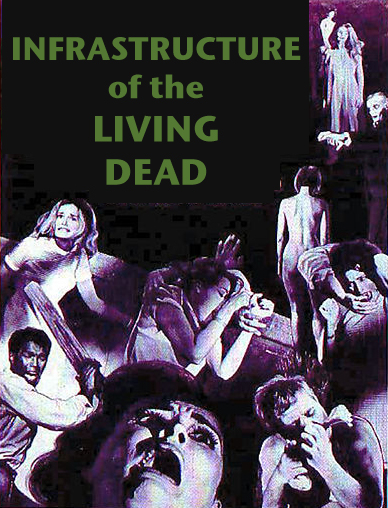
Dawn of the Living Infrastructure

So how do we get out of this place?

infrastructure_of_living_dead

Let’s face it. Mike Arrington’s problem with the iPhone, Om Malik’s problem with AT&T, the FCC’s problem with Apple + AT&T together, my own problems with Cox, Dish Network and Sprint, David Pogue’s problem with the whole freaking cell phone industry … all of these are a great big WAAAH! in the wilderness of industrial oblivity to what customers want. We’re in the graveyard of what Umair Haque calls the zombieconomy. We’re living in Night of the Living Dead and complaining that the zombies want to eat us alive.

What they really want is to strap us down while they bleed us for small change—tiny amounts of ARPU. They do this, for example, by forcing us to sit through “The … number … you … have … dialed … eight … zero … five … seven …” until a small ka-ching happens somewhere deep in their billing system, so you get bled whether or not you’ve left (or received) a message. David Pogue:

Is 15 seconds here and there that big a deal? Well, Verizon has 70 million customers. If each customer leaves one message and checks voicemail once a day, Verizon rakes in — are you sitting down? — $850 million a year. That’s right: $850 million, just from making us sit through those 15-second airtime-eating instructions.

It was JP Rangaswami (disclosure: I consult JP and his company, BT) who first pointed out to me that the primary competence of phone companies isn’t technical. It’s financial. They’re billing machines. That’s their core competency. And it was r0ml who pointed out, way back when he was with AT&T Wireless (before it became Cingular, and then the AT&T we all know and hate today), that phone companies arrived at the holy grail of micropayments decades ago. They don’t charge small amounts, but they know how to add them up, and round piles of microminutes into billions of dollars.

A better movie metaphor is The Matrix. We’re all wet cell batteries inside giant phone company billing systems. The machines took over a long time ago, and they’re still running the world.

Not that acting like machines does them much good in the long run. Umair Haque:

Profit through economic harm to others results in what I’ve termed “thin value.” Thin value is an economic illusion: profit that is economically meaningless, because it leaves others worse off, or, at best, no one better off. When you have to spend an extra 30 seconds for no reason, mobile operators win — but you lose time, money, and productivity. Mobile networks’ marginal profits are simply counterbalanced by your marginal losses. That marginal profit doesn’t reflect, often, the creation of authentic, meaningful value.

He adds,

The fundamental challenge for 21st Century businesses — and economies — is learning to create thick value. We’re seeing the endgame of a global economy built to create thin value: collapse. Why? Simple: thin value is a mirage — and like all mirages, it ultimately evaporates. In the 21st Century, we’ve got to reconceive value creation.

Constructive Capitalists are disrupting their rivals by creating thicker value. Thick value is sustainable, meaningful value — and a new generation of radical innovators is wielding it like a strategic superweapon.

Rick Segal thinks Mike Arrington‘s CrunchPad is one of those superweapons. Here’s what the Crunchies say will look like:

crunchpad-near-final-design

Sez Rick,

No, this probably isn’t the next Apple or Motion Computing, but here’s the secret.

Let’s assume there are just 1000 people out of all the TechCrunch people in the world that want this device.  If this device gets made and sold to 1000 happy people and the result is a manufacturing world and process which can now do these “one off” type devices, the game changes.

That’s why I want this device to get made. It begins a high profile (and positive) disruption at the point of manufacture and that can mean exciting things to you.

One way to blow up silos and walled gardens is de-verticalize industry itself. Not by making it horizontal (that’s too abstract), but by making it personal. Rick’s angle here is to go all the way to the source, and make manufacturing personal.

That’s what Rick thinks Mike & Co. are doing here. I also think the Crunchpad is compliant with what Dave says in this post here:

I’ve been through this loop many times, this is Mike’s first. The only platform that really works is a platform with no platform vendor, and that’s the Internet.

Right. The Crunchpad, as I understand it (and the Crunchies have explained it) is a Net-native device. Standards-based. Commodity parts. Full of open source stuff. The platform is the Net. The vendor is TechCrunch, but trapping users isn’t their game. They’d rather have thick value than thin.

So how do we contribute, besides paying cash for goods? By being constructive customers, rather than passive consumers. That’s what Rick is calling for here, and why we, as free and independent customers, can choose to support something that uses the Net as the platform, and is built to be user-driven.

Think about it. Is the Crunchpad crippled by any deals with a major vendor of any kind? Is it locked into any phone company’s billing and application approval systems? Is it locked into any one industry’s Business-as-Usual? No.

So who is in the best position to contribute to its continued improvement, besides the Crunchies themselves?

You. Me. Users. Customers.

We can drive this thing. Even if what Dan Frommer says is right, and Apple comes out with the world’s most beautiful pad ever, and pwns the whole category, there’s more vroom for improvement in the Crunchpad, because Apple’s device will be closed and the Crunchpad will be open. Or should be.

You listening, Mike?

Adjusting Business to a Networked World

In response to The Trillion Dollar Market, which adds a few paragraphs to Gain of Facebook (below), which responded to How Facebook Could Create a Revolution, Do Good, and Make Billions, by Bernard Lunn in ReadWriteWeb, Nate Ritter raised some questions that I’d like to answer in detail. We begin…

…one question that needs to be solved is that if both suppliers and demanders are getting value out of the transaction why is it the suppliers are always fronting the money to make the connection?

The short answer is that we’ve done it that way ever since Industry won the Industrial Revolution. The long answer is that customer choice in the prevailing industrial system is provided by sellers to buyers they “target,” “acquire,” “control,” “manage” and “lock in.” These efforts include telling captives what their choices are. We call this “marketing”.

At the level of simple customer choice, the industrial system is no different than it was when sellers operated out of carts and stalls at village crossroads. Such is the nature of straightforward retailing. But in our industrial system, sellers sit out at the last link of many value chains. Exchanging goods and services for money is a small part of that system. The final transaction is just the far end of a process that moves from source to sale through a series of complex stages in which individual customers have little if any direct say. At the end of those stages, the customer’s choice is to buy or not to buy. The customer’s job is to consume, and not to do much more than that. It works well enough, but it is also open to countless improvements in a world where everybody is approximately zero distance from everybody else. That world is the Internet. And it’s new.

The Net makes it easy—or should make it easy—for customers to advertise what they want. That is, to find and drive supply. To a very limited degree, the supply side helps this with CRM (Customer Relationship Management) systems, but those systems are all silo’d and allow very limited input from customers themselves. Put crudely, they have ways of making you talk—with a minimal set of allowable words and phrases.

If this weren’t already broken enough, many sellers’ sites and systems are also poorly designed or maintained.  Think about what we all go through when we need customer service or tech support. Why should you have to give a series of call center people your account and phone numbers, even after you’ve already punched them in, time and again? These systems are lame because they put all responsibility for maintaining a “relationship” on the sell side. They exclude most forms of customer input because they don’t want more variables than they can easily “manage”. That excludes countless clues about what the market is up to, in addition to countless sums of money left on tables they can’t see through the CRM blinders they wear.

To be clear, I’m not saying CRM is inherently bad. I am saying it’s no closer to what we need than AOL and Compuserve were to the Internet, or than mainframes were to PCs.

What VRM proposes is shifting relationship responsibility to customers as well as sellers, for the simple reason that the customer is, for many purposes, the best point of integration for his or her own data—and the best point of origination for what can be done with it.

For example, a customer’s VRM system should be able to say, globally, “I want receipts emailed to me. Here is my email address. You can do business with me if you don’t share that address with anybody, and if you don’t send me unwanted emails. Sign here (digitally) if you agree to these terms.”

Yes, that may sound scary to sellers, but guess what? The customer-control horse left the seller’s barn as soon as the Internet came along. All that precious customer data that sellers think they own is a tiny fraction of what they can gain from independent customers in relationships where both sides are open to whatever the other brings to the table. In other words, relationships in which sellers do not speak of “acquiring”, “managing”, “controlling”, “owning” or “locking in” customers as if they were slaves or livestock.

What VRM offers are better ways for sellers and buyers to relate—as equals with a wide range of options. Yes, we’ll need open and standard protocols, data types, and methodologies. Not to mention agreements that the customer (and not just the seller) asserts. We’re working on all that stuff.

Next item…

I have a feeling the culture of consumerism dissuades consumers from believing they are giving up anything (or devalues the money they are giving away for the product/service). For example, the belief that everything is free that is on the web. That’s an inherent problem that has to be solved before there will be an market that starts with the consumers. The “market’ necessitates a trade of value, and if one side is inherently told that what they want is free, then why would they give up money to trade for it?

First, what we call “consumerism” should be re-labeled “producerism”, because it’s a phenomenon driven by production. As Thorstein Veblen put it long ago (and I used to put it before discovering Veblen said it first), invention is the mother of necessity. Consumers participate, of course, but they don’t drive it. The production side does.

Of course, I’m speaking on the general scale, and of course there are definitely products and services that exist because people wanted them to. And of course they do well in charging for something because the demographic believes it’s worth the trade. But that’s not a change of the macro market. And although it’s nice and warm and fuzzy, the reality is that on a large scale people are simply being conditioned to take things for free. They don’t want to trade value for value.

When Napster came along, and suddenly everybody’s CD collection was free for the taking, “everything is free” became a mantra. Nobody, it seemed, would ever pay for music again. Why would they, when all of it is free, and one’s chances of getting caught and nailed by the RIAA and its running dogs were so small? Then Apple created the iPod and iTunes and the iTunes store, and started charging 99¢ for medium-fi music that didn’t work on more than five “authorized” devices. And people ate it up. Suddenly music had two price points: $.00 for illegal music and $.99 for legal but crippled music. How big is the latter business? Said here two years ago that Apple had already sold 2.5 billion songs. And how much has the former non-business driven the whole music industry in a new direction? Why cry about how disruptive the Internet is, and how much it devalues every old business it touches*, when it’s an expanding planet-sized environment on which countless new businesses can be built to do far more, and make money from (and for) many more people, and companies, than the old ones?

My point: it’s early. The Net is a giant zero between everything and everybody. It removes distance and reduces the costs of connection, storage, and distribution in the direction of zero.

There is still plenty of money to be made at the commodity level (just ask Nick Carr, or Amazon), but that’s one more reason why the Giant Zero is a great place to build all kinds of new businesses. And why it’s still very, very early in what Craig Burton calls the “terraforming” of the Net’s new world.

The point of my two postings (in the first sentence up top) is that there is much more money to be made in helping demand find and drive supply than in helping supply find and drive demand. And that this will be much better for the supply side than the old system, where suppliers have to do it all.

I wish it weren’t that way. Perhaps some day it won’t be. But we have to start changing the message that we’re sending out there, or even better than pushing a message, finding the areas where people are indicating they’re willing to pay for a product to be created. Harder done than said.

True. But we’ve already started. If one looks at markets (or economies) as places where parties signal each other, we’re already well underway. Nate himself did a heroic job of putting Twitter on the map as a great signaling system on the Live Web during real-world emergencies. In his case, it was the San Diego Fire. It’s conceivable that what the market learned in that experience helped save my own house during the two recent fires in Santa Barbara.

Last winter I used Twitter successfully to signal our family’s interest in a good restaurant during a layover at O’Hare. This was way less significant than what Nate did during a huge fire, but no less eye-opening for me.

Still, tweeting—microblogging—is just one early step in a direction where lies an endless variety of signals that can move from demand to supply. VRM is about creating open, standard, and simple pro forma ways of doing that.

* Tom Foremski is right when he says The Internet Devalues Everything It Touches, Anything That Can Be Digitized. But you have to read Tom’s points deeply to get the full implications. Losing the old will be painful. But there is far more value to be found in the new. For example, in fourth parties.


Privacy and VRM

In Privacy is Relative my column in May’s Linux Journal, I wrote,

there are essentially two forms of privacy. One is the kind where you hide out. You minimize exposure by confining it to yourself. The other is where you trust somebody with your information.

In order to trust somebody, you need a relationship with them. You’re their spouse, friend, client or patient.

This isn’t so easy if you’re just a customer, or worse, a “consumer”. There the obligation is minimized, usually through call centers and other customer-avoidance mechanisms that get only worse as technology improves. Today, the call center wants to scrape you off onto a Web site or a chat system.

Minimizing human contact isolates your private information inside machines that have little interest in relating to you as a human being or in putting you in contact with a human being inside the company. Hence, your data is indeed safe—from you. It’s also safe from the assumption that this data might in any way also belong to you—meaning, under your control. It’s still private, but only on the company’s terms. Not on yours.

This mess can’t be fixed just by humanizing call centers. It can be fixed only by humanizing companies. This has to be done from both inside and out.

There isn’t enough room in a column like that to unpack that last statement. But there is in a thread like this one, if you’re game.

Off base but still kinda relevant

I suppose you’ve succeeded when people start making fun of what you’re up to. That might be what’s going on with The Vendor-Client Relationship, a YouTube video I found via markfonteijn. In this video the clients — diners at a restaurant, a customer at a hairdresser — bargain over costs. I suppose this is to point out the oddities of doing the same kind of thing in a B2B world.

It’s not about VRM at all, but it does bring up an occasional misunderstanding about VRM: that it’s about negotiating on price. It’s not. It’s about relationship; or more precisely, about relating. If price negotiation isn’t on the table, or shouldn’t (or can’t) be on the table — as would be the case at a restaurant, a hairdresser, or most retail establishments — it’s outside VRM’s scope. VRM is about enlarging the table, not turning it over.

EmanciPay does put the pricing gun in the hands of the customer, but only for goods that cost nothing and are worth more than that. Which is why our likely first deployments are with public radio.

It helps organize our understanding to divide market activities there into three categories: transaction, conversation and relationship. Of those three, the least developed in our “developed” economy is relationship. (And it’s the most developed in the less-developed world.) The most developed in our familiar settings is transaction. With VRM we are trying to create more balance between the three by concentrating on relationship, even when the relating required is minimal. We’re doing that by better equipping the buyers’ side with tools that will serve both sides.

The kind of interaction we see in that video is about as far from VRM as you’ll get.

EmanciPay: A Content Monetization Plan for Newspapers

Yesterday I reported hearing that the New York Times was thinking about putting its editorial behind a paywall again. Today James Warren gives substance to the rumors:

Here’s a story the newspaper industry’s upper echelon apparently kept from its anxious newsrooms: A discreet Thursday meeting in Chicago about their future.

“Models to Monetize Content” is the subject of a gathering at a hotel which is actually located in drab and sterile suburban Rosemont, Illinois; slabs of concrete, exhibition halls and mostly chain restaurants, whose prime reason for being is O’Hare International Airport. It’s perfect for quickie, in-and-out conclaves.

There’s no mention on its website but the Newspaper Association of America, the industry trade group, has assembled top executives of the New York Times, Gannett, E. W. Scripps, Advance Publications, McClatchy, Hearst Newspapers, MediaNews Group, the Associated Press, Philadelphia Media Holdings, Lee Enterprises and Freedom Communication Inc., among more than two dozen in all. A longtime industry chum, consultant Barbara Cohen, “will facilitate the meeting.”

I can see the headline already: Newspaper Bigs Form Trust To Set Content Prices.

Just kidding.

We do need to be serious here. The Situation is dire. Humpty Dumpty is reaching terminal velocity.

But don’t bother wishing the king’s horses and men luck with the fix. They can’t do it. No newspaper trade group, no collection of top newspaper executives, will come up with a creative solution to problems that have already earned Top Rank status in the innovators dilemma casebook. The best these execs can do is make Humpty’s fall a drop into cyberspace. They have to make Humpty Net-native. They can’t do that just with better-and-better websites, or with “monetization” schemes such as “micropayments” or other scarcity plays with a net-ish gloss.

As disruptive technologies go, it’s hard to beat the Interent. The Net didn’t just push Humpty off the wall. It blew up that wall and the whole world on which both sat. In that wall’s place is a wide-open space where abundance is not only the prevailing condition, but a severly reproductive one that’s especially suited to interesting “content.” As Kevin Kelly aptly puts it, The internet is a copy machine. One measure of content’s worth is how much it gets copied and quoted. How the hell do you monetize that?

In a New Yorker piece this week, Bill Keller, the Times‘ Executive Editor, said, “There’s a crying demand for what we do and, sadly, a diminishing supply of it. How we get the demand to pay for the supply is the existential question of newspapers in general and the Times in particular.” He’s right in all but one respect: that first person plural we. Unless he’s referring to a population of sufficient generality to include readers. Or, more importantly, hackers. Geeks bearing gifts.

As it happens, we (the geeks) have one. It’s called EmanciPay. It hands the pricing gun over to the customers (readers in this case) and then makes it easy for them to pay as much as they like, however they like, on their terms. Or at least to start with that full set of options. Whatever readers decide to pay, the sum of it won’t be $0, which is what readers are paying now. (Online, at least, in nearly all cases.)

Evidence:::

Peter Kafka reports this from the D7 conference today (over a Wall Street Journal AllThingsDigital blog):

Time for some polls! No surprise: People like to read newspapers online. Also no surprise: But people don’t pay for it. Somewhat of a surprise: People say that they are willing to pay for some kind of news.

My boldface.

I conduct similar audience polls often, though my subject is usually public radio. “How many people here listen to public radio?” Nearly all hands go up. “How many of you pay for it?” About 10% stay up. “How many would pay for it if it were real easy?” More hands go up. “How many would pay if stations would stopped begging for money with fund drives?” Many more hands go up, enthusiastically.

So the market is there. The question is how to tap it.

At ProjectVRM we propose tapping it from the customers’ side: for newspapers, from the readers side. We also propose doing it one way for all readers and all newspapers, rather than X different ways for X different papers, each designed by each paper for their own readers. In that direction lies a field of silos, all with their own scarcities, their own frictions, their own lock-ins. We need one way to do this for the same reason we need one way to do email.

Remember back when AOL, Prodigy, Lotus Notes, MCIMail and the rest all had their own ways of making you correspond? That’s what we’ll get if we leave content monetization up to the papers alone. They’ll all have their own ways of locking you in, just like retailers all have their own “loyalty” programs, each with their own cards, their own barcodes for you, their own reward systems, their own special ways of inconveniencing you for their own exclusive benefit.

EmanciPay will be simple and straightforward. It will make it easy for you to pay what you want (which may be what the papers want you to pay … or more … or less), and to do it on your terms and not just theirs. This doesn’t mean that the papers can’t have terms of their own. Maybe they have a suggested price, or a minimum they’re willing to accept. Whatever they come up with, however, will be informed by interaction out in the open marketplace, rather than their own private ones, where they make all the rules.

Think of EmanciPay as a way to unburden sellers of the need to keep trying to control markets that are beyond their control anyway. Think of it as a way that “free market” can mean more than “your choice of captor.” Think of it as a way that “customer relationships” can be worthy of the label because both sides are carrying their ends of the relationship burden — rather than the sellers’ side carrying the whole thing (as CRM systems do today).

EmanciPay is an open source project. When it rolls out, it will be free and open to anybody.

Want to help? Let me know. (firstname at lastname dot com) I’m serious.

The only problem is that development work on EmanciPay is just getting started. (I haven’t wanted to publicize it, because I wanted it to be ready to go — or at least to vet — first.) But that’s also an opportunity.

What matters for the papers is that there’s at least one answer to their challenge out there. And it’s free for the making.

(Cross-posted here.)

Making surveys unnecessary

It’s almost going on two years since I wrote Why Surveys Suck. They still do. Case in point: Sirius, the satellite radio company. Last December, Mike Elgen in Computerworld listed satellite radio among 10 Things That Won’t Survive the Recession. Said Mike,

I’m sorry, Howard Stern. It’s over. The newly merged Sirius XM Radio simply cannot sustain its losses. The company is already deeply in debt and would need to dramatically increase subscribers over the next six months in order to meet its debt obligations. Unfortunately, new car sales, which account for a huge percentage of satellite radio sales, are in the gutter and stand-alone subscriptions are way down.

I’ve been a Sirius subscriber for years. I’m currently paid through next November, but after that I’ll let it lapse if nothing convinces me to renew. The reasons are straightforward:

  1. I don’t like having no choice about what company I buy my gear from. Near as I can tell, Sirius has few or no third parties. They make their own receivers, antennas, and accessories. True, some car radios come with Sirius already installed, but I don’t want to have to buy a car to get the service.
  2. Their gear is full of proprietary suckage. The dock for one won’t work with another, to name one problem. My old Sportster radio has a display that’s as dim as a nebula. None of the new offerings fit in my old docks (I have three of those).
  3. I don’t like being forced to pay for something I don’t want in order to keep getting for “free” something I’m already paying for. (I visit that one here.)
  4. At the very least, they should have a player that works on the iPhone. If other developers can get 20,000 apps on the iPhone, why can’t Sirius? (They should follow on other smartphones, as well as hand-helds of all sorts.)
  5. Listening online should be easy. It’s not. The whole website is a triumph of design over utility.
  6. I want to spool data off of the radio, just to know what I listened to and when. Can’t do that.
  7. I would be willing to pay on an a la carte basis for lot of Sirius’ offerings. Especially their most expensive: Howard Stern.

I could go on, but it would all be beside the point: that none of this stuff shows up on the survey Sirius sent me this morning.

Here’s Sirius’ side of this little market “conversation”:

  1. “Please enter your primary Email Address (required)”. Would it be other than the one they used to send me the survey?
  2. “What types of music do you like? Please select up to 7 (roll over with mouse to see examples)” In fact I like more kinds of music than they list. Some would be in my top seven.
  3. “What types of talk/entertainment/news do you listen to? Check all that apply”. I like Howard, sports and public radio. That’s it. (I like music too, but for that I listen to Internet radio because the stations are better, and there are many more of them.) They list Howard as a check box. Public radio doesn’t rate. Sports gets its own section…
  4. What types of sports do you follow? Check all that apply.” I checked three. This is the only place where I sensed the survey talking to me, personally.

That was about it. Meanwhile I want to scream at Mel Karmazin (who runs Sirius XM) — a guy I have respected for many years — HEY, MEL! QUIT BEING SO VERTICAL. GET HIP TO THE NET. QUIT TRYING TO OWN THE WHOLE MARKETPLACE. STOP TRYING TO BE PROPRIETARY AT ALL COSTS. HURRY! THEY’RE WRITING YOUR EPITAPH OUT HERE.

What will VRM do to make surveys stop sucking? Two words: eliminate guesswork.

Surveys are ways of improving guesswork. But they are no substitute either for conversation or for relationships that transcend the mass-marketed. And that transcendance is required for companies like Sirius to survive.

So. What can we do on the VRM side to make it easier for customers to relate to any vendor? What tools already exist, or can we make, that will standardize and unify the way we make our wishes known for any vendor or combinations of vendors?

How can we offer to pay on an a la carte basis that the vendor can take or leave — but at least know that the money is there to ignore?

These are some of the challenges we’ll be working on at the VRM West Coast workshop on Friday and Saturday of this week in Palo Alto. Follow that link for more details.

« Older posts Newer posts »

© 2026 ProjectVRM

Theme by Anders Noren — Up ↑