Category: Technology (Page 5 of 10)

Can C2B customers lead in a dance with vendors like B2B customers do?

That question came to mind when I read Inside Facebook’s Fantastic Plan To Dominate Cisco’s $23 Billion Market, by Julie Bort, in Business Insider. The gist:

To recap: OCP launched two years ago to create “open source” data center hardware. That means hardware vendors like HP, Dell and Cisco don’t control the product designs. Instead, customers like Facebook and Goldman Sachs do.

OCP is the Open Compute Project.* What matters about the project, for our purposes, is that it models a way for a customer to relate to a vendor: taking the lead in the dance, rather than just following.

A question for VRooMers is, Can we as individual customers do the same thing? I’m thinking we can. One way is through personal clouds, including scenarios such as the one Phil Windley describes here. I am sure there are many others. So I’ll leave detailing those up to the rest of you. 🙂

*BI, like too many other ad-funded Web publishers, doesn’t link to OCP, but instead to its own page full of stories about OCP. This is unhelpful, selfish and at variance with nature of the Web itself.  More about that here. (BTW, I’m guessing that the choice not to link is BI’s policy and not Julie’s, and would welcome correction on that.)


VRM help is where you find it

As Dean Landsman tweets here, a lot of suff out there is VRM without saying so. (Which is cool; it doesn’t have to.) The example toward which he points is How can we provide better customer service? Create software that lets customers serve each other, by Ashley Verrill in Gigaom. The summary:

As consumers increasingly turn to social media to both praise and criticize brands, those brands can’t possibliy respond to all the feedback. The solution is to empower customers to speak on their behalf.

Her piece begins,

Recently I was asked a question following a presentation that suddenly made me realize social application developers are missing a big opportunity in customer service. I had just finished speaking at the global HP Social Support Summit, when an audience member took the microphone and asked, “Do you know of any software that lets community members respond on behalf of companies on Twitter, Facebook and other social media platforms?”

I do, and more on that below. Meanwhile, Ashley unpacks the problem requiring this kind of question:

The current customer service model is moribund

One of the biggest reasons this idea struck me is that the current model just isn’t working. In one study I conducted, major brands such as Coca-Cola and Wells Fargo responded just 14 percent of the time when they were asked questions via Twitter. This is a big problem when you consider more than half of Twitter users expect a personal response within two hours of sending a question or complaint, according to a report by Oracle last year.

This is a scaling problem that can be partially answered by equipping more employees to respond to requests from customers. Ashley sees customers themselves — “community members” — taking up the rest of the slack:

Existing, active community members can be the perfect candidates to respond for companies on social media for two reasons: For one, they’re already enthusiastic about your products and so can be good brand ambassadors; and two, they’ve proven their zeal for answering questions from other customers already.

Take this HP community member, for example. He spends upwards of 30 unpaid  hours a week responding to queries in their discussion forums. The software I’m suggesting would essentially empower “wb2001″ and thousands of other similar customers like him to respond to questions on social media (in addition to the community that exists already).

This hypothetical technology could still leverage all of the tools that make communities so effective – things like gamification and automated alerts. Also, social listening tools could filter out messages that would be better suited for an employee response. This could include messages from customers that are particularly angry, or questions that would require a technical expert.

This would lead, she concludes, to “empowering your brand advocates to create a sea of new discussions that never would have existed in the first place.”

What would do the empowering, exactly?

Among VRM developers, I see one company that does exactly what the HP audience member asked for. The company is Directly. Here is its mission:

A Better Way To Get Help.

Directly makes it easy to get fast, personal attention from experts who know different companies inside and out. Our community of experts work independently in their own free time. They earn rewards and reputation, and can cash out their rewards or donate them to one of the non-profit causes we support.

  • Our support site helps customers get better customer support — so customers can spend less time dealing with support and more time enjoying their life.
  • Our mortgage site helps homebuyers and homeowners — so more families can buy new homes or stay in the ones they love.

Directly launched publicly in December 2012 with a network that reaches 3.2 million customers monthly and has already helped 35,000 airline, bank, cable and wireless customers with a 97% response rate and an average response time of less than 10 minutes.

So whether you need to evaluate the best options, resolve an issue or just get things done, Directly is a better way to get help straight from the experts who can help.

As for software for making her scenario work, I think it would have to be independent of the world’s HPs, but would work with any or all of them.

For example, let’s say I wish to leverage my expertise with these things:

  • Canon 5D camera
  • 2000 Volkswagen Passat station wagon
  • Sangean ATS-909/Radio Shack DX-398 radio
  • Garmin eTrex Legend HCx GPS
  • Starbucks’ Saeco and Barista espresso machines

Rather than be empowered by each of those companies to speak for them, I might like one standard and non-proprietary way I could provide help for users of all of them. Or that would give customers a way of notifying the marketplace (including the corporate CRM systems, plus help systems such as Directly, plus anybody interested in helping without an intermediator) of a need for help.

Is that way out there yet? There are a zillion fora for a zillion products and services already. Some are hosted by the companies themselves, and some are out in the wild. But all I can name are to some degree centralized. What I’d like to see is something decentralized, but capable of working both with customers and with any of the CRM systems already in place from providers like Salesforce, IBM, SAP, Microsoft Dynamics and the rest of them.

Maybe something like that is out there already. If so, let us know.

Prepping for #VRM Day and #IIW

The 16th IIW (Internet Identity Workshop) is coming up, Tuesday to Thursday, 7-9 May, will be tat the Computer History Museum in Mountain View, CA. As usual, VRM will be a main topic, with lots of developers and other interested folk participating. Also as usual, we will have a VRM planning day on the Monday preceding: 6 May, also at the CHM. So that’s four straight days during which we’ll get to present, whiteboard, discuss and move forward the many projects we’re working on. From the top of my head at the moment:

  • Personal Clouds, including —
    • The Internet of Me and My Things
    • QS (Quantified Self) and Self-Hacking
  • Fully personal wallets, rather than branded ones that work only with payment silos and their partners
  • Intentcasting — where customers advertise their purchase intentions in a secure, private and trusted way, outside of any vendor’s silo
  • Browser add-ons, extensions, related developments
  • Licensing issues
  • Sovereign and administrative identity approaches, including Persona, formerly BrowserID, from Mozilla
  • Legal issues, such as creating terms and policies that individuals assert
  • Tracking and ad blocking, and harmonizing methods and experiences
  • Health Care VRM
  • Devices, such as the freedom box
  • VRM inSovereign vs./+ Administrative identities
    • Real estate
    • Banking (including credit cards, payments, transactions)
    • Retail
  • Personal data pain points, e.g. filling out forms
  • Trust networks
  • Harnessing adtech science and methods for customers, rather than only for vendors

The morning will be devoted to VRM issues, while the afternoon will concentrate on personal clouds.

We still have eight tickets left here. There is no charge to attend.

In the next few days here on the blog we’ll be going over some of the topics above. Input welcome.


VRM development work

I’ll be having a brown bag lunch today with a group of developers, talking about VRM and personal clouds, among other stuff that’s sure to come up. To make that easier, I’ve copied and pasted the current list from the VRM developers page of the ProjectVRM wiki. If you’d like to improve it in any way, please do — either on the wiki itself, or by letting us know what to change.

While there are entire categories that fit in the larger VRM circle — quantified self (QS) and personal health records (PHRs) are two that often come up — we’ve tried to confine this list to projects and companies that directly address the goals (as well as the principles) listed on the main page of the wiki.


Here is a partial list of VRM development efforts. (See About VRM). Some are organizations, some are commercial entities, some are standing open source code development efforts.

SOFTWARE and SERVICES
Intentcasting
AskForIt † – individual demand aggregation and advocacy
Body Shop Bids † – intentcasting for auto body work bids based on uploaded photos
Have to Have † – “A single destination to store and share everything you want online”
Intently † – Intentcasting “shouts” for services, in the U.K.
Innotribe Funding the Digital Asset Grid prototype, for secure and accountable Intentcasting infrastructure
OffersByMe † – intentcasting for local offers
Prizzm †- social CRM platform rewarding customers for telling businesses what they want, what they like, and what they have problems with
RedBeacon † – intentcasting locally for home services
Thumbtack † – service for finding trustworthy local service providers
Trovi intentcasting; matching searchers and vendors in Portland, OR and Chandler, AZ†
Übokia intentcasting†
Zaarly † intentcasting to community – local so far in SF and NYC
Browser Extensions
Abine † DNT+, deleteme, PrivacyWatch: privacy-protecting browser extentions
Collusion Firefox add-on for viewing third parties tracking your movements
Disconnect.me † browser extentions to stop unwanted tracking, control data sharing
Ghostery † browser extension for tracking the trackers
PrivacyScore † browser extensions and services to users and site builders for keeping track of trackers
Databases
InfoGrid – graph database for personal networking applications
ProjectDanube – open source software for identity and personal data services
Messaging Services and Brokers
Gliph †- private, secure identity management and messaging for smartphones
Insidr † – customer service Q&A site connecting to people who have worked in big companies and are willing to help when the company can’t or won’t
PingUp (was Getabl) †- chat utility for customers to engage with merchants the instant customers are looking for something
TrustFabric † – service for managing relationships with sellers
Personal Data and Relationship Management
Azigo.com † – personal data, personal agent
ComplainApp † – An iOS/Android app to “submit complaints to businesses instantly – and find people with similar complaints”
Connect.Me † – peer-to-peer reputation, personal agent
Geddup.com † – personal data and relationship management
Higgins – open source, personal data
The Locker Project – open source, personal data
Mydex †- personal data stores and other services
OneCub †- Le compte unique pour vos inscriptions en ligne (single account for online registration)
Paoga † – personal data, personal agent
Personal.com † – personal data storage, personal agent
Personal Clouds – personal cloud wiki
Privowny † – privacy company for protecting personal identities and for tracking use and abuse of those identities, building relationships
QIY † – independent infrastructure for managing personal data and relationships
Singly † – personal data storage and platform for development, with an API
Transaction Management
Dashlane † – simplified login and checkout
Trust-Based or -Providing Systems and Services
id3 – trust frameworks
Respect Network † – VRM personal cloud network based on OAuth, XDI, KRL, unhosted, and other open standards, open source, and open data initiatives. Respect Network is the parent of Connect.Me.
Trust.cc Personal social graph based fraud prevention, affiliated with Social Islands
SERVICE PROVIDERS OR PROJECTS BUILT ON VRM PRINCIPLES
First Retail Inc. † commodity infrastructure for bi-directional marketplaces to enable the Personal RFP
dotui.com † intelligent media solutions for retail and hospitality customers
Edentiti Customer driven verification of idenity
Real Estate Cafe † money-saving services for DIY homebuyers & FSBOs
Hover.com Customer-driven domain management†
Hypothes.is – open source, peer review
MyInfo.cl (Transitioning from VRM.cl) †
Neustar “Cooperation through trusted connections” †
NewGov.us – GRM
[1] † – Service for controlling one’s reputation online
Spotflux † malware, tracking, unwanted ad filtration through an encrypted tunnel
SwitchBook † – personal search
Tangled Web † – mobile, P2P & PDS
The Banyan Project– community news co-ops owned by reader/members
TiddlyWiki – a reusable non-linear personal Web notebook
Ting † – customer-driven mobile virtual network operator (MVNO – a cell phone company)
Tucows †
VirtualZero – Open food platform, supply chain transparency
INFRASTRUCTURE
Concepts
EmanciPay – dev project for customer-driven payment choices
GRM: Government Relationship Management – subcategory of VRM
ListenLog – personal data logging
Personal RFP – crowdsourcing, standards
R-button – UI elements for relationship members
Hardware
Freedom Box – personal server on free software and hardware
Precipitat, WebBox – new architecture for decentralizing the Web, little server
Standards, Frameworks, Code bases and Protocols
Datownia † – builds APIs from Excel spreadsheets held in Dropbox
Evented APIs – new standard for live web interactivity
KRL (Kinetic Rules Language) – personal event networks, personal rulesets, programming Live Web interactions
Kynetx † – personal event networks, personal rulesets
https://github.com/CSEMike/OneSwarm Oneswarm] – privacy protecting peer-to-peer data sharing
http://www.mozilla.org/en-US/persona/ Mozila Persona] – a privacy-protecting one-click email-based way to do single sign on at websites
TAS3.eu — Trusted Architecture for Securely Shared Services – R&D toward a trusted architecture and set of adaptive security services for individuals
Telehash – standards, personal data protocols
Tent – open decentralized protocol for personal autonomy and social networking
The Mine! Project – personal data, personal agent
UMA – standards
webfinger – personal Web discovery, finger over HTTP
XDI – OASIS semantic data interchange standard
PEOPLE
Analysts and Consultants
Ctrl-SHIFT † – analysts
Synergetics † – VRM for job markets
VRM Labs – Research
HealthURL – Medical
Consortia, Workgroups
Fing.org – VRM fostering organization
Information Sharing Workgroup at Kantara – legal agreements, trust frameworks
Pegasus – eID smart cards
Personal Data Ecosystem Consortium (PDEC) – industry collaborative
Meetups, Conferences, and Events
IIW: Internet Identity Workshop – yearly unconference in Mountain View
VRM Hub – meeting in LondonNOTES:
† Indicates companies. Others are organizations, development projects or both. Some development projects are affiliated with companies. (e.g. Telehash and The Locker Project with Singly, and KRL with Kynetx.)
A – creating standard
B – Using other standards
1 – EventedAPI

Toward the Internet of Everythings

So @xl_cr tweets,

Do you really believe the customer is in charge? If so check out @dsearls @vrm or visit ProjectVRM at http://projectvrm.org  #vrm

Since ProjectVRM.org is the shortcut to http://blogs.harvard.law.edu/vrm, that link goes here.

XL.CR is here. All the copy there says,

Ever upward.

Empowering buyers through invention.

“Webify your world with a Twine. http://t.co/cQxQLx7Z via @supermechanical— xl_cr

The shortlink goes to http://supermechanical.com/twine/. Twine is a gizmo that looks like this:

It’s funded through this Kickstarter effort by Supermechanical, which is comprised of David Carr and John Kestner, and HQ’d here in Cambridge, Mass, where I too am riding out The Storm.

Some copy:

How it works
Twine is a wireless sensor block tightly integrated with a cloud-based service. The durable, rubbery block has WiFi, on-board temperature and vibration sensors, and an expansion connector for other sensors. Power is supplied by micro USB or two AAA batteries (and Twine will email you when you need to change the batteries).

The Spool web app makes it simple to set up and monitor your Twines from a browser anywhere. You set rules to trigger messages — no programming needed. The rules are put together with a palette of available conditions and actions, and read like English: WHEN moisture sensor gets wet THEN text “The basement is flooding!” We’ll get you started with a bunch of rule sets, and you can share rules you create with other Twine owners.

So I’m wanting to make a connection between all this good stuff and what’s going on with Phil Windley, Personal Clouds (for every item in the Internet of Things), The Live Web, Kynetx, KRL, Evented API’s, Sam Curren‘s SquareTag and the future I wrote about in The Wall Street Journal.

The VRM angle is distributed-everything, outside of silos, with individuals (which Craig Burton calls “enterprises of one”) in control.

Bonus links for Twine: The Wall Street Journal, Engadget, Wired, Forbes and Fast Company.

Let’s turn Do Not Track into a dialog

Do Not Track (DNT), by resembling Do Not Call in name, sounds like a form of prophylaxis.  It isn’t. Instead it’s a request by an individual with a browser not to be tracked by a website or its third parties. As a request, DNT also presents an interesting opportunity for dialogue between user and site, shopper and retailer, or anybody and anything. I laid out one possibility recently in my Inkwell conversation at The Well. Here’s a link to the page, and here’s the text of the post:

The future I expect is one in which buyers have many more tools than they have now, that the tools will be theirs, and that these will enable buyers to work with many different sellers in the same way.

One primitive tool now coming together is “Do Not Track” (or DNT): http://en.wikipedia.org/wiki/Do_Not_Track It’s an HTTP header in a user’s browser that signals intention to a website. Browser add-ons or extensions for blocking tracking, and blocking ads, are also tools, but neither constitute a social protocol, because they are user-side only. The website in most cases doesn’t know ad or tracking blocking being used, or why. On the other hand, DNT is a social gesture. It also isn’t hostile. It just expresses a reasonable intention (defaulted to “on” in the physical world) not to be followed around.

But DNT opens the door to much more. Think of it as the opening to dialog:

User: Don’t track me.
Site: Okay, what would you like us to do?
User: Share the data I shed here back to me in a standard form, specified here (names a source).
Site: Okay. Anything else?
User: Here are my other preferences and policies, and means for matching them up with yours to see where we can agree.
Site: Good. Here are ours.
User: Good. Here is where they match up and we can move forward.
Site: Here are the interfaces to our CRM (Customer Relationship Management) system, so your VRM (Vendor Relationship Management) system can interact with it.
User: Good. From now on my browser will tell me we have a working relationship when I’m at your site, and I can look at what’s happening on both sides of it.

None of this can be contemplated in relationships defined entirely by the sellers, all of which are silo’d and different from each other, which is what we’ve had on the commercial Web since 1995. But it can be contemplated in the brick & mortar world, which we’ve had since Ur. What we’re proposing with VRM is nothing more than bringing conversation-based relationships that are well understood in the brick-and-mortar world into the commercial Web world, and weaving better marketplaces in the process.

A bit more about how the above might work:
http://blogs.law.harvard.edu/vrm/2012/02/23/how-about-using-the-no-track-button-we-already-have/

And a bit more about what’s wrong with the commercial Web (so far, and it’s not hard to fix) here:
http://blogs.law.harvard.edu/vrm/2012/02/21/stop-making-cows-stop-being-calves /

So, to move forward, consider this post a shout-out to VRM developers, to the Tracking Protection Working Group at the W3C, to browser developers, to colleagues at Berkman (where Chris Soghoian was a fellow, about at the time he helped think up DNT) — and to everybody with the will and the ways to move forward on this thing.

And hey: it’s also our good luck that the next IIW is coming up at the Computer History Museum in Mountain View, from October 23rd to 25th. IIW is the perfect place to meet and start hashing out DNT-D (I just made that up: DNT-Dialog) directions. IIW is an unconference: no keynotes, panelists or vendor booths. Participants vet and choose their own topics and break out into meeting rooms and tables. It’s an ideal venue for getting stuff done, which always happens, and why this is the 15th of them.

Meanwhile, let’s get in touch with each other and start making it happen.

Can we each be our own Amazon?

The most far-out chapter in  is one set in a future when free customers are known to be more valuable than captive ones. It’s called “The Promised Market,” and describes the imagined activities of a family traveling to a wedding in San Diego. Among the graces their lives enjoy are these (in the order the chapter presents them):

  1. Customer freedom and intentions are not restrained by one-sided “agreements” provided only by sellers and service providers.
  2. — service organizations working as agents for the customer — are a major breed among user driven services.
  3. The competencies of nearly all companies are exposed through interactive that customers and others can engage in real time. These will be fundamental to what calls .
  4. s (now also called intentcasts), will be common and widespread means for demand finding and driving supply in the marketplace.
  5. Augmented reality views of the marketplace will be normative, as will mobile payments through virtual wallets on mobile devices.
  6. Loyalty will be defined by customers as well as sellers, in ways that do far more for both than today’s one-sided and coercive loyalty programs.
  7. Relationships between customers and vendors will be genuine, two-way, and defined cooperatively by both sides, which will each possess the technical means to carry appropriate relationship burdens. In other words, VRM and CRM will work together, at many touch-points.
  8. Customers will be able to proffer prices on their own, independently of intermediaries (though those, as fourth parties, can be involved). Something like EmanciPay will facilitate the process.
  9. Supply chains will become “empathic” as well as mechanical. That is, supply chains will be sensitive to the demand chain: signals of demand, in the context of genuine relationships, from customers and fourth parties.
  10. The advertising bubble of today has burst, because the economic benefits of knowing actual customer intention — and relating to customers as independent and powerful economic actors, worthy of genuine relationships rather than coercive — bob will have became obvious and operative. Advertising will continue to do what it does best, but not more.
  11. Search has evolved to become far more user-driven and interactive, involving agents other than search engines.
  12. Bob Frankston‘s will be taken for granted. There will still be businesses that provide connections, but nobody will be trapped into any one provider’s “plan” that excludes connection through other providers. This will open vast new opportunities for economic activity in the marketplace.

In , Sheila Bounford provides the first in-depth volley on that chapter, focusing on #4: personal RFPs. I’ll try to condense her case:

I’ve written recently of a certain frustration with the seemingly endless futurology discussions going on in the publishing world, and it’s probably for this reason that I had to fight my way through the hypothesis in this chapter. However on subsequent reflection I’ve found that thinking about the way in which Amazon currently behaves as a customer through its Advantage programme sheds light on Searls’ suggestions and projections…

What Searls describes as the future for individual consumers is in fact very close to the empowered relationship that Amazon currently enjoys with its many suppliers via Amazon Advantage…  Amazon is the customer – and a highly empowered one at that.

Any supplier trading with Amazon via Advantage (and that includes most UK publishing houses and a significant portion of American publishers) has to meet all of the criteria specified by Amazon in order to be accepted into Advantage and must communicate online through formats and channels entirely prescribed and controlled by Amazon…

Alone, an individual customer is never going to be able to exert the same kind of leverage over vendors in the market place as a giant like Amazon. However individual customers online are greater than the sum of their parts: making up a crucial market for retailers and service providers. Online, customers have a much louder voice, and a much greater ability to collect, organise and mobilise than offline. Searls posits that as online customers become more attuned to their lack of privacy and control – in particular of data that they consider personal – in current normative contracts of adhesion, they will require and elect to participate in VRM programmes that empower them as individual customers and not leave them as faceless, impotent consumers.

So? So Amazon provides us with a neat example of what it might look like if we, as individuals, could control our suppliers and set our terms of engagement. That’s going to be a very different online world to the one we trade in now.  Although I confess to frustration with the hot air generated by publishing futurology, it seems to me that the potential for the emergence VRM and online customer empowerment is one aspect of the future we’d all do well to work towards and plan for.

From the start of ProjectVRM, Iain Henderson (now of The Customer’s Voice) has been pointing to B2B as the future model for B2C. Not only are B2B relationships rich, complex and rewarding in ways that B2C are not today (with their simplifications through customer captivity and disempowerment), he says, but they also provide helpful modeling for B2C as customers obtain more freedom and empowerment, outside the systems built to capture and milk them.

Amazon Advantage indeed does provide an helpful example of where we should be headed as VRM-enabled customers. Since writing the book (which, except for a few late tweaks, was finished last December) I have become more aware than ever of Amazon’s near-monopoly power in the book marketplace, and possibly in other categories as well. I have heard many retailers complain about “scan and scram” customers who treat brick-and-mortar stores as showrooms for Amazon. But perhaps the modeling isn’t bad in the sense that we ought to have monopoly power over our selves. Today the norm in B2C is to disregard that need by customers. In the future I expect that need to be respected, simply because it produces more for everybody in the marketplace.

It is highly astute of Sheila to look toward Amazon as a model for individual customers. I love it when others think of stuff I haven’t, and add to shared understanding — especially of a subject as protean as this one. So I look forward to the follow-up posts this week on her blog.

Scaling business in parallel

Companies and customers need to be able to deal with each other in two ways: as individuals and as groups.

As of today companies can deal with customers both ways. They can get personal with customers, and they can deal with customers en masse. Without the latter capability, mass marketing would not be possible.

Customers, on the other hand, can only deal with companies as individuals, one at a time. Dealing with companies as groups is still a challenge. Consider the way you engage companies in the marketplace, both online and off. Your dealings with companies, on the whole, are separate and sequential. Nothing wrong with that, but it lacks scale. Hence: opportunity.

We can arrive at that opportunity space by looking at company and personal dealings, each with two kinds of engagement circuits: serial and parallel.

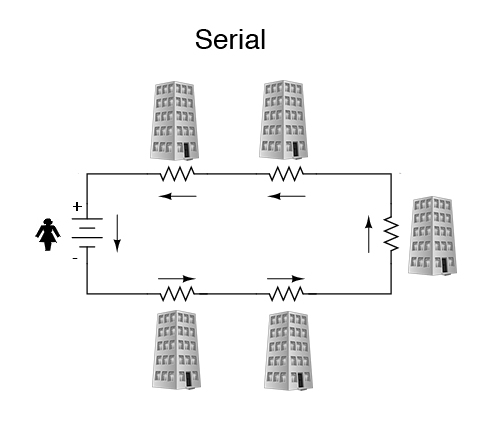
Start with a small company, say a store with customers who line up at the counter. That store  deals with customers in a serial way:

business, serial

The customers come to the counter, one after another, in a series. Energy in the form of goods goes out, and money comes back.

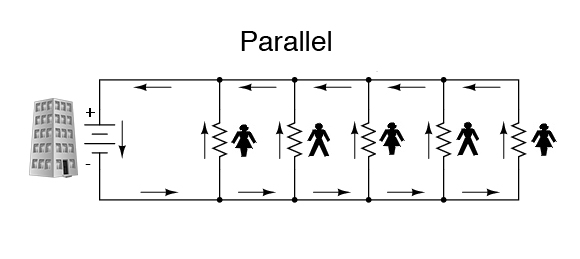
As companies scale up in size, however, they’d rather deal with many customers in parallel rather than in series. A parallel circuit looks like this:

business, parallel

Here customers are dealt with as a group: many at once, and in the same way. This, in an extremely simplified form, is a diagram of mass marketing. While it is still possible for a company to deal with customers individually, the idea is to deal with as many customers as possible at once and in the same ways.

I use electronic symbols in those circuits because resistance (the zig-zag symbol) adds up in series, while it goes down in parallel. This too is a virtue of mass marketing. Thus one-to-many works very well, and has proven so ever since Industry won the Industrial Revolution.

Over on the customers’ side, the marketplace on the whole looks like this:

customer, serial

The customer goes from one company to the next. This is not a problem on the vendors’ side, except to the degree that vendors would rather customers not shop elsewhere. This is why vendors come up with loyalty programs and other schemes to increase “switching costs” and to otherwise extract as much money and commitment as possible out of the customer.

But, from the customer’s side, it would also be cool if they could enjoy scale in parallel across many companies, like this:

In the physical world this is all but unthinkable. But the Internet makes it very thinkable, because the Net reduces nearly to zero the functional distance between any two entities, and presents an open space across which many connections can be made, at once if necessary, with few limits on the number or scope of possibilities. There is also no limit to the new forms of interaction that can happen here.

For example, a customer could scale in parallel by expressing demand to multiple vendors at the same time, or could change her contact information at once with many companies. In fact this is basically what VRM projects are about: scaling in parallel across many other entites. (Not just vendors, but also elected officials, government agencies, churches, clubs, and so on.)

It is easy to see how companies can feel threatened by this. For a century and a half we in business have made a virtue of “targeting,” “acquiring,” “capturing,” “managing,” “locking in” and “owning” customers. But think about the free market for a minute. Shouldn’t free customers be more valuable than captive ones? Wouldn’t it be better if customers and prospects could send many more, and better, signals to the marketplace, and to vendors as well, if they were capable of having their own native ways of dealing, consistently, across multiple vendors?

We have that now with email and other forms of messaging. But why stop there?

Naturally, it’s easy to ask, Could social media such as Facebook, Google+ and Twitter provide some of what we need here? Maybe, but the problem is that they are not ours, and they don’t work for us — in the sense that they are accountable to us. They work for advertisers. Email, IM and browsing aren’t owned by anybody. They are also substitutable. For example, you can move your mail from Gmail to your own server or elsewhere if you like. Google doesn’t own email’s protocols. No browser company owns HTTP, HTML or any of the Web’s protocols.

The other problem with social solutions is that they’re not personal. And that’s the scale we’re talking about here: adding parallel capabilities to individuals. Sure, aggregation is possible, and a good thing. (And a number of VRM projects are of the aggregating-demand sort.) But the fallow ground is under our own feet. That’s where the biggest market opportunity is located. Also where, still, it is most ignored. Except, of course, here.

[Continued in VRM/CX + CRM/CX.]

VRM at IIW

VRM was a hot topic at IIW last week, with at least one VRM or VRM-related breakout per session — and that was on top of the VRM workshop held at Ericsson on Monday, April 30, the day before IIW started. (Thanks to Nitin Shah and the Ericsson folks for making the time and space available, in a great facility.) Here’s a quick rundown from the #IIW14 wiki:

Tuesday, May 1, Session 1

Tuesday, May 1,Session 2

Tuesday, May 1, Session 3

Tuesday, May 1,Session 4

Tuesday, May 1,Session 5

Wednesday, May 2, Session 1

Wednesday, May 2,Session 2

Wednesday, May 2,Session 3

Wednesday, May 2,Session 4

Wednesday, May 2,Session 5

Thurssday, May 3,Sessions 1-5

On Friday, May 4, I also visited with Jeremie Miller, Jason Cavnar and the Locker Project / Singly team in San Francisco. Very impressed with what they’re up to as well.

Bonus IIW linkage:

How about using the ‘No Track’ button we already have?

left r-buttonright r-buttonFor as long as we’ve had economies, demand and supply have been attracted to each other like a pair of magnets. Ideally, they should match up evenly and produce good outcomes. But sometimes one side comes to dominate the other, with bad effects along with good ones. Such has been the case on the Web ever since it went commercial with the invention of the cookie in 1995, resulting in a calf-cow model in which the demand side — that’s you and me — plays the submissive role of mere “users,” who pretty much have to put up with whatever rules websites set on the supply side.

Consistent with Lord Acton’s axiom (“Power corrupts; absolute power corrupts absolutely”) the near absolute power of website cows over user calves has resulted in near-absolute corruption of website ethics in respect to personal privacy.

This has been a subject of productive obsession by Julia Anguin and her team of reporters at The Wall Street Journal, which have been producing the What They Know series (shortcut: http://wsj.com/wtk) since July 30, 2010, when Julia by-lined The Web’s New Gold Mine: Your Secrets. The next day I called that piece a turning point. And I still believe that.

Today came another one, again in the Journal, in Julia’s latest, titled Web Firms to Adopt ‘No Track’ Button. She begins,

A coalition of Internet giants including Google Inc. has agreed to support a do-not-track button to be embedded in most Web browsers—a move that the industry had been resisting for more than a year.

The reversal is being announced as part of the White House’s call for Congress to pass a “privacy bill of rights,” that will give people greater control over the personal data collected about them.

The long White House press release headline reads,

We Can’t Wait: Obama Administration Unveils Blueprint for a “Privacy Bill of Rights” to Protect Consumers Online

Internet Advertising Networks Announces Commitment to “Do-Not-Track” Technology to Allow Consumers to Control Online Tracking

Obviously, government and industry have been working together on this one. Which is good, as far as it goes. Toward that point, Julia adds,

The new do-not-track button isn’t going to stop all Web tracking. The companies have agreed to stop using the data about people’s Web browsing habits to customize ads, and have agreed not to use the data for employment, credit, health-care or insurance purposes. But the data can still be used for some purposes such as “market research” and “product development” and can still be obtained by law enforcement officers.

The do-not-track button also wouldn’t block companies such as Facebook Inc. from tracking their members through “Like” buttons and other functions.

“It’s a good start,” said Christopher Calabrese, legislative counsel at the American Civil Liberties Union. “But we want you to be able to not be tracked at all if you so choose.”

In the New York Times’ White House, Consumers in Mind, Offers Online Privacy Guidelines Edward Wyatt writes,

The framework for a new privacy code moves electronic commerce closer to a one-click, one-touch process by which users can tell Internet companies whether they want their online activity tracked.

Much remains to be done before consumers can click on a button in their Web browser to set their privacy standards. Congress will probably have to write legislation governing the collection and use of personal data, officials said, something that is unlikely to occur this year. And the companies that make browsers — Google, Microsoft, Apple and others — will have to agree to the new standards.

No they won’t. Buttons can be plug-ins to existing browsers. And work has already been done. VRM developers are on the case, and their ranks are growing. We have dozens of developers (at that last link) working on equipping both the demand and the supply side with tools for engaging as independent and respectful parties. In fact we already have a button that can say “Don’t track me,” plus much more — for both sides. Its calle the R-button, and it looks like this: ⊂ ⊃. (And yes, those symbols are real characters. Took a long time to find them, but they do exist.)

Yours — the user’s — is on the left. The website’s is on the right. On a browser it might look like this:

r-button in a browser

Underneath both those buttons can go many things, including preferences, policies, terms, offers, or anything else — on both sides. One of those terms can be “do not track me.” It might point to a fourth party (see explanations here and here) which, on behalf of the user or customer, maintains settings that control sharing of personal data, including the conditions that must be met. A number of development projects and companies are already on this case. All the above falls into a category we call EmanciTerm. Much has been happening as well around personal data stores (PDSes), also called “lockers,” “services” and “vaults.” These include:

Three of those are in the U.S., one in Austria, one in France, one in South Africa, and three in the U.K. (All helping drive the Midata project by the U.K. government, by the way.) And those are just companies with PDSes. There are many others working on allied technologies, standards, protocols and much more. They’re all just flying below media radar because media like to look at what big suppliers and governments are doing. Speaking of which… 🙂

Here’s Julia again:

Google is expected to enable do-not-track in its Chrome Web browser by the end of this year.

Susan Wojcicki, senior vice president of advertising at Google, said the company is pleased to join “a broad industry agreement to respect the ‘Do Not Track’ header in a consistent and meaningful way that offers users choice and clearly explained browser controls.”

White House Deputy Chief Technology Officer Daniel Weitzner said the do-not-track option should clear up confusion among consumers who “think they are expressing a preference and it ends up, for a set of technical reasons, that they are not.”

Some critics said the industry’s move could throw a wrench in a separate year-long effort by the World Wide Web consortium to set an international standard for do-not-track. But Mr. Ingis said he hopes the consortium could “build off of” the industry’s approach.

So here’s an invitation to the White House, Google, the 3wC, interested BigCos (including CRM companies), developers of all sizes and journalists who are interested in building out genuine and cooperative relationships between demand and supply::::

Join us at IIW — the Internet Identity Workshop — in Mountain View, May 1-3. This is the unconference where developers and other helpful parties gather to talk things over and move development forward. No speakers, no panels, no BS. Just good conversation and productive work. It’s our fourteenth one, and they’ve all been highly productive.

As for the r-button, take it and run with it. It’s there for the development. It’s meaningful. We’re past square one. We’d love to have all the participation we can get, from the big guys as well as the little ones listed above and here.

To help get your thinking started, visit this presentation of one r-button scenario, by Adam Marcus of MIT. Here’s another view of the same work, which came of of a Google Summer of Code project through ProjectVRM and the Berkman Center:
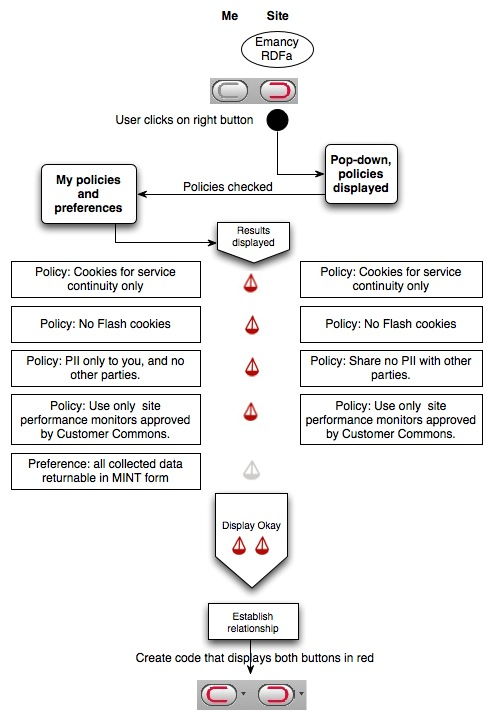
(Props to Oshani Seneviratne and David Karger, also both of MIT, and Ahmad Bakhiet, of Kings College London, for work on that project.)

If we leave fixing the calf-cow problem entirely up to the BigCos and BigGov, it won’t get fixed. We have to work from the demand side as well. In economies, customers are the 100%.

Here are some other stories, mostly gathered by Zemanta:

All look at the symptoms, and supply-side cures. Time for the demand side to demand answers from itself. Fortunately, we’ve been listening, and the answers are coming.

Oh, and by the way, Mozilla has been offering “do not track” for a long time. Other tools are also available:

« Older posts Newer posts »

© 2026 ProjectVRM

Theme by Anders NorenUp ↑