Category: MyTerms

Digital Omnibus Article 88b needs to be about contract, not just consent

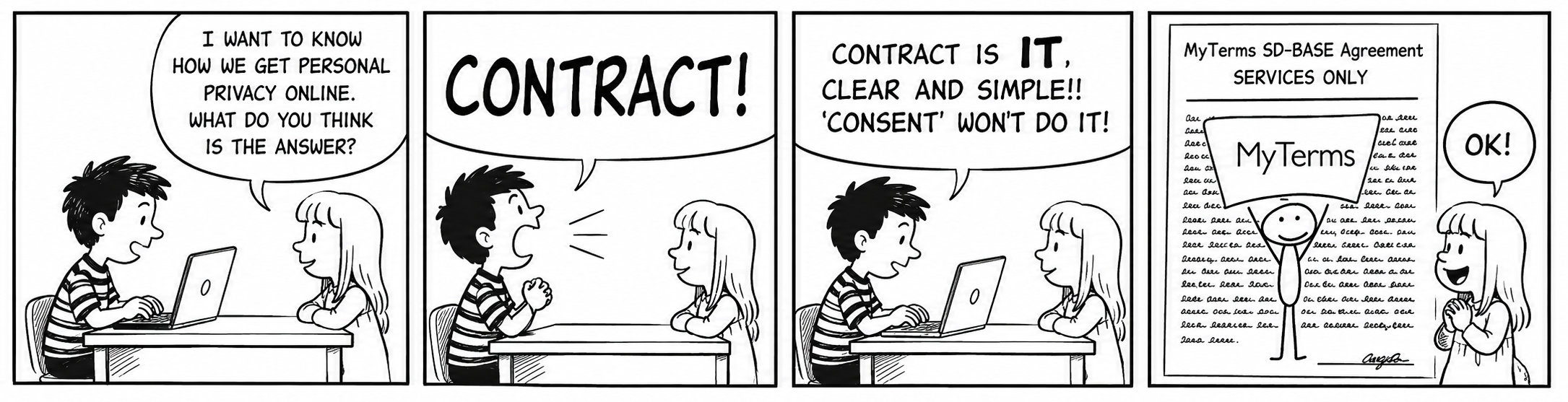
With gratitude to the famous Peanuts cartoon. (And art help from ChatGPT.)

The EU’s new Digital Omnibus proposal aims to update and expand the GDPR, notably with Article 88b, which includes this. (I’ve boldfaced the phrases that matter):

A new Article 88b Regulation (EU) 2016/679 (General Data Protection Regulation), for automated and machine-readable indications of individual choices and respect of those indications by website providers once standards are available.

That was written in June 2025. We now have a standard for exactly that: IEEE 7012-2025—Standard for Machine-Readable Personal Privacy Terms. It is nicknamed MyTerms (much as IEEE 802.11 is nicknamed Wi-Fi) and was published by the IEEE in January 2026 after nine years in the making. Here’s the PDF.

Article 6 of the GDPR lists six bases for the  Lawfulness of Processing:

  1. the data subject has given consent to the processing of his or her personal data for one or more specific purposes;
  2. processing is necessary for the performance of a contract to which the data subject is party or in order to take steps at the request of the data subject prior to entering into a contract;
  3. processing is necessary for compliance with a legal obligation to which the controller is subject;
  4. processing is necessary in order to protect the vital interests of the data subject or of another natural person;
  5. processing is necessary for the performance of a task carried out in the public interest or in the exercise of official authority vested in the controller;
  6. processing is necessary for the purposes of the legitimate interests pursued by the controller or by a third party, except where such interests are overridden by the interests or fundamental rights and freedoms of the data subject which require protection of personal data, in particular where the data subject is a child.

I’ve boldfaced the three that matter, and italicised their core distinctions.

The entire adtech business relies on the first and last of these, consent and legitimate interests, as their excuses for tracking people, allowing them to obey the letter of the GDPR while screwing its spirit.

We see consent at work with every cookie notice we click on or click past. And we have no faith that clicks on consent “choices” provide any privacy protection at all. Reasons:

  1. Most sites ignore cookie choices.
  2. Many sites set cookies even before a cookie choice is made.
  3. It’s obvious that adtech is a personalised guesswork business that relies on surveillance, so most of these “choices” are misdirections away from corporate hunger for personal data.
  4. We have no record of the “choices” we make (and in many cases, no choice is offered), or any way to audit or dispute compliance.
  5. Uninvited and unwanted surveillance is by now so far out of control that cars, TVs, and AI chatbots are all in on the game (and hardly bother with consent notices).

To adtech, personal privacy is a bug, not a feature. It is incentivised to violate privacy. No amount of regulatory oversight will fix that. To adtech, paying fines for privacy violations is just a cost of doing business.

The only fix that will work is what people—customers and citizens—bring to the market’s table. With MyTerms, they can do that.

MyTerms addresses the second of the GDPR’s six legal bases: contract. Put simply, here is what  the MyTerms standard says:

  • The person (not a mere data subject) is the first party, and the site or service is the second party.
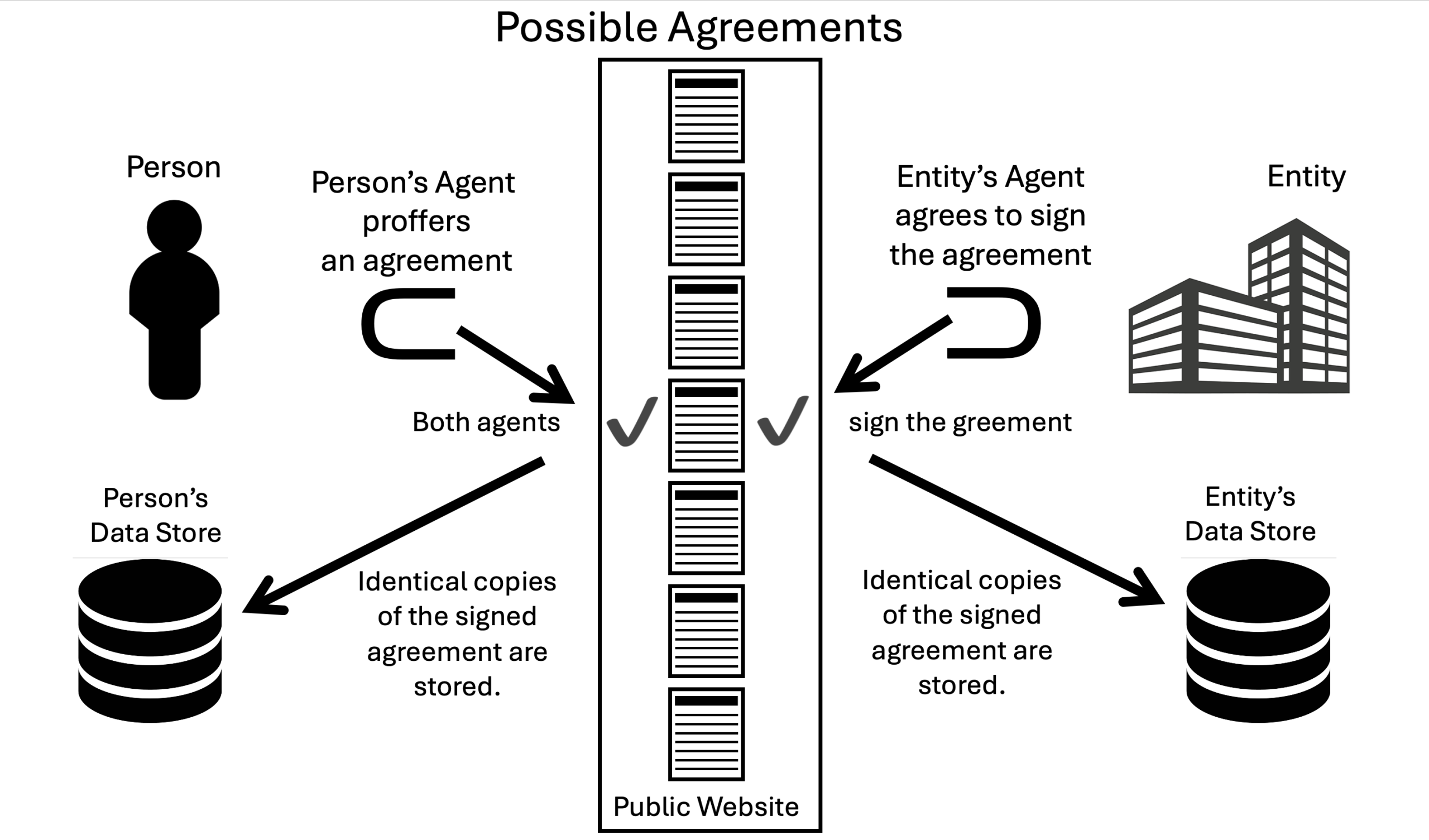
  • The person proffers a contractual agreement chosen from a limited roster posted on the public website of a disinterested nonprofit, such as Customer Commons (which was created to do for personal contracts what Creative Commons does for personal copyrights—and which the IEEE approached with the idea for making MyTerms a standard).
  • When the second party agrees, both parties keep an identical record, which supports compliance auditing and dispute resolution. (By preserving evidence, this also creates an infrastructure for dispute avoidance as well.)

The GDPR succeeded by recognising natural persons as holders of rights, but it left intact the industrial age convention in which organisations are the exclusive originators of terms at scale. That’s one reason why persons have remained mere data subjects rather than contractual parties.

Fortunately, the Internet’s base protocols are peer-to-peer. Treating people on the Net as mere “users” and “data subjects” limits their agency. With MyTerms, people acquire a status they yielded when industry won the industrial revolution. (Before the industrial age, surnames—Baker, Müller, Weaver,  Lefebvre, Smith, Marchand, Farmer—signified agency: what people did in the world. That’s just one thing we lost when we became workers, executives, consumers, and users.)

In the natural world, privacy is maintained mostly by tacit agreements. In the digital world there is no tacit, so agreements must become explicit and programmable. This is why contracts are the only way we’ll get real personal privacy in the digital world.

It should also be clear by now that polite requests also don’t work. We tried that with Do Not Track, and by the time it finished failing, the adtech lobby had turned it into Tracking Preference Expression—as if we wanted to be tracked all along.

That main pro-consent lobby is the Interactive Advertising Bureau, or IAB. Among its recommendations for the Digital Omnibus are deleting 88b and  improving consent in various ways, such as  “Revise the proposed stricter consent rules.”

The IAB is blind to the simple fact that people hate being spied on and do what they can to stop it—mainly by turning off ads. By 2015, ad blocking was already the biggest boycott in human history. That boycott rose in direct response to obvious tracking, especially with retargeting. (That’s how one ad or advertiser keeps following you from site to site and app to app.)  And the boycott is much bigger now:

The IAB earned all of that. Yet they still see ad blocking and tracking protection as problems to solve rather than clear and constructive signals from the marketplace.

So it should be clear by now that the old brownfield of consent has become a toxic wasteland of surveillance, lost privacy, and minimised human agency—led by an industry that has been hostile to privacy from the start.

In fact, consent is required for what Shoshana Zuboff calls Surveillance Capitalism. That form of capitalism is based on inferred or extracted consent. The only way we can defeat that regime is by re-basing e-commerce on contractual agreements in which customers take the lead. After all, it’s their privacy that needs protection.

The surveillance economy is limited entirely by its methods, which are built around grabbing attention, harvesting data, and guessing at people.

We can replace it with an intention economy that’s based on what customers actually want. The range of those wants far exceeds what companies and their systems can guess at. Far more business, and business improvement, opens up when market intelligence can flow both ways. In the consent/surveillance regime, it can’t, because all relationships are silo’d in sellers’ separate systems, all built to minimize customer interactions, by design. But relationships built on respectful contractual agreements can be far more capacious when those relationships start with forms of mutual trust that whole markets share. That’s what MyTerms makes possible.

Here is a quick outline of some additional benefits.

For customers, the most obvious one is getting rid of cookie notices, which are annoying and not worth the pixels they are printed on.  If a company really does care about personal privacy, it’ll respect personal privacy requirements. This is how things work in the natural world, where tracking people like marked animals has been morally wrong for millennia. In the digital world, however, agreements need to be explicit, so programming and services can be based on them. MyTerms does that.

For business, MyTerms has lots of advantages:

  • Reduced or eliminated compliance risk
  • Competitive differentiation
  • Lower customer churn
  • A basis for real rather than coerced relationships
  • A basis for better signalling in both directions
  • Reduced or eliminated guesswork about what customers want, how they use products and services, and  how both might be improved

Lawyers get a new market for services on both the buy and sell sides of the marketplace. Companies in the CMP (consent management platform) business (e.g. Admiral and OneTrust) have something new and better to sell to enterprises (and perhaps to people as well).

Lawmakers and Regulators can start looking at the Internet and the Web as places where freedom of contract prevails, and contracts of adhesion (such as what you “agree” to with cookie notices) are obsolete.

Developers can have a field day (or decade). Look for these categories to emerge

In the marketplace, we can start to see all these things:

  • VRM + CRM will flourish, as described by Iain Henderson (one of MyTerms’ authors) in Towards Network-Based Ecosystems.
  • We should expect improvements to digital public infrastructure, as relationships move out of Big Tech’s silos and into distributed relationship frameworks based on the Internet’s base peer-to-peer protocols.
  • Predictions I made in The Intention Economy: When Customers Take Charge (Harvard Business Review Press, 2012) and Tim Berners-Lee made in the Attention vs. Intention chapter of This Is for Everyone: The Unfinished Story of the World Wide Web (Farrar, Straus and Giroux, 2025) will finally come true.
  • There will be new dances between customers and companies. (“The Dance” is a closing chapter of The Intention Economy.)
  • New commercial ecosystems can grow around a richer flow of useful information in both directions, based on shared interest and trust between customers and companies.
  • Surveillance capitalism will be obsolesced — and replaced by an economy aligned with personal agency and mutual respect from contractual partners.

And much more.

So it would be helpful for the European Commission to expand its scope from protecting data subjects to empowering first parties. They can do that by welcoming MyTerms in the Omnibus Directive, expanding human agency into a new greenfield where boundless positive outcomes can flourish.


Drafts of myterms agreements are currently posted at MyTerms.info, which is a project of Customer Commons and MyData Global. You can also read more about MyTerms in writings by Iain Henderson, Nitin Badjatia, and me.

We also invite you to join the ProjectVRM list, where we can converse and collaborate on moving MyTerms forward.


Shooting for the World

There is no organisation on Earth with a more audacious purpose than this one:

From Customer Commons’ current index page.

This isn’t shooting for the Moon. It’s shooting for the whole world of business.

What Customer Commons wants to restore isn’t just what was lost when the Internet got real. (For example, privacy.) Customer Commons also wants to restore personal agency that was lost when Industry won the Industrial Revolution. That’s when jobs replaced work, labour replaced teams, and customers became consumers.

That last shift, Jerry Michalski explains, was from human beings to “gullets with wallets and eyeballs.” After that shift, freedom of contract in marketplaces was enjoyed only by businesses. Not by gullets.

Customer Commons was created to change that. It was spun out of ProjectVRM as a 501(c)3 nonprofit in 2013, shortly after Harvard Business Review Press published  The Intention Economy: When Customers Take Charge. That book specifically gave Customer Commons the job of doing for personal privacy terms what Creative Commons did for personal copyright.  And to do it by making privacy a contract between customers and businesses, rather than a “consent” to whatever the hell businesses wanted to shove down our gullets. (For example, with interruptive cookie “choices” that really aren’t and leave no audit trail.)

Work on that began in 2017, when the IEEE approached Customer Commons with an offer to host development of a standard for machine-readable personal privacy terms. That standard, officially called IEEE 7012-2025, and nicknamed MyTerms, was published this past January, concluding nine years of work.

Now what?

MyTerms is a great start toward completing Customer Commons’ audacious mission. Here are some goals we will achieve when that mission is accomplished:

  1. VRM will be a business category, welcomed and engaged by CRM and CX functions on the sell sides of markets.
  2. We will have proof that free customers are worth more than captive ones—to companies they engage, to whole markets, and to themselves. This was ProjectVRM’s original mission in 2006.
  3. The intention economy will materialize when voluntary signaling from customers to companies outperforms and obsolesces surveillance as the primary means for companies to obtain data about customers.

MyTerms is required for all three, because a contract is the only way for companies to commit to respecting personal privacy, and MyTerms is the standard for doing that.

So the first challenge is to make Customer Commons viable as the first mover in establishing MyTerms in the world.

The second challenge is to make Customer Commons substantial enough to lead work toward all three of the challenges listed above. Customer Commons won’t be the only entity working on those. In the U.S., Consumer Reports has already stepped forward as a natural ally.  MyData Global is partnering with Customer Commons in standing up the MyTerms Alliance, which is HQ’d in Europe. There are many other potential partners, such as Mozilla and the EFF.

There is development work on MyTerms already. You can learn more about those at VRM Day, IIW, and AIW, which run M-F through the last week of this month (April 27 to May 1) at the Computer History Museum in Silicon Valley.

Here are other ideas that have been floated in the past for Customer Commons:

  1. Customers Union. Being for customers what the AARP is for retired people. Only bigger, because it would include everybody who is a customer of anything. This isn’t far from Consumers Union, which begat Consumer Reports, and is now its advocacy group.
  2. CustomerCon. A trade show with company booths run by customers, to which companies are invited as guests. Key feature: no complaining. Guest companies are treated only to positive and constructive ideas. HT to Tim Hwang for helping come up with that one.
  3. Omie. A tablet with apps free of Google and Apple. HT to Iain Henderson.
  4. The ByWay, a new path for local e-commerce.
  5. The Free Customer Award. This would be given to companies that value free customers and do nothing to entrap them. The canonical example described in The Intention Economy is Trader Joe’s. But there are others. In-N-Out Burger, for example.

I share those only to give you an idea of how big and influential Customer Commons might be, and how it’s possible to have fun making a new and better economy happen.

We’re not at Square One. Customer Commons is an extant nonprofit, has an energetic board, and a huge accomplishment by getting MyTerms finished. What it needs now is to build out a working organisation. How can we do that?

Let’s look at how Creative Commons got rolling in 2002 and kept moving after that. Here is what I’ve found in diggings so far—

  • The History of Creative Commons in Wired (December 2011) says, “An hour after the court’s decision was announced, the William and Flora Hewlett Foundation presented Creative Commons with $1,000,000 to launch the movement.” The case was Eldred v. Ashcroft.
  • In 2008, there was a successful funding challenge from Hewlett: “The 5×5 challenge, issued in honor of Creative Commons’ fifth birthday, called for the organization to find five funders to each promise five years of support at $500,000 per year. In addition to the Hewlett Foundation, Creative Commons received pledges of $500,000 in yearly support for five years from Omidyar Network, as well as from an anonymous European trust. Google has pledged $300,000 in support renewable for five years, while Mozilla and Red Hat have each pledged to contribute $100,000 annually for five years. The final block of support comes from the board of Creative Commons, which has promised to personally raise or contribute $500,000 to the organization annually for five years.”(Source: Creative Commons Newsletter No.5, February 2008)
  • A Creative Commons  announcement in April 2008 said, “We’re thrilled about a major new grant of $4 million from the William and Flora Hewlett Foundation, consisting of $2.5 million to provide general support to Creative Commons over five years, as well as $1.5 million to support ccLearn.”
  • A MacArthur grant search reports a total of $3,225,000 provided between 2002 and 2022:
    • $750,000 in 2005 to support general operations for three years
    • $500,000 in 2007 to support Science Commons for two years
    • $700,000 in2008 to support general operations and an endowment campaign for three years
    • $25,000 in 2015 to provide travel and other support for attendees of the Creative Commons Global Summit in South Korea, for two months. The meeting was also funded in part by the Institute for Museu m and Library Services and th e Gates Foundation, and by the Korean Ministry of Culture, Sports and Tourism ($25,000), Mozilla ($10,000), and the Wikimedia Foundation ($10,000).
    • $50,000 in 2022 to support dedicated programming on open journalism issues at the 2023 Global Summit, “which is an annual event that brings together educators, artists, technologists, legal experts, and activists to promote the power of open licensing and global access.”

So, by inference, the phases were roughly this:

  • Launch (2001–2002) $1M of initial funding
  • Early build-out (2002–2004) +$1–3M with  additional foundation support
  • Continuous operations (2005 onward) at ~$1–3M/year

That gives us an idea of what we need to raise. (Given inflation, multiply those numbers by 1.5x.)

I’ll tell you more when I find out more. Meanwhile, watch this space. Better yet, jump in and help out.


Without Privacy, VRM Can’t Happen

Nor can CRM. Not really. The middle name of both is Relationship, and those require respect for each other’s boundaries. We don’t have that yet online, and can’t without working standards (hello MyTerms), tech, and norms. In fact, the opposite prevails: extreme exploitation of absent personal privacy.

Helen Nissenbaum has been teaching us that for decades, and working on solutions. One is Adnauseum, which may be on your browser already.  It works (says that last link) “by automating ad clicks universally and blindly on behalf of its users. Built atop uBlock Origin, AdNauseam quietly clicks on every blocked ad, registering a visit on ad networks’ databases. As the collected data gathered shows an omnivorous click-stream, user tracking, targeting and surveillance become futile.” In another word, obfuscation.

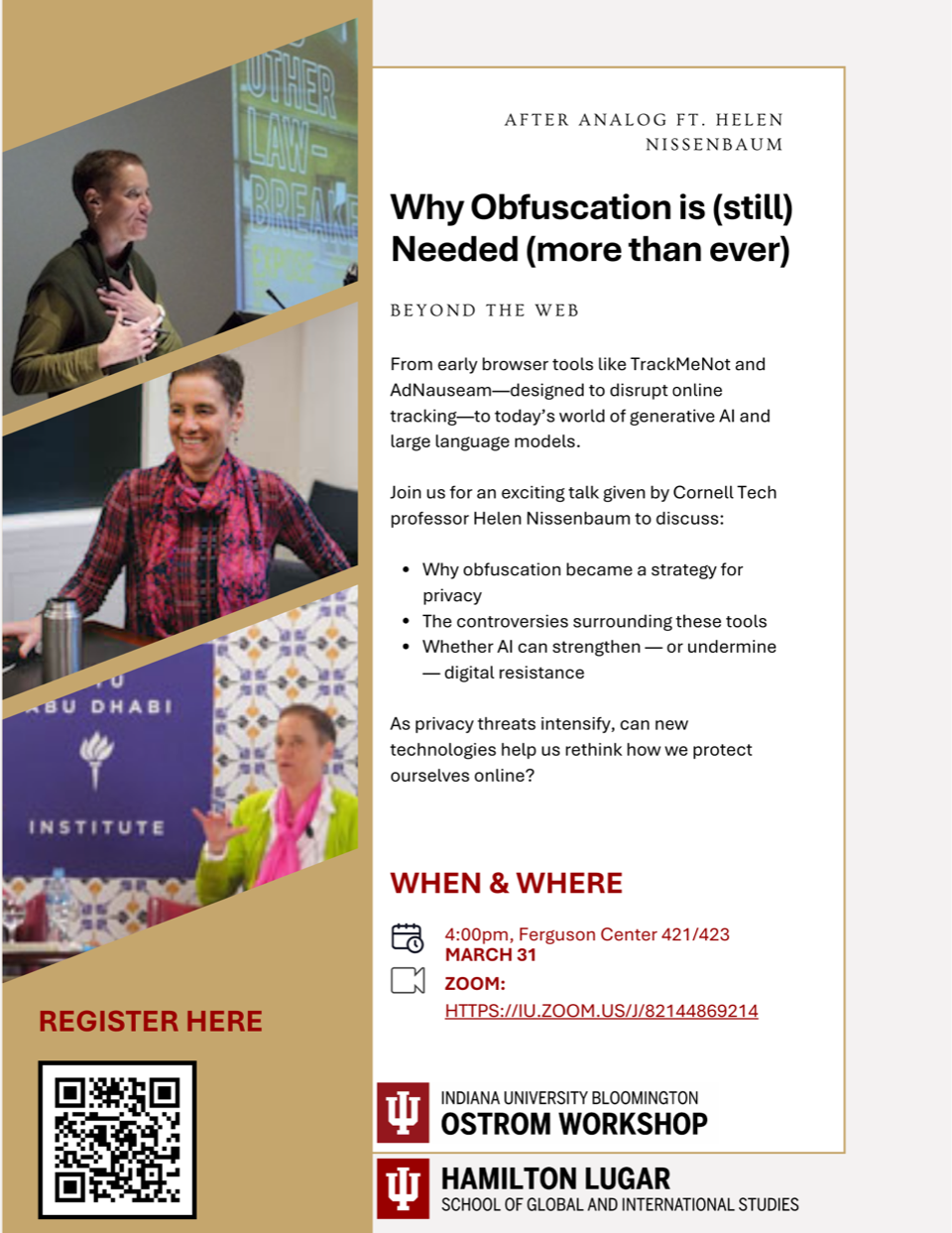
And that’s what Helen will unpack when she speaks in our salon series here at Indiana University next Tuesday at 4 pm Eastern, and on Zoom. Her title is Why Obfuscation is (still) Needed (more than ever). Here’s the flyer, with the registration and Zoom links:

And in case you don’t click on that, here it is again.

See you there.

Making a New News Business

Watching the old galaxy fade away.

In the dawning decades of our new Digital Age, the news business has shrunk from a galaxy of bright stars to a loose collection of white dwarfs glowing in otherwise dark empty spaces. The empty spaces are called  “news deserts.”

In the meantime (at least in the US), the redstream is the new mainstream, while more and more people get news (or what passes for it) from social media and each other. Countless sources are also faked up by AI.

Less metaphorically, the news business has de-institutionalized. How can we re-institutionalize it in digital ways that can also be trusted?

I suggest we start by spinning up News Commons that work with the fewest possible intermediaries between people and sources, and value exchanges that reward everyone.

Some background:::

1) The Dying Galaxy

Here’s how bright stars have turned into white dwarfs:

  1. Stopped Presses: There are now fewer than 1,000 daily newspapers left in the U.S. Over 50 million Americans now live in news deserts.
  2. Radio Silence: CBS News Radio—the oldest and most august of all the syndcated broadcast news sources— will be gone in May 2026 after a 99-year run. Meanwhile, Public Radio (NPR et al.) faces a “shrinking pie” problem: ratings (dig around here) remain steady or are growing only because stations hold larger shares of a rapidly dwindling over-the-air audience.
  3. Cut Cables: Cord-cutting continues, as viewing moves from cable to Internet, and from live to on-demand streamed entertainment. In the midst of this shift, cable news is morphing from mainstream to redstream. Specifically, CNN is moving rightward under the Ellisons, while Fox News stays as right as they were, and MSNBC under its new MS NOW brand continues to glow dimly at the left end of the ratings. None come close in popularity to any of the top news commentary podcasts. Anyway, cable news is transitioning from a collection of leanings (center, left, and right) to highly partisan amen corners with shrinking audiences.
  4. Thinning Air: Over-the-air TV (what we still call stations, with channel numbers) is now called “linear,” whether it’s from a connected antenna or from a cable screwed into the same jack on the back of a TV. That category is also in decline, a victim of the same viewing shift to streaming services (now less often called over-the-top, or OTT, now that the bottom—linear TV—is fading away).
  5. Babes in New Woods: News is still being consumed, though it’s hardly hard  news or from the media we knew when all the stars were bright and mostly trusted. Especially for young people. Lots of stats at both those links. The bottom line is that none of that flow is from the old stars. At least not directly.

Nearly all coverage of changes in the dimming news galaxy concerns one or more of the five factors listed above. Some of that coverage (most notably from the Nieman Journalism Lab) is about innovations. To mix metaphors a bit, while some of these innovations look like greenfields, none of them look very large. (More credit where due: At least these efforts, as the Quakers say, improve on the silence.)

2) MyTerms (IEEE 7012) and the Agentic Shift

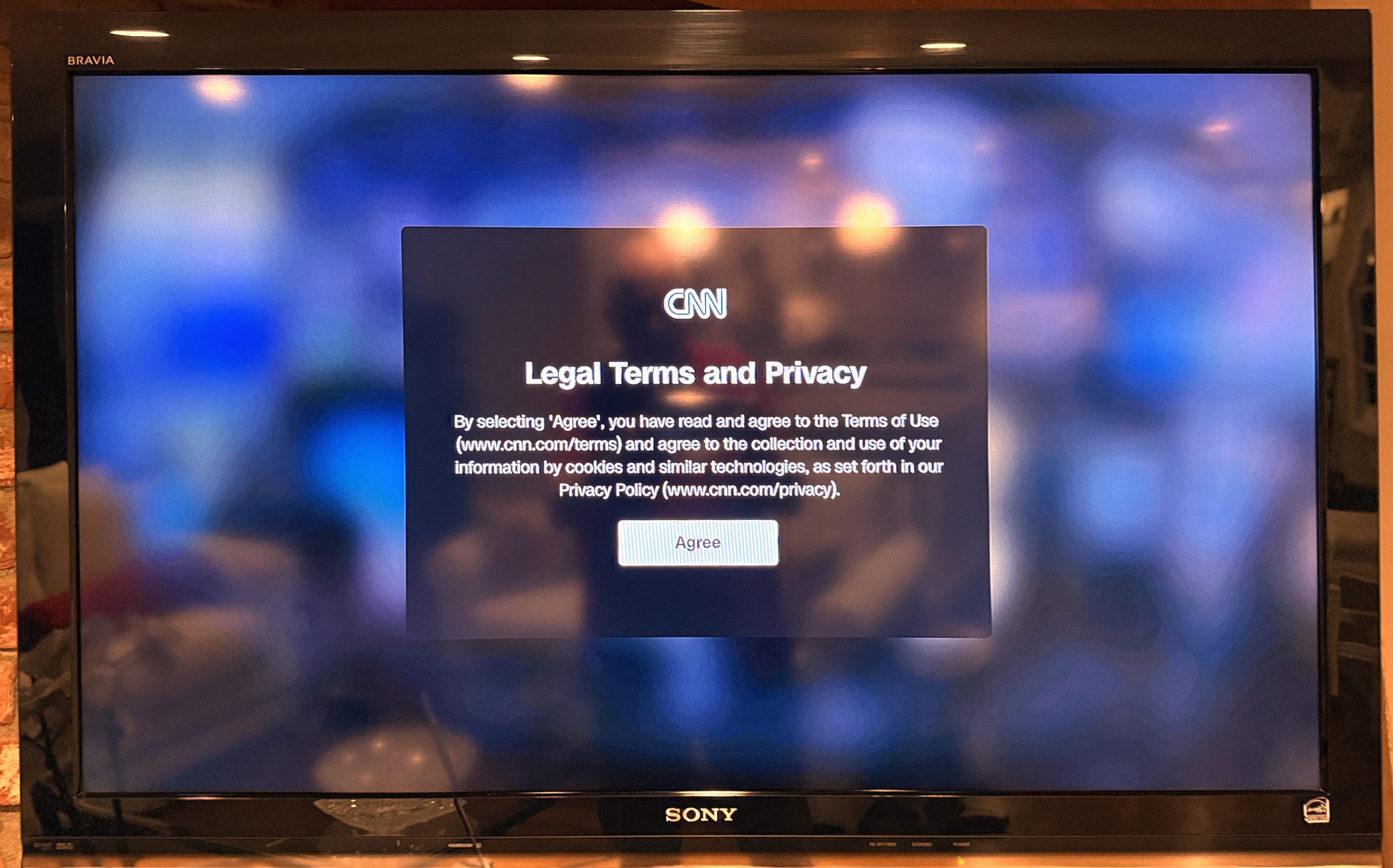
Today, the news world is mostly hidden behind permission walls. Inside those walls, absent personal privacy is exploited to extremes almost nobody will contemplate or admit to.  (Here’s a PageXray of Wired.com—one of the “good” guys.) For a fig leaf over the hard-ons walled garden barons have for personal data, visitors knocking on front doors must yield to demands in the form of misleading cookie notices and in crap like this:

Go to www.cnn.com/privacy, as the notice suggests (or just click on that image), and you will find your privacy well and truly fucked.

The ProjectVRM community has written a lot about this over many years. But now, thanks to our work with Customer Commons since 2012 and the IEEE since 2017, we have IEEE 7012 (MyTerms): a standard that flips the script on privacy-as-bullshit by giving individuals a way to proffer their own damn privacy terms as binding contracts, with agents working for both parties. Specifics:

  • Personal AI Agents: Under MyTerms, individuals operate through agents that can range in complexity from browser plug-ins to private AI agents. These agents have a sole responsibility to the person, proffering and signing agreements, and keeping auditable records of them.
  • Reciprocal Agency: On the other side, news providers use their own agents tto choose from the person’s roster of privacy agreement choices (on the Creative Commons model). This machine-to-machine handshake replaces the deceptive, unfair, and un-auditable non-agreements we get with cookie notices and shit such as we see in the image above.
  • Unlocked Possibilities: Unlike corporate AI agents designed to keep people inside a walled garden (one cause of the zero-click problem), a personal AI agent can get the requested news item after a MyTerms agreement is signed, and then participate in a whole new value exchange system that works for everyone. For example, should a further agreement be reached (such as one for a micropayment or an acceptable subscription (also built atop MyTerms) the personal AI agent can both obtain the requested news and work out forms of compensation. In this new system, personal data will be shared on an as-needed and trusted basis that continues to assure personal privacy. This can be done in ways that preserve the open Web and create settlement systems that work for all involved (and not just for sellers and the platforms that trapped them in the past).
  • Downstream Economic Benefits: When use-value and sale-value are both exchanged on terms that work for all involved, a news ecosystem can be built that rivals the old news galaxy, but with many more bright stars and fewer dark spaces. It will also obsolesce the current all-dwarf system, which is based on customr capture, constant surveillance, and algorithmic guesswork that annoys or offends everyone involved.

3. The New News Commons

To maximize both use-value and sale-value, our goal here is an ecosystem with maximized agency on both sides, and the fewest and simplest intermediaries.

  • From redstreams and bluestreams to wide open mystreams: Partisan news at the personal level (look at all those podcasts and blogs) has proven that decentralized, on-demand media are highly resilient. The task now is to multiply and disintermediate both consumption and production. This is required especially at the local level, where realities on the ground (e.g., weather and potholes) tend not to be partisan. What we want here is a common space governed by shared standards (and Ostrom’s principles) rather than algorithmic guesswork by unaccountable giants and their grudging dependents.
  • The Nonprofit Pivot: Local digital-first nonprofits now represent over 50% of the Institute for Nonprofit News (INN), providing a model for news as a public good.
  • The New Frontier: When you zero-base service and business models on agreed-upon privacy that starts with personal agency and respect for it, anything is possible. (By the way, this is what we’ve had in the natural world since we traded stones for fish. Just because we are still as naked on the Net as we were in Eden doesn’t mean we can’t clothe ourselves and get on with business.)
Feature Dying Star News System Bright Star News Commons
Privacy Corporate “consent” (tracking) MyTerms (User-Proffered Contract)
Agency Dependent “users” Independent readers, listeners, and viewers with loyal agents
Distribution Centralized walled gardens with paywalls and coerced subscriptions Open and independent consumers and producers creating use-value and sale-value exchanges that reward both sides

I could go on, but I want to get this up before I get on another airplane. Meanwhile, contact me by email (first name at last name dot com) or in the comments with ways to improve this. Thanks!

A MyTerms Summary

MyTerms will give strength to the Internet’s fabric of human connections, through agentic agreements between people and the organizations that serve them.

The Internet is peer-to-peer, by design. It supports agreements between equals, for the good of both. On that equality a massive amount of new and better dealings can be built, on stronger foundations of mutual agency and respect.

MyTerms are contracts, which are binding mutual agreements between parties. They replace consents, which are corporate protections to which individuals can only acquiesce. Consents give individuals no record of having agreed to anything and cannot be audited or enforced. They are also annoying for both individuals and companies, with massive amounts of operational and cognitive overhead. In most cases they also don’t obey the settings people make.

With MyTerms, individuals, operating as first parties, proffer a contract they choose from a limited list posted on a public website by a neutral nonprofit organization. The company, as the second party, can choose to agree to that contract or an alternate specified by the individual from the same list. Both sign the agreement electronically and keep matching records that can be audited later if need be. If the company declines to agree, the individual can keep a record of that choice, which they are free to share.

This process is described in a new standard from the IEEE called P7012, which is due for publication in January 2026. Its nickname is MyTerms, much as the nickname of IEEE 802.11 is Wi-Fi.

The most basic MyTerms agreement is for services only. This resets the marketplace to what we have in the natural world, where one can visit an establishment for the services it provides, in faith that one will not be tracked out of it for any reason, and data about oneself will not be sold or given to others. It also commits the individual to respect for the establishment and the services it provides.

With MyTerms, voluntary and genuine relationships can be built on a foundation of mutual respect and willingness to engage. Following a MyTerms agreement, individuals can selectively disclose information about themselves and their intentions, and additional services might be provided, in mutually agreeable and fruitful ways.

In this manner, companies can come to know individuals far better than has ever been possible through unwelcome surveillance and algorithmic guesswork and manipulation. Genuine relationships can also replace the coercive kind typified by “loyalty” programs meant constantly to manipulate customers. (Consider how marketers, without irony, speak of customers as “targets” to be “acquired,” shoved through a “funnel,” “controlled,” “managed,” and “locked in” as if they were slaves or cattle.)

The MyTerms standard also says that both sides will use machine agents to make agreements. These can be as simple as browser plug-ins on the individual side and server plug-ins on the corporate side. They can also be AI agents, which is why it is opportune for the standard to be published in an age when AI is still a new and rapidly evolving—for both companies and individuals.

For maximized agency on both sides, AI agents must be private instruments of full sovereignty, meaning they work privately and exclusively for each party. They cannot be instruments of surveillance or control by outside actors of any kind. Working exclusively will also maximize agency for both sides.

Civilization requires privacy. Simple as that. We worked out privacy in the natural world with technologies such as clothing and shelter, and well-understood ways to signal our intentions. The digital world, however, is still new, and not civilized. We lack the equivalents of clothing and shelter, and in their absence, surveillance has become the norm. So has the theater of consent, with its insincere and ineffective cookie notices.

The only way to obtain personal privacy and make good on the Internet’s original promises is with mutually beneficial agreements that begin with the simple privacy requirements we as individuals present to the corporations of the world. With MyTerms, we can start civilizing the worldwide public marketplace, making it a safe and productive environment for business, and everything else that depends on it.

Protocols for MyTerms

MyTerms (IEEE P7012 Draft Standard for Machine Readable Personal Privacy Terms, unpacked here) has a simple conceptual structure that is open to many different protocols and roles for them. Note the arrows in this graphic:

MyTerms flow

Protocols are required for those.

Here is an alphabetized list of some protocols that I know so far, and what I think they might do (given my incomplete knowledge across all of them.). Note that the standard never says “user,” which has subordinate and dependent implications. It calls the first party a “person” or an “individual,” and the second party an “entity.”

  • A2A Protocol — “An open protocol enabling communication and interoperability between AI agents, giving them a common language – irrespective of the framework or vendor they are built on.” More here.
  • ActivityPub — Can publish or reference a MyTerms URI in actor metadata or message extensions so follows/interactions and happen under the person’s terms.
  • AT Protocol — Can include a MyTerms pointer in profile schemas or event metadata so interactions can be logged under the proffered terms.
  • Beckn Protocol — Can carry a MyTerms URI (or the terms JSON) in discovery/order messages and bind acceptance in the async ACK/NACK flow.
  • DIDComm v2 — Can attach MyTerms as a claim/document in DID-to-DID messages; the counterparty signs/acks to bind the contract.
  • GNAP — Can pass a MyTerms URI/hash in the grant/interaction; record acceptance alongside the grant.
  • HCP (Human/Hyper-Capability Protocol) — Called (at that link) “a user-owned, secure, and interoperable preference layer that grants individuals granular, revocable control over how their data steers AI systems,” it can store a MyTerms reference in the person’s preference set, gate releases on acceptance, and optionally include the URI/hash in OAuth flows to enable audit.
  • HTTP Message Signatures (RFC 9421) — Can bind MyTerms to specific HTTP exchanges by signing requests/responses that include a terms reference.
  • HTTPS — This is generic transport. It can attach or link MyTerms in headers/body and have the counterparty echo/ack to the transaction log.
  • JLINC — Designed for MyTerms-like ceremonies, it can carry a MyTerms ID/hash for “data shared under an agreement.”
  • Matrix — Can include a MyTerms pointer in a profile state or an event content so rooms/interactions are conducted under the person’s terms.
  • Model Context Protocol (MCP) — Can send a MyTerms URI/hash in a tool/agent handshake or call metadata, so tools operate under those terms and log acceptance.
  • NANDA (Internet of AI Agents) — Can expose MyTerms during agent discovery/handshake and metadata in registry so agents negotiate under the person’s terms.
  • Nostr — Can include a MyTerms reference in profile/event tags so relays and clients can honor and log acceptance.
  • OAuth 2.0 — Can carry MyTerms as a parameter or in a request object, recording consent/acceptance with the access transaction.
  • OpenID Connect — Can include a MyTerms URI/hash as a claim (e.g., in the ID token) or request object with RP/OP log acceptance.
  • Solid — Can host the person’s MyTerms in their wallet (formerly called a pod) and require apps or services to transact under those terms for resource access.
  • UMA 2.0 — Can treat MyTerms as a policy at the resource server and share only with parties that have accepted the person’s terms.
  • Web Linking (RFC 8288) — Can advertise a MyTerms URI via Link: headers or a /.well-known/ location for discovery and binding.

Please give me additions, corrections, and improvements.  And forgive the need for all of those changes. I think it’s important at this stage to get a list of possible protocols out there, and to get the discussion rolling. Thanks!

The MyTerms PAR

With MyTerms, the person (and their electronic agent) is the first party, and the corporate entity (with its agent) is the second party. This is essential for assuring full respect for personal privacy in the digital world.

Every IEEE standard starts with a PAR: a Project Authorization Request.

Here is the PAR for EEE P7012 (nicknamed MyTerms—much as IEEE 802.11 is nicknamed Wi-Fi). It launched a working group in 2017 (that I now chair), and is expected to go from draft to done by early 2026.

Because what the standard will do is plainly laid out in the PAR, I’m breaking its paragraph into separate sentences to make reading it easier:

This draft standard covers contractual interactions and agreements between individuals and the service providers they engage on a network, including websites.

It describes how individuals, acting as first parties, can proffer their privacy requirements as contractual terms and arrive at agreements recorded and kept by both sides.

These terms shall be chosen from a collection of standard-form agreements in a roster kept by an independent and neutral non-business entity.

Computing devices and software performing as agents for both first and second parties shall engage using any protocol that serves the purpose.

The first party shall point to a preferred agreement, or a set of agreements, from which the second party shall accept one.

Party-to-party negotiations over terms in any of these contracts or other agreements are outside the scope of this standard. If both parties agree, the chosen contract or agreement shall be signed electronically by both parties or their agents.

A matching record shall be kept by both sides in a form that can be retrieved, audited, or disputed, if necessary, at some later time–and which is available to do so easily.*

I can’t share the draft before the final version is published, but I can say that what it says is about as simple as what you read above. It also does not specify what tech or protocol to use. This is to leave development as open as possible.

The main thing is that MyTerms obsolesces notice-and-consent by basing privacy agreements on contracts that individuals proffer as first parties, and sites and services agree to as second parties.

Never mind that this hardly seems thinkable to the status quo. The same was once said of the Internet, the Web, email, and other free and open graces we take for granted today.

Putting each of us in charge of our privacy online is what makes MyTerms the most important standard in development today. But only if we make it so.

If you want to get involved, help us build out Customer Commons, so it can play the same role for personal privacy terms that Creative Commons plays for personal copyright.


*Shall is  IEEE-speak for will or must. The purpose of that rule is to make clear that it does not mean shouldcould, or any other modal auxiliary verb.

© 2026 ProjectVRM

Theme by Anders NorenUp ↑