MyTerms (IEEE P7012 Draft Standard for Machine Readable Personal Privacy Terms, unpacked here) has a simple conceptual structure that is open to many different protocols and roles for them. Note the arrows in this graphic:
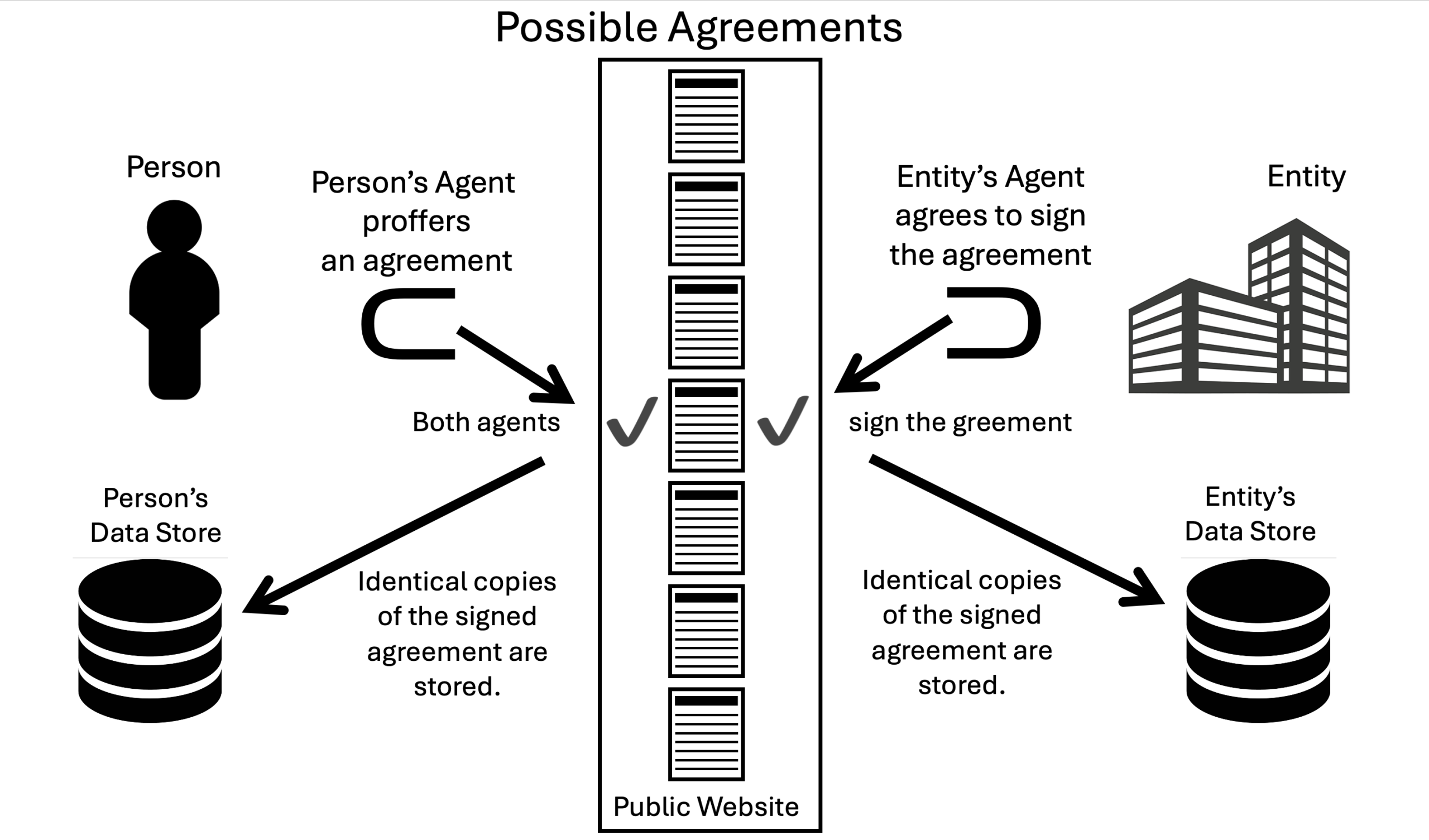
Protocols are required for those.
Here is an alphabetized list of some protocols that I know so far, and what I think they might do (given my incomplete knowledge across all of them.). Note that the standard never says “user,” which has subordinate and dependent implications. It calls the first party a “person” or an “individual,” and the second party an “entity.”
- A2A Protocol — “An open protocol enabling communication and interoperability between AI agents, giving them a common language – irrespective of the framework or vendor they are built on.” More here.
- ActivityPub — Can publish or reference a MyTerms URI in actor metadata or message extensions so follows/interactions and happen under the person’s terms.
- AT Protocol — Can include a MyTerms pointer in profile schemas or event metadata so interactions can be logged under the proffered terms.
- Beckn Protocol — Can carry a MyTerms URI (or the terms JSON) in discovery/order messages and bind acceptance in the async ACK/NACK flow.
- DIDComm v2 — Can attach MyTerms as a claim/document in DID-to-DID messages; the counterparty signs/acks to bind the contract.
- GNAP — Can pass a MyTerms URI/hash in the grant/interaction; record acceptance alongside the grant.
- HCP (Human/Hyper-Capability Protocol) — Called (at that link) “a user-owned, secure, and interoperable preference layer that grants individuals granular, revocable control over how their data steers AI systems,” it can store a MyTerms reference in the person’s preference set, gate releases on acceptance, and optionally include the URI/hash in OAuth flows to enable audit.
- HTTP Message Signatures (RFC 9421) — Can bind MyTerms to specific HTTP exchanges by signing requests/responses that include a terms reference.
- HTTPS — This is generic transport. It can attach or link MyTerms in headers/body and have the counterparty echo/ack to the transaction log.
- JLINC — Designed for MyTerms-like ceremonies, it can carry a MyTerms ID/hash for “data shared under an agreement.”
- Matrix — Can include a MyTerms pointer in a profile state or an event content so rooms/interactions are conducted under the person’s terms.
- Model Context Protocol (MCP) — Can send a MyTerms URI/hash in a tool/agent handshake or call metadata, so tools operate under those terms and log acceptance.
- NANDA (Internet of AI Agents) — Can expose MyTerms during agent discovery/handshake and metadata in registry so agents negotiate under the person’s terms.
- Nostr — Can include a MyTerms reference in profile/event tags so relays and clients can honor and log acceptance.
- OAuth 2.0 — Can carry MyTerms as a parameter or in a request object, recording consent/acceptance with the access transaction.
- OpenID Connect — Can include a MyTerms URI/hash as a claim (e.g., in the ID token) or request object with RP/OP log acceptance.
- Solid — Can host the person’s MyTerms in their wallet (formerly called a pod) and require apps or services to transact under those terms for resource access.
- UMA 2.0 — Can treat MyTerms as a policy at the resource server and share only with parties that have accepted the person’s terms.
- Web Linking (RFC 8288) — Can advertise a MyTerms URI via
Link:headers or a/.well-known/location for discovery and binding.
Please give me additions, corrections, and improvements. And forgive the need for all of those changes. I think it’s important at this stage to get a list of possible protocols out there, and to get the discussion rolling. Thanks!
 Most of us weren’t at the latest





 The
The difference between Phase One and Phase Two is
  Next steps in tracking protection and ad blocking. At the last VRM Day and IIW, we discussed