
Category: GDPR

The Only Way to Get Privacy Online

No regulation to make organizations respect personal privacy will work.

We’ve had cookie laws since the ’00s, the GDPR since the ’10s, and the CCPA since 2020. None of them has worked.

All those regulations are aimed at reducing the power of organizations to violate personal privacy. None is to empower people. That’s why, under those regulations, all we can do is agree to the terms organizations provide. We have no independent agency.  All we have is what they promise, and their promises aren’t worth the pixels they’re printed on.

The only way we will get privacy is with contracts, which are laws that two parties make for themselves.

And the only way to make contracts work, at scale, is if we are the ones proffering those terms as first parties, and organizations agree to them as second parties. This flips the script on business-as-usual online.

By the old script, privacy is a grace of corporate obedience to selections in cookie notices, many of which provide no choice at all. There is “Accept,” and that’s it. In that case, all you’re accepting is a corporate privacy policy, which is typically just a fig leaf over the company’s hard-on for personal data.

Regardless of what you do with a cookie notice, chances are the company still tracks you like a marked animal.  See here and here. You also have no easy of auditing compliance, because you keep no record of your “choices.” And we have that system because the incentives are worse than misaligned: they are completely broken.

See, if you are a typical website, you get paid for allowing third parties to harvest visitors’ personal data and use it to aim personalized advertising at their eyeballs. This is morally wrong on its face, but easily rationalized because it pays.

In the natural world, a store would never plant tracking beacons on every shopper, or require those shoppers to “choose” privacy protections by stripping naked and then selecting the purposes to which their personal tracking beacons will be put. Shoppers would avoid that store like the plague,

However, on the Net and the Web, we haven’t yet invented privacy, just as we hadn’t in the natural world before we invented clothing and shelter. So, on the Net and the Web, we are still naked as fish. As a result, a plague of near-ubiquitous surveillance has been raging online for decades. It is nearly impossible to avoid getting infected.

Most of that surveillance is for the $742 Billion surveillance-fed fecosystem* called adtech. And the only way we can obsolesce it is with a business ecosystem that works for everyone: customers and companies alike, and together.

We can do that now, with MyTerms.

MyTerms is the nickname for IEEE P7012 Standard for Machine Readable Personal Privacy Terms, which will be published next week after eight years in the works. (I chair the working group.)

It describes a protocol in the diplomatic sense: a way to reach and record agreements. Here is a diagram that shows how it works:
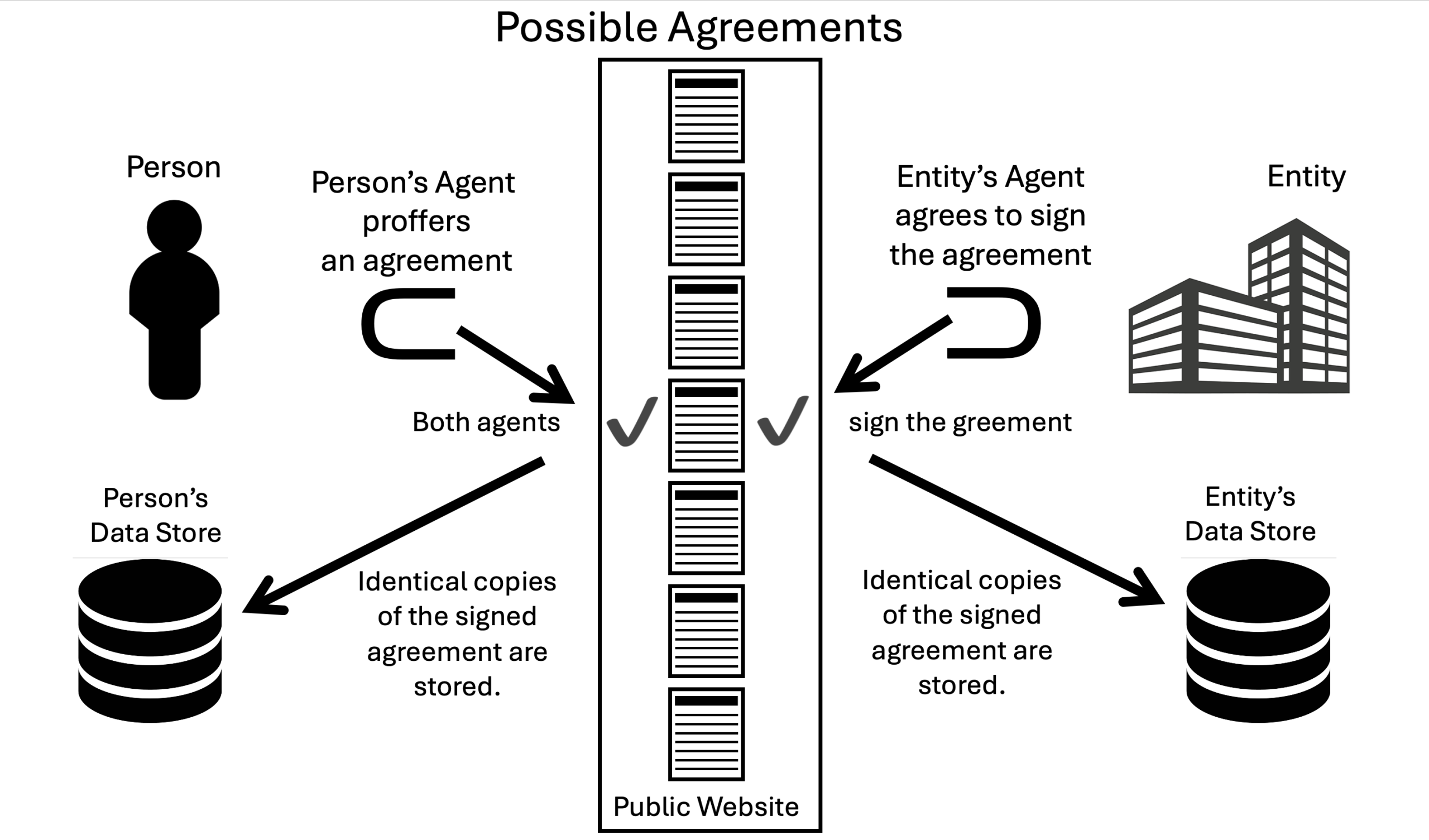
It is also the ultimate product of ProjectVRM, which began in 2006 with a mission: to prove that free customers are more valuable than captive ones—to companies, to markets, and to themselves. It was to ProjectVRM’s nonprofit spinoff, Customer Commons, that the IEEE came in 2017 with the challenge to create the MyTerms standard.

Of course, every agreement needs to be good for both sides. Right now we have five draft agreements for that. SD-BASE says “Service Delivery only.” This one requires that the site or service provide the visitor only what the visitor came for, and not to share personal data with third parties. This will make the site or service more inviting. (Customer Commons also plans to offer a trustmark to sites and services that sign MyTerms Agreements.) Lots of other mutually respectful agreements can also be built on top of SD-BASE: agreements that respect personal agency as well as privacy.

Other initial MyTerms agreements cover data portability, intentcasting, data-for-good, and AI training.

MyTerms will foster businesses and business methods that the surveillance fecosystem prevents. We describe how that will work, and some of the businesses MyTerms will create and improve, in The Cluetrain Will Run from Customers to Companies.

Of course, we need to develop tools and services for making that cluetrain run.  Please tell us what you’ve got or plan.

The place to list those is in a new section of our Developments page. We also need to re-write and condense our privacy manifesto, and welcome help with both.

We also need to thank our many teams over the past two decades for jobs well done, even if many of those jobs didn’t go anywhere, mostly because they were too early.

Now is the time, because the world is fed up with surveillance—and it is easier than ever to develop tools and services using AI.

MyTerms will be announced on 28 January at this event in the Imperial Business School and online. Please come.


*The word fecosystem is apropos, kinda like Cory Doctorow’s ensittification. Spread both words.

The Wurst of the Web

Don’t think about what’s wrong on the Web. Think about what pays for it. Better yet, look at it.

Start by installing Privacy Badger in your browser. Then look at what it tells you about every site you visit. With very few exceptions (e.g. Internet Archive and Wikipedia), all are putting tracking beacons (the wurst cookie flavor) in your browser. These then announce your presence to many third parties, mostly unknown and all unseen, at nearly every subsequent site you visit, so you can be followed and profiled and advertised at. And your profile might be used for purposes other than advertising. There’s no way to tell.

This practice—tracking people without their invitation or knowledge—is at the dark heart and sold soul of what Shoshana Zuboff calls Surveillance Capitalism and Brett Frischmann and Evan Selinger call Re-engineering Humanity. (The italicized links go to books on the topic, both of which came out in the last year. Buy them.)

While that system’s business is innocuously and misleadingly called advertising, the surveilling part of it is called adtechThe most direct ancestor of adtech is not old fashioned brand advertising. It’s direct marketing, best known as junk mail. (I explain the difference in Separating Advertising’s Wheat and Chaff.) 

In the online world, brand advertising and adtech look the same, but underneath they are as different as bread and dirt. While brand advertising is aimed at broad populations and sponsors media it considers worthwhile, adtech does neither. Like junk mail, adtech wants to be personal, wants a direct response, and ignores massive negative externalities. It also uses media to mark, track and advertise at eyeballs, wherever those eyeballs might show up. (This is how, for example, a Wall Street Journal reader’s eyeballs get shot with an ad for, say, Warby Parker, on Breitbart.) So adtech follows people, profiles them, and adjusts its offerings to maximize engagement, meaning getting a click. It also works constantly to put better crosshairs on the brains of its human targets; and it does this for both advertisers and other entities interested in influencing people. (For example, to swing an election.)

For most reporters covering this, the main objects of interest are the two biggest advertising intermediaries in the world: Facebook and Google. That’s understandable, but they’re just the tip of the wurstberg.  Also, in the case of Facebook, it’s quite possible that it can’t fix itself. See here:

How easy do you think it is for Facebook to change: to respond positively to market and regulatory pressures?

Consider this possibility: it can’t.

One reason is structural. Facebook is comprised of many data centers, each the size of a Walmart or few, scattered around the world and costing many $billions to build and maintain. Those data centers maintain a vast and closed habitat where more than two billion human beings share all kinds of revealing personal shit about themselves and each other, while providing countless ways for anybody on Earth, at any budget level, to micro-target ads at highly characterized human targets, using up to millions of different combinations of targeting characteristics (including ones provided by parties outside Facebook, such as Cambridge Analytica, which have deep psychological profiles of millions of Facebook members). Hey, what could go wrong?

In three words, the whole thing.

The other reason is operational. We can see that in how Facebook has handed fixing what’s wrong with it over to thousands of human beings, all hired to do what The Wall Street Journal calls “The Worst Job in Technology: Staring at Human Depravity to Keep It Off Facebook.” Note that this is not the job of robots, AI, ML or any of the other forms of computing magic you’d like to think Facebook would be good at. Alas, even Facebook is still a long way from teaching machines to know what’s unconscionable. And can’t in the long run, because machines don’t have a conscience, much less an able one.

You know Goethe’s (or hell, Disney’s) story of The Sorceror’s Apprentice? Look it up. It’ll help. Because Mark Zuckerberg is both the the sorcerer and the apprentice in the Facebook version of the story. Worse, Zuck doesn’t have the mastery level of either one.

Nobody, not even Zuck, has enough power to control the evil spirits released by giant machines designed to violate personal privacy, produce echo chambers beyond counting and amplify tribal prejudices (including genocidal ones)—besides whatever good it does for users and advertisers.

The hard work here is lsolving the problems that corrupted Facebook so thoroughly, and are doing the same to all the media that depend on surveillance capitalism to re-engineer us all.

Meanwhile, because lawmaking is moving apace in any case, we should also come up with model laws and regulations that insist on respect for private spaces online. The browser is a private space, so let’s start there.

Here’s one constructive suggestion: get the browser makers to meet next month at IIW, an unconference that convenes twice a year at the Computer History Museum in Silicon Valley, and work this out.

Ann Cavoukian (@AnnCavoukian) got things going on the organizational side with Privacy By Design, which is now also embodied in the GDPR. She has also made clear that the same principles should apply on the individual’s side.  So let’s call the challenge there Privacy By Default. And let’s have it work the same in all browsers.

I think it’s really pretty simple: the default is no. If we want to be tracked for targeted advertising or other marketing purposes, we should have ways to opt into that. But not some modification of the ways we have now, where every @#$%& website has its own methods, policies and terms, none of which we can track or audit. That is broken beyond repair and needs to be pushed off a cliff.

Among the capabilities we need on our side are 1) knowing what we have opted into, and 2) ways to audit what is done with information we have given to organizations, or has been gleaned about us in the course of our actions in the digital world. Until we have ways of doing both,  we need to zero-base the way targeted advertising and marketing is done in the digital world. Because spying on people without an invitation or a court order is just as wrong in the digital world as it is in the natural one. And you don’t need spying to target.

And don’t worry about lost business. There are many larger markets to be made on the other side of that line in the sand than we have right now in a world where more than 2 billion people block ads, and among the reasons they give are “Ads might compromise my online privacy,” and “Stop ads being personalized.”

Those markets will be larger because incentives will be aligned around customer agency. And they’ll want a lot more from the market’s supply side than surveillance based sausage, looking for clicks.

© 2026 ProjectVRM

Theme by Anders NorenUp ↑