Category: Future (Page 1 of 2)

The Only Way to Get Privacy Online

No regulation to make organizations respect personal privacy will work.

We’ve had cookie laws since the ’00s, the GDPR since the ’10s, and the CCPA since 2020. None of them has worked.

All those regulations are aimed at reducing the power of organizations to violate personal privacy. None is to empower people. That’s why, under those regulations, all we can do is agree to the terms organizations provide. We have no independent agency.  All we have is what they promise, and their promises aren’t worth the pixels they’re printed on.

The only way we will get privacy is with contracts, which are laws that two parties make for themselves.

And the only way to make contracts work, at scale, is if we are the ones proffering those terms as first parties, and organizations agree to them as second parties. This flips the script on business-as-usual online.

By the old script, privacy is a grace of corporate obedience to selections in cookie notices, many of which provide no choice at all. There is “Accept,” and that’s it. In that case, all you’re accepting is a corporate privacy policy, which is typically just a fig leaf over the company’s hard-on for personal data.

Regardless of what you do with a cookie notice, chances are the company still tracks you like a marked animal.  See here and here. You also have no easy of auditing compliance, because you keep no record of your “choices.” And we have that system because the incentives are worse than misaligned: they are completely broken.

See, if you are a typical website, you get paid for allowing third parties to harvest visitors’ personal data and use it to aim personalized advertising at their eyeballs. This is morally wrong on its face, but easily rationalized because it pays.

In the natural world, a store would never plant tracking beacons on every shopper, or require those shoppers to “choose” privacy protections by stripping naked and then selecting the purposes to which their personal tracking beacons will be put. Shoppers would avoid that store like the plague,

However, on the Net and the Web, we haven’t yet invented privacy, just as we hadn’t in the natural world before we invented clothing and shelter. So, on the Net and the Web, we are still naked as fish. As a result, a plague of near-ubiquitous surveillance has been raging online for decades. It is nearly impossible to avoid getting infected.

Most of that surveillance is for the $742 Billion surveillance-fed fecosystem* called adtech. And the only way we can obsolesce it is with a business ecosystem that works for everyone: customers and companies alike, and together.

We can do that now, with MyTerms.

MyTerms is the nickname for IEEE P7012 Standard for Machine Readable Personal Privacy Terms, which will be published next week after eight years in the works. (I chair the working group.)

It describes a protocol in the diplomatic sense: a way to reach and record agreements. Here is a diagram that shows how it works:
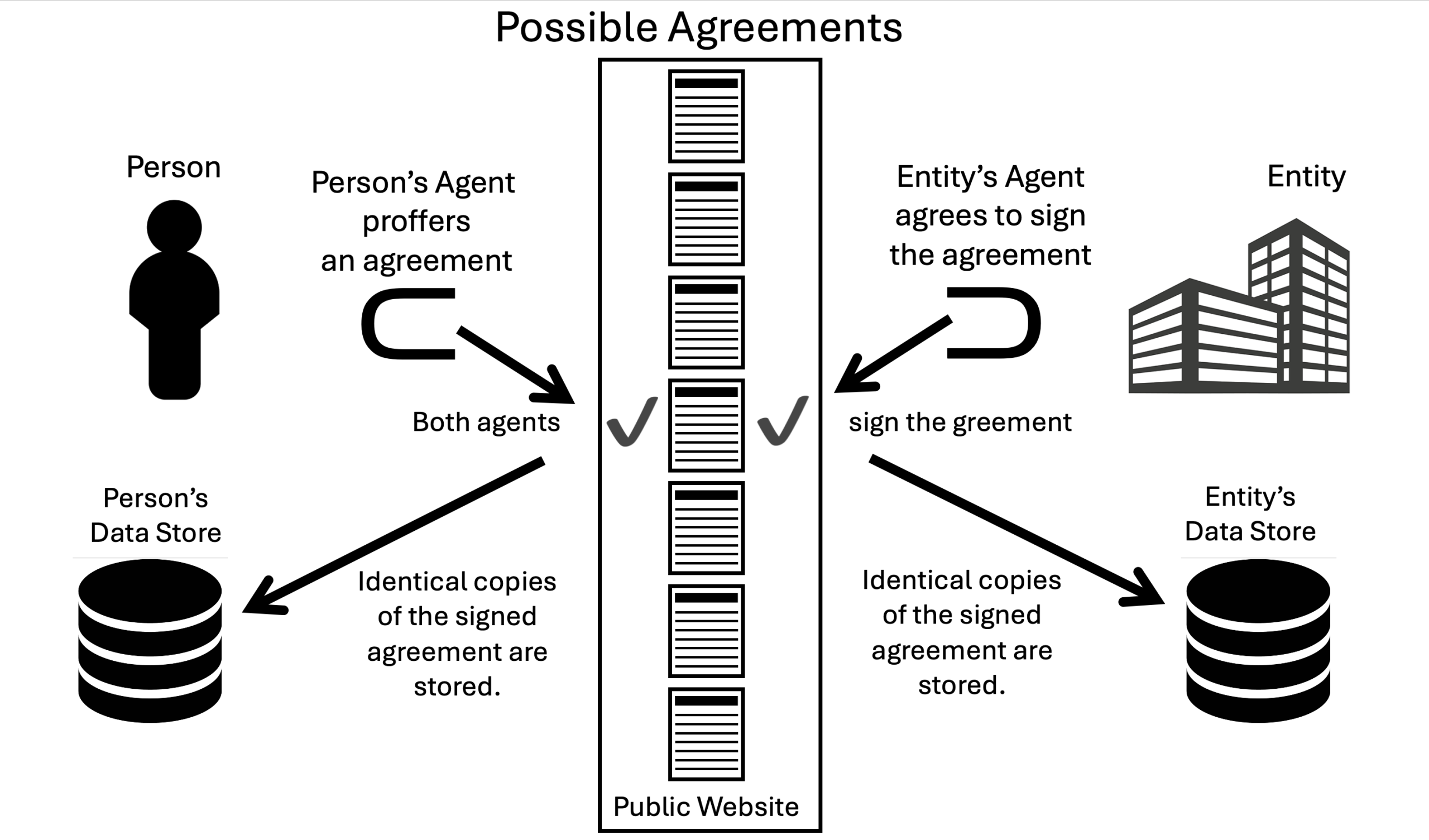
It is also the ultimate product of ProjectVRM, which began in 2006 with a mission: to prove that free customers are more valuable than captive ones—to companies, to markets, and to themselves. It was to ProjectVRM’s nonprofit spinoff, Customer Commons, that the IEEE came in 2017 with the challenge to create the MyTerms standard.

Of course, every agreement needs to be good for both sides. Right now we have five draft agreements for that. SD-BASE says “Service Delivery only.” This one requires that the site or service provide the visitor only what the visitor came for, and not to share personal data with third parties. This will make the site or service more inviting. (Customer Commons also plans to offer a trustmark to sites and services that sign MyTerms Agreements.) Lots of other mutually respectful agreements can also be built on top of SD-BASE: agreements that respect personal agency as well as privacy.

Other initial MyTerms agreements cover data portability, intentcasting, data-for-good, and AI training.

MyTerms will foster businesses and business methods that the surveillance fecosystem prevents. We describe how that will work, and some of the businesses MyTerms will create and improve, in The Cluetrain Will Run from Customers to Companies.

Of course, we need to develop tools and services for making that cluetrain run.  Please tell us what you’ve got or plan.

The place to list those is in a new section of our Developments page. We also need to re-write and condense our privacy manifesto, and welcome help with both.

We also need to thank our many teams over the past two decades for jobs well done, even if many of those jobs didn’t go anywhere, mostly because they were too early.

Now is the time, because the world is fed up with surveillance—and it is easier than ever to develop tools and services using AI.

MyTerms will be announced on 28 January at this event in the Imperial Business School and online. Please come.


*The word fecosystem is apropos, kinda like Cory Doctorow’s ensittification. Spread both words.

Markets vs. Marketing in the Age of AI

Maybe history will defeat itself.

Remember FreePC? It was a thing, briefly, at the end of the last millennium, right before Y2K pooped the biggest excuse for a party in a thousand years. This may help. The idea was to put ads in the corner of your PC’s screen. The market gave it zero stars, and it failed.

And now comes Telly, hawking free TVs with ads in a corner, and a promise to “optimize your ad experience.” As if anybody wants an ad experience other than no advertising at all.

Negative demand for advertising has been well advertised by both ad blocking (the biggest boycott in human history) and ad-free “prestige” TV, (or SVOD— Subscription Video On Demand). With those we gladly pay—a lot— not to see advertising. (See numbers here.)

But the advertising business (in the mines of which I toiled for too much of my adult life) has always smoked its own exhaust and excels best at getting high with generous funders. (Yeah, some advertising works, but on the whole people still hate it on the receiving end.)

The fun will come when our own personal AI bots, working for our own asses, do battle with the robot Nazgûls of marketing — and win, because we’re on the Demand side of the marketplace, and we’ll do a better job of knowing what we want and don’t want to buy than marketing’s surveillant AI robots can guess at. Supply will survive, of course. But markets will defeat marketing by taking out the middle creep.

The end state will be one Cluetrain forecast in 1999, Linux Journal named in 2006, the VRM community started working on that same year, and The Intention Economy detailed in 2012. The only thing all of them missed was how customer intentions might be helped by personal AI.

Personal, not personalized.

Markets will become new and better dances between Demand and Supply, simply because Demand will have better ways to take the lead, and not just follow all the time. Simple as that.


*For more on how this will work, see Individual Empowerment and Agency on a Scale We’ve Never Seen Before.

As an aside, the mouth in whch BUY!!! appears is mine.  The gold crowns were provided by students of the UNC School of Dentistry, under the direction of Dr. Clinton Max Studevant for just $25 each, half a century ago. The original photo is here on Flickr, was shot with a Sony camcorder that could take low-res stills, and has had more than 80,000 views, which is way more than any of the 80,000 other photos I have on Flickr. I don’t know why.

ESC

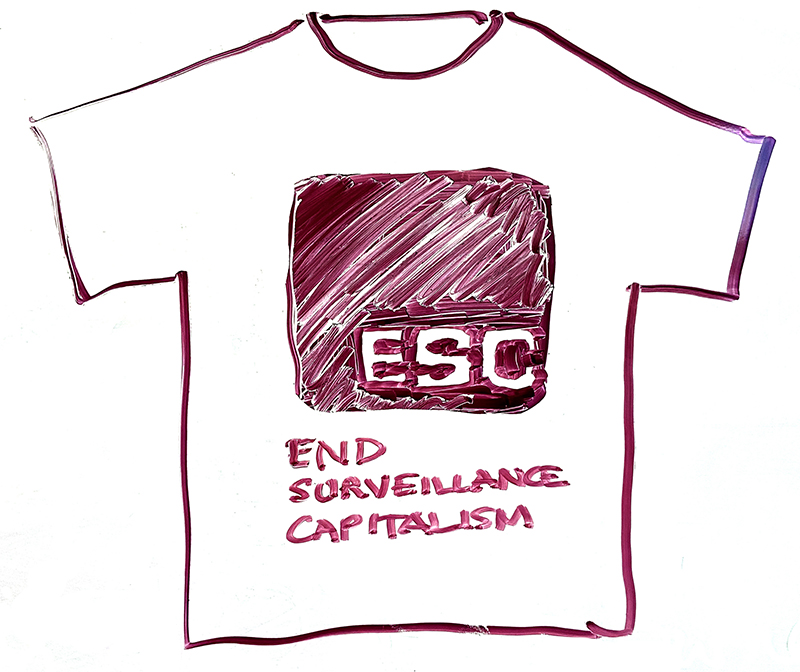
ESC t-shirt

VRM Day had an extraordinary outcome this time: a movement to end surveillance capitalism.

The movement began with a talk by Roger McNamee titled Saving us from Big Tech: the Gen Z Solution. It was the latest in the Ostrom Workshop‘s Beyond the Web salon series, which on this occasion took place live and in person simultaneously in the Computer History Museum‘s Boole room and on the Web via Owl and Zoom, through the Workshop at Indiana University, where people also participated in a room and virtually. You can see the first hour of the talk here.

The conversation with Roger was super-energized, continued well past the scheduled hour, and onward through breakout sessions on each of the three days that followed at the Museum during IIW, and since then on Signal and Zoom. The conversation informally called itself “Roger and We,” and it vectored toward what it says on the t-shirt design above, drawn on a whiteboard during the third of the IIW sessions: End Surveillance Capitalism or ESC. (Also implying ESCape). One of us at the session created this graphic—

—and used it to create this t-shirt at Zazzle.com:

He’s bought a number of them, so far, because when he wore the first to Thanksgiving dinner, other people there also wanted one. In the spirit of freedom and openness, please feel free to use the same graphic (which, if you drag it off, is quite large ), or something like it, to make one or more of your own. Or run with it any way you please. Movements work that way.

This is where I pause and thank Shoshana Zuboff for making surveillance capitalism a full-sized Thing. Also to Brett Frishcmann and Evan Sellinger for explaining what it does to all of us, personally.

Where this goes is up to the group, which is small, growing, and gathering weekly in virtual space while corresponding asynchronously as well. It’s still small but growing.

To succeed, its fire needs to be so large and hot that profiting by tracking people will fail because neither people nor regulators will put up with it. It is also sobering to know that similar efforts to end surveillance capitalism have faltered in the past (which is still now), in spite of the simple fact that spying on people without their clear invitation (not mere “consent”) or a court order is wrong on its face, regardless of the purposes to which that spying is put.

We talked about lots of other stuff during VRM Day, of course. For example, Don Marti led a session on the W3C’s Private Advertising Technology Community Group, which he encouraged everyone in the room to join. (Please do.)

But the main outcome was ESC.

Now, some background for those not familiar with ProjectVRM.

From its start at the Berkman Klein Center in 2006, ProjectVRM has had (says here) “the immodest ambition of turning business on its head — for its own good, and for everyone else’s as well.” Perhaps ESC will be the thing to do that, after sixteen years of encouraging countless other efforts, some of which are listed here. (There is no easy way to keep up with all of them.)

If you’re interested in joining this cabal, write to me (the email is doc @ my last name dot com). You can also follow along on the ProjectVRM mailing list.


Why personal agency matters more than personal data

Lately a lot of thought, work and advocacy has been going into valuing personal data as a fungible commodity: one that can be made scarce, bought, sold, traded and so on.  While there are good reasons to challenge whether or not data can be property (see Jefferson and  Renieris), I want to focus on a different problem: the one best to solve first: the need for personal agency in the online world.

I see two reasons why personal agency matters more than personal data.

The first reason we have far too little agency in the networked world is that we settled, way back in 1995, on a model for websites called client-server, which should have been called calf-cow or slave-master, because we’re always the weaker party: dependent, subordinate, secondary. In defaulted regulatory terms, we clients are mere “data subjects,” and only server operators are privileged to be “data controllers,” “data processors,” or both.

Fortunately, the Net’s and the Web’s base protocols remain peer-to-peer, by design. We can still build on those. And it’s early.

A critical start in that direction is making each of us the first party rather than the second when we deal with the sites, services, companies and apps of the world—and doing that at scale across all of them.

Think about how much more simple and sane it is for websites to accept our terms and our privacy policies, rather than to force each of us, all the time, to accept their terms, all expressed in their own different ways. (Because they are advised by different lawyers, equipped by different third parties, and generally confused anyway.)

Getting sites to agree to our own personal terms and policies is not a stretch, because that’s exactly what we have in the way we deal with each other in the physical world.

For example, the clothes that we wear are privacy technologies. We also have  norms that discourage others from doing rude things, such as sticking their hands inside our clothes without permission.

We don’t yet have those norms online, because we have no clothing there. The browser should have been clothing, but instead it became an easy way for adtech and its dependents in digital publishing to plant tracking beacons on our naked digital selves, so they could track us like marked animals across the digital frontier. That this normative is no excuse. Tracking people without their conscious and explicit invitation—or a court order—is morally wrong, massively rude, and now (at least hopefully) illegal under the GDPR and other privacy laws.

We can easily create privacy tech, personal terms and personal privacy policies that are normative and scale for each of us across all the entities that deal with us. (This is what ProjectVRM’s nonprofit spin-off, Customer Commons, is about.)

It is the height of fatuity for websites and services to say their cookie notice settings are “your privacy choices” when you have no power to offer, or to make, your own privacy choices, with records of those choices that you keep.

The simple fact of the matter is that businesses can’t give us privacy if we’re always the second parties clicking “agree.” It doesn’t matter how well-meaning and GDPR-compliant those businesses are. Making people second parties in all cases is a design flaw in every standing “agreement” we “accept.” And we need to correct that.

The second reason agency matters more than data is that nearly the entire market for personal data today is adtech, and adtech is too dysfunctional, too corrupt, too drunk on the data it already has, and absolutely awful at doing what they’ve harvested that data for, which is so machines can guess at what we might want before they shoot “relevant” and “interest-based” ads at our tracked eyeballs.

Not only do tracking-based ads fail to convince us to do a damn thing 99.xx+% of the time, but we’re also not buying something most of the time as well.

As incentive alignments go, adtech’s failure to serve the actual interests of its targets verges on absolute. (It’s no coincidence that more than a year ago, up to 1.7 billion people were already blocking ads online.)

And hell, what they do also isn’t really advertising, even though it’s called that. It’s direct marketing, which gives us junk mail and is the model for spam. (For more on this, see Separating Advertising’s Wheat and Chaff.)

Privacy is personal. That means privacy is an effect of personal agency, projected by personal tech and by personal expressions of intent that others can respect without working at it. We have that in the offline world. We can have it in the online world too.

Privacy is not something given to us by companies or governments, no matter how well they do Privacy by Design or craft their privacy policies. Top-down privacy simply can’t work.

In the physical world we got privacy tech and norms before we got privacy law. In the networked world we got the law first. That’s why the GDPR has caused so much confusion. Good and helpful though it may be, it is the regulatory cart in front of the technology horse. In the absence of privacy tech, we also failed to get the norms that would normally and naturally guide lawmaking.

So let’s get the tech horse back in front of the lawmaking cart. If we don’t do that first, adtech will stay in control. And we know how that movie goes, because it’s a horror show and we’re living in it now.


Our radical hack on the whole marketplace

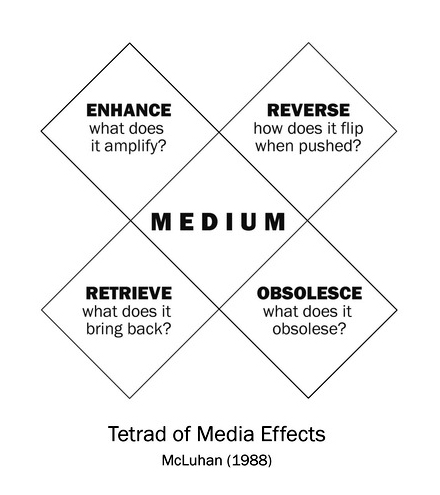
In Disruption isn’t the whole VRM story, I visited the Tetrad of Media Effects, from Laws of Media: the New Science, by Marshall and Eric McLuhan. Every new medium (which can be anything from a stone arrowhead to a self-driving car), the McLuhans say, does four things, which they pose as questions that can have multiple answers, and they visualize this way:

tetrad-of-media-effects

The McLuhans also famously explained their work with this encompassing statement: We shape our tools and thereafter they shape us.

This can go for institutions, such as businesses, and whole marketplaces, as well as people. We saw that happen in a big way with contracts of adhesion: those one-sided non-agreements we click on every time we acquire a new login and password, so we can deal with yet another site or service online.

These were named in 1943 by the law professor Friedrich “Fritz” Kessler in his landmark paper, “Contracts of Adhesion: Some Thoughts about Freedom of Contract.” Here is pretty much his whole case, expressed in a tetrad:

contracts-of-adhesion

Contracts of adhesion were tools industry shaped, was in turn shaped by, and in turn shaped the whole marketplace.

But now we have the Internet, which by design gives everyone on it a place to stand, and, like Archimedes with his lever, move the world.

We are now developing that lever, in the form of terms any one of us can assert, as a first party, and the other side—the businesses we deal with—can agree to, automatically. Which they’ll do it because it’s good for them.

I describe our first two terms, both of which have potentials toward enormous changes, in two similar posts put up elsewhere: 

— What if businesses agreed to customers’ terms and conditions? 

— The only way customers come first

And we’ll work some of those terms this week, fittingly, at the Computer History Museum in Silicon Valley, starting tomorrow at VRM Day and then Tuesday through Thursday at the Internet Identity Workshop. I host the former and co-host the latter, our 24th. One is free and the other is cheap for a conference.

Here is what will come of our work:
personal-terms

Trust me: nothing you can do is more leveraged than helping make this happen.

See you there.


“Disruption” isn’t the whole VRM story

250px-mediatetrad-svg

The vast oeuvre of Marshall McLuhan contains a wonderful approach to understanding media called the tetrad (i.e. foursome) of media effects.  You can apply it to anything, from stone tools to robots. McLuhan unpacks it with four questions:

  1. What does the medium enhance?
  2. What does the medium make obsolete?
  3. What does the medium retrieve that had been obsolesced earlier?
  4. What does the medium reverse or flip into when pushed to extremes?

I suggest that VRM—

  1. Enhances CRM
  2. Obsoletes marketing guesswork, especially adtech
  3. Retrieves conversation
  4. Reverses or flips into the bazaar

Note that many answers are possible. That’s why McLuhan poses the tetrad as questions. Very clever and useful.

I bring this up for three reasons:

  1. The tetrad is also helpful for understanding every topic that starts with “disruption.” Because a new medium (or technology) does much more than just disrupt or obsolete an old one—yet not so much more that it can’t be understood inside a framework.
  2. The idea from the start with VRM has never been to disrupt or obsolete CRM, but rather to give it a hand to shake—and a way customers can pull it out of the morass of market-makers (especially adtech) that waste its time, talents and energies.
  3. After ten years of ProjectVRM, we still don’t have a single standardized base VRM medium (e.g. a protocol), even though we have by now hundreds of developers we call VRM in one way or another. Think of this missing medium as a single way, or set of ways, that VRM demand can interact with CRM supply, and give every customer scale across all the companies they deal with. We’ve needed that from the start. But perhaps, with this handy pedagogical tool, we can look thorugh one framework toward both the causes and effects of what we want to make happen.

I expect this framework to be useful at VRM Day (May 1 at the Computer History Museum) and at IIW on the three days that follow there.

Save

VRM Day: Starting Phase Two

VRM Day is today, 24 October, at the Computer History Museum. IIW follows, over the next three days at the same place. (The original version of this post was October 17.)

We’ve been doing VRM Days since (let’s see…) this one in 2013, and VRM events since this one in 2007. Coming on our tenth anniversary, this is our last in Phase One.

sisyphusTheRolling snowball difference between Phase One and Phase Two is that between rocks and snowballs. In Phase One we played Sisyphus, pushing a rock uphill. In Phase Two we roll snowballs downhill.

Phase One was about getting us to the point where VRM was accepted by many as a thing bound to happen. This has taken ten years, but we are there.

Phase Two is about making it happen, by betting our energies on ideas and work that starts rolling downhill and gaining size and momentum.

Some of that work is already rolling. Some is poised to start. Both kinds will be on the table at VRM Day. Here are ones currently on the agenda:

  • VRM + CRM via JLINC. See At last: a protocol to link VRM and CRM. , and The new frontier for CRM is CDL: customer driven leads. This is a one form of intentcasting that should be enormously appealing to CRM companies and their B2B corporate customers. Speaking of which, we also have—
  • Big companies welcoming VRM.  Leading this is Fing, a French think tank that brings together many of the country’s largest companies, both to welcome VRM and to research (e.g. through Mesinfos) how the future might play out. Sarah Medjek of Fing will present that work, and lead discussion of where it will head next. We will also get a chance to participate in that research by providing her with our own use cases for VRM. (We’ll take out a few minutes to each fill out an online form.)
  • Terms individuals assert in dealings with companies. These are required for countless purposes. Mary Hodder will lead discussion of terms currently being developed at Customer Commons and the CISWG / Kantara User Submitted Terms working group (Consent and Information Sharing Working Group). Among other things, this leads to—
  • 2016_04_25_vrmday_000-1Next steps in tracking protection and ad blocking. At the last VRM Day and IIW, we discussed CHEDDAR on the server side and #NoStalking on the individual’s side. There are now huge opportunities with both, especially if we can normalize #NoStalking terms for all tracking protection and ad blocking tools.  To prep for this, see  Why #NoStalking is a good deal for publishers, where you’ll find the image on the right, copied from the whiteboard on VRM Day.
  • Blockchain, Identity and VRM. Read what Phil Windley has been writing lately distributed ledgers (e.g. blockchain) and what they bring to the identity discussions that have been happening for 22 IIWs, so far. There are many relevancies to VRM.
  • Personal data. This was the main topic at two recent big events in Europe: MyData2016 in Helsinki and PIE (peronal information economy) 2016 in London.  The long-standing anchor for discussions and work on the topic at VRM Day and IIW is PDEC (Personal Data Ecosystem Consortium). Dean Landsman of PDEC will keep that conversational ball rolling. Adrian Gropper will also brief us on recent developments around personal health data as well.
  • Hacks on the financial system. Kevin Cox can’t make it, but wants me to share what he would have presented. Three links: 1) a one minute video that shows why the financial system is so expensive, 2) part of a blog post respecting his local Water Authority and newly elected government., and 3) an explanation of the idea of how we can build low-cost systems of interacting agents. He adds, “Note the progression from location, to address, to identity, to money, to housing.  They are all ‘the same’.” We will also look at how small business and individuals have more in common than either do with big business. With a hint toward that, see what Xero (the very hot small business accounting software company) says here.
  • What ProjectVRM becomes. We’ve been a Berkman-Klein Center project from the start. We’ve already spun off Customer Commons. Inevitably, ProjectVRM will itself be spun off, or evolve in some TBD way. We need to co-think and co-plan how that will go. It will certainly live on in the DNA of VRM and VRooMy work of many kinds. How and where it lives on organizationally is an open question we’ll need to answer.

Here is a straw man context for all of those and more.

  • Top Level: Tools for people. These are ones which, in legal terms, give individuals power as first parties. In mathematical terms, they make us independent variables, rather than dependent ones. Our focus from the start has been independence and engagement.
    • VRM in the literal sense: whatever engages companies’ CRM or equivalent systems.
    • Intentcasting.
    • PIMS—Personal Information Management Systems. Goes by many names: personal clouds, personal data stores, life management platforms and so on. Ctrl-Shift has done a good job of branding PIMS, however. We should all just go with that.
    • Privacy tools. Such as those provided by tracking protection (and tracking-protective ad blocking).
    • Legal tools. Such as the terms Customer Commons and the CISWG are working on.
    • UI elements. Such as the r-button.
    • Transaction & payment systems. Such as EmanciPay.

Those overlap to some degree. For example, a PIMS app and data store can do all that stuff. But we do need to pull the concerns and categories apart as much as we can, just so we can talk about them.

Kaliya will facilitate VRM Day. She and I are still working on the agenda. Let us know what you’d like to add to the list above, and we’ll do what we can. (At IIW, you’ll do it, because it’s an unconference. That’s where all the topics are provided by participants.)

Again, register here. And see you there.


Save

Save

Save

Save

We’re done with Phase One

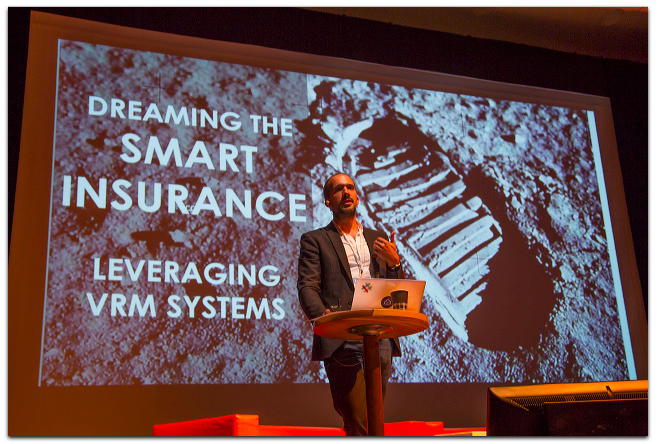
Here’s a picture that’s worth more than a thousand words:

maif-vrm

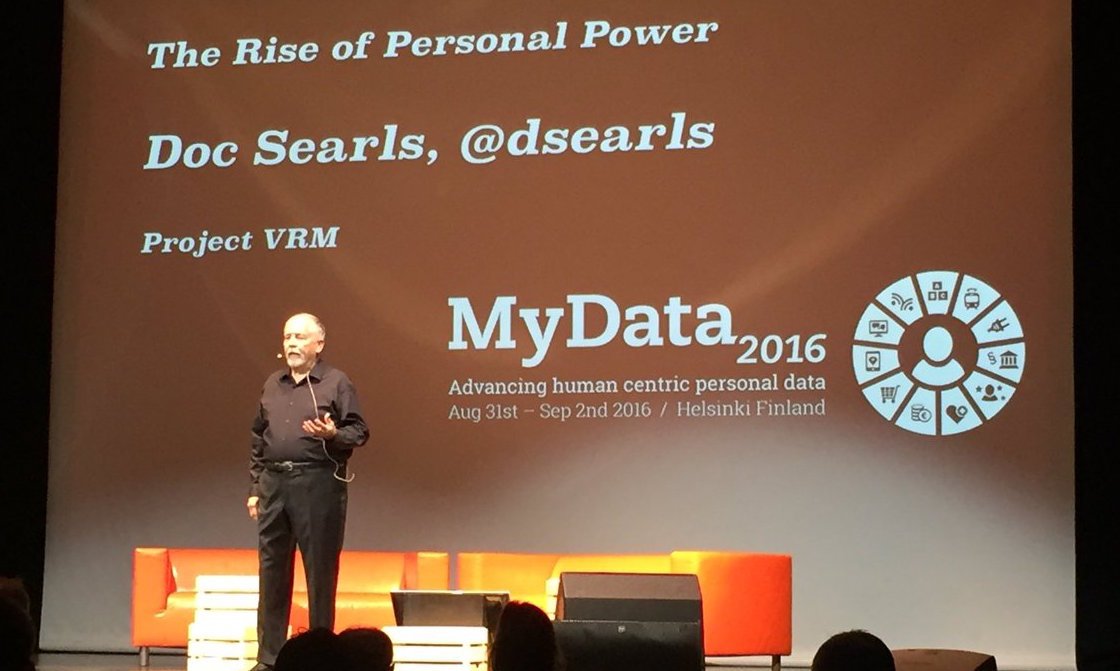
He’s with MAIF, the French insurance company, speaking at MyData 2016 in Helsinki, a little over a month ago. Here’s another:

sean-vrm

That’s Sean Bohan, head of our steering committee, expanding on what many people at the conference already knew.

I was there too, giving the morning keynote on Day 2:

cupfu1hxeaa4thh

It was an entirely new talk. Pretty good one too, especially since  I came up with it the night before.

See, by the end of Day 1, it was clear that pretty much everybody at the conference already knew how market power was shifting from centralized industries to distributed individuals and groups (including many inside centralized industries). It was also clear that most of the hundreds of people at the conference were also familiar with VRM as a market category. I didn’t need to talk about that stuff anymore. At least not in Europe, where most of the VRM action is.

So, after a very long journey, we’re finally getting started.

In my own case, the journey began when I saw the Internet coming, back in the ’80s.  It was clear to me that the Net would change the world radically, once it allowed commercial activity to flow over its pipes. That floodgate opened on April 30, 1995. Not long after that, I joined the fray as an editor for Linux Journal (where I still am, by the way, more than 20 years later). Then, in 1999, I co-wrote The Cluetrain Manifesto, which delivered this “one clue” above its list of 95 Theses:

not

And then, one decade ago last month, I started ProjectVRM, because that clue wasn’t yet true. Our reach did not exceed the grasp of marketers in the world. If anything, the Net extended marketers’ grasp a lot more than it did ours. (Shoshana Zuboff says their grasp has metastasized into surveillance capitalism. ) In respect to Gibson’s Law, Cluetrain proclaimed an arrived future that was not yet distributed. Our job was to distribute it.

Which we have. And we can start to see results such as those above. So let’s call Phase One a done thing. And start thinking about Phase Two, whatever it will be.

To get that work rolling, here are a few summary facts about ProjectVRM and related efforts.

First, the project itself could hardly be more lightweight, at least administratively. It consists of:

Second, we have a spin-off: Customer Commons, which will do for personal terms of engagement (one each of us can assert online) what Creative Commons (another Berkman-Klein spinoff) did for copyright.

Third, we have a list of many dozens of developers, which seem to be concentrated in Europe and Australia/New Zealand.  Two reasons for that, both speculative:

  1. Privacy. The concept is much more highly sensitive and evolved in Europe than in the U.S. The reason we most often get goes, “Some of our governments once kept detailed records of people, and those records were used to track down and kill many of them.” There are also more evolved laws respecting privacy. In Australia there have been privacy laws for several years requiring those collecting data about individuals to make it available to them, in forms the individual specifies. And in Europe there is the General Data Protection Regulation, which will impose severe penalties for unwelcome data gathering from individuals, starting in 2018.
  2. Enlightened investment. Meaning investors who want a startup to make a positive difference in the world, and not just give them a unicorn to ride out some exit. (Which seems to have become the default model in the U.S., especially Silicon Valley.)

What we lack is research. And by we I mean the world, and not just ProjectVRM.

Research is normally the first duty of a project at the Berkman Klein Center, which is chartered as a research organization. Research was ProjectVRM’s last duty, however, because we had nothing to research at first. Or, frankly, until now. That’s why we were defined as a development & research project rather than the reverse.

Where and how research on VRM and related efforts happens is a wide-open question. What matters is that it needs to be done, starting soon, while the “before” state still prevails in most of the world, and the future is still on its way in delivery trucks. Who does that research matters far less than the research itself.

So we are poised at a transitional point now. Let the conversations about Phase Two commence.

VRM at MyData2016

mydata2016-image

As it happens I’m in Helsinki right now, for MyData2016, where I’ll be speaking on Thursday morning. My topic: The Power of the Individual. There is also a hackathon (led by DataBusiness.fi) going on during the show, starting at 4pm (local time) today. In no order of priority, here are just some of the subjects and players I’ll be dealing with,  talking to, and talking up (much as I can):

Please let me know what others belong on this list. And see you at the show.

Save

The Castle Doctrine

home castle

The Castle doctrine has been around a long time. Cicero (106–43 BCE) wrote, “What more sacred, what more strongly guarded by every holy feeling, than a man’s own home?” In Book 4, Chapter 16 of his Commentaries on the Laws of England, William Blackstone (1723–1780 CE) added, “And the law of England has so particular and tender a regard to the immunity of a man’s house, that it stiles it his castle, and will never suffer it to be violated with impunity: agreeing herein with the sentiments of ancient Rome…”

Since you’re reading this online, let me ask, what’s your house here? What sacred space do you strongly guard, and never suffer to be violated with impunity?

At the very least, it should be your browser.

But, unless you’re running tracking protection in the browser you’re using right now, companies you’ve never heard of (and some you have) are watching you read this, and eager to use or sell personal data about you, so you can be delivered the human behavior hack called “interest based advertising.”

Shoshana Zuboff, of Harvard Business School, has a term for this:surveillance capitalism, defined as “a wholly new subspecies of capitalism in which profits derive from the unilateral surveillance and modification of human behavior.”

Almost across the board, advertising-supported publishers have handed their business over to adtech, the surveillance-based (they call it “interactive”) wing of advertising. Adtech doesn’t see your browser as a sacred personal space, but instead as a shopping cart with ad space that you push around from site to site.

So here is a helpful fact: we don’t go anywhere when we use our browsers. Our browser homes are in our computers, laptops and mobile devices. When we “visit” a web page or site with our browsers, we actually just request its contents (using the hypertext protocol called http or https).

In no case do we consciously ask to be spied on, or abused by content we didn’t ask for or expect. That’s why we have every right to field-strip out anything we don’t want when it arrives at our browsers’ doors.

The castle doctrine is what hundreds of millions of us practice when we use tracking protection and ad blockers. It is what called the new Brave browser into the marketplace. It’s why Mozilla has been cranking up privacy protections with every new version of Firefox . It’s why Apple’s new content blocking feature treats adtech the way chemo treats cancer. It’s why respectful publishers will comply with CHEDDAR. It’s why Customer Commons is becoming the place to choose No Trespassing signs potential intruders will obey. And it’s why #NoStalking is a good deal for publishers.

The job of every entity I named in the last paragraph — and every other one in a position to improve personal privacy online — is to bring as much respect to the castle doctrine in the virtual world as we’ve had in the physical one for more than two thousand years.

It should help to remember that it’s still early. We’ve only had commercial activity on the Internet since April 1995. But we’ve also waited long enough. Let’s finish making our homes online the safe places they should have been in the first place.


« Older posts

© 2026 ProjectVRM

Theme by Anders NorenUp ↑