
Category: First person technology (Page 5 of 5)

#TakeBackControl with #VRM

That’s a big part of what tonight’s Respect Network launch here in London is about. I’ll be speaking briefly tonight at the event and giving the opening keynote at the Immersion Day that will follow tomorrow. Here is a draft of what I’ll say tonight:

This launch is personal.

It’s about privacy.

It’s about control.

It’s about taking back what we lost when Industry won the Industrial Revolution.

It’s about fixing a marketplace that has been ruled by giant companies for a hundred and fifty years — even on the Internet, which was designed — literally — to support our independence, our autonomy, our freedom, our liberty, our agency in the world.

Mass marketing required subordinating the individual to the group, to treat human beings as templates, demographics, typicalities.

The promise of the Internet was to give each of us scale, reach and power.

But the commercial Internet was built on the old model. On the industrial model. What we have now is what the security guru Bruce Schneier calls a feudal system. We are serfs in the Kingdom of Google, the Duchy of Facebook, the Principality of Amazon.

Still, it’s early. The Internet as we know it today — with browsers, ISPs, search engines and social media — is just eighteen years old. In the history of business, and of civilization, this is nothing. We’ve barely started.

But the Internet does something new that nothing else in human history ever did, and we’re only beginning to wrap our heads around the possibilities: It puts everybody and everything at zero functional distance from everybody and everything else — and at costs that want to be zero as well.

This is profound and huge. The fact that we have the Net means we can zero-base new solutions that work for each of us, and not just for our feudal overlords.

Archimedes said “Give me a place to stand and I can move the world.”

That’s why we are here today. Respect Network has been working to give each of us a place to stand, to take back control: of our identities, our data, our lives, our relationships… of everything we do on the Net as free and independent human beings.

And what’s extra cool about this is that Respect Network isn’t just one company. It’s dozens of them, all standing behind the same promise, the same principles, the same commitment to build markets upward from you and me, and not just downward like eyes atop pyramids of control.

I’ll have a lot more to say about this tomorrow at Immersion Day, but for now I invite you to savor participating in a historic occasion.

I’m sure I’ll say something different, because I’ll speak extemporaneously and without the crutchware of slides. But I want to get this up  because I can’t print where I am at the moment, and it seems like a fun and useful thing to do in any case.

For more, see A New Data Deal, starting today, at my personal blog.

VRM is as distributed as humanity

VRM is for the  individual human beings we call customers.

While human beings form collective groups — families, teams, parishes, parties — what makes each of us most human is our individuality — and our capacity to grow and change.

We are all different. Even identical twins, grown from the same split egg, can be as different as male and female.

Our species evolved faces so we could tell each other apart, express ourselves differently, and live separate and unique lives. No other species has the same degree of variation among faces and voices, or has the same ability to customize personal appearance, behavior and voice, through diet, exercise, piercings, markings (such as tatoos) and other choices.

And yet we also form organizations — tribes, churches, businesses, governments — that cannot scale to usefulness without treating people as populations, groups and templates. We need these organizations to operate civilization.

But we also need our individuality. This is why we bristle when asked in a survey to provide our age, ethnicity or income group. Both asking and answering those questions insults our dignity as separate and distinct individuals: ones with dominion over ourselves, born to possess full agency in the world, and irreducible to demographic characteristics.

Humanity by its nature is also distributed. Scattered. In the computing and networking worlds — which are now the same — distributed means comprised of individual points of autonomy and control. The same goes for links between those nodes.

Paul Baran described the different ways humanity and its networks can be organized, with this drawing here —

fig1

— in this essay for the Rand Corporation on the subject of distributed communications. It was radical when it was written, in 1962, because centralized networks were the only kind. But Baran was also writing  at the height of the cold war, when the need to create the smallest possible “attack surface” was imperative. Hence the distributed design that later became the base-level nature of the Internet: as basic and elemental as chemical valency — the combining power of elements — and human nature.

This design is what David Isenberg calls “stupid” — because its purpose is to put all the intelligence at the network’s infinite number of ends (which are mostly human), rather than in the middle(s), where it is vulnerable.

Over the last decade, however, large businesses operating on the Internet, and provisioning access to it, have become increasingly centralized — or at best decentralized, but in very central ways. Visualizations of the Internet, such as this —

internet

— and this —

Internet_map_1024_-_transparent


— are of type B in Baran’s drawing above: decentralized, rather than distributed.

But the forces of decentralization and distribution are still with us, growing up from the Net’s own grass roots: individual geeks, working together on behalf of the Net itself, and its native nature.

Jon Udell wrote about them yesterday, pointing to this amazing list by @rossjones by way of @Jeremie Miller, father of XMPP, one of the most widespread protocols in the Internet suite. It’s far longer than our own here at Project VRM. But we will include it, because what they’re doing supports what we are doing, in the most fundamental way possible.

Lately I’ve been asked, along with many others, if there is still hope for a Net free from control by giant Net-based corporations, governments, phone and cable companies, the entertainment industry, and combinations of all those forces. On the surface it looks like the answer is no.

But looking down in the grass roots, growing upward out of the Net’s deepest and most permanent layer — also the most human one — gives me faith.

Why we need first person technologies on the Net

mousehammerWe need first person technologies for the same reason we need first person voices: because there are some things only a person can say and do.

Only a person can use the pronouns  “I,” “me,” “my” and “mine.” Likewise, only a person can use tools such as screwdrivers, eyeglasses and pencils. Those things are all first person technologies. They were invented for individual persons to use.

We use first person technologies the same unique ways we use our voices. “The human voice is unmistakably genuine,” The Cluetrain Manifesto says. “It can’t be faked.” Same with first person technologies. GoPro cameras, for example, are first person technologies that are used as many different ways as the people who strap them to their helmets.

Here in the physical world, first person technologies are extensions of our bodies and our senses. When we swing a hammer, twist a fork, ride a bike, or drive a car, our senses dwell within each of those things. They become part of us, and us part of them.

There are social influences on how we use first person technologies, of course, just as there are social influences on how we speak. But that does not diminish the personal nature of what we do with our tools and our voices. Each of us speaks, writes, walks, and drives in ways that are ours alone.

What’s purely personal is clear in the physical world. In the networked world, however, it is not — and this is a problem that needs fixing.

For example, there was a time when personal computers were truly personal. They ran applications that you acquired (or created) and used by and for yourself. You did not have to subscribe to them as services, and they did not require some company’s cloud. That time was before personal computers became network nodes. We are in a new world now — one in which first person agency is both provided and limited by what the lawyers call second and third parties, out on the Net.

Take smartphones and tablets for example. These are personal in many intimate ways, but they are also suction cups on corporate tentacles. So, while you can still operate a PC as independently as you would a typewriter, you cannot operate your mobile device except by the graces of Apple, Google, Microsoft, Samsung and other controlling parties — especially your mobile network provider. And, unless you are a serious hacker, you can’t acquire apps except through company stores. Many of those apps are also just interfaces on remote services over which you have little control.

This state of things is one of the reasons why privacy has lately become a big issue. The term covers several concerns at once. Here is how Eben Moglen unpacks them:

Privacy—as we use the word in our conversations now all around the world, and particularly when we talk about the net— really means three things.

The first is secrecy, which our ability to keep messages “private,” so that their content is known only to those who we intend to receive them.

The second is anonymity, which is our ability to keep our messages—even when their content is open—obscure as to who has published them and who is receiving them. It is very important that anonymity is an interest we can have in both our publishing and our reading.

The third is autonomy, which is our ability to make our life decisions free any force which has violated our secrecy or our anonymity.

Our old PCs provided all of those graces. (So does your GoPro camera.) We have none of them with our smart mobile devices today. Not yet, anyway.

Books in the physical world are first person technologies as well. Digital ones we “buy” from Amazon are not, because they come with leashes. Eben asks, “What if every book for the last five hundred years had been reporting its readers at headquarters?”

We won’t get back our privacy, or make real progress toward real personal freedom, until we develop and deploy first person technologies for everybody. Without them our democracies and marketplaces will also continue to be compromised, because both require those three virtues of privacy.

First person technologies are also required  by the distributed design of the Net, which Paul Baran first describede in 1964, using this drawing:
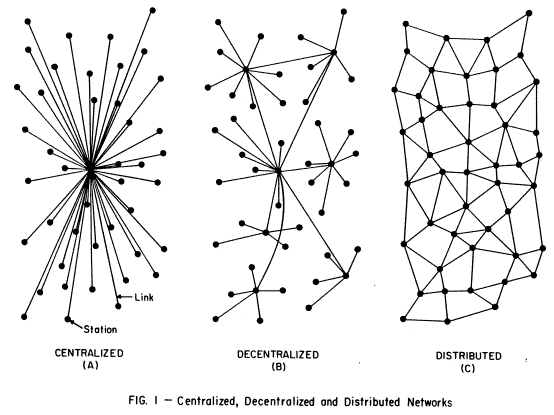
The Internet is the one on the right. In it each node is equal and possesses full agency. It is also what Adriana Lukas calls a heterarchy. Routing (which Paul Baran called “hot potato” and we now call packet switching) takes the best available path, rather than running only through central (or multi-central) relay points.  He posed this in contrast to the centralized model of computing, which prevailed at the time, and to decentralized networks, which reduced some of the risks of centralized networks but still held the same vulnerabilities, because they still contain central hubs and therefore also hierarchies. We experience those vulnerabilities  today when services we depend on are attacked, and the privacy of many is compromised at once.

Design models and habits die long and hard, however; and it remains too easy to create centralized services, such as corporate clouds, and to deliver benefits from those that are good enough — until something goes wrong.

First person technologies are a step in the right direction: the distributed one.

From the start a variety of ProjectVRM developers have been developing first person technologies. Here’s a quick list:

Everything there is open source or uses open standards and protocols. There are many others I insult by not listing (corrections are invited); but the main thing is not just to give credit where due. It’s to show groundwork toward a whole new category: first person technology.

Nailing down what this category means, and contains, is job one. It isn’t easy, because there is plenty of gray in the networked world. But lines can and must be drawn. Here’s one: we can use them to make a dent in the universe. Here’s another: They move us from what Dave Winer describes as Model #1 to Model #2:

Once we’ve done that, we can see how first person technologies, for example, deliver benefits in all four of the development categories Fred Wilson listed in the speech he gave at LeWeb in December:

  1. Money
  2. Health and wellness
  3. Data leakage
  4. Trust and identity

As with our own voices, solutions here will come from our sovereign and independent selves, using tools that extend our native capabilities. They won’t come only from systems others provide for us. Ours will, however, make those systems better as well.

Bonus link: Tahrir.

Newer posts »

© 2026 ProjectVRM

Theme by Anders Noren — Up ↑