
Fifteen years ago, The Onion published this story:
Study Finds Paint Aisle At Lowe’s Best Place To Have Complete Meltdown
Now it’s the vitamin aisle at CVS:

Enshittification at work.
When Cory Doctorow coined enshittification, he was talking about how online platforms such as Google, Amazon, and TikTok get shitty over time. Well, the same disease also afflicts many big retail operations, especially ones that flood their zones with discounts and other gimmicks, enshittifying what marketers call “the customer experience” (aka CX).
Take the vitamin aisle, above. The only people who will ever get down on all fours to read the yellow tags near the floor are the cursed employees who have to creep the length of the aisle putting them there.
For customers, the main cost of shopping at CVS is cognitive overhead. Think about—
- All those yellow stickies
- All the slow-downs at check-out when you wave your barcode at a reader, punch your phone number into a terminal, or have a CVS worker to do the same
- All the conditionalities in every discount or “free” offer that isn’t
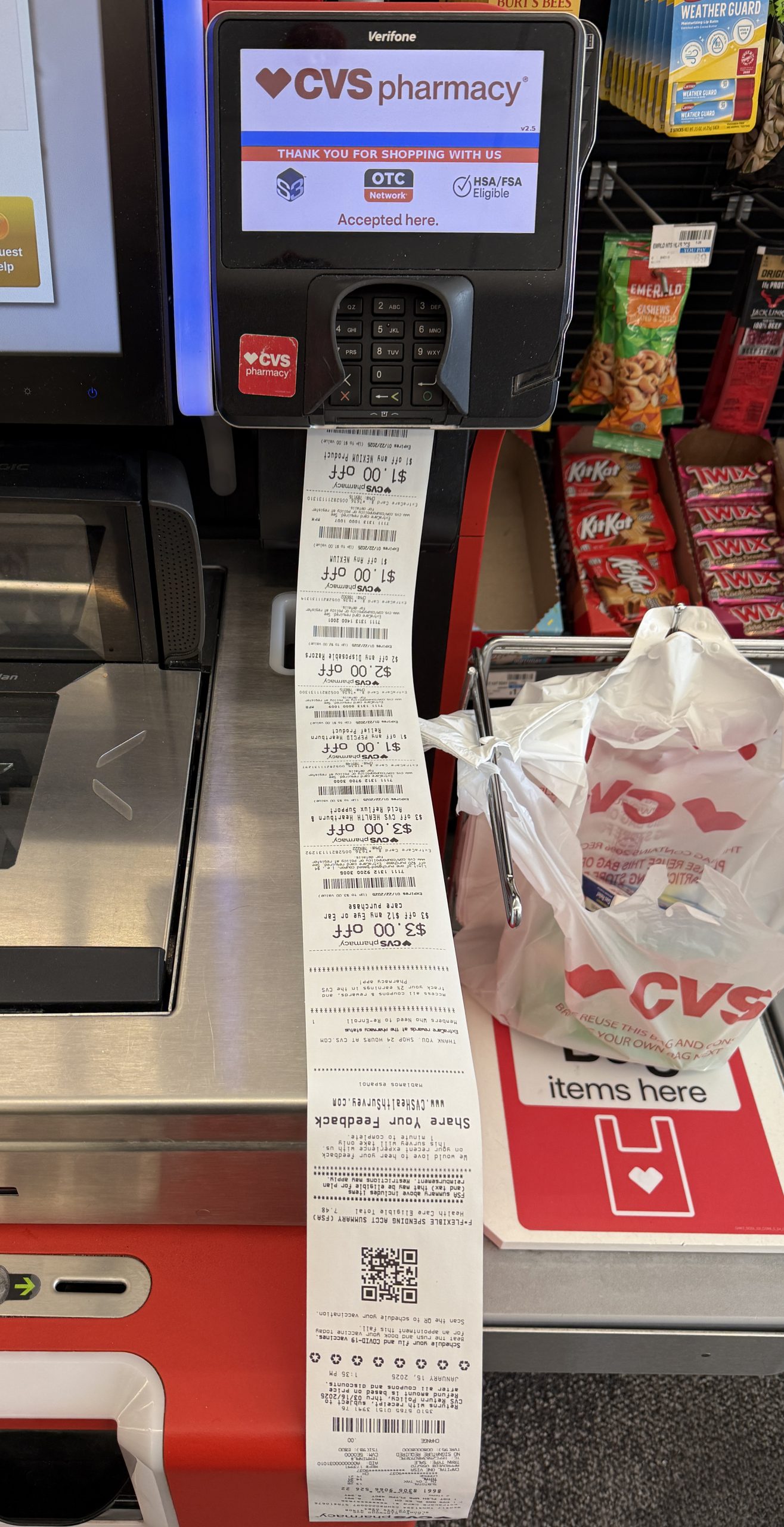
- All the yard-long receipts, such as this one:
And the app!
OMFG, all we really need the damned app for is the one CVS function our life depends on: the pharmacy.
To be fair, the app doesn’t suck at the basics (list of meds, what needs to be refilled, etc.). But it does suck at helping you take advantage of CVS’s greatest strength: that there are so many of them. Specifically,

While that’s down a bit from the peak in 2021, CVS is still the Starbucks of pharmacies. And while they are busy laying off people while investing in tech, you’d think they would at least make it easy to move your prescription from one store to another, using the app. But noooo.
What the app is best for is promotional crap. For example, this:

Look at the small gray type in the red oval: 198 coupons!
After I scroll down past the six Extrabucks Rewards (including the two above), I get these:

First, who wants a full-priced item when it seems damn near everything is discounted?
Second, you’d think after all these years of checking out with my Extracare barcode, and the app shows me (under “Buy It Again”) all the stuff I’ve purchased recently, that CVS would know I am a standard-issue dude with no interest in cosmetics. So why top the list of coupons with that shit? I suppose it’s to make me scroll down through the other 178 coupons to find other stuff I might want at a cheaper price.
I just did that and found nothing. Why? Because most of the coupons are for health products I already bought or don’t need. (I’m not sick right now.) Also, almost all of the coupons (as you see) expire three days from now.
Now think about the cognitive and operational overhead required to maintain that whole program at CVS. Good gawd.
And is it necessary? At all? When you’re the Starbucks of pharmacies?
Without exception, all loyalty programs like this one are coercive. They are about trapping and milking customers.
But do stores need them? Do customers? Does CVS? Really? When its customers are already biased by convenience.
Pro Tip: Real loyalty is earned, not coerced.
Want your store, or your chain, to be loved? Take some lessons from the most loved chain in the country: Trader Joe’s. In a chapter of The Intention Economy called “The Dance,” I list some reasons why TJ’s is loved by its customers. My main source for that list is Doug Rauch, the retired president of TJ’s, where he worked for 31 years. Here are the top few:
- They never use the word “consumer.” They call us “customers,” “persons,” or “individuals.”
- They have none of what Doug calls “gimmicks.” No loyalty programs, ads, promotions, or anything else that manipulates customers, raises cognitive overhead or insults anyone’s intelligence. In other words, none of what marketing obsesses about. “Those things are a huge part of retailing today, and have huge hidden costs,” Doug says. (I think the company’s biggest marketing expense is its float in the Rose Parade.)
- They never discount anything, or say anything is “on sale.” Those kinds of signals add more cognitive overhead. TJ’s wants customers not just to assume, but to know. A single price takes care of that.
- They have less than no interest in industry fashion. TJ’s goes to no retail industry meetings or conferences, belongs to no associations, and avoids all settings where the talk is about gaming customers. That’s not TJ’s style because that’s not its substance.
- They believe, along with Cluetrain, that markets are conversations—with customers. Doug told me his main job, as president of the company, was “shopping along with customers.” That’s how he spent most of his time. “We believe in honesty and directness between human beings…We do this by engaging with the whole person, rather than just with the part that ‘consumes….We’ll even open packages with customers to taste and talk about the goods.” As a result, “There’s nothing sold at Trader Joe’s that customers haven’t improved.”
Then there’s what Walmart CEO Lee Scott told me in 2000 (at this event) when I asked him “What happened to K-Mart?” From The Intention Economy:
His answer, in a word, was “Coupons.” As Lee explained it, K-Mart overdid it with coupons, which became too big a hunk of their overhead, while also narrowing their customer base toward coupon-clippers. They had other problems, he said, but that was a big one. By contrast, Wal-Mart minimized that kind of thing, focusing instead on promising “everyday low prices,” which was a line of Sam Walton’s from way back. The overhead for that policy rounded to zero.
Which brings me to trust.
We trust Trader Joe’s and Walmart to be what they are. In simple and fundamental ways, they haven’t changed. The ghosts of Joe Coloumbe and Sam Walton still run Trader Joe’s and Walmart. TJ’s is still the “irreverent but affordable” grocery store Joe built for what (in his book) Joe called “the overeducated and underpaid,” and based in Los Angeles. Walmart is still Sam’s five-and-dime from Bentonville, Arkansas. (Lee Scott told me that.)
CVS’s equivalent to Joe and Sam was Ralph Hoagland, a good friend of good friends of ours in Santa Barbara. All of us also shared history around Harvard and Cambridge, where Ralph lived when he co-founded CVS, which stood for Consumer Value Store, in 1963. In those days CVS mostly sold health and beauty products, cheaply. I remember Ralph saying the store’s main virtue was just good prices on good products. Hence the name.
CVS can do a much better job of signaling bargain prices by just making them as low as possible, on the model of Trader Joe’s and Walmart.
I think there is also a good Health position for CVS: one that bridges its health & beauty origins and its eminence as the leading pharmacy chain in the U.S. And it could rest on trust.
I’m thinking now about tech. Specifically, FPCs, for First-Person Credentials. Read what Jamie Smith says about them in his Customer Futures newsletter under the headline The most important credentials you’ve never heard of. Also check out—
- What I wrote last year about Identity as Root
- What DIF is doing
- What Ayra is doing
- Other stuff you’ll be hearing about first-person credentials (but isn’t published yet) when you come to the next IIW (April 8-10).
- What you’ll be learning soon about re-basing everything (meaning every SKU, as well as every person) on a new framework that is far more worthy of trust than any of the separate collections of records, databases, and namespaces that currently divides a digital world that desperately needs unity and interop—especially around health. And:::
- MyTerms, which is the new name for IEEE P7012, the upcoming standard (for which I am the working group chair) that should become official later this year, though nothing prevents anyone from putting its simple approach to work.
MyTerms can be huge and world-changing because it flips around the opt-out consent mechanisms that have been pro forma since industry won the industrial revolution and metastasized in the Digital Age. With MyTerms, the sites and services of the world agree to your terms, not the other way around. With MyTerms, truly trusting relationships can be established between customers and companies. This is why I immodestly call it the most important standard in development today.
So I have five simple recommendations for CVS, all to de-enshittify corporate operations and customer experiences:
- Drop the whole loyalty thing. Completely. Cold turkey. Hell, fire the marketing department. Put the savings into employees you incentivize to engage productively (not promotionally) with customers. And publicize the hell out of it. Should be fun.
- Confine your research to what your human employees learn directly from their human customers.
- Be the best version of what you are: a great pharmacy/convenience store chain that’s still long in health and beauty products.
- Simplify the app by eliminating all the promotional shit, and by making it as easy as possible for customers to move prescriptions from one CVS store to another.
- Watch what’s happening with first-person credentials and MyTerms. Getting on board with those will make CVS a leader, rather than a follower.
Coupon-clipping addicts may feel some pain at first, but if you market the new direction well—making clear that you have “everyday low prices” rather than annoying and labor-intensive discounts (many of which expire in three days), customers will come to love you.