Category: Demand chain (Page 6 of 6)

GoDaddy VRooMed?

GoDaddy CEO Warren Adelman says “We listened to our customers. GoDaddy no longer supports SOPA.” (Here’s the GoDaddy blog post.)

Lauren Weinstein says that’s not the same as opposing SOPA: “they’re the same ethically vacuous firm as always, with their public facade changing like a chameleon, blowing in the wind of Internet public opinion.”

I still see it as a good sign when a company in a direct personal service business changes its mind because its customers made clear that change was required.

What I’d like to know now is what GoDaddy customers said to the company personally. (Not just that customers pulled their accounts in protest.) When I know that Warren Adelman and the company turned around because of direct personal pressure, in real conversation with paying customers who wished to remain so — and not just because of negative PR or customers bailing — then I’ll be glad to call it a full VRM move by customers.

Some links:

Say howdy to Insidr and Glome

One is , which is “rewriting the Rules of ” by giving you a way to “connect directly to real people who have worked in big companies and are willing to help when the company can’t or won’t.” You post a question, offer a bounty for an answer, and get an answer from an insider at the company. So far those include (copied and pasted from Insidr’s about/learn page):

I asked a question regarding , with which I’ve flown .82 million miles so far. The question had nothing to do with customer service, but rather with looking for a connection inside the airline, with whom I might talk about publishing a book of aerial photos (such as these) taken from United planes, timed to publish about the time  come into service. It’s a long shot, but a fun one.

I think Insidr qualifies as a fourth party (as described this blog post and this ProjectVRM wiki article). That is, one working primarily for the customer, rather than for the vendor. That Insidr is paid by places it on the side of customers financially, which is significant — and novel, in an age when most new Web-based businesses still look for revenue coming from sellers “targeting” customers rather than customers expressing their own intentions, in their own ways.

about Insidr. (I was given a heads-up that TechCrunch might call to get the VRM angle, but that didn’t happen.)

[Update…] I spoke with Antony Brydon, Insidr’s CEO. He made it clear that the term “Insider” is not limited to people working for the company, and in fact is refers to the collection of experts who are proximal to the company rather than inside the company — though it might include those too. He also begs our indulgence of Insidr’s learning process. They’re just getting started.

The other new VRM entry is .  “Stop being a product” says the main copy on the index page. @glomeinc‘s Twitter page says,

Glome Inc@GlomeInc Helsinki, Finland
Media startup aiming to change the way advertisers connect with customers online. Buzzwords: VRM, User controlled data, online privacy, open API:s

The first and only tweet so far there says,

Glome Inc. is officially founded. Stay tuned for private beta invite instructions. #glomeinc #vrm #privacy #changetheworld

I tweeted back,

@GlomeInc Tell us more about your #VRMwork. DM me if you need to keep it private for now.

We’ll see how that goes. Meanwhile, it’s good to know that both companies fly the #VRM flag.

Here’s Zemanta‘s list of Related Articles:

Signs of progress

The bottom line (literally) of this report on the Consumer Energy Summt in the UK is this piece of excellent news:

…energy companies have agreed to give consumers access to their data in electronic format as part of the government Midata programme.

Connect.me, a VRM company, gives us a way to construct “trust frameworks” among ourselves. They have worked to make this as game-free as possible. Check it out.

Twitter search for VRM.

Singly and Locker Project getting mojo as Jeremie presents at Web 2.o, on Day One. (Too bad  Web 2.0 co-happens on the calendar with IIW.)

Smári McCarthyThe End of Artificial Scarcity. Required reading.

Phil Windley on personal event networks.

In a session at IIW: EventedAPIs vs./+ ActivityStreams. Bonus link.

ProgrammableWeb’s directory of APIs.

Hypothes.is will be discussed this afternoon at IIW. “Peer review for the Internet.”

John Battelle wishes Tapestry existed. Connecting the dots. Recalling the database of intentions. Mentioning Singly and Locker Project.

e-Patient Dave: Is “Gimme my damn data” coming to radiology at last??

Vetted as VRM companies:

Bonus links:

A visit to the advertising echo chamber

Two days ago, eMarketer Digital Intelligence ran a post titled Age, Gender Affect Whether Consumers Will ‘Like’ an Ad. Here are the first few paragraphs:

Older consumers are more likely to click on a Facebook ad, while younger consumers, who are more comfortable with interacting with brands on Facebook, are more likely to click “like.” This information can help marketers target specific audiences with their Facebook ads, a tactic that can be leveraged by using Facebook’s self-serve ad platform.

Over the 10 months leading up to August 2011, Facebook agencySocialCode analyzed Facebook ads for 50 clients and focused on those that included an image, text and a “like” button. The study analyzed how many consumers clicked on the ads, and from there, how many went on to “like” the company’s page.

Women are more likely to click on an ad on Facebook, though both men and women are about equally likely to then click “like” once they’ve done so, the study found. The average clickthrough rate for women of all ages was 0.029%, compared to 0.026% for men of all ages. The “like” rate among those who clicked an ad was 39% for women and 38% for men.

Clickthrough and "Like" Rate* of Facebook Display Ads Among US Internet Users, by Age and Gender, 2011

Older consumers are more likely to click on a Facebook ad, as clickthrough rates increased from 0.026% for the 18-to-29 age range, up to 0.033% for the over-50 group.

However, consumers under the age of 50 were more likely to then “like” a brand, with 18- to 29-year-olds and 40- to 49-year-olds doing so 40% of the time. Those ages 30 to 39 had a 38% “like” rate, while only 36% of those over 50 hit the “like” button.

Clickthrough and "Like" Rate of Facebook Display Ads Among US Internet Users, by Age, 2011

This data supports the fact that younger consumers, having been on Facebook longer, are more familiar with showing support for a brand through a “like” and do so more often. Meanwhile, older consumers click through on an ad to learn more and investigate a brand.

Note the use of “more likely,” several times in those paragraphs. The difference is between fine degrees of “very, very, very, very few.” That’s because highest click-through rate for any demographic is about one third of one percent. Most click-through rates are about one quarter of one percent. That up to 40% of those clicking will also click “like” is interesting only to marketers who ignore the 99.76% to 99.66% who don’t click through at all, and who might regard the ads as noise or worse. Since Facebook allows users to express only one sentiment, it’s impossible to tell what other feelings an ad elicits, if any at all.

Here’s what I tweeted about the piece yesterday…

Doc Searls dsearls Which matters more in this data: bit.ly/putQMr — that only 0.025% click on an ad, or that X% of clickers “like” the ad? #VRM 11 hours ago

… and here’s Bitly’s list of all tweets with links to the piece, which they call —

Conversations

  • FoxyLoxy Total surveillance by some of the finest minds on the planet = 0.026% CTR. Pathetic result from a broken model. http://t.co/Yt8UhIi @dsearls about 1 hour ago
  • BSitko Age, Gender Affect Whether Consumers Will ‘Like’ an Ad – eMarketer http://j.mp/o6dzuF about 2 hours ago
  • Kate_DonahueRT @Britopian: Good info here! Age, Gender Affect Whether Consumers Will ‘Like’ an Ad from eMarketer http://t.co/PD0G5d1about 5 hours ago
  • sbwhite1RT @Britopian: Good info here! Age, Gender Affect Whether Consumers Will ‘Like’ an Ad from eMarketer http://t.co/PD0G5d1about 6 hours ago
  • socialmediafltrRT @Britopian Good info here! Age, Gender Affect Whether Consumers Will ‘Like’ an Ad from eMarketer http://t.co/39vcPW5about 7 hours ago
  • BritopianGood info here! Age, Gender Affect Whether Consumers Will ‘Like’ an Ad from eMarketer http://t.co/PD0G5d1about 7 hours ago
  • jemiwebRT @dsearls: Which matters more in this data: http://t.co/szArq3c — that only 0.025% click on an ad, or that X% of clickers “like” the ad? #VRMabout 7 hours ago
  • TedCRT @dsearls: Which matters more in this data: http://t.co/szArq3c — that only 0.025% click on an ad, or that X% of clickers “like” the ad? #VRMabout 9 hours ago
  • dsearlsWhich matters more in this data: http://t.co/szArq3c — that only 0.025% click on an ad, or that X% of clickers “like” the ad? #VRMabout 9 hours ago
  • JessicalowensOlder consumers will click on an ad, while younger ones go for the “like” http://t.co/lojMwGUabout 15 hours ago
  • marccustersAge, Gender Affect Whether Consumers Will ‘Like’ an Ad – http://ow.ly/6q67e – @eMarketer RT @ClemLelardouxabout 17 hours ago
  • SMCBrusselsAge, Gender Affect Whether Consumers Will ‘Like’ an Ad http://ow.ly/6qDE7about 20 hours ago
  • SocialWendyLooking for Like Conversion Stats for your Facebook Marketing Plans- here you go http://t.co/6uvQ0nrabout 20 hours ago
  • JudithSotoAge, Gender Affect Whether Consumers Will ‘Like’ an Ad – eMarketer http://j.mp/o6dzuFabout 21 hours ago
  • JessicalowensAge, Gender Affect Whether Consumers Will ‘Like’ an Ad – eMarketer http://t.co/lojMwGUabout 21 hours ago
  • morantreAge, Gender Affect Whether Consumers Will ‘Like’ an Ad http://t.co/x27OSWS – isn’t that kinda obvious ?!about 21 hours ago
  • spl900Age, Gender Affect Whether Consumers Will ‘Like’ an Ad – eMarketer http://t.co/cwegPnp via @AddToAnyabout 21 hours ago
  • LocalAdExecAge, Gender Affect Whether Consumers Will ‘Like’ an Ad http://t.co/jppQvBcabout 21 hours ago
  • Vanessa_BrightOlder consumers are more likely to click on a Facebook ad, while younger consumers are more likely to click “like.” http://ow.ly/6qHJkabout 21 hours ago
  • philpostroAge, Gender Affect Whether Consumers Will ‘Like’ an Ad http://ow.ly/6pSDp #ad #facebook #marketing #stat #philpostroabout 22 hours ago
  • Ben_KaplanFor “Like” ads, older users will click on the ad while younger consumers will go for the “like” http://t.co/lAEVaSR via @emarketerabout 22 hours ago
  • ChristinePilchGood insight for marketers: How Age, Gender Affect Whether Consumers Will ‘Like’ an Ad http://t.co/t5hmUjsabout 23 hours ago
  • harumotteいいね、とアドのクリックは、年齢や性別によって異なる。いいねはブランド支持を示し、アドはブランドを学んだり、調査するため。Age, Gender Affect Whether Consumers Will ‘Like’ an Ad http://t.co/dx0C83cabout 23 hours ago
  • qermsaAge, Gender Affect Whether Consumers Will ‘Like’ an Ad – eMarketer http://t.co/KcjlX72 via @AddToAny1 day ago
  • WSIThamesAge, Gender Affect Whether Consumers Will ‘Like’ an Ad r http://t.co/BE32nzM1 day ago
  • ntshas@covertony Age, Gender Affect Whether Consumers Will ‘Like’ an Ad – eMarketer http://t.co/og6HjTj via @AddToAny1 day ago
  • 10thstepsAge, Gender Affect Whether Consumers Will ‘Like’ an Ad – eMarketer http://t.co/x9Z8UIv via @AddToAny1 day ago
  • hisomAge, Gender Affect Whether Consumers Will ‘Like’ an Ad http://t.co/25llLAd1 day ago
  • jantoniotormoAge, Gender Affect Whether Consumers Will ‘Like’ an Ad http://t.co/jWQanZz http://t.co/2V6RGCA1 day ago
  • alina_popescuAge, Gender Affect Whether Consumers Will ‘Like’ an Ad http://ow.ly/6qyRn eMarketer.com1 day ago
  • meenricoAge, Gender Affect Whether Consumers Will ‘Like’ an Ad – via @eMarketer http://t.co/kyfG6BR1 day ago
  • EatStrategyRT @eMarketer: Age, Gender Affect Whether Consumers Will ‘Like’ an Ad – http://t.co/LizJHCw1 day ago
  • TheFunKenRT @rachaelcpowell: Old consumers are more likely to click on a Facebook ad; younger consumers are more likely to ‘like’ directly from it http://t.co/iwaDRKR1 day ago
  • V12studioslikes vs ads… Age, Gender Affect Whether Consumers Will ‘Like’ an Ad – eMarketer http://t.co/WTF09Nt via @AddToAny1 day ago
  • arjunsethiRT @isocket: Did you know that women are more likely to click a Facebook ad? http://ow.ly/6qic91 day ago
  • isocketDid you know that women are more likely to click a Facebook ad? http://ow.ly/6qic91 day ago
  • KellyMcNicolAge, Gender Affect Whether Consumers Will ‘Like’ an Ad – eMarketer http://t.co/Ho71mFJ1 day ago
  • mrwebmarketingAge affects ‘Like’ rate http://t.co/lTCoJvK http://t.co/W7XoV9J 1 day ago
  • MattLBrennan RT @JamieCrager: Age, Gender Affect Whether Consumers Will “Like” an Ad http://t.co/Y1m6XN8 1 day ago
  • JamieCrager Age, Gender Affect Whether Consumers Will “Like” an Ad http://t.co/Y1m6XN8 1 day ago
  • SocialNet_Fun RT @DonnaAntoniadis: Age, Gender Affect Whether Consumers Will ‘Like’ an Ad – eMarketer – http://ow.ly/6pPwk 1 day ago
  • imagecomm Age, Gender Affect Whether Consumers Will ‘Like’ an Ad. http://t.co/ZVixZbw 1 day ago
  • i_Lyndon Age, Gender Affect Whether Consumers Will ‘Like’ an Ad http://t.co/r3wJk3b via @zite 1 day ago
  • WordsBySusan #SMstudy: Age & gender differences re Facebook “Likes” http://ow.ly/6qkn1 1 day ago
  • holly_berkleyOlder consumers will click on an ad, while younger ones go for the “like” – eMarketer http://t.co/0WXv3cS1 day ago
  • holly_berkleyAge, Gender Affect Whether Consumers Will ‘Like’ an Ad – eMarketer http://t.co/0WXv3cS via @AddToAny1 day ago
  • WoodyWittersAge & gender determine whether consumers Will ‘Like’ an Ad – via @eMarketer http://t.co/8ZF1oFa #socialmedia1 day ago
  • socialradarage/gender affect #socialmedia actions. older people click. younger ones “like,” via @eMarketer: http://t.co/IKqEa7m1 day ago
  • HopeRun_TechAge, Gender Affect Whether Consumers Will ‘Like’ an Ad http://ow.ly/6pTiv1 day ago
  • adgrlSuAge, Gender Affect Whether Consumers Will ‘Like’ an Ad – eMarketer http://t.co/vYvSHQn via @AddToAny1 day ago
  • flipelevenAge, Gender Affect Whether Consumers Will ‘Like’ an Ad http://t.co/gHNXRq91 day ago
  • RMM_OnlineAge, gender affect Clickthrough and “Like” rate of Facebook display ads. http://t.co/k03QGC1 #socialmedia1 day ago
  • ADWMarketingOlder FB consumers tend to click on ads, but younger Facebookers go for “like”. Interesting stats. http://t.co/N7Y6lcf http://t.co/92ohbTM1 day ago
  • lizzagAge, Gender Affect Whether Consumers Will ‘Like’ an Ad http://t.co/cLaI6RE1 day ago
  • ThereseMatthysAge, Gender Affect Whether Consumers Will ‘Like’ an Ad http://t.co/muLTxOb1 day ago
  • JBGonzalezAge 50 and older are more likely to click on a Facebook ad while those under 50 are more likely to “Like” a brand. More..http://ht.ly/6qdeg1 day ago
  • SEOSKYE1Do you know your demographic? Contact SeoSkye to find out. http://t.co/DK5EKLe1 day ago
  • Worldcom_PRAge, Gender Affect Whether Consumers Will ‘Like’ an Ad – eMarketer http://t.co/rJo5ftC1 day ago
  • TravelMediaGuruNEw Study: Age, Gender Affect Whether Consumers Will ‘Like’ an Ad http://ht.ly/6pSY11 day ago
  • UXfeederDelicious: Age, Gender Affect Whether Consumers Will ‘Like’ an Ad – eMarketer: http://t.co/Y5dHn78 [marketing]1 day ago
  • csinkusRT @Foolproof_UX: ‘Age, Gender Affect Whether Consumers Will ‘Like’ an Ad according to emarketer http://t.co/gosJj3p #Facebook1 day ago
  • byeagercarterWomen more likely to click on Facebook ad – http://t.co/JNmtbm51 day ago
  • allenmirelesRT @AdrenalineJoe: Age, Gender Affect Whether Consumers Will ‘Like’ an Ad… http://t.co/443Blvo1 day ago
  • LisaOstrikoffNew Media Marketing Insight … RT @emarketer: Age, Gender Affect Whether Consumers Will ‘Like’ an Ad – http://t.co/3iaaohP1 day ago
  • BizBOXTVRT @emarketer: Age, Gender Affect Whether Consumers Will ‘Like’ an Ad – http://t.co/iKkqJQo1 day ago
  • yeuseungAge, Gender Affect Whether Consumers Will ‘Like’ an Ad – eMarketer http://t.co/RenDc2i via @AddToAny1 day ago
  • GenerationsGuruRT @JanisG: Age, Gender Affect Whether Consumers Will ‘Like’ an Ad – eMarketer http://t.co/cYJYMzZ via @AddToAny1 day ago
  • MAInteractiveOlder consumers will click on an ad, while younger ones go for the “like” – @eMarketer http://t.co/hiZvUeY #socialmedia #MKTdigital1 day ago
  • JasonKaplerBrands need 2 evolve engagement beyond Likes >> RT @LAdvertising Age, Gender Affect Whether Consumers Will ‘Like’ an Ad http://t.co/0i03LsE1 day ago
  • wsipremierSome info for social media marketers on the influence of age and gender on customer behavior. http://ow.ly/6q4ce1 day ago
  • DigitalMNAge, Gender Affect Whether Consumers Will ‘Like’ an Ad http://j.mp/o6dzuF1 day ago
  • NetSpeakDesignThis study indicates that if you want “likes” for younger FB users, don’t try advertising for them! http://t.co/lHgM9yt1 day ago
  • YotpoOfficialOlder will click-thru, younger will engage. Age, Gender Affect Whether Consumers Will ‘Like’ an Ad – http://t.co/hniOfTB via @eMarketer1 day ago
  • philaestateAge, Gender Affect Whether Consumers Will ‘Like’ an Ad – eMarketer http://t.co/35kzQZG1 day ago
  • ClemLelardouxAge, Gender Affect Whether Consumers Will ‘Like’ an Ad http://ow.ly/6q67e #in1 day ago
  • CaptiCorrieRT @adrenalinejoe: Age, Gender Affect Whether Consumers Will ‘Like’ an Ad… http://t.co/ly4MMCf1 day ago
  • jer979RT @robbirgfeld: Age, Gender Affect Whether Consumers Will ‘Like’ an Ad – eMarketer http://t.co/psTubyU1 day ago
  • AdrenalineJoeAge, Gender Affect Whether Consumers Will ‘Like’ an Ad… http://t.co/443Blvo1 day ago
  • JanisGAge, Gender Affect Whether Consumers Will ‘Like’ an Ad – eMarketer http://t.co/cYJYMzZ via @AddToAny1 day ago
  • jconeAge, Gender Affect Whether Consumers Will ‘Like’ an Ad – eMarketer http://t.co/XSgbdZF via @AddToAny1 day ago
  • pcdnetworkRT @nutshellmail: Age, Gender Affect Whether Consumers Will ‘Like’ an Ad http://ow.ly/6pYgX via @eMarketer1 day ago
  • targetmarket1RT @DonnaAntoniadis: Age, Gender Affect Whether Consumers Will ‘Like’ an Ad – eMarketer – http://ow.ly/6pPwk1 day ago
  • nutshellmailAge, Gender Affect Whether Consumers Will ‘Like’ an Ad http://ow.ly/6pYgX via @eMarketer1 day ago
  • resultsjhowaldAge, Gender Affect Whether Consumers Will ‘Like’ an Ad http://t.co/0vMVqII via @eMarketer1 day ago
  • sagonphiorWant to know who is “liking” and who clicks on Facebook ads? http://t.co/2udUwbJ1 day ago
  • lipup_kattyAge, Gender Affect Whether Consumers Will ‘Like’ an Ad – http://t.co/qel4x5j RT: @eMarketer1 day ago
  • jerilynbizznessThings to consider when placing an ad – Age, Gender Affect Whether Consumers Will ‘Like’ an Ad – eMarketer http://t.co/Pk1o4d2 via @AddToAny1 day ago
  • frankcdaleFacebook Ads get a .003% or less click-through rate – eMarketer http://t.co/5l5LuTp1 day ago
  • rocketfuelincOlder Consumers More likely to click on an ad, while Younger One’s go for the “Like” @emarketer http://t.co/qhsqgm2 #online #advertising1 day ago
  • Erika_Vanessa_VRT @eMarketer: Age, Gender Affect Whether Consumers Will ‘Like’ an Ad – http://t.co/LizJHCw1 day ago
  • crushdirectAge, Gender Affect Whether Consumers Will ‘Like’ an Ad – eMarketer http://t.co/QdmpCoB via @AddToAny1 day ago
  • BTeichenAge, Gender Affect Whether Consumers Will ‘Like’ an Ad – eMarketer http://t.co/62hvr9y via @AddToAny1 day ago
  • DennisPangAge, Gender Affect Whether Consumers Will ‘Like’ an Ad http://t.co/2f2YRq4 #Facebook1 day ago
  • ironhorseinter Age, Gender Affect Whether Consumers Will ‘Like’ an Ad: Older consumers are more likely to click on a Facebook ad,… http://t.co/fV7C8k6 1 day ago
  • bendonaldson News flash: Younger generations use social media http://ow.ly/6q1QN 1 day ago
  • eCommerceFAQs Older consumers will click on an ad, while younger ones go for the “like” http://t.co/i3fuI0i 1 day ago
  • mentionmappAge, Gender Affect Whether Consumers Will ‘Like’ an Ad http://ow.ly/6q1PU via @eMarketer1 day ago
  • mottacaioRT @eMarketer: Age, Gender Affect Whether Consumers Will ‘Like’ an Ad – http://t.co/LizJHCw 1 day ago
  • targetmarket1RT @eMarketer: Age, Gender Affect Whether Consumers Will ‘Like’ an Ad – http://t.co/LizJHCw 1 day ago
  • GuyMansueto 18- to 29-year-olds both click ads and like brands 40% of the time @emarketer http://t.co/7HudEFs 1 day ago

RTs are not conversations. They are echos.

Here are more, from “Related Articles” that a service called Zemanta shows me, in one of my WordPress panels:

Some of these are “promoted.” Note that Zemanta assumes that everything related will be in the same echo chamber.

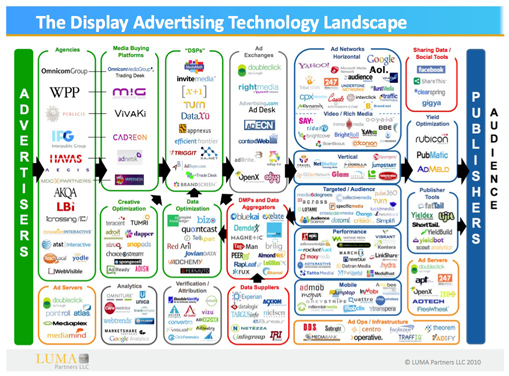
Here is my favorite view of that echo chamber, as it now stands:

It’s from , by , CEO of the investment bank . He has many other similar (and equally fascinating) graphics at Slideshare.

The least colorful part of the graphic is the word AUDIENCE, over on the right. That’s you, me, and the other 99.xx% out there who don’t click on an ad, as well as the 00.xx% who do.

What we see here is how supply tries to drive demand — and fails most of the time.

The much bigger market opportunity is in demand driving supply. That’s what we’ve been working on with , at Harvard’s , for (as of this month) the last five years.

In that time the list of VRM development projects has grown from none to dozens. They are in Santiago, Johannesburg, Vienna, New York, London, Boston, D.C., Dubuque, Santa Barbara, Salt Lake City, Montreal, San Francisco and elsewhere. In their own ways they all help Demand signal Supply, rather than the reverse. They serve the actual intentions of individual buyers, rather than the machinations of advertisers and their legion of assistants, all scheming to grab the attention of an “audience” — a delusional term that suggests a patient group, all facing a stage, ready to applaud a performance.

It’s early in the new game here. That game is Customer Intentions vs. Advertiser Guesswork. As I said in The Data Bubble, back when The Wall Street Journal launched their terrific What They Know series (about tracking users without consent),

Here’s what’s delusional about all this: There is no demand for tracking by individual customers. All the demand comes from advertisers — or from companies selling to advertisers. For now.

Here is the difference between an advertiser and an ordinary company just trying to sell stuff to customers: nothing. If a better way to sell stuff comes along — especially if customers like it better than this crap the Journal is reporting on — advertising is in trouble.

Here is the difference between an active customer who wants to buy stuff and a consumer targeted by secretive tracking bullshit: everything.

Two things are going to happen here. One is that we’ll stop putting up with it. The other is that we’ll find better ways for demand and supply to meet — ways that don’t involve tracking or the guesswork called advertising.

Improving a pain in the ass doesn’t make it a kiss. The frontier here is on the demand side, not the supply side.

Advertising may pay for lots of great stuff (such as search) that we take for granted, but advertising even at its best is guesswork. It flourishes in the absence of more efficient and direct demand-supply interactions.

The idea of making advertising perfectly personal has been a holy grail of the business since Day Alpha. Now that Day Omega is approaching, thanks to creepy shit like this, the advertsing business is going to crash up against a harsh fact: “consumers” are real people, and most real people are creeped out by this stuff.

Rough impersonal guesswork is tolerable. Totally personalized guesswork is not.

While the advertising mills keep talking to themselves, VRM development continues. As it starts to go mainstream, we’ll need a new organization, primarily for customers, rather than just for developers. We’re working on that, and expect to have it going in the next six months. So stay tuned. Meanwhile, join me in thanking the Berkman Center for giving us the runway we needed to get VRM development off the ground.

Circling Around Your Wallet

To get our heads all the way around Google+, it helps to remember Microsoft’s Hailstorm initiative from ten years ago. Think of Google+ as Hailstorm done right, or at least better. (That is, for Google.)
googlepluswallet

What Microsoft wanted with Hailstorm was less “social” than personal. (“Social” in 2001 was years away from getting buzzy.)  What Google wants with Google+ is very personal, or Google wouldn’t be so picky about the “real names” thing.

One difference from Hailstorm is that Google isn’t playing all its cards yet. Microsoft laid all theirs on the table with Hailstorm, and its identity service, Passport. What they wanted was to be the iDP, or IDentity Provider, for everybody. Is that what Google has in mind too? In 2005 John Battelle said Google was “angling to become the de facto marketplace for global commerce.” That might be a stretch, but it’s the vector that counts here, and Google+ points in that direction.

Let’s connect the dots.

  • Google’s “real names” policy (they actually say common names) for Google+ is freaking people out, sparking “nym wars“, on the other side of which are my.nameis.me, Kathy Gill, Kevin MarksSkud (who unpacks the whole thing extensively) and many others. (Here’s the latest from Kaliya.)
  • Google+ has just started. The big type on the current index page says “A quick look at the first pieces of the project.” Brad Horowitz, who runs Google+, in an interview with Tim O’Reilly (Google’s main defender at this point) says the project is “unfinished”, in “limited field trial” and not “launch ready”, meaning some people aren’t being served, and getting going for others is still “hard”. Specifically, Google+ cannot serve “tranches” of users who, for example, a) work inside enterprises that “bet their businesses on Google”, b) are minors, c) are brands, and d) wish to use pseudonyms or otherwise uncommon names. (That last group includes many early adopters of Google+ who are now being rejected.)
  • The common names policy wasn’t there for Gmail or any (or many) of Google’s many other services. Why this one? An answer came from Eric Schmidt, who told Andy Carvin that Google+ was being built “primarily as an identity service.”
  • Google has many services, none of which are truly “finished,” and some of which are just getting started. On the finished end of that spectrum is Google Checkout. At just-started end is Google+. Not out yet but announced is Google Wallet. What matters is that they can all both iterate and connect.
  • Google makes most of its money from advertising. That’s different than being an “advertising company.” Google was launched as a search company, and found a way to make money through advertising. They surely wish to diversify their income streams. One way is to support actual commercial activities, at the point of engagement between buyer and seller: to support the Intention Economy that starts with buyer volition, and not just the Attention Economy of which advertising is a part. In other words, to work where the demand chain meets the supply chain.
  • The first source of revenue in markets is customers: ones that have real names on their drivers licenses and credit cards. Pseudonyms, handles and nicknames — such as IdentityWoman, @Skud, FactoryJoe and Doc — might appear on business cards, but not on the bank- or government-issued plastic cards in those folks’ wallets.
  • To Google, Twitter and Facebook, pseudonyms, handles and nicknames are for users. Real names, or common names, are for customers. And real names tend to be what we have on our credit cards and government-issued identification cards and documents, such as drivers licenses and passports. When a seller wishes to authenticate us, that’s what they ask for.
  • Note carefully: Most users don’t pay. All customers pay: that’s what makes them customers.
  • Facebook is already the de facto iDP for perhaps hundreds of millions of people. (Pete Touchner unpacks that nicely in a slide deck, especially starting here.) The ubiquitous Facebook Connect button testifies to that. (As does Marc Zuckerberg calling the name you use in Facebook “your online identity.” But…
  • Facebook Connect lacks infrastructural legs that Google can put under the market’s table — legs like Google Checkout, Android and Google Wallet, as well as Google’s own physical network, back-end processing power and engineering knowhow, spread across many more business and technical disciplines than Facebook can pull together.

Back in May, I posted Google’s Wallet and VRM here. In it I posed eleven reasons why Google Wallet is potentially a development of profound importance. Here’s one:

Reason #9: Now you can actually relate. When a customer has the ability to shop as well as to buy, right in his or her wallet — and to put shopping in the context of the rest of his or her life, which includes far more than shopping alone — retailers can discover advantages other than discounts, coupons and other gimmicks. Maybe you’ll buy from Store B because you like the people there better, because they’re more helpful in general, because they took your advice about something, or because they help your kid’s school. Many more factors can come into play.

Such as when your circles intersect.

The earliest thrust for Google Wallet has been NFC (Near Field Communication), for doing mobile payments. From a Google post back in May:

Because Google Wallet is a mobile app, it will do more than a regular wallet ever could. You’ll be able to store your credit cards, offers, loyalty cards and gift cards, but without the bulk. When you tap to pay, your phone will also automatically redeem offers and earn loyalty points for you. Someday, even things like boarding passes, tickets, ID and keys could be stored in Google Wallet.

At first, Google Wallet will support both Citi MasterCard and a Google Prepaid Card, which you’ll be able to fund with almost any payment card. From the outset, you’ll be able to tap your phone to pay wherever MasterCard PayPass is accepted. Google Wallet will also sync your Google Offers, which you’ll be able to redeem via NFC at participating SingleTap™ merchants, or by showing the barcode as you check out. Many merchants are working to integrate their offers and loyalty programs with Google Wallet.

With Google Wallet, we’re building an open commerce ecosystem, and we’re planning to develop APIs that will enable integration with numerous partners. In the beginning, Google Wallet will be compatible with Nexus S 4G by Google, available on Sprint. Over time, we plan on expanding support to more phones.

Two months after that, in July, Google acquired punchd, “a better solution for loyalty cards”. (More here.) And now it seems that one of the first retailers with the NFC devices required at checkout is going to be Radio Shack. (Google’s list of signed-up “single tap™” partners is quite long.)

Pause now to think about supply and demand.

Most of Google’s commercial work so far has been on the market’s supply side, especially with advertising. (Nearly all their customers are sellers, not buyers.) Google Wallet, however, works on the demand side, because it goes on your phone, which lives in your pocket or your purse.

Your electronic wallet is the point of contact between your demand chain and the sellers’ supply chain. With electronic wallets, we get many new ways for these two to dance. And, therefore, many more commercial opportunities.

Wallets are also instruments of independence. (As are, say, cars.) As the Intention Economy grows (and electronic wallets will help with that), so must the things we as individual customers can do with them — and behind them, back up our demand chain, in our personal data stores. This is where we need to be the point of integration for our own data, which should include data collected by and about us.

Don’t think about how and why we should sell our data, especially to marketing’s guesswork mills (of which Google is the largest). Think about what services we might buy, to help us apply intelligence to the use of our data.

Think about new and different ways in which we might save and spend our money — ways that have nothing to do with today’s defaulted vendor-run gimmicks (loyalty cards, “sales,” coupons, “rewards”…) meant to trap us, herd us and shake us down for more money. Think about having more control over how, why, and where we spend (or actually save — as in a bank) our money. That’s what we start to see when we think about electronic Wallets beyond the near horizons of point-of-sale connections and better come-ons from sellers. That’s what Google will start to see when they start talking with us, and not just with big companies looking for more and better ways to sell.

If our electronic wallets are to become instruments of independence, we need a choice of interchangeable ones that work the same with every seller — much as we have a choice of cars that work the same way with every driveway, highway, gas station and parking lot. This means Google’s can’t be the only wallet. (I’m sure they know and welcome that.)

Presumably, Google Wallet will be open source. In fact, that would be a good way to fight Isisa new competitor to Google Wallet, funded by AT&T, Verizon and T-Mobile — and whatever Apple comes up with if it wishes to fight Google Wallet and/or Isis. Says Mashable (at that last link), “Isis was born last year, and aside from allowing mobile payments, it’ll also give you the ability to redeem coupons via their mobile payment service. It’s planned to debut in several unnamed major cities next year and will monetize by charging marketers a fee for sending offers to consumers’ phones.”

Earth to Big Boys: We’ll pay for value, including services that make our wallets serve us, and not just the marketing mills of the world.

When we have full independence, we will also have the ability to engage as equals in agreements and contracts. The legal dance online will need to resemble the legal dance offline, which is in the background. In the same way that we don’t need to “accept” a written “agreement” to enter and shop at most stores in the physical world, we shouldn’t need to do the same online. We should be able to bring agreeable terms with us, match them with those of sellers, electronically, without the intervention of lawyers or forms to sign, and do business. In other words, freedom of contract needs to obsolete contracts of adhesion, and the calf-cow system of asymmetrical non-relationships we’ve had online since the dawn of the cookie.

Listening to Brad Horowitz talk with Tim O’Reilly, I sense that Google is also tired of the old cookie-based paradigm of e-commerce. Helping make the customer independent, starting with his or her own wallet, is a great way to start breaking that paradigm.

The problem, as Google is discovering though the “nym wars”, is identity. People take that one personally.

To get a better angle on the issue, let’s look more closely at Microsoft’s Hailstorm. Here’s what I wrote about it at the time. Here’s a much longer piece by Clay Shirky, also from back then.

Microsoft saw Hailstorm as (among other things) a way to compete with AOL, which was the Facebook of its time. Hailstorm’s main feature was Passport: a then-new single-sign-on authentication service. The idea was to have Passport login buttons appear everywhere, like Facebook buttons do now (though far less securely than Passport, which didn’t spill your social guts by default). Such buttons provided Single Sign-On, or SSO.

Joe Wilcox’ unpacked Hailstorm and Passport in March 2001 for CNET. An excerpt:

HailStorm is a group of services, using Microsoft’s Passport authentication technology, meant to provide secure access to e-mail, address lists and other personal data from virtually anywhere via PCs, cell phones and PDAs (personal digital assistants). The catch? Users of the services will be required to pay a fee to use them. Analysts said that if the HailStorm model is widely adopted–and if people will pay a premium for security–the days of ad-subsidized Internet services, such as free e-mail and messaging, may be over.

“HailStorm is absolutely the test of can you make money on the Web,” saidGartner analyst Chris LeTocq. “But to get there, you have to offer people something they are willing to pay for. That will be the test for Microsoft.”

Microsoft executives are confident that the time is right for HailStorm. “There’s been a lot of stuff (on the Internet) in the last couple of years that was free and interesting, but people weren’t actually willing to pay for it,” said Charles Fitzgerald, director of business development in Microsoft’s platform strategy group. “We want to pursue a model that lets us deliver a lot more value in an economic fashion so that we all can get paid every two weeks like we’re used to.”

One big difference: Google isn’t looking to make money with fees here. In fact they say clearly that they are not. But Google is looking to make money their old-fashioned way, which is with “second and third order effects” that will manifest in due time.

Here’s what’s the same: Passport was an identity service. Which Eric Schmidt says Google+ is now.

Microsoft failed because they thought their platform (Window plus .Net) was bigger than the Net and the Web. (In the now-gone Hailstorm white paper, they talked about “moving the Web” in a new direction.) Google knows better.

Still, the game is the same. That game is turning users into customers.

In competitive terms, Facebook and Google will both have users. But Google will have the customers — even if they’re not customers of Google’s services directly. Google will be helping customers use their wallets, while Facebook will be stuck at SSO.

But Google vs. Facebook, or anybody vs. anybody, is the wrong way to look at the market opportunities opening up in the Intention Economy. Because the Intention Economy isn’t a supply-side game. It’s a demand-side game. The slate is fresh, but not blank. Two groups are already there:

  1. VRM developers, working to equip customers with tools of both independence and engagement. (Automobiles, rather than seats on railroad cars.)
  2. Fourth parties, working on behalf of customers, helping them build out their personal demand chains. These can include any service company an individual employs — that is, pays, to help work with the third and second parties of the world (numbered from the customer perspective). We’re talking here about banks, insurance companies and anything called an agency, plus all the new companies coming into the personal services and personal data store businesses. These might include parties the individual doesn’t pay, but that clearly are in business mainly to help individuals (first parties) rather than second and third parties. That qualifies Google, should they wish to join.

There is a lot happening with VRM here that we’re not ready to talk about yet. (No, none of it involves Google Wallet, at least not yet.) But demand chain (Craig Burton‘s term) hints strongly at where we’re going.

Investors take note.

Newer posts »

© 2026 ProjectVRM

Theme by Anders NorenUp ↑