Category: Customer Commons (Page 1 of 2)

The Cluetrain Will Run from Customers to Companies

For the good of both.

Customers need privacy, respect, and the ability to provide good and helpful information to the companies they deal with. The good clues customers bring can include far more than what companies get today from their CRM systems and from surveillance of customer activities. For example, market intelligence that flows both ways can happen on a massive scale.

But only if customers set the terms.

Now they can, using a new standard from the IEEE called P7012, aka MyTerms. It governs machine readability of personal privacy terms. These are terms that customers proffer as first parties, and companies agree to as second parties. Lots of business can be built on top of those terms, which at the ground level start with service provision without surveillance or unwanted data sharing by the company with other parties. New agreements can be made on top of that, but MyTerms are where genuine and trusting (rather than today’s coerced and one-sided) relationships can be built.

When companies are open to MyTerms agreements, they don’t need cookie notices. Nor do they need 10,000-word terms and conditions or privacy policies because they’ll have contractual agreements with customers that work for both sides.

On top of that foundation, real relationships can be built by VRM systems on the customers’ side and CRM systems on the corporate side. Both can also use AI agents: personal AI for customers and corporate AI for companies. Massive businesses can grow to supply tools and services on both sides of those new relationships. These are businesses that can only grow atop agreements that customers bring to the table, and at scale across all the companies they engage.

This is the kind of thing that four guys (me included)† had in mind when they posted The Cluetrain Manifesto* on the Web in April 1999. A book version of the manifesto came out in early 2000 and became a business bestseller that still sells in nine languages. Above the manifesto’s 95 theses is this master clue**, written by Christopher Locke:

MyTerms is the only way we (who are not seats or eyeballs or end users or consumers) finally have reach that exceeds corporate grasp, so companies can finally deal with the kind of personal agency that the Internet promised in the first place.

The MyTerms standard requires that a roster of possible agreements be posted at a disinterested nonprofit.  The individual chooses one, the company agrees to it (or not). Both sides keep an identical record of the agreement.

The first roster will be at Customer Commons, which is ProjectVRM’s 501(c)3 nonprofit spinoff. It was created to do for personal privacy terms what Creative Commons does for personal copyright licenses. (It was Customer Commons, aka CuCo, that the IEEE approached with the idea of creating the MyTerms standard.)

Work on MyTerms started in 2017 and is in the final stages of IEEE approval process. While it is due to be published early next year, what it specifies is simple:

  • Individuals can choose a term posted at Customer Commons or the equivalent
  • Companies can agree to the individual’s choice or not
  • The decision can be recorded identically by both sides
  • Data about the decision can be recorded by both sides and kept for further reference, auditing, or dispute resolution
  • Both sides can know and display the state of agreement or absence of agreement (for example, the state of a relationship, should one come to exist)

MyTerms not a technical spec, so implementations are open to whatever. Development on any of those can start now. So can work in any of the six areas listed above.

The biggest thing MyTerms does for customers—and people just using free services—is getting rid of cookie notices, which are massively annoying and not worth the pixels they are printed on.  If a company really does care about personal privacy, it’ll respect personal privacy requirements. This is how things work in the natural world, where tracking people like marked animals has been morally wrong for millennia. In the digital world, however, agreements need to be explicit, so programming and services can be based on them. MyTerms does that.

For business, MyTerms has lots of advantages:

  • Reduced or eliminated compliance risk
  • Competitive differentiation
  • Lower customer churn
  • Grounds for real rather than coerced relationships (CRM+VRM)
  • Grounds for better signaling (clues!) going in both directions
  • Reduced or eliminated guesswork about what customers want, how they use products and services, and  how both might be improved

Lawyers get a new market for services on both the buy and sell sides of the marketplace. Companies in the CMP (consent management platform) business (e.g. Admiral and OneTrust) have something new and better to sell.

Lawmakers and Regulators can start looking at the Net and the Web as places where freedom of contract prevails, and contracts of adhesion (such as what you “agree” to with cookie notices) are obsolesced.

Developers can have a field day (or decade). Look for these categories to emerge

  • Agreement Management Platforms – Migrate from today’s much-hated consent management platforms (hello OneTrust, Admiral, and the rest).
  • Vendor Relationship Management (VRM) Tools and services – Fill the vacuum that’s been there since the Web got real in 1995.
  • Customer Relationship Management (CRM) – Make its middle name finally mean something.
  • Customer Data Return (CDR) – Give, sell back, or share with customers the data you’ve been gathering without their permission since forever. Talking here to car companies, TV makers, app makers, and every other technology product with spyware onboard for reporting personal activity to parties unknown.
  • Platform Relief –  Free customers from the walled gardens of Apple, Microsoft, Amazon, and every other maker of hardware and software that currently bears the full burden of providing personal privacy to customers and users. Those companies can also embrace and help implement MyTerms for both sides of the marketplace.
  • Personal AI (pAI)– Till and plant a vast new greenfield for countless companies, old and new. This includes Apple (which can make Apple Intelligence truly “AI for the rest of us” rather than Siri in AI drag), Mozilla (with its Business Accelerator for personal AI) , Kwaai (for open source personal AI), and everyone else who wants to jump on the train.
  • Big meshes of agents, such as what these developers are all working on.

In the marketplace, we can start to see all these things:

  • Predictions made by The Intention Economy: When Customers Take Charge finally come true.
  • New dances between customers and companies, demand and supply. (“The Dance” is a closing chapter of The Intention Economy.)
  • New commercial ecosystems can grow around a richer flow of clues in both directions, based on shared interest and trust between demand and supply.
  • Surveillance capitalism will be obsolesced — and replaced by an economy aligned with personal agency and respect from customers’ corporate partners.
  • A new distributed P2P fabric of personally secure and shared data processing and storage — See what KwaaiNet + Verida, for example, might do together.

All aboard!


†Speaking for myself in this post. I invite the other two surviving co-authors to weigh in if they like.

*At this writing, the Cluetrain website, along with many others at its host, is offline while being cured of an infection.  To be clear, however, it will be back on the Web. Meanwhile, I’m linking to a snapshot of the site in the Internet Archive—a service for which the world should be massively grateful.

**The thesis that did the most to popularize Cluetrain was “Markets are conversations,” which was at the top of Cluetrain’s ninety-five theses. Imagining that this thesis was just for them, marketers everywhere saw marketing, rather than markets, as “conversations.” Besides misunderstanding what Cluetrain meant by conversation (that customers and companies should both have equal and reciprocal agency, and engage in human ways), marketing gave us “conversational” versions of itself that were mostly annoying.  And now (thank you, marketing), every damn topic is now also a fucking “conversation”—the “climate conversation,” the “gender conversation,” the “conversation about data ownership.” I suspect that making “conversation” a synonym for “topic” was also a step toward making every piece of propaganda into a “narrative.” But I digress. Stop reading here and scroll back to read the case for MyTerms. And please, hope that it also doesn’t become woefully misunderstood.

Four Roads to The Intention Economy

Thirteen years after The Intention Economy was published by Harvard Business Review Press, there are now four clear paths toward making it come true.

  1. IEEE P7012, aka MyTerms. This will make individuals first parties in their agreements with companies, completely flipping the status quo that has been with us since industry won the Industrial Revolution and manifests today in those insincere and annoying cookie notices that interrupt your experience every time you visit a new website or open a new app. MyTerms makes each of us first parties in agreements with sites and services, and in full charge of personal privacy online.
  2. The First Person Project, or FPP  (website pending). With help on the buy side from Customer Commons and on the sell side by Ayra, we can finally replace “show your ID” with verifiable credentials presented on an as-needed basis by independent and self-sovereign individuals operating inside their own webs of trust.
  3. Visa Intelligent Commerce, which will make intentcasting happen in a big way. It will also elevate the roles of Inrupt and the open-source  Solid Project.
  4. Personal AI. This is AI that is as much yours as your shoes, your bike, and your PC. Personal, not personalized.

To explain how these will work together, start here:

Not long after The Intention Economy came out in May, 2012, Robert Thomson, Managing Editor of The Wall Street Journal, wanted the book’s opening chapter to serve as the cover essay for the Marketplace section of an upcoming issue. Harvard Business Review Press didn’t like that idea, so I wrote an original piece based on one idea in the book: that shoppers will soon be able to tell the market what they’re looking for, in safe, secure and anonymous ways—a kind of advertising in reverse that the book called “personal RFPs” and has since come to be called “intentcasting.” This became The Customer as a God: The image above was the whole cover of the Marketplace section on Monday,  July 23, 2012. The essay opened with these prophetic words: “It’s a Saturday morning in 2022…”

It is now a Friday morning in 2025, and that godly future for customers is still not here. Yes, we have more market power than in 2012, but we are digital serfs whose powers are limited to those granted by  Amazon, Apple, Facebook, Google, Microsoft, and other feudal overlords. This system is a free market only to the degree that you can choose your captor.  This has led to—

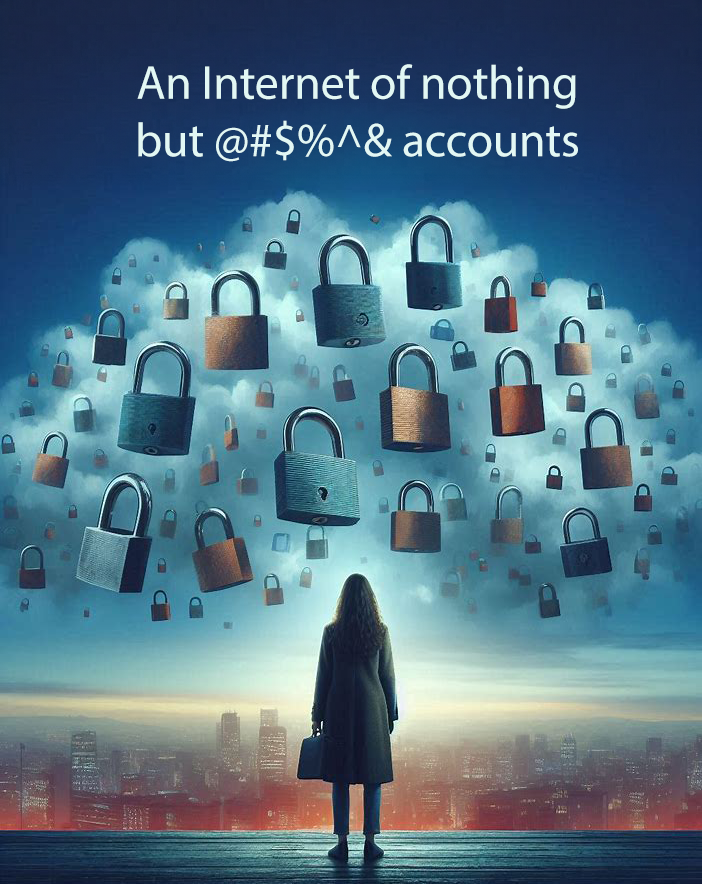
The IONBA (Internet Of Notning But Accounts) is based on a premise: that the best customers are captive ones. In this relic of the industrial age, customers are captive to every entity that requires logins and passwords. Customers also have no ways of their own to globally control what data is collected about them, or how. Or to limit how that data is used.  This is why our digital lives are infected by privacy-killing data-collection viruses living inside our computers, phones, TVs, and cars.

If you didn’t know about those last two, dig:

  • Consumer Reports says “All smart TVs—from Samsung, LG, you name it—collect personal data.” They also come with lame “privacy” controls, typically buried deep in a settings menu. (Good luck exhuming them. The ones in our TCL and Samsung TVs have all but disappeared.)
  • Mozilla calls new cars “the Worst Product Category We Have Ever Reviewed for Privacy.” There is also nothing you can do to stop your car from reporting on everything your car does—and everything you do, including sexual ativity—to the carmaker, insurance companies, law enforcement, and who knows who else. This data goes out through your car’s cell phone, misleadingly called a telematics control unit. The antenna is hidden in the shark fin on your car’s roof or in an outside mirror.

Businesses are also starting to lose faith in surveillance, for at least eight reasons:

  1. People hate it.
  2. They also fight it. By 2015 ad blocking and tracking protection were the biggest boycott in world history.
  3. It tarnishes brands.
  4. Ad fraud is a gigantic problem, and built into the system.
  5. It commits Chrysoogocide (killing golden geese, most notably publishers)Bonus link.
  6. Regulatory pressure against it is getting bigger all the time.
  7. Advertisers are finally remembering that brands are made by ads aimed at populations, while personalized ads are just digital junk mail.
  8. Customers are using AI tools for guidance toward a final purchase, bypassing marketing schemes to bias purchasing decisions along the way. For more on that, see Tom Fishburne’s cartoon, and Bain’s report about it.

So our four roads to The Intention Economy start with the final failings of the systems built to prevent it. Now let’s look at those roads.

1—IEEE P7012 “MyTerms”

MyTerms, the most important standard in development today, will be a keystone service of Customer Commons, the nonprofit spinoff of ProjectVRM. It will do for contract what Creative Commons did for copyright: give individuals a new form of control. With MyTerms, agreements between customers and companies will be far more genuine mutual, and open to new forms of innovation not based on the kind of corporate control that typifies the IONBA. For example, it can open Visa Intelligent Commerce to conversations and relationships that go far past transaction. Take for example Market intelligence that flows both ways. While this has been thinkable for a decade or more (that last link is from 2016), it’s far more do-able when customers and companies have real relationships based on equal power and mutual interests. These are best framed up on agreements that start on the customer’s side, and give customers scale across all the companies with which they have genuine relationships.

2—First Person Project (FPP)

To me, FPP begins with the vision “Big Davy” Sallis came up with while he was working for VISA Europe in 2012, and read the The Intention Economy. At the time, he wanted Visa to make VRM a real category, but assumed that would take too long. So he decided to create a VRM startup called Qredo. Joyce and I consulted Qredo until  Davy died (far too young) in 2015. Qredo went into a different business, but a draft I created for Qredo’s original website survives, and it outlines much of what the  FPP will make possible. That effort is led by Drummond Reed, another friend and collaborator of Davy’s and a participant in ProjectVRM from the start. Drummond says the FPP is inspired by Why We Need First Person Technologies on the Net, a post published here in 2014. That post begins,

We need first person technologies for the same reason we need first person voices: because there are some things only a person can say and do.

Only a person can use the pronouns  “I,” “me,” “my” and “mine.” Likewise, only a person can use tools such as screwdrivers, eyeglasses and pencils. Those things are all first person technologies. They were invented for individual persons to use.

We use first person technologies the same unique ways we use our voices.

Among other things, the First Person Project will fix how identity works on the Internet. With FPI—First Person Identity—interactions with relying parties (the ones wanting “your ID”) don’t need your drivers license, passport, birth certificate, credit card, or account information. You just give them what’s required, on an as-needed basis, in the form of verifiable credentials. The credentials you provide can verify that you are a citizen of a country, licensed to drive, have a ticket to a game, or whatever. In other words, they do what Kim Cameron outlined in his Laws of Identity: disclose minimum information for constrained uses (Law 2) to justifiable parties (Law 3) under your control and consent (Law 1). The credential you present is called a DID: a Decentralized Identifier. No account is required.

Trust in FPI also expands from individual to community. Here is how Phil Windley explains it in Establishing First Person Digital Trust:

When Alice and Bob met at IIW, they didn’t rely on a platform to create their connection. They didn’t upload keys to a server or wait for some central authority to vouch for them. They exchanged DIDs, authenticated each other directly, and established a secure, private communication channel.

That moment wasn’t just a technical handshake—it was a statement of first-person identity. Alice told Bob, “This is who I am, on my terms.” Bob responded in kind. And when they each issued a verifiable relationship credential, they gave that relationship form: a mutual, portable, cryptographically signed artifact of trust. This is the essence of first-person identity—not something granted by an institution, but something expressed and constructed in the context of relationships. It’s identity as narrative, not authority; as connection, not classification.

And because these credentials are issued peer-to-peer, scoped to real interactions, and managed by personal agents, they resist commodification and exploitation. They are not profile pages or social graphs owned by a company to be monetized. They are artifacts of human connection, held and controlled by the people who made them. In this world, Alice and Bob aren’t just users—they’re participants.

This also expands outward into community, and webs of trust. You get personal agency plus community agency.

The FPP covers a lot more ground than identity alone, but that’s where it starts. Also, Customer Commons is a funding source for the FPP, and I’m involved there as well.

3—Visa Intelligent Commerce

The press release is Find and Buy with AI: Visa Unveils New Era of Commerce. Less blah is Enabling AI agents to buy securely and seamlessly. Here’s the opening copy.

Imagine a future where an AI agent can shop and buy for you. AI commerce — commerce powered by an AI agent — is going to transform the way consumers around the world shop.

Introducing Visa Intelligent Commerce, an initiative that will empower AI agents to deliver personalized and secure shopping experiences for consumers – at scale.

From browsing and selection to purchase and post-purchase management, this program will equip AI agents to seamlessly manage key phases of the shopping process.

Visa CEO Ryan McInerney says a lot more in a 1:22 talk at Visa Product Drop 2025. The most relevant part starts about 26 minutes in, with a demo starting at about 31:30. Please watch it. Much of what you see there owes to Inrupt and Solid, which Sir Tim Berners-Lee says were inspired by The Intention Economy. For more about where Inrupt and Solid fit in Visa Intelligent Commerce, see Standards for Agentic Commerce: Visa’s Bold Move and What It Means: Visa’s investment in safe Intelligent Commerce points to a future of standards-forward personal AI, by John Bruce, Inrupt’s CEO. John briefed Joyce and me over Zoom the other day. Very encouraging, with lots to develop on and talk about.

More links:

Some news being made about Visa Intelligent Commerce:

4—Personal AI

Reza Rassool was also inspired by The Intention Economy when he started Kwaai.ai, a nonprofit community developing open-source personal AI. I now serve Kwaai as its volunteer Chief Intention Officer.

Let’s look at what personal AI will do for this woman:

Looks great, but we’re stuck in IONBA, she has little control over her personal data in all those spaces. For example,

  • She doesn’t have the digital version of what George Carlin called “a place for my stuff.” (Watch that video. It’s brilliant—and correct.)
  • She has few records of where she’s been, who she’s been with and when—even though apps on her phone know that stuff and are keeping it inside the records of her giant overlords and/or selling it to parties unknown, with no way yet for getting it back for her own use.
  • Her finances are possibly organized, but scattered between the folders she keeps for taxes, plus the ones that live with banks, brokers, and other entities she hardly thinks about. It would be mighty handy to have a place of her own where she could easily see all her obligations, recurring payments, subscriptions, and other stuff her counterparties would rather she not know completely.
  • Her schedules are in Apple, Google, and/or Microsoft calendars, which are well app’d and searchable, but not integrated. She has no digital calendar that is independent and truly her own.
  • Her business and personal relationship records are scattered across her contact apps, her Linkedin page, and piles of notes and business cards. She has no place or way of her own to manage all of them.
  • Her health care records (at least here in the U.S.) are a total mess. Some of them ares inside the MyCharts and patient portals provided by separate (and mostly unconnected) health care specialists and medical systems. Some of it is in piles of printouts she has accumulated (if she’s kept them) from all the different providers she has seen. Some of it is in fitness and wellness apps, all with exclusive ways of dealing with users. None of it is in a unified and coherent form.

So the challenge for personal AI is pulling all that data out of all her accounts, and putting it into forms that give her full agency, with the help of her personal AIs.  Personalized AIs from giants can’t do that. We need our own personal AIs.

And there we have it: Four roads to a world where free customers prove more valuable than captive ones. And we’re making it happen. Now.

ESC

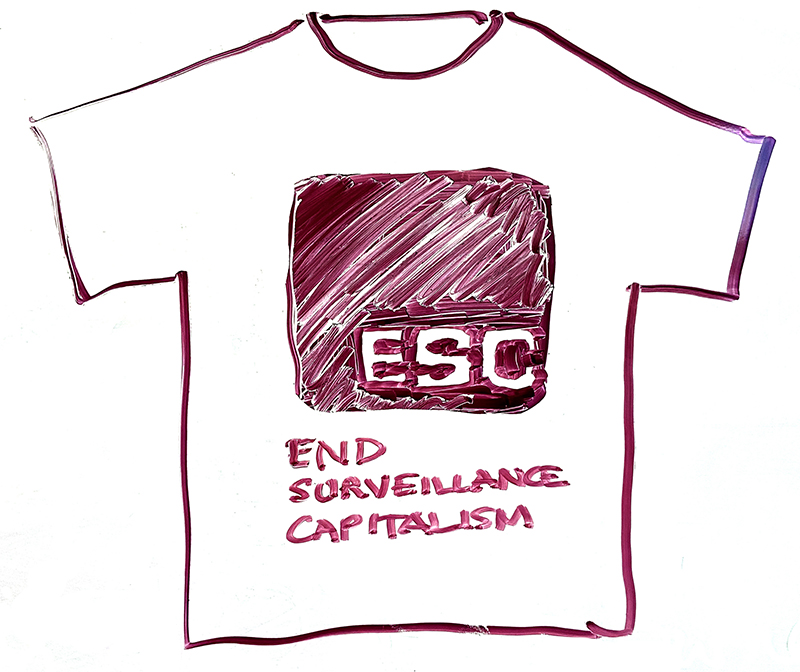
ESC t-shirt

VRM Day had an extraordinary outcome this time: a movement to end surveillance capitalism.

The movement began with a talk by Roger McNamee titled Saving us from Big Tech: the Gen Z Solution. It was the latest in the Ostrom Workshop‘s Beyond the Web salon series, which on this occasion took place live and in person simultaneously in the Computer History Museum‘s Boole room and on the Web via Owl and Zoom, through the Workshop at Indiana University, where people also participated in a room and virtually. You can see the first hour of the talk here.

The conversation with Roger was super-energized, continued well past the scheduled hour, and onward through breakout sessions on each of the three days that followed at the Museum during IIW, and since then on Signal and Zoom. The conversation informally called itself “Roger and We,” and it vectored toward what it says on the t-shirt design above, drawn on a whiteboard during the third of the IIW sessions: End Surveillance Capitalism or ESC. (Also implying ESCape). One of us at the session created this graphic—

—and used it to create this t-shirt at Zazzle.com:

He’s bought a number of them, so far, because when he wore the first to Thanksgiving dinner, other people there also wanted one. In the spirit of freedom and openness, please feel free to use the same graphic (which, if you drag it off, is quite large ), or something like it, to make one or more of your own. Or run with it any way you please. Movements work that way.

This is where I pause and thank Shoshana Zuboff for making surveillance capitalism a full-sized Thing. Also to Brett Frishcmann and Evan Sellinger for explaining what it does to all of us, personally.

Where this goes is up to the group, which is small, growing, and gathering weekly in virtual space while corresponding asynchronously as well. It’s still small but growing.

To succeed, its fire needs to be so large and hot that profiting by tracking people will fail because neither people nor regulators will put up with it. It is also sobering to know that similar efforts to end surveillance capitalism have faltered in the past (which is still now), in spite of the simple fact that spying on people without their clear invitation (not mere “consent”) or a court order is wrong on its face, regardless of the purposes to which that spying is put.

We talked about lots of other stuff during VRM Day, of course. For example, Don Marti led a session on the W3C’s Private Advertising Technology Community Group, which he encouraged everyone in the room to join. (Please do.)

But the main outcome was ESC.

Now, some background for those not familiar with ProjectVRM.

From its start at the Berkman Klein Center in 2006, ProjectVRM has had (says here) “the immodest ambition of turning business on its head — for its own good, and for everyone else’s as well.” Perhaps ESC will be the thing to do that, after sixteen years of encouraging countless other efforts, some of which are listed here. (There is no easy way to keep up with all of them.)

If you’re interested in joining this cabal, write to me (the email is doc @ my last name dot com). You can also follow along on the ProjectVRM mailing list.


The Rise of Robot Retail

end of personal dealings
From Here Comes the Full Amazonification of Whole Foods, by Cecelia Kang (@CeceliaKang) in The New York Times:

…In less than a minute, I scanned both hands on a kiosk and linked them to my Amazon account. Then I hovered my right palm over the turnstile reader to enter the nation’s most technologically sophisticated grocery store…

Amazon designed my local grocer to be almost completely run by tracking and robotic tools for the first time.

The technology, known as Just Walk Out, consists of hundreds of cameras with a god’s-eye view of customers. Sensors are placed under each apple, carton of oatmeal and boule of multigrain bread. Behind the scenes, deep-learning software analyzes the shopping activity to detect patterns and increase the accuracy of its charges.

The technology is comparable to what’s in driverless cars. It identifies when we lift a product from a shelf, freezer or produce bin; automatically itemizes the goods; and charges us when we leave the store. Anyone with an Amazon account, not just Prime members, can shop this way and skip a cash register since the bill shows up in our Amazon account.

And this is just Amazon. Soon it will be every major vendor of everything, most likely with Amazon as the alpha sphincter among all the chokepoints controlled by robotic intermediaries between first sources and final customers—with all of them customizing your choices, your prices, and whatever else it takes to engineer demand in the marketplace—algorithmically, robotically, and most of all, personally.

Some of us will like it, because it’ll be smooth, easy and relatively cheap. It will also subordinate us utterly to machines. Or perhaps udderly, because we will be calves raised to suckle on the teats of retail’s robot cows.

This system can’t be fixed from within. Nor can it be fixed by regulation, though some of that might help. It can only be obsolesced by customers who bring more to the market’s table than cash, credit, appetites and acquiescence to systematic training.

What more?

Start with information. What do we actually want (including, crucially, to not be bothered by hype or manipulated by surveillance systems)?

Add intelligence. What do we know about products, markets, needs, and how things actually work than roboticized systems can begin to guess at?

Then add values, such as freedom, choice, agency, care for others, and the ability to collectivize in constructive and helpful ways on our own.

Then add tech. But this has to be our tech: customertech that we bring to market as independent, sovereign and capable human beings. Not just as “users” of others’ systems, or consumers (which Jerry Michalski calls “gullets with wallets and eyeballs”) of whatever producers want to feed us.

Time for solutions. Here is a list of fourteen market problems that can only be solved from the customers’ side.

And yes, we do need help from the sellers’ side. But not with promises to make their systems more “customer centric.” (We’ve been flagging that as a fail since 2008.) We need CRM that welcomes VRM. B2C that welcomes Me2B.

And money. Our startups and nonprofits have done an amazing job of keeping the VRM and Me2B embers burning. But they could do a lot more with some gas on those things.

Homeless on the Web

Do you have a home on the Web?

I mean a page or a site that is yours. Not one that belongs to some .com, .org or .edu. One that’s truly yours, with a name you gave to it, nobody else has, and you fully inhabit.

Some of us do. I’m one of those, but with nothing to brag about. Go to searls.com and you’ll find a placeholder I’ve been updating every couple of years since the mid-’90s.  Behind that façade is a garage full of files I keep stored online but blocked from search engines. That’s so I can find them from anywhere, or so I can point other people to them every once in a while.

Like the rest of us, most of what I’ve done on the Web are on the sites that belong others. The goods in those sites are mine in the sense that I’ve created them. But where they are is not mine. Not in the least.

Nearly all the pages called “home” are those of what in the trade we call enterprises. Mine here is in an enterprise called Harvard University. I thank it for that grace.

Still, in a literal sense, most of us are homeless here. In a literal way maybe all of us are, because we don’t own our domain names. We rent them. Searls.com will exist only so long as I, or my heirs, continue paying to keep it active.

This isn’t a bad thing. Hell, the benefits of the Web are enormous in the extreme. I’m not knocking those.

I am, however, saying we are homeless. Here.

Yet there is nothing about the Internet that says you can’t have a home there—which is a deeper here, underneath the Web.

This is important because we need to clearly and finally make a sharp distinction between the Web and the Internet. Because they are not the same. The Internet is what the Web sits on. And, big and broad as it is, the Web is not the only thing that can sit on the Internet. This was true for Web as it was in the first place,  for what we called Web 2 in the early ’00s, and for what we call Web 3 today.

The Internet is different.  And there are few limits to what the Internet can support, much as there are few limits to what can be built on land or float on ocean.

But there are limits to what we can build on the Web. One of those is a home for ourselves. A real home. One that does not require renting a domain name. One that lets us zero-base what we can do upon the infinite grace granted us by simply connecting to a worldwide network of networks that exists only to move packets of data from any end to any other end.

So let’s start thinking about that.

Some of us (present company included) are on the case already. We need more.

While we ponder that, here’s a thought: Maybe one reason VRM has been slow to happen is that we’ve been trying to do it on the Web.


The photo above is on Love Ranch Road, in the center of Wyoming. The story of the ranch, and the home now abandoned there, is central to John McPhee’s Rising from the Plains. I was there to shoot the solar eclipse of August 2017, which was at its totality there. The darkness on the horizon is the shadow of the moon, approaching from the west.

Beyond the Web

The Cluetrain Manifesto said this…

not

…in 1999.

And now, in 2021, it’s still not true—at least not on the Web.

If it was true, California’s CCPA wouldn’t call us mere “consumers” and Europe’s GDPR  wouldn’t call us mere “data subjects,” whose privacy is entirely at the grace of corporate “data processors” and “data controllers.” (While the GDPR does say a “natural person” can be either of those, the prevailing assumption says no. Worse, it assumes that what privacies we enjoy on the Web should be valved by choices we make when confronted with “consent” notices that pop up when we first visit a website, and which are recorded somewhere we don’t know and can’t audit or dispute.)

Simply put, we are not free, and our reach does not exceed their grasp. Again, on the Web.

But (this is key), the Web is not the Internet. It’s a haystack of stuff on the Net. It’s a big one, and hugely good in many ways. And maybe we can be really free there eventually. But why not work outside of it? That’s the question.

And that’s what some of us are answering. You might call what we’re doing a blue ocean strategy:

For example, Joyce and I are now in Bloomington, Indiana, embedded as visiting scholars at Indiana University’s Ostrom Workshop, where we are rolling out a new project called the Byway, for Customer Commons, ProjectVRM’s nonprofit spin-off. We will also be working with local communities of interest here in Bloomington. Stay tuned for more on that.

To find out more about what we’re up to—or just to discuss whatever seems relevant—please come to our first Beyond the Web salon, by Zoom, on Monday at 3pm Eastern time. The full link: https://events.iu.edu/ostromworkshop/event/264653-ostrom-salon-series-beyond-the-web

ProjectVRM at 15

This project started in September 2006, when I became a fellow at what is now the Berkman Klein Center. Our ambitions were not small.:

  1. To encourage development of tools by which individuals can take control of their relationships with organizations — especially in commercial marketplaces.
  2. To encourage and conduct research on VRM-related theories, usage of VRM tools, and effects as adoption of VRM tools takes place.

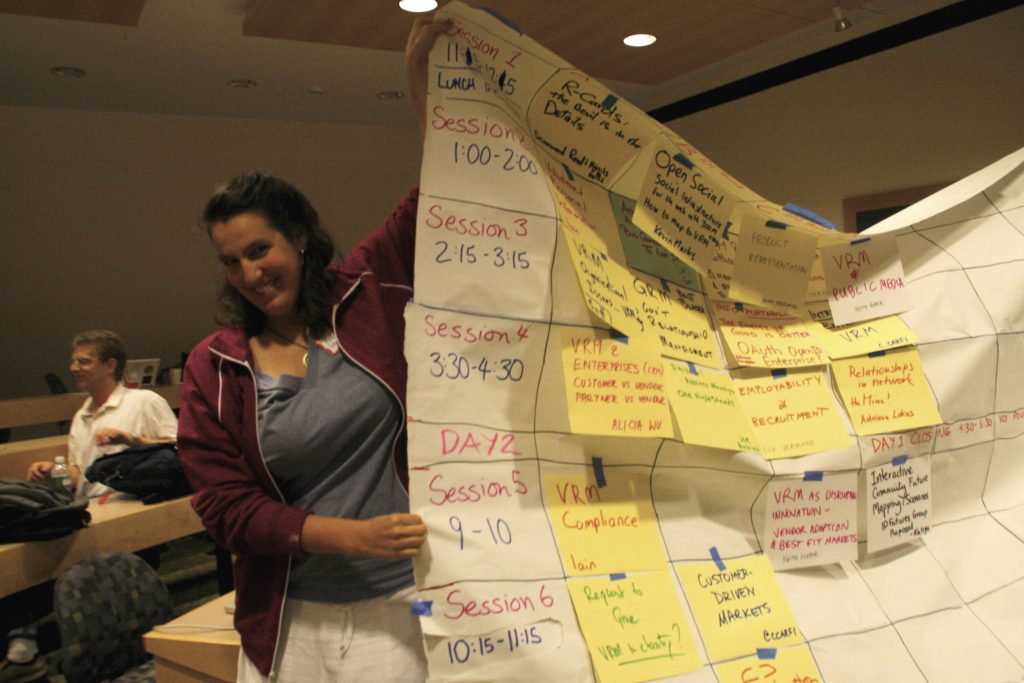
The photo above is of our first workshop, at Harvard Law School, in 2008. Here is another photo with a collection of topics discussed in breakout sessions:

Zoom in on any of the topics there (more are visible on the next photo in the album), and you will find many of them still on the table, thirteen years later. Had some prophet told us then that this would still be the case, we might have been discouraged. But progress has been made on all those fronts, and the main learning in the meantime is that every highly ambitious grassroots movement takes time to bear fruit.

One example is what we discussed in the “my red dot” breakout at the May 2007 Internet Identity Workshop (the 3rd of what next week will be our 33rd ) is now finally being done with the Byway, which is about to get prototyped by our nonprofit spin-off, Customer Commons, with help from the Ostrom Workshop at Indiana University Bloomington, where Joyce and I are currently embedded as visiting scholars.

Our mailing list numbers 567 members, and is active, though it won’t hog your email flow. Check out the action at that link. And, if you like, join in.

You can also join in at our next gathering, VRM Day 2021b, which happens this coming Monday, 11 October.  We’ll visit our learnings thus far, and present progress and plans on many fronts, including

And we thank the BKC for its patience and faith in our project and its work.

How the Web sucks

This spectrum of emojis is a map of the Web’s main occupants (the middle three) and outliers (the two on the flanks). It provides a way of examining who is involved, where regulation fits, and where money gets invested and made. Yes, it’s overly broad, but I think it’s helpful in understanding where things went wrong and why. So let’s start.

Wizards are tech experts who likely run their own servers and keep private by isolating themselves and communicating with crypto. They enjoy the highest degrees of privacy possible on and around the Web, and their approach to evangelizing their methods is to say “do as I do” (which most of us, being Muggles, don’t). Relatively speaking, not much money gets made by or invested in Wizards, but much money gets made because of Wizards’ inventions. Those inventions include the Internet, the Web, free and open source software, and much more. Without Wizards, little of what we enjoy in the digital world today would be possible. However, it’s hard to migrate their methods into the muggle population.

‍Muggles are the non-Wizards who surf the Web and live much of their digital lives there, using Web-based services on mobile apps and browsers on computers. Most of the money flowing into the webbed economy comes from Muggles. Still, there is little investment in providing Muggles with tools for operating or engaging independently and at scale across the websites and services of the world. Browsers and email clients are about it, and the most popular of those (Chrome, Safari, Edge) are by the grace of corporate giants. Almost everything Muggles do on the Web and mobile devices is on apps and tools that are what the trade calls silos or walled gardens: private spaces run by the websites and services of the world.

Sites. This category also includes clouds and the machinery of e-commerce. These are at the heart of the Web: a client-server (aka calf-cow) top-down, master-slave environment where servers rule and clients obey. It is in this category that most of the money on the Web (and e-commerce in general) gets made, and into which most investment money flows. It is also here that nearly all development n the connected world today happens.

 Ad-tech, aka adtech, is the home of surveillance capitalism, which relies on advertisers and their agents knowing all that can be known about every Muggle. This business also relies on absent Muggle agency, and uses that absence as an excuse for abusing the privilege of committing privacy violations that would be rude or criminal in the natural world. Also involved in this systematic compromise are adtech’s dependents in the websites and Web services of the world, which are typically employed by adtech to inject tracking beacons in Muggles’ browsers and apps. It is to the overlap between adtech and sites that all privacy regulation is addressed. This is why, the GDPR sees Muggles as mere “data subjects,” and assigns responsibility for Muggle’s privacy to websites and services the regulation calls “data controllers” and “data processors.” The regulation barely imagines that Muggles could perform either of those roles, even though personal computing was invented so every person can do both. (By the way, the adtech business and many of its dependents in publishing like to say the Web is free because advertising pays for it. But the Web is as free by nature as are air and sunlight. And most of the money Google makes, for example, comes from plain old search advertising, which can get along fine without tracking. There is also nothing about advertising itself that requires tracking.)

 Crime happens on the Web, but its center of gravity is outside, on the dark web. This is home to botnets, illegal porn, terrorist activity, ransom attacks, cyber espionage, and so on. There is a lot of overlap between crime and adtech, however, given the moral compromises required for adtech to function, plus the countless ways that bots, malware and other types of fraud are endemic to the adtech business. (Of course, to be an expert criminal on the dark web requires a high degree of wizardry. So I one could arrange these categories in a circle, with an overlap between wizards and criminals.)

I offer this set of distinctions for several reasons. One is to invite conversation about how we have failed the Web and the Web has failed us—the Muggles of the world—even though we enjoy apparently infinite goodness from the Web and handy services there. Another is to explain why ProjectVRM has been more aspirational than productive in the fifteen years it has been working toward empowering people on the commercial Net. (Though there has been ample productivity.) But mostly it is to explain why I believe we will be far more productive if we start working outside the Web itself. This is why our spinoff, Customer Commons, is pushing forward with the Byway toward i-commerce. Check it out.

Finally, I owe the idea for this visualization to Iain Henderson, who has been with ProjectVRM since before it started. (His other current involvements are with JLINC and Customer Commons.) Hope it proves useful.

What makes a good customer?

For awhile the subhead at Customer Commons (our nonprofit spin-off) was this:

How good customers work with good companies

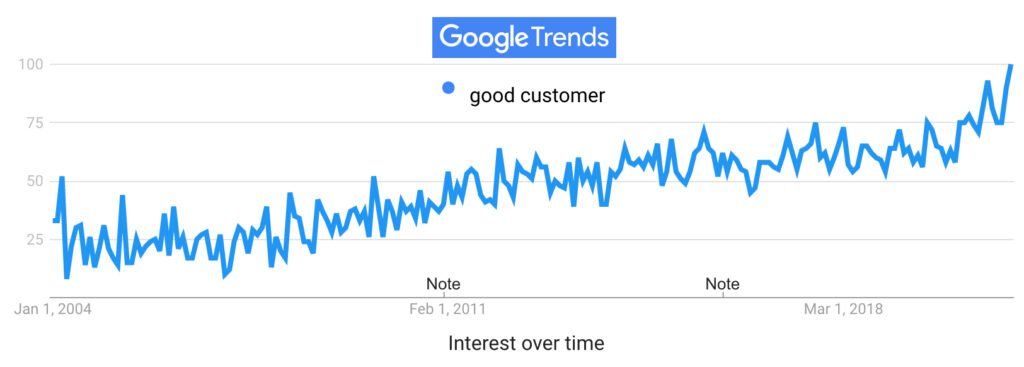
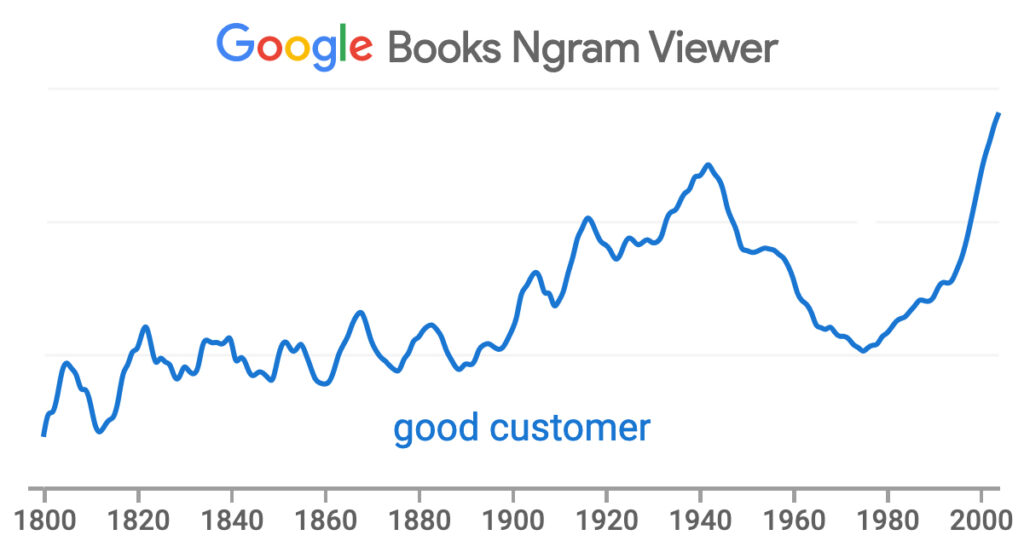
It’s still a timely thing to say, since searches on Google for “good customer” are at an all-time high:


The year 2004, when Google began keeping track of search trends, was also the year “good customer” hit at an all-time high in percentage of appearances in books Google scanned*:

So now might be the time to ask, What exactly is a “good customer?

The answer depends on the size of the business, and how well people and systems in the business know a customer. Put simply, it’s this:

  1. For a small business, a good customer is a person known by face and name to people who work there, and who has earned a welcome.
  2. For a large business, it’s a customer known to spend more than other customers.

In both cases, the perspective is the company’s, not the customer’s.

Ever since industry won the industrial revolution, the assumption has been that business is about businesses, not about customers. It doesn’t matter how much business schools, business analysts, consultants and sellers of CRM systems say it’s about customers and their “experience.” It’s not.

To  see how much it’s not, do a Bing or a Google search for “good customer.” Most of the results will be for good customer + service. If you put quotes around “good customer” on either search engine and also The Markup’s Simple Search (which brings to the top “traditional” results not influenced by those engines’ promotional imperatives), your top result will be Paul Jun’s How to be a good customer post on Help Scout. That one offers “tips on how to be a customer that companies love.” Likewise with Are You a Good Customer? Or Not.: Are you Tippin’ or Trippin’? by Janet Vaughan, one of the top results in a search for “good customer” at Amazon. That one is as much a complaint about bad customers as it is advice for customers who aspire to be good. Again, the perspective is a corporate one: either “be nice” or “here’s how to be nice.”

But what if customers can be good in ways that don’t involve paying a lot, showing up frequently and being nice?

For example, what if customers were good sources of intelligence about how companies and their products work—outside current systems meant to minimize exposure to customer input and to restrict that input to the smallest number of variables? (The worst of which is the typical survey that wants to know only how the customer was treated by the agent, rather than by the system behind the agent.)

Consider the fact that a customer’s experience with a product or service is far more rich, persistent and informative than is the company’s experience selling those things, or learning about their use only through customer service calls (or even through pre-installed surveillance systems such as those which for years now have been coming in new cars).

The curb weight of customer intelligence (knowledge, knowhow, experience) with a company’s products and services far outweighs whatever the company can know or guess at.

So, what if that intelligence were to be made available by the customer, independently, and in standard ways that worked at scale across many or all of the companies the customer deals with?

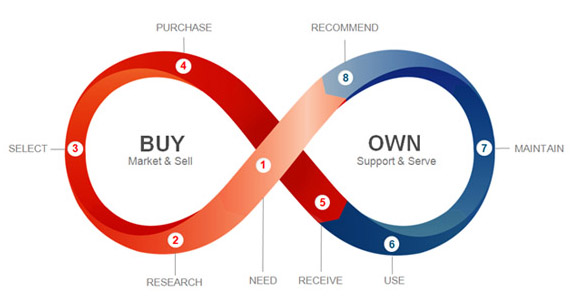
At ProjectVRM, this has been a consideration from the start. Turning the customer journey into a virtuous cycle explores how much more the customer knows on the “own” side of what marketers call the “customer life journey”†:

Given who much more time a customer spends owning something than buying it, the right side of that graphic is actually huge.

I wrote that piece in July 2013, alongside another that asked, Which CRM companies are ready to dance with VRM? In the comments below, Ray Wang, the Founder, Chairman and Principal Analyst at Constellation Research, provided a simple answer: “They aren’t ready. They live in a world of transactions.”

Yet signals between computing systems are also transactional. The surveillance system in your new car is already transacting intelligence about your driving with the company that made the car, plus its third parties (e.g. insurance companies). Now, what if you could, when you wish, share notes or questions about your experience as a driver? For example—

  • How there is a risk that something pointed and set in the trunk can easily puncture the rear bass speaker screwed into the trunk’s roof and is otherwise unprotected
  • How some of the dashboard readouts could be improved
  • How coins or pens dropped next to the console between the front seats risk disappearing to who-knows-where
  • How you really like the way your headlights angle to look down bends in the road

(Those are all things I’d like to tell Toyota about my wife’s very nice (but improvable) new 2020 Camry XLE Hybrid. )

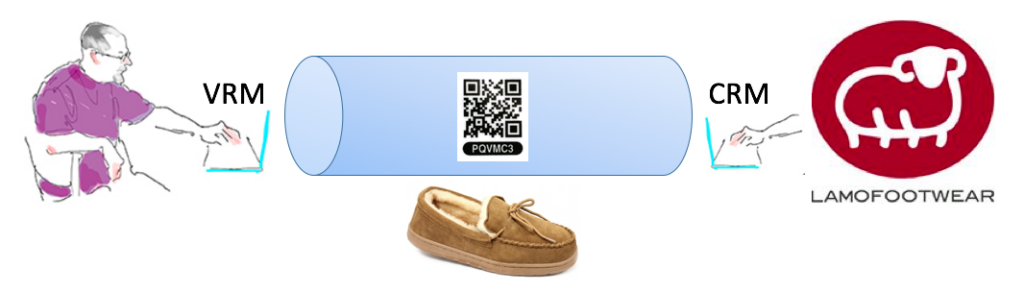
We also visited what could be done in How a real customer relationship ought to work in 2014 and in Market intelligence that flows both ways in 2016. In that one we use the example of my experience with a pair of Lamo moccasins that gradually lost their soles, but not their souls (I still have and love them):

By giving these things a pico (a digital twin of itself, or what we might call internet-of-thing-ness without onboard smarts), it is not hard to conceive a conduit through which reports of experience might flow from customer to company, while words of advice, reassurance or whatever might flow back in the other direction:

That’s transactional, but it also makes for a far better relationship that what today’s CRM systems alone can imagine.

It also enlarges what “good customer” means. It’s just one way how, as it says at the top, good customers can work with good companies.

Something we’ve noticed in Pandemic Time is that both customers and companies are looking for better ways to get along, and throwing out old norms right and left. (Such as, on the corporate side, needing to work in an office when the work can also be done at home.)

We’ll be vetting some of those ways at VRM/CuCo Day, Monday 19 April. That’s the day before the Internet Identity Workshop, where many of us will be talking and working on bringing ideas like these to market. The first is free, and the second is cheap considering it’s three days long and the most leveraged conference of any kind I have ever known. See you there.


*Google continued scanning books after that time, but the methods differed, and some results are often odd. (For example, if your search goes to 2019, the last year they cover, the  results start dropping in 2009, hit zero in 2012 and stay at zero after that—which is clearly wrong as well as odd.)

†This graphic, and the whole concept, are inventions of Estaban Kolsky, one of the world’s great marketing minds. By the way, Estaban introduced the concept here in 2010, calling it “the experience continuum.” The graphic above comes from a since-vanished page at Oracle.

Let’s zero-base zero-party data

Forrester Research has gifted marketing with a hot buzzphrase: zero-party data, which they define as “data that a customer intentionally and proactively shares with a brand, which can include preference center data, purchase intentions, personal context, and how the individual wants the brand to recognize her.”

Salesforce, the CRM giant (that’s now famously buying Slack), is ambitious about the topic, and how it can “fuel your personalized marketing efforts.” The second person you is Salesforce’s corporate customer.

It’s important to unpack what Salesforce says about that fuel, because Salesforce is a tech giant that fully matters. So here’s text from that last link. I’ll respond to it in chunks. (Note that zero, first and third party data is about you, no matter who it’s from.)

What is zero-party data?

Before we define zero-party data, let’s back up a little and look at some of the other types of data that drive personalized experiences.

First-party data: In the context of personalization, we’re often talking about first-party behavioral data, which encompasses an individual’s site-wide, app-wide, and on-page behaviors. This also includes the person’s clicks and in-depth behavior (such as hovering, scrolling, and active time spent), session context, and how that person engages with personalized experiences. With first-party data, you glean valuable indicators into an individual’s interests and intent. Transactional data, such as purchases and downloads, is considered first-party data, too.

Third-party data: Obtained or purchased from sites and sources that aren’t your own, third-party data used in personalization typically includes demographic information, firmographic data, buying signals (e.g., in the market for a new home or new software), and additional information from CRM, POS, and call center systems.

Zero-party data, a term coined by Forrester Research, is also referred to as explicit data.

They then go on to quote Forrester’s definition, substituting “[them]” for “her.”

The first party in that definition the site harvesting “behavioral” data about the individual. (It doesn’t square with the legal profession’s understanding of the term, so if you know that one, try not to be confused.)

It continues,

why-is-zero-party-data-important

Forrester’s Fatemeh Khatibloo, VP principal analyst, notes in a video interview with Wayin (now Cheetah Digital) that zero-party data “is gold. … When a customer trusts a brand enough to provide this really meaningful data, it means that the brand doesn’t have to go off and infer what the customer wants or what [their] intentions are.”

Sure. But what if the customer has her own way to be a precious commodity to a brand—one she can use at scale with all the brands she deals with? I’ll unpack that question shortly.

There’s the privacy factor to keep in mind too, another reason why zero-party data – in enabling and encouraging individuals to willingly provide information and validate their intent – is becoming a more important part of the personalization data mix.

Two things here.

First, again, individuals need their own ways to protect their privacy and project their intentions about it.

Second, having as many ways for brands to “enable and encourage” disclosure of private information as there are brands to provide them is hugely inefficient and annoying. But that is what Salesforce is selling here.

As industry regulations such as GDPR and the CCPA put a heightened focus on safeguarding consumer privacy, and as more browsers move to phase out third-party cookies and allow users to easily opt out of being tracked, marketers are placing a greater premium and reliance on data that their audiences knowingly and voluntarily give them.

Not if the way they “knowingly and voluntarily” agree to be tracked is by clicking “AGREE” on website home page popovers. Those only give those sites ways to adhere to the letter of the GDPR and the CCPA while also violating those laws’ spirit.

Experts also agree that zero-party data is more definitive and trustworthy than other forms of data since it’s coming straight from the source. And while that’s not to say all people self-report accurately (web forms often show a large number of visitors are accountants, by profession, which is the first field in the drop-down menu), zero-party data is still considered a very timely and reliable basis for personalization.

Self-reporting will be a lot more accurate if people have real relationships with brands, rather (again) than ones that are “enabled and encouraged” in each brand’s own separate way.

Here is a framework by which that can be done. Phil Windley provides some cool detail for operationalizing the whole thing here, here, here and here.

Even if the countless separate ways are provided by one company (e.g. Salesforce),  every brand will use those ways differently, giving each brand scale across many customers, but giving those customers no scale across many companies. If we want that kind of scale, dig into the links in the paragraph above.

With great data comes great responsibility.

You’re not getting something for nothing with zero-party data. When customers and prospects give and entrust you with their data, you need to provide value right away in return. This could take the form of: “We’d love you to take this quick survey, so we can serve you with the right products and offers.”

But don’t let the data fall into the void. If you don’t listen and respond, it can be detrimental to your cause. It’s important to honor the implied promise to follow up. As a basic example, if you ask a site visitor: “Which color do you prefer – red or blue?” and they choose red, you don’t want to then say, “Ok, here’s a blue website.” Today, two weeks from now, and until they tell or show you differently, the website’s color scheme should be red for that person.

While this example is simplistic, the concept can be applied to personalizing content, product recommendations, and other aspects of digital experiences to map to individuals’ stated preferences.

This, and what follows in that Salesforce post, is a pitch for brands to play nice and use surveys and stuff like that to coax private information out of customers. It’s nice as far as it can go, but it gives no agency to customers—you and me—beyond what we can do inside each company’s CRM silo.

So here are some questions that might be helpful:

  • What if the customer shows up as somebody who already likes red and is ready to say so to trusted brands? Or, better yet, if the customer arrives with a verifiable claim that she is already a customer, or that she has good credit, or that she is ready to buy something?
  • What if she has her own way of expressing loyalty, and that way is far more genuine, interesting and valuable to the brand than the company’s current loyalty system, which is full of gimmicks, forms of coercion, and operational overhead?
  • What if the customer carries her own privacy policy and terms of engagement (ones that actually protect the privacy of both the customer and the brand, if the brand agrees to them)?

All those scenarios yield highly valuable zero-party data. Better yet, they yield real relationships with values far above zero.

Those questions suggest just a few of the places we can go if we zero-base customer relationships outside standing CRM systems: out in the open market where customers want to be free, independent, and able to deal with many brands with tools and services of their own, through their own CRM-friendly VRM—Vendor Relationship Management—tools.

VRM reaching out to CRM implies (and will create)  a much larger middle market space than the closed and private markets isolated inside every brand’s separate CRM system.

We’re working toward that. See here.


« Older posts

© 2025 ProjectVRM

Theme by Anders NorenUp ↑