Category: crm (Page 5 of 7)

Beyond Bullwhips

In the Pardalis Data Ownership Blog @Steve Holcombe has an interesting and important pair of posts titled The Bullwhip Effect Part I and Part II. An excerpt:

… isn’t this already happening on Facebook? Can’t the Customer, Producer, Wholesaler, Retailer, and even the Government Regulators all become Facebook friends and experience right now this mashed-together vision of VRM and whole chain traceability? And isn’t this what Social CRM is all about?”

No, no and … no.

The challenge is not one of fixing the latest privacy control issue that Facebook presents to us. Nor is the challenge fixed with an application programming interface for integrating Salesforce.com with Facebook. The challenge is in providing the software, tools and functionalities for the discovery in real-timeof proprietary supply chain data that can save people’s lives and, concurrently, in attracting the input of exponentially more valuable information by consumers about their personal experiences with food products (or products in general, for that matter). Supply chain VRM (SCVRM)? Whole chain VRM (WCVRM)? Traceability VRM (TVRM)? Whatever we end up calling it, we know we will be on the right track when we see a flattening out of the Bullwhip Effect, won’t we?

Yep.

He promises more in Part III. Watch for it.

VRM as Agency

Most of us understand agency to mean a kind of company: one that represents other companies, or individuals. Insurance, real estate and advertising agencies come to mind.

In fact agency has a deeper and more important meaning. Namely, the capacity of individuals to act independently, to make choices, and to impose their will in the world. By this meaning, agency is a big deal in sociology, psychology, philosophy, law and many other fields. But it’s missing is business. That’s because we’re accustomed to understanding business as a structural thing:  an instrument of control.

Wikipedia frames this problem well in the opening paragraph of its Structure vs. Agency Debate article:

The debate concerning the primacy of either structure or agency on human behaviour is a central ontological issue in sociology, political science, and the other social sciences. In this context, “agency” refers to the capacity of individuals to act independently and to make their own free choices.[1]Structure“, by contrast, refers to the recurrent patterned arrangements which seem to influence or limit the choices and opportunities that individuals possess.[2] The structure versus agency debate may therefore be understood simply as the issue of socialisation against autonomy.

Limiting individual choices through “patterned arrangements” has been an ideal of big business for a very long time. Choice is an ideal too, provided your product or service provides a choice for customers to not choose competing products or services. Agency-type choice, in which individuals are free to assert their will and their means, doesn’t get much respect.

In fact, most big businesses aren’t interested in customers that have lots of agency — unless those customers aren’t captured yet. Instead big business has long idealized controlling customers. That’s why they talk about “capturing,” “acquiring,” “managing,” “locking in” and “owning” them. And spend billions on systems that help them do that.

These controlling ideals are still with us in the era of “social networking” and “social media.” (Or what one friend calls SEFTTI, for “social every fucking thing there is.”) Sure, Facebook is as social as a kegger (or more so), but it is also a “patterned arrangement that seems to influence or limit the choices and opportunities that individuals possess.”

Personal autonomy on Facebook only goes as far as Facebook lets it go. Same with every other “social” system run by an entity other than yourself. They put a lid on your agency. You are not free.

I’m not saying there’s anything wrong with social systems, or structures, or even with businesses that want to control your choices. I am saying that agency has been AWOL from the market’s table. And bringing it there is what we’re doing with VRM.

I realized that VRM is about agency when I was talking with Iain Henderson the other day. Iain and his company MyDex have been working on creating and deploying personal data stores, or PDSes. These are the means by which individuals manage and  share personal data selectively. In that conversation Iain casually mentioned that the U.K. government was clearly invested in “user agency.” That is, in citizen responsibility for data about themselves and generated by themselves. In this fundamental way, he said, the U.K. government is far ahead of our own here in the U.S. — and the U.K. is therefore a more ideal environment for testing out VRM tools, such as the personal data store. (In fact MyDex’s prototype trials are going on right now, in three U.K. towns.)

What we’ll have, as VRM tools roll out and come into use, is many ways to test concepts such as methodological individualism and action theory. Mostly, however, I think it’s a way to see how much larger, and better, we can make the economy once individual customers are free to express their intentions.

Bonus link — which I put here hoping that somebody can fix it. Since it’s about me and some stuff I’ve said, I’m not the one to do that.

Do we have to “trade off” privacy?

Look up privacy trade-offs and you’ll get more than 150,000,000 results. The assumption in many of those is that privacy is something one can (and often should) trade away. Also that privacy trading is mostly done with marketers and advertisers, the most energetic of which take advantage of social media such as and .

I don’t think this has to be so.

One example of a trade-off story is this one on public radio’s Marketplace program, which I heard this evening. It begins with the case of Shea Sylvia, a FourSquare user who got creeped out by an unwelcome call from a follower who knew her location. Marketplace’s Sally Herships says,

There are millions of Sylvias out there, giving away their private information for social reasons. More and more, they’re also trading it in for financial benefits, like coupons and discounts. Social shopping websites like Blippy and Swipely let shoppers post about what they buy. But first they turn over the logins to their e-mail accounts or their credit card numbers, so their purchases can be tracked online.

Later, there’s this (the voice is Herships again):

Alessandro Acquisti researches the economics of privacy at Carnegie Mellon, and he says the value we put on privacy can easily shift. In other words, if giving away your credit card information or even your location in return for a discount or a deal seems normal, it must be OK.

ALESSANDRO ACQUISTI: Five years ago, if someone told you that there’d be lots of people going online to show, to share with strangers their credit card purchases, you probably would have been surprised, you probably would thought, “No, I can’t believe this. I wouldn’t have believed this.”

But Acquisti says, when new technologies are presented as the norm, people accept them that way. Like social shopping websites.

HERSHIPS: So the more we use sites like Blippy, the more we’ll use sites like Blippy?

ACQUISTI: Or Blippy 2.0.

Which Acquisti says will probably be even more invasive, because as time passes, we’re going to care less and less about privacy.

Back in Kansas City Shea Sylvia is feeling both better and worse. She thinks the phone call she got that night at the restaurant was probably a prank. But it was a wake up call.

What we’re dealing with here is an evanescent norm. A fashion. A craze. I’ve indulged in it myself with FourSquare, and at one point was the “mayor” of ten different places, including the #77 bus on Mass Ave in Cambridge. (In fact, I created that location.) Gradually I came to believe that it wasn’t worth the hassle of “checking in” all over the place, and was worth nothing to know Sally was at the airport, or Bill was teaching a class, or Mary was bored waiting in some check-out line, much as I might like all those people. The only time FourSquare came in handy was when a friend intercepted me on my way out of a stop in downtown Boston, and even then it felt strange.

The idea, I am sure, is that FourSquare comes to serve as a huge central clearing house for contacts between companies selling stuff and potential buyers (that’s you and me) wandering about the world. But is knowing that a near-infinite number of sellers can zero in on you at any time a Good Thing? And is the assumption that we’re out there buying stuff all the time not so wrong as to be insane?

Remember that we’re the product being sold to advertisers. The fact that our friends may be helping us out might be cool, but is that the ideal way to route our demand to supply? Or is it just one that’s fun at the moment but in the long term will produce a few hits but a lot of misses—some of which might be very personal, as was the case with Shea Silvia? (Of course I might be wrong about both assumptions. What I’m right about is that FourSquare’s business model will be based on what they get from sellers, not from you or me.)

The issue here isn’t how much our privacy is worth to the advertising mills of the world, or to intermediaries like FourSquare. It’s how we maintain and control our privacy, which is essentially priceless—even if millions of us give it away for trinkets or less. Privacy is deeply tied with who we are as human beings in the world. To be fully human is to be in control of one’s self, including the spaces we occupy.

An excellent summary of our current privacy challenge is this report by Joy L. Pitts (developed as part of health sciences policy development process at the Institute of Medicine, the health arm of the National Academy of Sciences). It sets context with these two quotes:

“The makers of the Constitution conferred the most comprehensive of rights and the right most valued by all civilized men—the right to be let alone.”

—Justice Louis Brandeis (1928)

“You already have zero privacy anyway. Get over it.”

—Scott McNealy, Chairman and CEO of Sun Microsystems (1999)

And, in the midst of a long, thoughtful and well-developed case, it says this (I’ve dropped the footnotes, which are many):

Privacy has deep historical roots. References to a private domain, the private or domestic sphere of family, as distinct from the public sphere, have existed since the days of ancient Greece.  Indeed, the English words “private” and “privacy” are derived from the Latin privatus, meaning “restricted to the use of a particular person; peculiar to oneself, one who holds no public office.” Systematic evaluations of the concept of privacy, however, are often said to have begun with the 1890 Samuel Warren and Louis Brandeis article, “The Right of Privacy,” in which the authors examined the law’s effectiveness in protecting privacy against the invasiveness of new technology and business practices (photography, other mechanical devices and newspaper enterprises). The authors, perhaps presciently, expressed concern that modern innovations had “invaded the sacred precincts of private and domestic life; and . . . threatened to make good the prediction that ‘what is whispered in the closet shall be proclaimed from the house-tops.’” They equated the right of privacy with “the right to be let alone” from these outside intrusions.

Since then, the scholarly literature prescribing ideal definitions of privacy has been “extensive and inconclusive.” While many different models of privacy have been developed, they generally incorporate concepts of:

  • Solitude (being alone)
  • Seclusion (having limited contact with others)
  • Anonymity (being in a group or in public, but not having one’s name or identity known to others; not being the subject of others’ attention)
  • Secrecy or reserve (information being withheld or inaccessible to others)

In essence, privacy has to do with having or being in one’s own space.

Some describe privacy as a state or sphere where others do not have access to a person, their information, or their identity. Others focus on the ability of an individual to control who may have access to or intrude on that sphere. Alan Westin, for example, considered by some to be the “father” of contemporary privacy thought, defines privacy as “the claim of individuals, groups or institutions to determine for themselves when, how and to what extent information about them is communicated to others.” Privacy can also be seen as encompassing an individual’s right to control the quality of information they share with others.

In the context of personal information, concepts of privacy are closely intertwined with those of confidentiality and security. Privacy addresses “the question of what personal information should be collected or stored at all for a given function.” In contrast, confidentiality addresses the issue of how personal data that has been collected for one approved purpose may be held and used by the organization that collected it, what other secondary or further uses may be made of it, and when the permission of the individual is required for such uses.Unauthorized or inadvertent disclosures of data are breaches of confidentiality. Informational security is the administrative and technological infrastructure that limits unauthorized access to information. When someone hacks into a computer system, there is a breach of security (and also potentially, a breach of confidentiality). In common parlance, the term privacy is often used to encompass all three of these concepts.

Take any one of these meanings, or understandings, and be assured that it is ignored or violated in practice by large parts of today’s online advertising business—for one simple reason (I got from long ago): Individuals have no independent status on the Web. Instead we have dependent status. Our relationships (and we have many) are all defined by the entities with which we choose to relate via the Web. All those dependencies are silo’d in the systems of sellers, schools, churches, government agencies, social media, associations, whatever. You name it. You have to deal with all of them separately, on their terms, and in their spaces. Those spaces are not your spaces. (Even if they’re in a place called . Isn’t it weird to have somebody else using the first person possessive pronoun for you? It will be interesting to see how retro that will seem after it goes out of fashion.)

What I’m saying here is that, on the Web, we do all our privacy-trading in contexts that are not out in the open marketplace, much less in our own private spaces (by any of the above definitions). They’re all in closed private spaces owned by the other party—where none of the rules, none of the terms of engagement, are yours. In other words, these places can’t be private, in the sense that you control them. You don’t. And in nearly all cases (at least here in the U.S.), your “agreements” with these silos are contracts of adhesion that you can’t break or change, but the other party can—and often does.

These contexts have been so normative, for so long, that we can hardly imagine anything else, even though we have that “else” out here in the physical world. We live and sleep and travel and get along in the physical world with a well-developed understanding of what’s mine, what’s yours, what’s ours, and what’s none of those. That’s because we have an equally well-developed understanding of bounded spaces. These differ by culture. In her wonderful book , Polly Platt writes about how French —comfortable distances from others—are smaller than those of Americans. The French feel more comfortable getting close, and bump into each other more in streets, while Americans tend to want more personal space, and spread out far more when they sit. Whether she’s right about that or not, we actually have personal spaces on Earth. We don’t on the Web, and in Web’d spaces provided by others. (The Net includes more than the Web, but let’s not get into that here. The Web is big enough.)

So one reason that privacy trading is so normative is that dependency requires it. We have to trade it, if that’s what the sites we use want, regardless of how they use whatever we trade away.

The only way we can get past this problem (and it is a very real one) is to create personal spaces on the Web. Ones that we own and control. Ones where we set the terms of engagement. Ones where we decide what’s private and what’s not.

In the VRM development community we have a number of different projects and companies working on exactly this challenge.  is pure open source and has a self-explanatory name. Others (, and others) are open in many ways as well, and are working together to create (or put to use) common code, standards, protocols, terminologies and other conventions on which all of us can build privacy-supporting solutions. You’ll find links to some of the people involved in those efforts (among others) in Personal Data Stores, Exchanges, and Applications, a new post by  (of Switchbook). There’s also the One example is the and at . (For more context on that, check out Iain Henderson’s unpacking of the .) There’s also our own work at ProjectVRM and , which has lately centered on developing -like legal tools for both individuals and companies.  What matters most here is that a bunch of good developers are working on creating spaces online that are as natural, human, personal—and under personal control—as the ones we enjoy offline.

Once we have those, the need for privacy trade-offs won’t end. But they will begin to make the same kind of down-to-Earth sense they do in the physical world. And that will be a huge leap forward.


VRM vertical: real estate

Bill Wendell of Real Estate Cafe poses a good Idea Starter question: What if homebuyers and sellers managed their own data? Sez Bill, Here are ten of our favorites ideas about how to retool the real estate industry with VRM.  What are yours? He actually provides more than ten. Here’s a sample:

5.  Buyers will be able to sign into open houses, and transfer their buyer profile or homesearchID by “bumping” their smart phone.  (See comments received / Discuss)

6.  Fourth parties, like locally initiated homebuyer club, will aggregate and deliver savings to buyers and sellers.  (See comments received / Discuss)

10.  Buyers will be able to manage and release their listing clickstreams so sellers, including distressed sellers, auctioneers, and leanders or government agencies with foreclosures, can invite them to bid on properties.  (See comments received / Discuss)

15.  Fourth parties will develop platforms to certify trust worthiness of real estate professionals based on terms of service, eg. No conflicts of interest because brokerage prohibits dual agency.  (See comments received / Discuss)

18.  Geoloco apps, augmented reality, and smartphones / mobile devices will enable real estate consumers to connect at hyperlocal level and engage in meaningful conversations that translate into more informed decisions and savings opportunities.  (See comments received / Discuss)

20.  eGov will embrace VRM tools, particularly homebuyerIDs, to reduce paperwork and help make sense of morass of competing housing program guidelines.  (See comments received / Discuss)

These are also in the reVRM Minifesto.

And Bill is tweeting with the hashtag #reVRM.

Also dig the CRM+VRM 2010 workshop tomorrow (where Bill and many other VRooMers and CRooMers will be). That hashtag is #vrmcrm2010.

We’re filling up

Our VRM+CRM workshop, exactly two weeks away, is filling up. We have about 70 people signed up so far, and if we get too many more we may be spilling out of our spaces.

So, if you care about VRM development, and how it matches up with what’s happening on the CRM side, register soon. (Click on the image to the left.) Right now we’re especially interested in companies that already do CRM or use CRM systems, and are dealing with real CRM problems. (And are looking for real opportunities opened by the operation of VRM on the customers’ side. But if you’re just interested and can contribute, that’s cool too.

The First VRM+CRM Workshop

The first VRM+CRM workshop will take place on 26-27 August, at Harvard Law School. It’s free. You can register here.

The purpose is to get VRM and CRM developers and other interested parties (such as CRM customers) together to start building out the common ground between them. That common ground is potentially very huge. CRM is already a $15 billion business. What happens when customers start managing relationships too? Let’s start answering that.

A number of VRM tools are now ready for vetting with CRM folks, and CRM interest in connecting to VRM is growing as well. Destination CRM will take place next week in New York. VRM+CRM 2010 will be a perfect place for VRM-CRM discussions started at Destination CRM to continue.

While the workshop sessions will be chosen by the participants (following opening briefings by VRM and CRM folks), here are a few of the topics and questions that are sure to come up —

  • Terms of service. How can we get past the legal hurdles and shackles that inconvenience both buyers and sellers when they get acquainted?
  • Privacy policies. How can we reduce the suspicions and frictions that these involve?
  • Personal data. What tools, methods and services are being developed for individuals to keep track of data they generate or is being kept by sellers and other parties? What means do we have for sharing or exchanging that data in secure and trustable ways?
  • Signaling. What new methods will both individuals and organizations have for notifying each other of interests, intentions, policies, preferences, or changes in any of those? How can we make these common across the industry, rather than different for every organization?
  • Self-tracking and personal informatics. What vendor-independent means are being developed for individuals to keep track of their own personal data, and manage it?
  • Search. What new paradigms for searching are being developed, especially in the context of all the topics above?
  • Non-coercive loyalty. What ways are being developed for individuals to express and manage their own forms of loyalty to sellers and other organizations? How can this improve existing loyalty programs?
  • Personal RFPs or Advertising in Reverse. How can individual customers notify whole market categories of their intent to purchase a product, safely and securely, without inviting a torrent of promotional jive in response?
  • Leveraging base-level protocols, standards and tools. There are hundreds of thousands of free and open source tools, protocols and other goods already in the world, ready to serve as free building materials and guidelines. What can we use of these, and what new ones do we need? What new ones are in development on the VRM side?
  • Reducing MLOTT — Money Left On The Table. In our current system, a huge sum of demand goes un-met because of the the means for communicating interest and availability are on the supply side. How (including the means listed above and others) can we equip demand to notify supply of money ready to be spent? In the old days this was seen as “lead generation” by suppliers. But now it’s time to get past that.
  • Tie-ins with SCRM. Social CRM is the hottest topic in CRM. How can VRM connect with and through social networking? Important question: Should “social” be restricted to just what can be done through Facebook, Twitter and other commercial services?
  • Patient-driven health care. How can individuals be the collection points for their own health data, and the point of origination for what gets done with it?
  • API symphonics. The commercial world is increasingly building around a collection of interconnected APIs, or Application Programming Interfaces. Many CRM systems are built around their own APIs. VRM will surely connect into many APIs. How should we be thinking about and guiding evolution here?
  • The oppposite of cookies. Sites and companies of all kinds have been keeping track of customers through cookies since the mid-’90s. How can customers do the same with their suppliers?

I’m sure I’ve left some stuff off this list. If you want to add to it, contact me or make a comment below. Better yet, show up and participate.

Look forward to seeing you there.

More details on the event wiki page.

VRM + CRM

We’ve reached the point where VRM and CRM developers are ready to talk.

There is a lot of CRM-facing development going on in the VRM community. A number of both commercial and non-commercial projects on this list are involved, and some are far enough downstream that folks in both communities need to show what they’re working on, sit down and talk.

Some of this is already happening. More will happen next week in New York. And more will happen in some other gatherings that are in the works. Stay tuned for those.

I think that will help answer some of the questions that have been coming up — partly as a result of what I’ve been writing here, and especially after CRM Magazine’s May Issue, Julian Gay’s Beyond Social CRM post, Ewe Hook’s Edison, Insull and planning for the future of VRM and Mitch Lieberman’s VRM Who Has the Relationship Repsonsibility Anyway?, in CRM Ousiders. Martin Schneider’s follow-up, Remember, No One “Owns” a Relationship aligns exactly with what I wrote in Cooperation vs. Coercion and in R-buttons and the open marketplace. As I said there,

Markets, in both their literal and metaphorical meanings, are middle grounds. They are places where we are selectively open to society, and especially to sellers — and where they are open to us. One way to represent that is to turn our silos on their sides and open them up, so we each have a representation of containment, but also of openness, and even of attraction. So, instead of having silos, we have magnets, like this:

You are on the left. The seller is on the right. And the market is in the middle.

The VRM community is working on building this out. (As we said above, the CRM community has begun to join the effort as well.) We are doing this by creating ways of relating in which both sides are open to the other, but neither contains the other. The two can have attractions toward each other, but engagement is optional. Think of the result as a market that’s far more free than the your-choice-of-silo model.

This also realates to Larry Augustin‘s Some Thoughts on Open post. Larry runs SugarCRM. Larry and I go way back to the 90s, when he started VA Linux and I was still a rookie editor for Linux Journal. Even at a distance we’ve been manning the same barricades for the duration. (Much of the time explaining the same things over and over again. Right, Larry? 🙂

I’m also know people at SalesForce.com, including Marc Benioff and especially my old buddy Steve Gillmor (for whom I can’t find a link currently, so here’s his latest Gillmor Gang, which I was on). Plus people at SAP, Oracle, IBM and Microsoft. (Though in some cases not in their CRM divisions.) I’m looking forward to seeing and talking to many of those folks (and more) over the coming weeks and months. More importantly, I’m looking forward to VRM developers other than myself meeting with their counterparts on the CRM side. And with customers and users of CRM software and services.

Meanwhile I’m looking for ways that ordinary users — that’s all of us — can become more aware and mindful of the good work that folks in the CRM community are trying to do. I’m talking here about the work that doesn’t just try to “capture,” “acquire,” “own,” “lock in” or otherwise “manage” us as if we were slaves or cattle. This customer-respecting work is at the leading edge of the CRM world. Respectable customers are at the leading edge of the VRM world. The twain should meet.

I should add that there is much happening in VRM that isn’t CRM facing as well. But for the next few weeks, the focus for many of us will be on reaching across and building out the new common ground between VRM and CRM. That ground is the marketplace, and in many ways it’s still virgin and unspoiled territory.

Positioning VRM

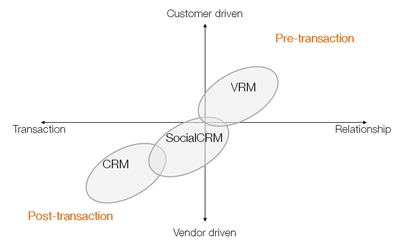
@JulianGay just put up a terrific piece called Beyond Social CRM that positions VRM very nicely. Here’s the graphic:

It’s important for anybody who wants to see how these pieces fit together. VRM’s scope goes into the post-transaction zone as well, but I also don’t want to get too ambitious here. The ovals do a good job, as do the axes. What matters is relationship, and the control both vendors and customers have over the middle ground they share.

Toward the bottom Julian lists five companies as examples of “VRM dynamics”. This is cool, but I want to add that VRM at its base level isn’t about the companies doing it, any more than email, messaging or syndicating are about companies. Those things rely on deeper protocols, standards and bodies of code that are pure building material. For a partial list of VRM development efforts, go here.

Cooperation vs. Coercion

We think of markets as competitive places: arenas, battlegrounds, playing fields, boxing rings. Which they are, if you look at them from the standpoint of vendors. As buyers, we do want vendors to compete, of course. But we also want them to cooperate — with us. From our perspective, markets are places where we shop, meet and do business. We want the freedom to do that, and we don’t want sellers taking any of that away, even if they think doing that makes them better competitors.

For decades, if not for a century or more, taking customers’ freedoms away has been something of a virtue for vendors. It’s not for nothing that marketers talk about “acquiring,” “capturing,” “owning” and “managing” customers as if they were slaves or cattle. In the old industrial economy, this made sense. It was easier to serve managed customers than free ones. You could limit the variables you addressed. Even today we sometimes like having our choices restricted, and gladly make the Faustian bargain of captivity. But even here we see the downsides, which go beyond lack of choice. Being captive may seem safe in some ways, but it also makes us vulnerable to a single source of goods on which we have no choice but to depend.

On the sell side, there are two problems. One is the burden of management itself, which should be easier if customers were also carrying some of the load. The other is intelligence. When all you know is what you learn from your captive customers (say, through your loyalty program), you don’t know enough. There is far more happening in the marketplace than you can learn and crunch only in your own exclusive ways.

What we need now is for vendors to discover that free customers are more valuable than captive ones. For that we need to equip customers with better ways to enjoy and express their freedom, including ways of engaging that work consistently for many vendors, rather than in as many different ways ways as there are vendors — which is the “system” (that isn’t) we have now.

There are lots of VRM development efforts working on both the customer and vendor sides of this challenge. In this post I want to draw attention to the symbols that represent those two sides, which we call r-buttons, two of which appear above. Yours is the left one. The vendor’s is the right one. They face each other like magnets, and are open on the facing ends.

These are designed to support what Steve Gillmor calls gestures, which he started talking about back in 2005 or so. I paid some respect to gestures (though I didn’t yet understand what he meant) in The Intention Economy, a piece I wrote for Linux Journal in 2006. (That same title is also the one for book I’m writing for Harvard Business Press. The subtitle is What happens when customers get real power.) On the sell side, in a browser environment, the vendor puts some RDFa in its HTML that says “We welcome free customers.” That can mean many things, but the most important is this: Free customers bring their own means of engagement. It also means they bring their own terms of engagement.

Being open to free customers doesn’t mean that a vendor has to accept the customer’s terms. It does mean that the vendor doesn’t believe it has to provide all those terms itself, through the currently defaulted contracts of adhesion that most of us click “accept” for, almost daily. We have those because from the dawn of e-commerce sellers have assumed that they alone have full responsibility for relationships with customers. Maybe now that dawn has passed, we can get some daylight on other ways of getting along in a free and open marketplace.

The gesture shown here —

— is the vendor (in this case the public radio station KQED, which I’m just using as an example here) expressing openness to the user, through that RDFa code in its HTML. Without that code, the right-side r-button would be gray. The red color on the left side shows that the user has his or her own code for engagement, ready to go. (I unpack some of this stuff here.)

Putting in that RDFa would be trivial for a CRM system. Or even for a CMS (content management system). Next step: (I have Craig Burton leading me on this… he’s on the phone with me right now…) RESTful APIs for customer data. Check slide 69 here. Also slides 98 and 99. And 122, 124, 133 and 153.

If I’m not mistaken, a little bit of RDFa can populate a pop-down menu on the site’s side that might look like this:

All the lower stuff is typical “here are our social links” jive. The important new one is that item at the top. It’s the new place for “legal” (the symbol is one side of a “scale of justice”) but it doesn’t say “these are our non-negotiable terms of service (or privacy policies, or other contracts of adhesion). Just by appearing there it says “We’re open to what you bring to the table. Click here to see how.” This in turn opens the door to a whole new way for buyers and sellers to relate: one that doesn’t need to start with the buyer (or the user) just “accepting” terms he or she doesn’t bother to read because they give all advantages to the seller and are not negotiable. Instead it is an open door like one in a store. Much can be implicit, casual and free of obligation. No new law is required here. Just new practice. This worked for Creative Commons (which neither offered nor required new copyright law), and it can work for r-commerce (a term I just made up). As with Creative Commons, what happens behind that symbol can be machine, lawyer or human-readable. You don’t have to click on it. If your policy as a buyer is that you don’t want to to be tracked by advertisers, you can specify that, and the site can hear and respond to it. The system is, as Renee Lloyd puts it, the difference between a handcuff and a handshake.

Giving customers means for showing up in the marketplace with their own terms of engagement is a core job right now for VRM. Being ready to deal with customers who bring their own terms is equally important for CRM. What I wrote here goes into some of the progress being made for both. Much more is going on as well. (I’m writing about this stuff because these are the development projects I’m involved with personally. There are many others.)

What I want to make clear here is that symbols are necessary. We need graphic representations of states and actions, and what’s possible for both. And we need ones that are not encumbered by anybody’s intellectual property claims. That’s why r-buttons are free for the using. Everybody is also free to use something else, if you think it’s better. I don’t care. I just know we need symbols, and these are some we’ve been using while we’ve been developing stuff.

In the next few weeks there will be a number of  occasions for VRM and CRM folks to get together, to talk, to start building toward each other, and to start training company legal departments in the new ways of open markets — cooperative ways, rather than just coercive ones. Looking forward to seeing how that all goes.

Work toward free and open markets

I just posted three long VRM pieces on my blog:

  1. R-buttons and the Open Marketplace
  2. ListenLog
  3. EmanciPay

They’re really one long post in three parts. Together they unpack the thinking behind my own development work at ProjectVRM here at the Berkman Center, and the three different components of that work. (It’s been a fun four-year-long learning by doing process.)

All this has been going on, of course, in the midst of a growing and active development community that’s also working on many other things, most of which overlap with these three.

See what you think.

Additional note… Those posts should have been on this site; but it’s past three in the morning here in Paris, where my upstream bandwidth is lousy (making the posting of graphics a glacial process) and I made the mistake of misreading my WordPress dashboard, and posting on my blog the first of those pieces. So, rather than start over I continued there. After I figure out how to cross-post the same items here, I’ll do that.

« Older posts Newer posts »

© 2026 ProjectVRM

Theme by Anders NorenUp ↑