Category: Cluetrain (Page 1 of 2)

When Branding Means Relating

What is your best friend’s personal brand? How about your spouse’s?

Those questions came to mind as I read through The Death of Merchandising in an Online World, by  Dana Blankenhorn, who is reliably wise. In that post, Dana correctly observes that brand value is declining as merchandising shifts from stores to online services, and to influencers who are also stores.

I think there’s also something else going on at the same time: the shift in media from real advertising to the online equivalent of junk mail, which is what you see with nearly every ad you encounter on your browsers and apps. To marketers, browsers and apps are boxes for junk mail, which at its most ideal is personalized by surveillance.  As I put it in Separating Advertising’s Wheat and Chaff, ” Madison Avenue fell asleep, direct response marketing ate its brain, and it woke up as an alien replica of itself.”

I wrote that a decade ago. With AI today, that alien replica is the real thing. Madison Avenue is now AM radio, with a whip antenna and tail fins.

Brand advertising worked best when “the media” were mostly print and broadcast. Sources of both were so few that they all fit on a newsstand and the dials of radios and TVs. To operate a source of either, you needed a printing plant or transmitting towers. Publishers and broadcasters are still around, but now their goods are mostly distributed over the Internet and consumed through glowing rectangles. And they’re competing in a world where the abundance of other sources of content is incalculably vast. In that world, the only places you can still reliably create and maintain brands is by sponsoring live events. Especially sports. That’s why I know fifteen minutes will save me fifteen percent with Geico, even though Geico stopped saying that years ago. I also know that you only pay for what you need with Liberty Mutual. And I’ll never get the Shaefer Beer jingle out of my mind.

On the whole, however, branding has finished running the same course as the broadcasting it paid for.

It helps to remember that the words brand and branding were borrowed from ranching. They applied especially well when people had few choices of media, and few if any ways to avoid ads meant to burn the names of companies and products onto mental hides.

What we really (or at least should) mean by brand today is reputation. How a business obtains that in our still-new Digital Age (now with AI!) is an open question.

I believe the answer will come from the natural world, where markets have been working far longer than we’ve had digital media, broadcasting, or print. It was in the natural world that two very different people—one an athiest and the other a pastor—separately explained to me, not long after The Cluetrain Manifesto came out, that markets are not just about transactions and (as Cluetrain insisted) conversations. They are about relationships.

Marketing prevents those. Or shortcuts them. Especially as it continues to devolve into funnels at the bottom end of which are transactions alone, or entrapment in a company’s “loyalty” system.

The Internet and the Web were both designed to support maximum agency and independence for every entity using them. We can have far better markets and marketing if demand and supply both work with maximized agency, and scale in ways that are good for both. That’s the idea behind market intelligence that flows both ways.

Making and maintaining those kinds of relationships will be VRM+CRM, What those together will make are wholes that exceed the sum of either part.

On Customer Constituency

A customer looks at a market where choice rules and nobody owns anybody. Source: Microsoft Copilot | Designer

I’m in a discussion of business constituencies. On the list (sourced from the writings of Doug Shapiro) are investors, employees, suppliers, customers, and regulators.

The first three are aware of their membership, but the last two? Not so sure.

Since ProjectVRM works for customers, let’s spin the question around. Do customers have a business constituency? If so, businesses are members by the customer’s grace. She can favor, ignore, or more deeply engage with any of those businesses at her pleasure. She does not “belong” to any of them, even though any or all of them may refer to her, or their many other customers, with possessive pronouns.

Take membership (e.g. Costco, Sam’s Club) and loyalty (CVS, Kroger) programs off the table. Membership systems are private markets, and loyalty programs are misnomered. (For more about that, read the “Dysloyalty” chapter of The Intention Economy.)

Let’s look instead at businesses that customers engage as a matter of course: contractors, medical doctors, auto mechanics, retail stores, restaurants, clubs, farmers’ markets, whatever. Some may be on speed dial, but most are not. What matters in all cases is that these businesses are responsible to their customers. “The real and effectual discipline which is exercised over a workman is that of his customers,” Adam Smith writes. “It is the fear of losing their employment which restrains his frauds and corrects his negligence.” That’s what it means to be a customer’s constituent.

An early promise of the Internet was supporting that “effectual discipline.” For the most part, that hasn’t happened. The “one clue” in The Cluetrain Manifesto said “we are not seats or eyeballs or end users or consumers. we are human beings and our reach exceeds your grasp. deal with it.” Thanks to ubiquitous surveillance and capture by corporate giants and unavoidable platforms, corporate grasp far outreaches customer agency.

That’s one reason ProjectVRM has been working against corporate grasp since 2006, and just as long for customer reach. Our case from the start has been that customer independence and agency are good for business. We just need to prove it.

Markets vs. Marketing in the Age of AI

Maybe history will defeat itself.

Remember FreePC? It was a thing, briefly, at the end of the last millennium, right before Y2K pooped the biggest excuse for a party in a thousand years. This may help. The idea was to put ads in the corner of your PC’s screen. The market gave it zero stars, and it failed.

And now comes Telly, hawking free TVs with ads in a corner, and a promise to “optimize your ad experience.” As if anybody wants an ad experience other than no advertising at all.

Negative demand for advertising has been well advertised by both ad blocking (the biggest boycott in human history) and ad-free “prestige” TV, (or SVOD— Subscription Video On Demand). With those we gladly pay—a lot— not to see advertising. (See numbers here.)

But the advertising business (in the mines of which I toiled for too much of my adult life) has always smoked its own exhaust and excels best at getting high with generous funders. (Yeah, some advertising works, but on the whole people still hate it on the receiving end.)

The fun will come when our own personal AI bots, working for our own asses, do battle with the robot Nazgûls of marketing — and win, because we’re on the Demand side of the marketplace, and we’ll do a better job of knowing what we want and don’t want to buy than marketing’s surveillant AI robots can guess at. Supply will survive, of course. But markets will defeat marketing by taking out the middle creep.

The end state will be one Cluetrain forecast in 1999, Linux Journal named in 2006, the VRM community started working on that same year, and The Intention Economy detailed in 2012. The only thing all of them missed was how customer intentions might be helped by personal AI.

Personal, not personalized.

Markets will become new and better dances between Demand and Supply, simply because Demand will have better ways to take the lead, and not just follow all the time. Simple as that.


*For more on how this will work, see Individual Empowerment and Agency on a Scale We’ve Never Seen Before.

As an aside, the mouth in whch BUY!!! appears is mine.  The gold crowns were provided by students of the UNC School of Dentistry, under the direction of Dr. Clinton Max Studevant for just $25 each, half a century ago. The original photo is here on Flickr, was shot with a Sony camcorder that could take low-res stills, and has had more than 80,000 views, which is way more than any of the 80,000 other photos I have on Flickr. I don’t know why.

Beyond the Web

The Cluetrain Manifesto said this…

not

…in 1999.

And now, in 2021, it’s still not true—at least not on the Web.

If it was true, California’s CCPA wouldn’t call us mere “consumers” and Europe’s GDPR  wouldn’t call us mere “data subjects,” whose privacy is entirely at the grace of corporate “data processors” and “data controllers.” (While the GDPR does say a “natural person” can be either of those, the prevailing assumption says no. Worse, it assumes that what privacies we enjoy on the Web should be valved by choices we make when confronted with “consent” notices that pop up when we first visit a website, and which are recorded somewhere we don’t know and can’t audit or dispute.)

Simply put, we are not free, and our reach does not exceed their grasp. Again, on the Web.

But (this is key), the Web is not the Internet. It’s a haystack of stuff on the Net. It’s a big one, and hugely good in many ways. And maybe we can be really free there eventually. But why not work outside of it? That’s the question.

And that’s what some of us are answering. You might call what we’re doing a blue ocean strategy:

For example, Joyce and I are now in Bloomington, Indiana, embedded as visiting scholars at Indiana University’s Ostrom Workshop, where we are rolling out a new project called the Byway, for Customer Commons, ProjectVRM’s nonprofit spin-off. We will also be working with local communities of interest here in Bloomington. Stay tuned for more on that.

To find out more about what we’re up to—or just to discuss whatever seems relevant—please come to our first Beyond the Web salon, by Zoom, on Monday at 3pm Eastern time. The full link: https://events.iu.edu/ostromworkshop/event/264653-ostrom-salon-series-beyond-the-web

Toward real market conversations

A friend pointed me to this video of a slide presentation by Bixy, because it looked to him kinda like VRM.  I thought so too…. at first. Here’s an image from the deck:
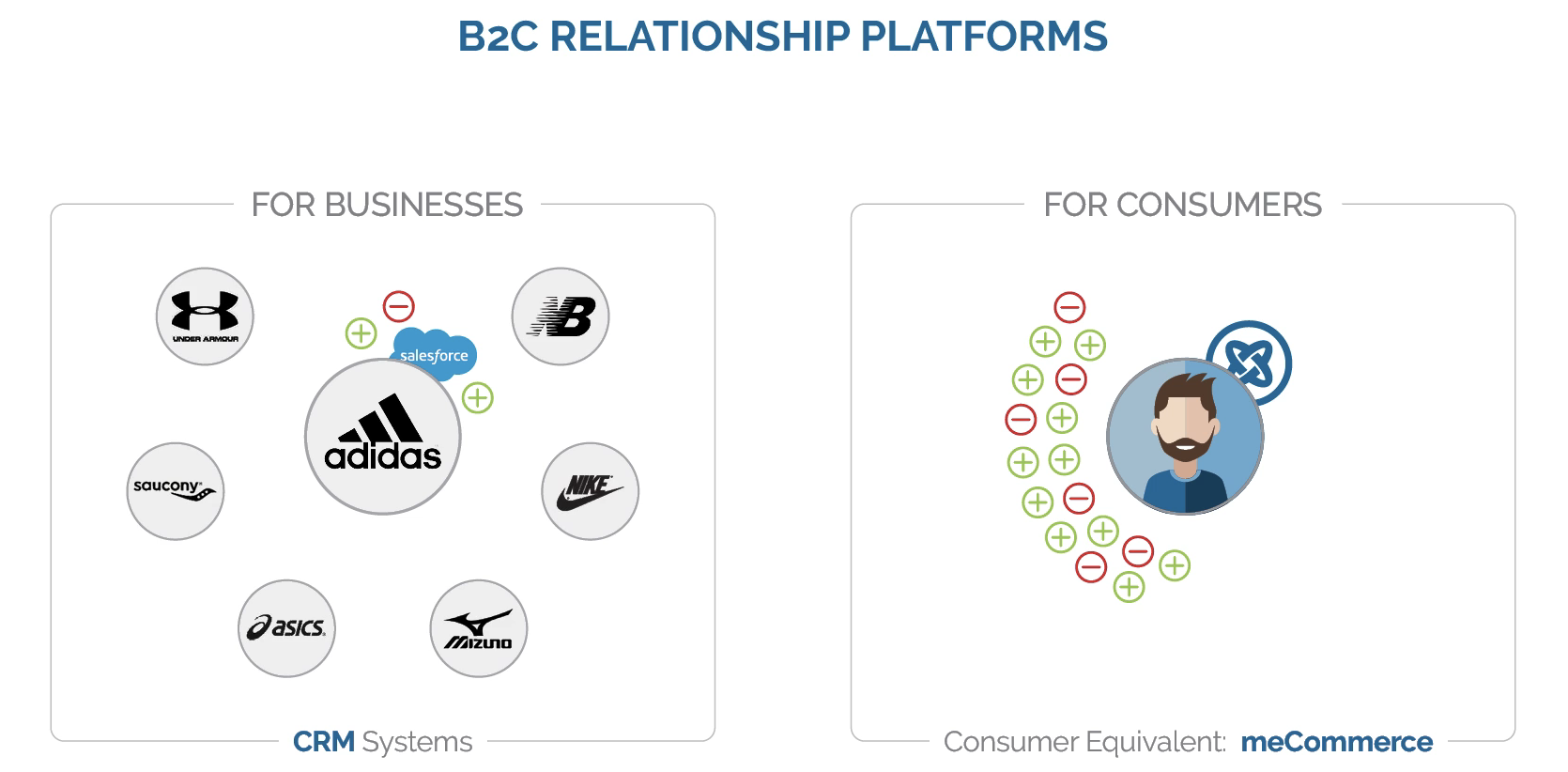
bixy slide

Here is what I wrote back, updated and improved a bit:

These are my notes on slides within the deck/video.

1) It looks to me like a CRM refresh rather than VRM. There have been many of these. And, while Bixy looks better than any others I can remember (partly because I can’t remember any… it’s all a blur), it’s still pitching into the CRM market. Nothing wrong with that: it’s a huge market, with side categories all around it. It’s just not VRM, which is the customer hand CRM shakes. (And no, a CRM system giving the customer a hand to shake the CRM’s with isn’t VRM. It’s just gravy on a loyalty card.)

2) The notion that customers  (I dislike the word “consumers”) want relationships with brands is a sell-side fantasy. Mostly customers are looking to buy something they’ve already searched for, or to keep what they already own working, or to replace one thing with another that won’t fail—and to get decent service when something does fail. (For more on this subject, I suggest reading the great Bob Hoffman, for example here.)

3) While it’s true that customers don’t want to be tracked, annoyed and manipulated, and that those practices have led to dislike of businesses and icky legislation (bulls eye on all of those), and that “relationships are based on trust, value, attention, respect and communication,” none of those five things mean much to the customer if all of them are locked into a company’s one-to-many system, which is what we have with 100% of all CRM, CX and XX (pick your initialism) systems—all of them different, which means  a customer needs to have as many different ways to trust, value, attend to, respect and communicate as there are company systems for providing the means.

4) Bixy’s idea here (and what the graphic above suggests, is that the customer can express likes and dislikes to many Brands’ Salesforce CRM systems. They call this “sharing for value in return.” But there is far appetite for this than than marketing thinks.  Customers share as little as they can when they are fully required to do so, and would rather share zero when they go about their ordinary surfing online or shopping anywhere. Worse, marketing in general (follow the news)—and adtech/martech in particular—continue to believe that customers “share” data gathered about them by surveillance, and that this is “exchanged” for free services, discounts and other goodies. This is one of the worst rationalizations in the history of business.

5) “B2C conversations” that are “transparent, personalized and informative” is more a marketing fantasy than a customer desire. What customers would desire, if they were available, are tools that enhance them with superpowers.  For example, the power to change their last name, email address or credit card for every company they deal with, in one move. This is real scale: customer scale.  We call these superpowers customertech:

CRM is vendortech.

6) Some percentage of Adidas customers (the example in that video) may be willing to fill out a “conversational” form to arrive at a shoe purchase, but I suspect a far larger percentage would regard the whole exercise as a privacy-risking journey down a sales funnel that they’d rather not be in. So long as the world lacks standard ways for people to prevent surveillance of their private spaces and harvesting of personal data, to make non-coercive two-way agreements with others, and ways to monitor person data use and agreement compliance, there is no way trustworthy “conversations” of the kind Bixy proposes can happen.

7) Incumbent “loyalty” programs are, on the whole, expensive and absurd.

Take Peet’s Coffee, a brand I actually do love. I’ve been a customer of Peet’s for, let’s see… 35 years. I have a high-end (like in a coffee shop) espresso machine at my house, with a high-end grinder to match. All I want from Peet’s here at home are two kinds of Peet’s beans: Garuda and Major Dickason Decaf. That’s it. I’ve sampled countless single-origin beans and blends from many sources, and those are my faves. I used to buy one-pound bags of those at Peet’s stores; but in COVID time I subscribe to have those delivered. Which isn’t easy, because Peet’s has made buying coffee online remarkably hard. Rather than just showing me all the coffees they have, they want to drag me every time through a “conversational” discovery process—and that’s after the customary (for every company) popover pitch to sign up as a member, which I already am, and to detour through a login-fail password-recovery ditch (with CAPTCHAs, over and over, clicking on busses and traffic lights and crosswalks) that show up every. damn. time. On arrival at the membership home page, “My Dashboard” all but covers the home screen, and tells me I’m 8 points away from my next reward (always a free coffee, which is not worth the trouble, and not why I’m loyal). Under the Shop menu (the only one I might care about) there are no lists of coffee types. Instead there’s “Find Your Match,” which features two kinds of coffee I don’t want and a “take your quiz” game. Below that are “signature blends” that list nothing of ingredients but require one to “Find My Coffee” through a “flavor wheel” that gives one a choice of five flavors (“herbal/earthy,” “bright/citrus”…). I have to go waaay the hell down a well of unwanted and distracting choices to get to the damn actual coffee I know I like.

My point: here is a company that is truly loved (or hell, at least liked) by its customers, mostly because it’s better than Starbucks. They’re in a seller’s market. They don’t need a loyalty program, or the high operational and cognitive overhead involved (e.g. “checking in” at stores with a QR code on a phone app). They could make shopping online a lot simpler with a nice list of products and prices. But instead they decided, typically (for marketing), that they needed all this bullshit to suck customers down sales funnels. When they don’t. If Peet’s dumped its app and made their website and subscription system simpler, they wouldn’t lose one customer and they’d save piles of money.

Now, back to the Adidas example. I am sure anybody who plays sports or runs, or does anything in athletic shoes, would rather just freaking shop for shoes than be led by a robot through a conversational maze that more than likely will lead to a product the company is eager to sell instead of one the customer would rather buy.

7) I think most customers would be creeped to reveal how much they like to run and other stuff like that, when they have no idea how that data will be used—which is also still the typical “experience” online. Please: just show them the shoes, say what they’re made of, what they’re good for, and (if it matters) what celeb jocks like them or have co-branded them.

8) The “value exchange” that fully matters is money for goods. “Relationship” beyond that is largely a matter of reputation and appreciation, which is earned by the products and services themselves, and by human engagement. Not by marketing BS.

8) Bixy’s pitch about “90% of conversation” occurring “outside the app as digital widgets via publisher and marketer SDKs” and “omnichannel personalization” through “buy rewards, affiliate marketing, marketer insights, CRM & CDP, email, ads, loyalty, eCommerce personalization, brand & retailer apps and direct mail” is just more of the half-roboticized marketing world we have, only worse. (It also appears to require the kind of tracking the video says up front that customers don’t want.)

9) The thought of “licensing my personal information to brands for additional royalties and personalization” also creeps me out.

10) I don’t think this is “building relationships from the consumer point of view.” I think it’s a projection of marketing fantasy on a kind of customer that mostly doesn’t exist. I also don’t think “reducing the sales cycle” is any customer’s fantasy.

To sum up, I don’t mean to be harsh. In fact I’m glad to talk with Bixy if they’re interested in helping with what we’re trying to do here at ProjectVRM—or at Customer Commons, the Me2B Alliance and MyData.

I also don’t think Cluetrain‘s first thesis (“Markets are conversations“) can be proven by tools offered only by sellers and made mostly to work for sellers. If we want real market conversations, we need to look at solving market problems from the customers’ side. Look here and here for ways to do that.

“Disruption” isn’t the whole VRM story

250px-mediatetrad-svg

The vast oeuvre of Marshall McLuhan contains a wonderful approach to understanding media called the tetrad (i.e. foursome) of media effects.  You can apply it to anything, from stone tools to robots. McLuhan unpacks it with four questions:

  1. What does the medium enhance?
  2. What does the medium make obsolete?
  3. What does the medium retrieve that had been obsolesced earlier?
  4. What does the medium reverse or flip into when pushed to extremes?

I suggest that VRM—

  1. Enhances CRM
  2. Obsoletes marketing guesswork, especially adtech
  3. Retrieves conversation
  4. Reverses or flips into the bazaar

Note that many answers are possible. That’s why McLuhan poses the tetrad as questions. Very clever and useful.

I bring this up for three reasons:

  1. The tetrad is also helpful for understanding every topic that starts with “disruption.” Because a new medium (or technology) does much more than just disrupt or obsolete an old one—yet not so much more that it can’t be understood inside a framework.
  2. The idea from the start with VRM has never been to disrupt or obsolete CRM, but rather to give it a hand to shake—and a way customers can pull it out of the morass of market-makers (especially adtech) that waste its time, talents and energies.
  3. After ten years of ProjectVRM, we still don’t have a single standardized base VRM medium (e.g. a protocol), even though we have by now hundreds of developers we call VRM in one way or another. Think of this missing medium as a single way, or set of ways, that VRM demand can interact with CRM supply, and give every customer scale across all the companies they deal with. We’ve needed that from the start. But perhaps, with this handy pedagogical tool, we can look thorugh one framework toward both the causes and effects of what we want to make happen.

I expect this framework to be useful at VRM Day (May 1 at the Computer History Museum) and at IIW on the three days that follow there.

Save

We’re done with Phase One

Here’s a picture that’s worth more than a thousand words:

maif-vrm

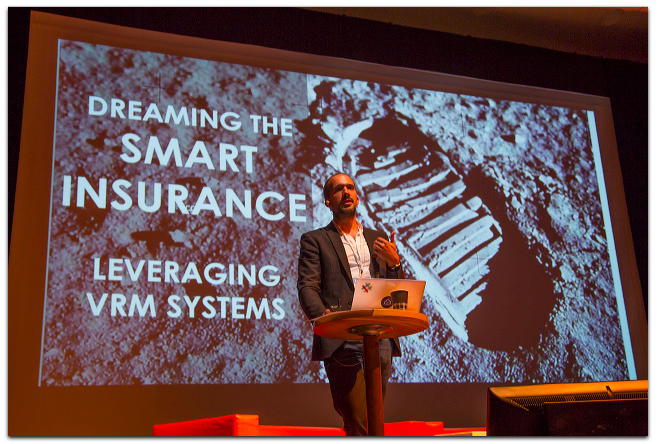
He’s with MAIF, the French insurance company, speaking at MyData 2016 in Helsinki, a little over a month ago. Here’s another:

sean-vrm

That’s Sean Bohan, head of our steering committee, expanding on what many people at the conference already knew.

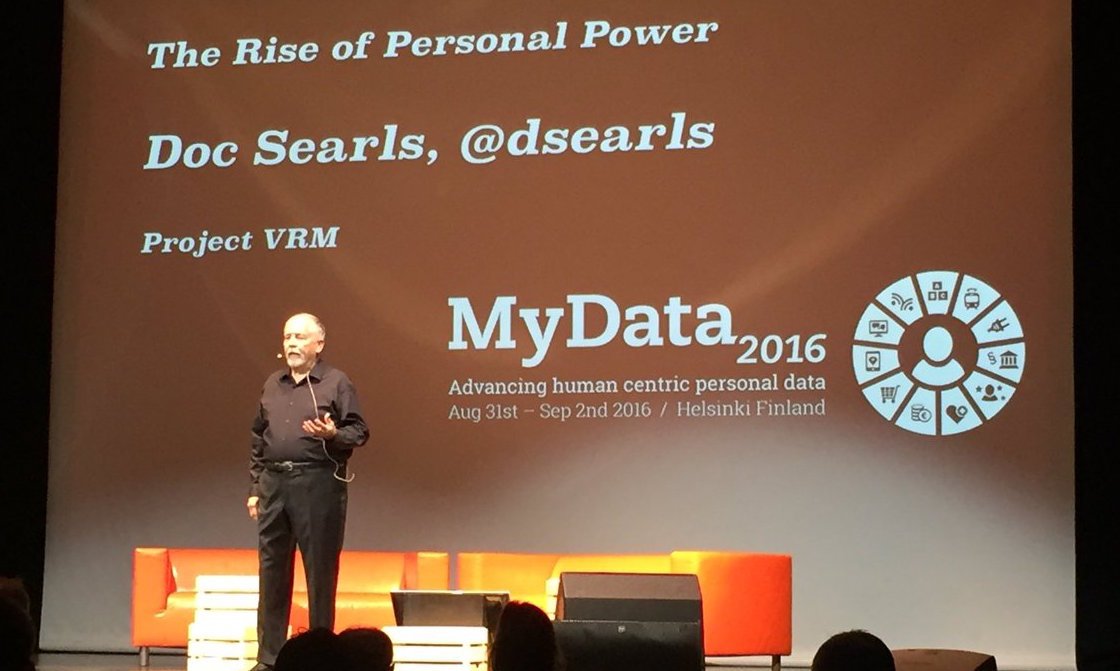
I was there too, giving the morning keynote on Day 2:

cupfu1hxeaa4thh

It was an entirely new talk. Pretty good one too, especially since  I came up with it the night before.

See, by the end of Day 1, it was clear that pretty much everybody at the conference already knew how market power was shifting from centralized industries to distributed individuals and groups (including many inside centralized industries). It was also clear that most of the hundreds of people at the conference were also familiar with VRM as a market category. I didn’t need to talk about that stuff anymore. At least not in Europe, where most of the VRM action is.

So, after a very long journey, we’re finally getting started.

In my own case, the journey began when I saw the Internet coming, back in the ’80s.  It was clear to me that the Net would change the world radically, once it allowed commercial activity to flow over its pipes. That floodgate opened on April 30, 1995. Not long after that, I joined the fray as an editor for Linux Journal (where I still am, by the way, more than 20 years later). Then, in 1999, I co-wrote The Cluetrain Manifesto, which delivered this “one clue” above its list of 95 Theses:

not

And then, one decade ago last month, I started ProjectVRM, because that clue wasn’t yet true. Our reach did not exceed the grasp of marketers in the world. If anything, the Net extended marketers’ grasp a lot more than it did ours. (Shoshana Zuboff says their grasp has metastasized into surveillance capitalism. ) In respect to Gibson’s Law, Cluetrain proclaimed an arrived future that was not yet distributed. Our job was to distribute it.

Which we have. And we can start to see results such as those above. So let’s call Phase One a done thing. And start thinking about Phase Two, whatever it will be.

To get that work rolling, here are a few summary facts about ProjectVRM and related efforts.

First, the project itself could hardly be more lightweight, at least administratively. It consists of:

Second, we have a spin-off: Customer Commons, which will do for personal terms of engagement (one each of us can assert online) what Creative Commons (another Berkman-Klein spinoff) did for copyright.

Third, we have a list of many dozens of developers, which seem to be concentrated in Europe and Australia/New Zealand.  Two reasons for that, both speculative:

  1. Privacy. The concept is much more highly sensitive and evolved in Europe than in the U.S. The reason we most often get goes, “Some of our governments once kept detailed records of people, and those records were used to track down and kill many of them.” There are also more evolved laws respecting privacy. In Australia there have been privacy laws for several years requiring those collecting data about individuals to make it available to them, in forms the individual specifies. And in Europe there is the General Data Protection Regulation, which will impose severe penalties for unwelcome data gathering from individuals, starting in 2018.
  2. Enlightened investment. Meaning investors who want a startup to make a positive difference in the world, and not just give them a unicorn to ride out some exit. (Which seems to have become the default model in the U.S., especially Silicon Valley.)

What we lack is research. And by we I mean the world, and not just ProjectVRM.

Research is normally the first duty of a project at the Berkman Klein Center, which is chartered as a research organization. Research was ProjectVRM’s last duty, however, because we had nothing to research at first. Or, frankly, until now. That’s why we were defined as a development & research project rather than the reverse.

Where and how research on VRM and related efforts happens is a wide-open question. What matters is that it needs to be done, starting soon, while the “before” state still prevails in most of the world, and the future is still on its way in delivery trucks. Who does that research matters far less than the research itself.

So we are poised at a transitional point now. Let the conversations about Phase Two commence.

What if we don’t need advertising at all?

advertisinggraveI’m serious.

Answer this question: Would you pay for any publication that is only advertising? If not, Do you believe advertising adds or subtracts value from the media it funds?

It depends, right? Ads add value to The New Yorker, Vogue, Brides, Guns & Ammo and the Super Bowl. Readers and viewers actually like the ads that show up in those places. In some others, well, kinda. As for the rest? No.

The rest rounds to everything. The italicized items in the paragraph above are exceptions to a  rule that is yucky in the extreme, especially on the Web and (increasingly) on our mobile devices.

So let’s say we normalize supply and demand to the Internet, which puts a giant zero — no distance — between everybody and everything.  All that should stand between any two entities on the Net are manners, permission and convenience. Any company and any customer should be able to connect with any other, without an intermediary, any time and in any way they both want — provided agreements and methods for doing that are worked out.

So far they aren’t, and that’s the reason we have so much icky advertising on the Web and on our phones: most of the pushers have no manners, and there are no mutually accepted ways to allow or deny permission for being bothered, so those being bothered have responded with ad and tracking blockers. In other words, in the absence of manners, we’ve created an inconvenience.

Naturally, publishers, agencies and ad industry associations are crying foul, but too bad. Blocking  that shit reduces friction and  feels good. (Thank you, Bob Garfield, for both of those.)

What we need next are better ways for demand and supply to inform and connect. Not just better ways to pay for media. (That would be nice, but media have mostly been a one-way channel for informing, and at best a secondary way to connect.)

Think about what will happen to markets when any one of us can intentcast our needs for products or services, and do so easily and in standard ways that any supplier can understand. Then think about what will happen when any company can inform existing or potential customers directly, without the intermediation of the media we know today — and with clear and well-understood permissions for doing that on both sides.

The result will be the intention economy, which will work far better for demand and supply than the attention economy we have today, simply because there will be so many more and better ways to inform and connect, in both directions.

Asking today’s media to give us the intention economy is like asking AM radio to give us cellular telephony.

They can’t, and they won’t. At best they’ll serve the remaining needs of the attention economy: namely, old-fashioned Madison Avenue type branding, like we get from the best ads in the Super Bowl and in your better print magazines. This is the wheat I talk about in Separating Advertising’s Wheat and Chaff, and that Don Marti calls “signalful” advertising. Maybe that stuff will be with us forever. For the sake of the good things they fund, I hope so.

But I don’t know, because I’m sure if we zero-base the intention economy in our new all-digital world, it is unlikely that we’ll invent any of the media we have today.

It would be easy to call the intention economy utopian hogwash, and I expect some comments to say as much. But one could have said the same thing about personal computing in 1973, the Internet in 1983 and smartphones in 1993. All of those were unthinkable at those points in history, yet inevitable in retrospect.

The fact is, we are now in a digital world as well as an analog one. That alone rewrites the future in a huge way. Digital itself is the only medium, and the whole environment. It’s also us, whether we like it or not. We are digital as well as cellular.

In the past we put up with being annoyed and yelled at by advertising. And now we’re putting up with being spied on and guessed at, personally, as well. But we don’t have to put up with any of it any more. That’s another thing digital life makes possible, even if we haven’t taken the measures yet. The limits of invention are a lot farther out on the Giant Zero than they ever were in the old analog world where today’s media — including  digital ones following analog models — were born.

Advertising is an analog thing. The arguments for its survival in the digital world need to be ones that start with demand. Is it something we want? Because we’ll get what we want. Sooner or later, we’ll have the digital versions of clothing and shelter (aka privacy), of terms and permissions, of ways to signal our intentions. If advertising fits in there somewhere, great. If not, R.I.P.


The most important event, ever

IIW XXIIW_XX_logothe 20th IIW — comes at a critical inflection point in the history of VRM. If you’re looking for a point of leverage on the future of customer liberation, independence and empowerment, this is it. Wall Street-sized companies around the world are beginning to grok what Main Street ones have always known: customers aren’t just “targets” to be “acquired,” “managed,” “controlled” and “locked in.” In other words, Cluetrain was right when it said this, in 1999:

if you only have time for one clue this year, this is the one to get…

Now it is finally becoming clear that free customers are more valuable than captive ones: to themselves, to the companies they deal with, and to the marketplace.

But how, exactly? That’s what we’ll be working on at IIW, which runs from April 7 to 9 at the Computer History Museum, in the heart of Silicon Valley: the best venue ever created for a get-stuff-done unconference. Focusing our work is a VRM maturity framework that gives every company, analyst and journalist a list of VRM competencies, and every VRM developer a context in which to show which of those competencies they provide, and how far along they are along the maturity path. This will start paving the paths along which individuals, tool and service providers and corporate systems (e.g. CRM) can finally begin to fit their pieces together. It will also help legitimize VRM as a category. If you have a VRM or related company, now is the time to jump in and participate in the conversation. Literally. Here are some of the VRM topics and technology categories that we’ll be talking about, and placing in context in the VRM maturity framework:

#NewClues and #VRM

David Weinberger littlepetdillo-newcluesand I posted New Clues on the Cluetrain site this morning. It’s the first new set of clues there in almost sixteen years. (The original went up in Spring of 1999.)

The urgency behind New Clues is the retreat of businesses, networks and people into the kinds of silos and walled gardens that the Internet was built to transcend.

That transcendence will aways be there; but as more and more of what we do on the Net happens inside GAFTA (Goolge, Apple, Facebook, Twitter and Amazon) and other boxes, the less we create stuff in the wide open spaces, where it can work for anybody and everybody.

VRM is by nature distributed, not centralized. Like humanity. Like the Net. If VRM happens only inside silos, it will at best be a denatured subset of what it could and should have been. And that applies to much more than VRM.

The buzzing around NewClues and Cluetrain is high ebb right now. Here’s where to watch:

I’m interested to see how well it persists. But whether it does or not may not matter all that much, because Cluetrain has already persisted for sixteen years, and will likely to continue to persist, enlarged by this new set of clues.

Some background.

When Cluetrain came out, the Web was a static place. Its main conceptual frame was real estate: sites at domains and locations that were built, browsed and visited, as if it were a library or a store. Time-to-index for search engines ranged from days to weeks. Now the Web is a live place. Real-time. Everything in it has the locational persistence of molecules in a fog. And in most cases the same life expectancy. (BTW, my son Allen brought up this distinction in a prophesy he uttered back in 2003.)

Some of the stuff we talked about back in the Static Web days is gone.  (Online malls, anyone?) But Cluetrain did more than survive. It proved to have real value to a lot of people. (Just look at the posts at those links above.) If the tweeted molecules now buzzing around New Clues accrete to Cluetrain, they have a good chance of adding to the value that’s already there. And if they do, I’m sure that will be good for #VRM as well.

« Older posts

© 2026 ProjectVRM

Theme by Anders NorenUp ↑