
By now you’ve seen one of these:

Never mind that you’re not running an ad blocker, but merely blocking tracking. Instead, note the small print in the lower right: “VRM by Admiral.”
By “VRM,” Admiral means this:
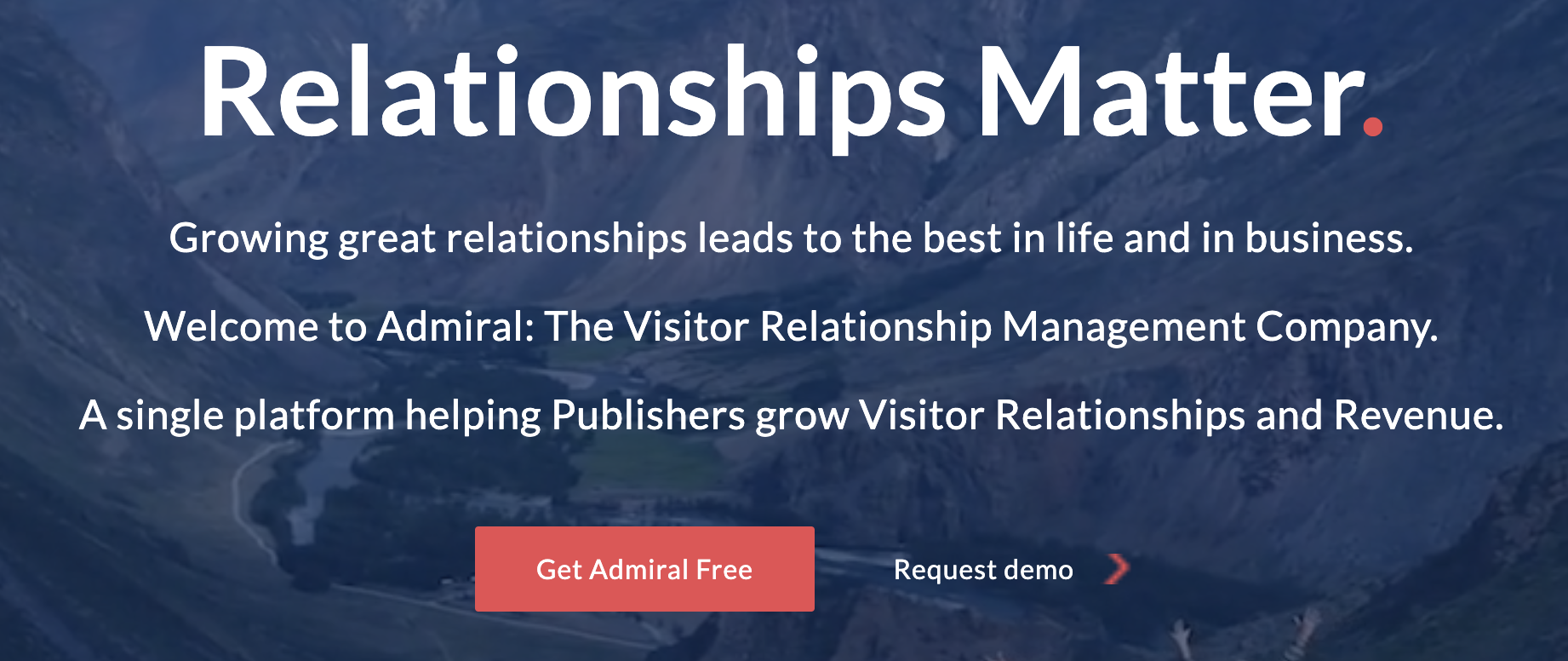
What we’re looking at here is the $.5 billion Consent Management Platform business, currently dominated worldwide by OneTrust, with a 40% market share. In the US, Admiral is the leading provider to publishers, giving it a high profile there. In Europe, the leaders are OneTrust, Usercentrics, and CookieYes.
So here is a challenge for Admiral , OneTrust, and the rest of them: make VRM mean Vendor Relationship Management (like it says in Wikipedia).
Our case: real relationships are based on mutual trust, which can only happen if personal privacy is fully respected as a starting point. Consent management by cookie notice can’t cut it. For real trust, we need people to bring their own terms to every website’s table, and have agreements to those. This is why we, the ProjectVRM community, through Customer Commons (our nonprofit spinoff) and the IEEE P7012 (aka MyTerms) working group, created the draft standard (on track to become official early next year) for machine-readable personal privacy terms. Three years ago, I called MyTerms The Most Important Standard in Development Today. The CMP business can help make it so, by getting on the Cluetrain.
Here are some opportunities:
- CMPs can provide sites & services with easy ways to respond to MyTerms choices brought to the table by visitors. Let’s call this a Terms Matching Engine.The current roster of terms we’re working with at Customer Commons (abbreviated CuCo, hence the cuco.org shortcut) starts with CC-BASE, which is “service provision only.” It says to a website, “just give me your service, and nothing more.” In other words, no tracking. Yet. Negotiation toward additional provisions comes after that. Those can be anything, but they should be in the spirit of We’re starting with personal privacy here, and the visitor sets the terms for that.
- There is a whole new business (which, like the VPN, grammar-help, and password management businesses, people would pay for) in helping people present, manage, remember, and monitor compliance with their terms, and what additional agreements have been arrived at. This can involve browser add-ons such as the one pictured on the ProjectVRM r-button page. CMP companies can make money there too, adding a C2B business to their B2B ones.
- Go beyond #2 to provide real VRM. Back in the last millennium, Iain Henderson pointed out that B2B relationships tend to have hundreds or thousands of variables over which both parties need to agree. Nitin Badjatia, another CRM veteran (and a Customer Commons board member like Iain and myself), has also pointed out that companies like Oracle have long provided AI-assisted ways for B2B relationships to arrive at contractual agreements. The same can work for C2B, once the base privacy agreement is established. There can be a business here that expands on what gets started with that first agreement.
- Verticals. There can be strong value-adds for regulated industries or companies wanting to acquire and signal accountability, or look for firmer ways to establish a privacy regime better than the called consent, which doesn’t work (except as thin ass-covering for companies fearing the GDPR and the CCPA). For example: banks, insurers, publishers, health care providers.
- For people (not just corporate clients), CMPs could offer browser plugins or apps (mobile and/or computer) that help people choose and present their privacy terms, track who honors them, notify them of violations, and have r-buttons mean something. Or multiple things.
Here is what a VRM-friendly person in the UK came up with as a prototypical first by a CMP away from cookie notices:
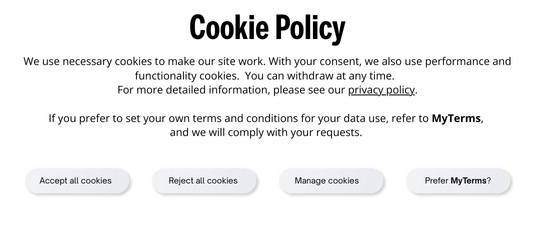
That was after this post went up. (Which is great.)
Obviously, we want cookie notices (and other forms of friction) to go away, but we also want CMPs to have a nice way to participate in a customer-led world in which intention-based economies can grow.
And here is an example of r-buttons in a browser:

Real relationships, including records of agreements, can be unpacked when a person (not a mere “user”) clicks on either the ⊂ or the ⊃ symbols. There are golden opportunities here for both VRM and CRM vendors. And, of course, companies such as Admiral and OneTrust working both sides—and being truly trusted.
Give us more. (Like that cookie notice above.)
Leave a Reply