
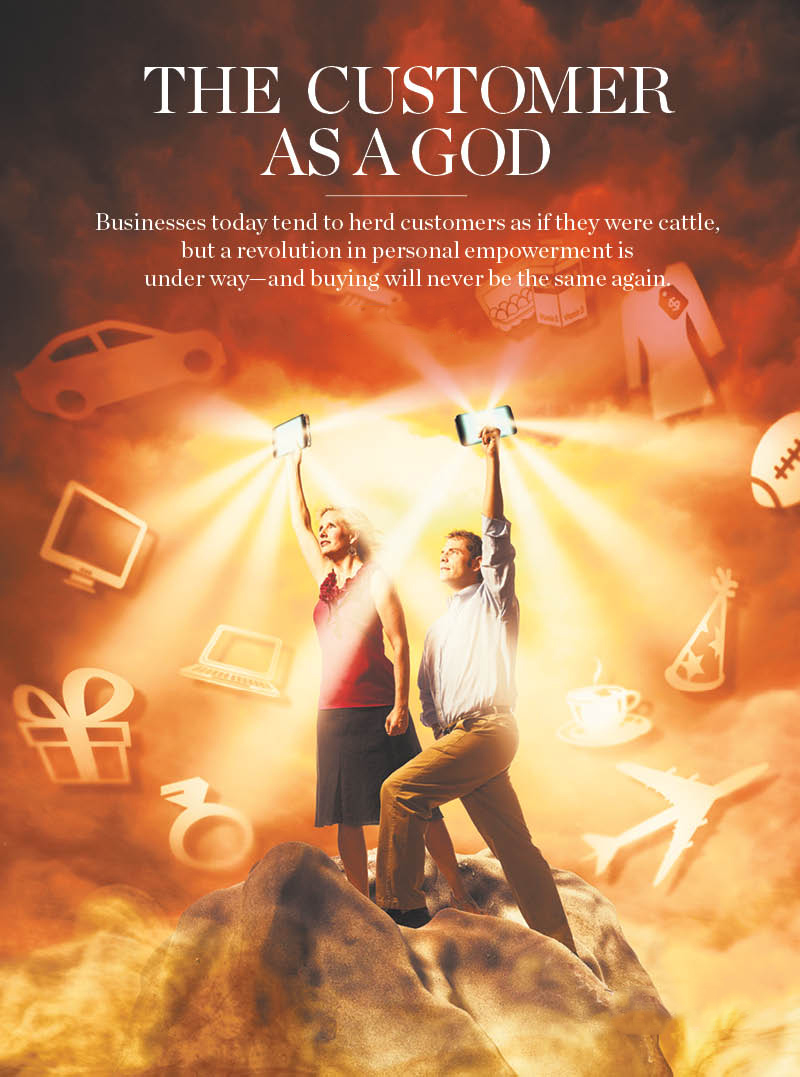
The cover page of the Weekend Review section of The Wall Street Journal, July 20, 2012
On July 9, 2012, not long after The Intention Economy came out, I got word from Gary Rosen of The Wall Street Journal that the paper’s publisher, Robert Thomson, loved the book and wanted “an excerpt/adaptation” from the book for the cover story of the WSJ’s Weekend Review section. The image above is the whole cover of that section, which appeared later that month.
In the article I described a new way to shop:
An “intentcast” goes out to the marketplace, revealing only what’s required to attract offers. No personal information is revealed, except to vendors with whom you already have a trusted relationship.
I also said that this form of shopping—
…can be made possible only by the full empowerment of individuals—that is, by making them both independent of controlling organizations and better able to engage with them. Work toward these goals is going on today, inside a new field called VRM, for vendor relationship management. VRM works on the demand side of the marketplace: for you, the customer, rather than for sellers and third parties on the supply side.
The scenario I described was set ten years out: in 2022, a future now two years in the past. In the meantime, many approaches to intentcasting have come and gone. The ones that have stayed are Craigslist, Facebook Marketplace, Instacart, TaskRabbit, Thumbtack, and a few others. (Thumbtack participated in the early days of ProjectVRM.) We include them in our list of intentcasting services because they model at least some of what we’d like intentcasting to be. What they don’t model is the full empowerment of individuals as independent actors: ones whose intentions can scale across whole markets and many sellers:

Scale gives the customer single ways to deal with many companies. For example, she should be able to change her address or last name with every company she deals with in one move—or to send an intention-to-buy “intentcast” to a whole market.
Should we call the sum of it “i-commerce“? Just a thought.
Back to the Wall Street Journal article. It is clear to me now that The Customer as a God would have been a much better title for my book than The Intention Economy, which needs explaining and sounds too much like The Attention Economy, which was the title of the book that came out ten years earlier. (I’ve met people who have read that one and thought it was mine—or worse, called my book “The Attention Economy” and sent readers to the wrong one.)
Of course, calling customers gods is hyperbole: exaggeration for effect. VRM has always been about customers coming to companies as equals. The “revolution in personal empowerment” in the subhead of “The Customer as a God” is about equality, not supremacy. For more on that, see the eleven posts before this one that mention the R-button:

That symbol (or pair of symbols) is about two parties who attract each other (like two magnets) and engage as equals. It’s a symbol that only makes full sense in open markets where free customers prove more valuable than captive ones. Not markets where customers are mere “targets” to “acquire,” “capture,” “manage,” “control” or “lock in” as if they were slaves or cattle.
The stage of Internet growth called Web 2.0 was all about those forms of capture, control, and coerced dependency. We’re still in it. (What’s being called Web3 is, while “decentralized” (note: not distributed), it is also based on tokens and blockchain. ) Investment in customer independence rounds to nil.
And that’s probably the biggest reason intentcasting as we imagined it in the first place has not taken off. It is very hard, inside industrial-age business norms (which we still have) to see customers as equals, or as human beings who should be equipped to lead in the dance between buyers and sellers, or demand and supply, in truly open marketplaces. It’s still easier to see us as mere consumers (which Jerry Michalski calls “gullets with wallets and eyeballs”).
So, where is there hope?
How about AI? It’s at the late end of its craze stage, but still here to stay, and hot as ever:
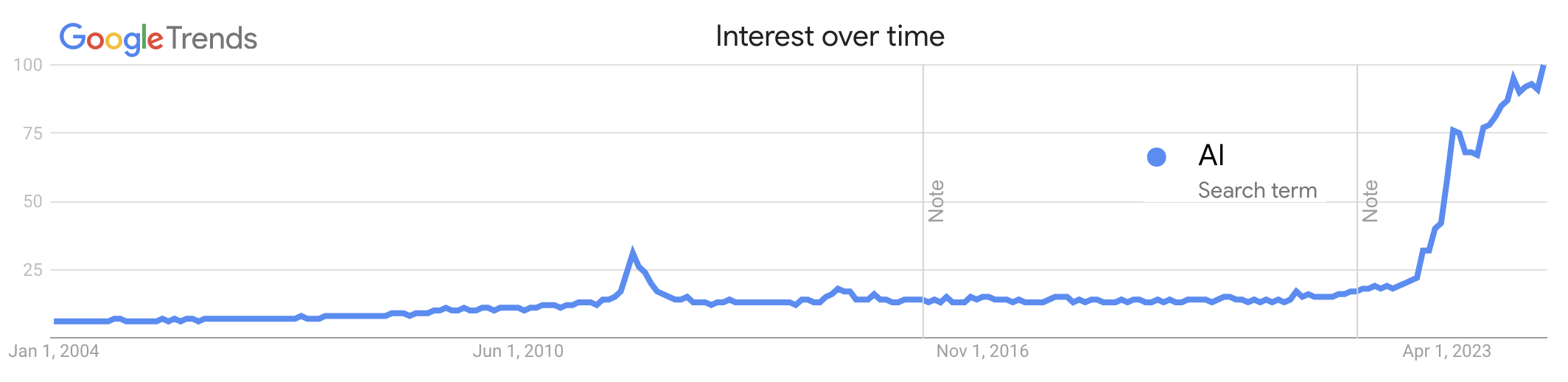
Can AI provide the “revolution in personal empowerment” we’ve been looking for here since 2006? Can it prove our thesis—that free customers are more valuable than captive ones—to themselves and to the marketplace?
If it is, then the market is a greenfield.
Some of us here are working at putting AI on both sides of intentcasting ceremonies. If you have, or know about, one or more of those approaches (or any intentcasting approaches), please share what you know, or what you’re got, in the comments below. And come to VRM Day on October 28. I’ll be putting up the invite for that shortly.
