

Are they going to shake hands or fight? We’ll answer that question after personal AI exists and operates as a powerful personal agent.
You’re reading this on a machine with an operating system: Linux, Windows, MacOS, iOS, or Android.
But that’s not your OS. It’s your machine’s.
How about one for you, that runs on your machine but is entirely yours? Let’s call it a Personal OS, or a POS.
The POS will have a kernel onto which abilities (not just applications) can be added. An extreme example of how this might work is Neo learning ju jitsu in The Matrix:
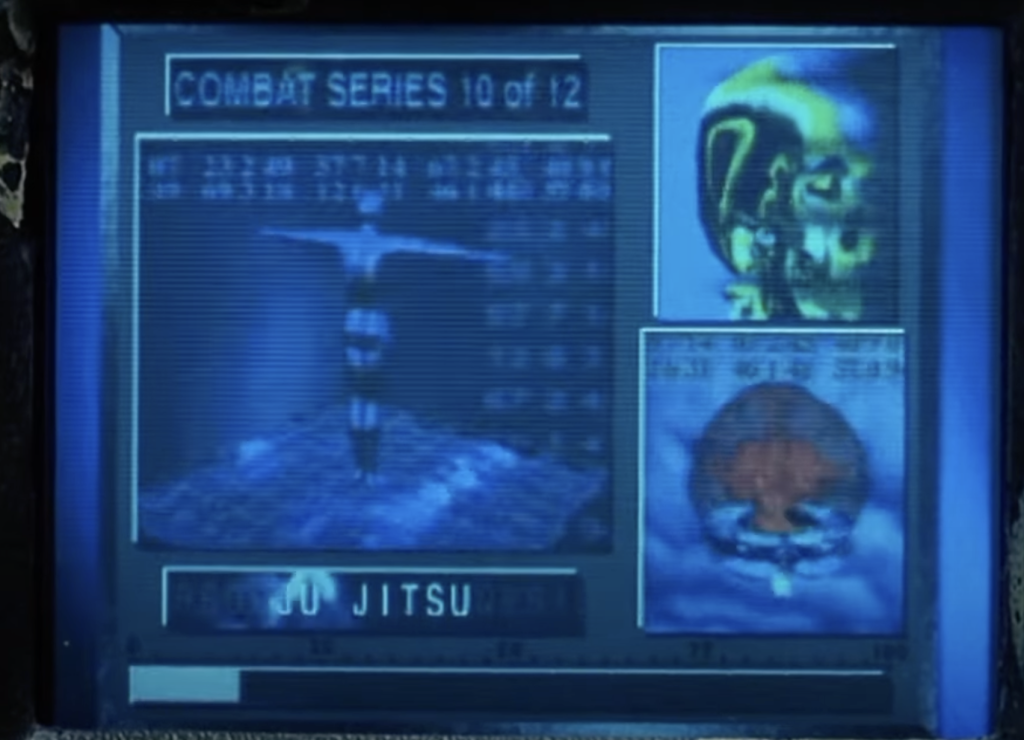
That OS amplified Neo’s own intelligence, in his own head. We’re far from that today. But we can at least add abilities to a POS of our own. Those too can give us more agency of many kinds.
To my knowledge, there is only one POS so far. It’s called pAI-OS (Github code), and it’s led by Kwaai.* To my knowledge, pAI-OS is the first and only truly personal operating system. (If others do the same, let me know and I’ll talk those up too.) And it is built to run our own AIs. Let’s call them PAIs, where the A can mean amplified or augmented (sourcing Doug Englebart for the latter).
So, what kind of abilities are we talking about?
Let’s start with something that could hardly be more mundane and important: memory.
In Laws of Media, Marshall McLuhan (five decades ago) said that computing promises “perfect memory—total and exact.” For many millennia, our species has been outboarding memory through speech, and the written word, and collecting all of that in libraries and museums. And now, in the digital age that dawned with microcircuits and the Internet, we now occupy a digital world where everybody can publish whatever they want. To peruse that, we made search engines. Those ruled from the late ’90s until approximately yesterday, when AIs took over servicing our interest in answers to questions. Google, Microsoft, ChatGPT, Perplexity.ai, and others have moved into a space we might call AI answerware.
Running all that answerware are corporate AIs. Let’s call them CAIs. Nothing wrong with CAIs, but also nothing personal, because they are not ours. I explain the difference in Personal vs. Personalized AI. Here’s a graphic from that post showing a bit of what abilities might run on your PAI:
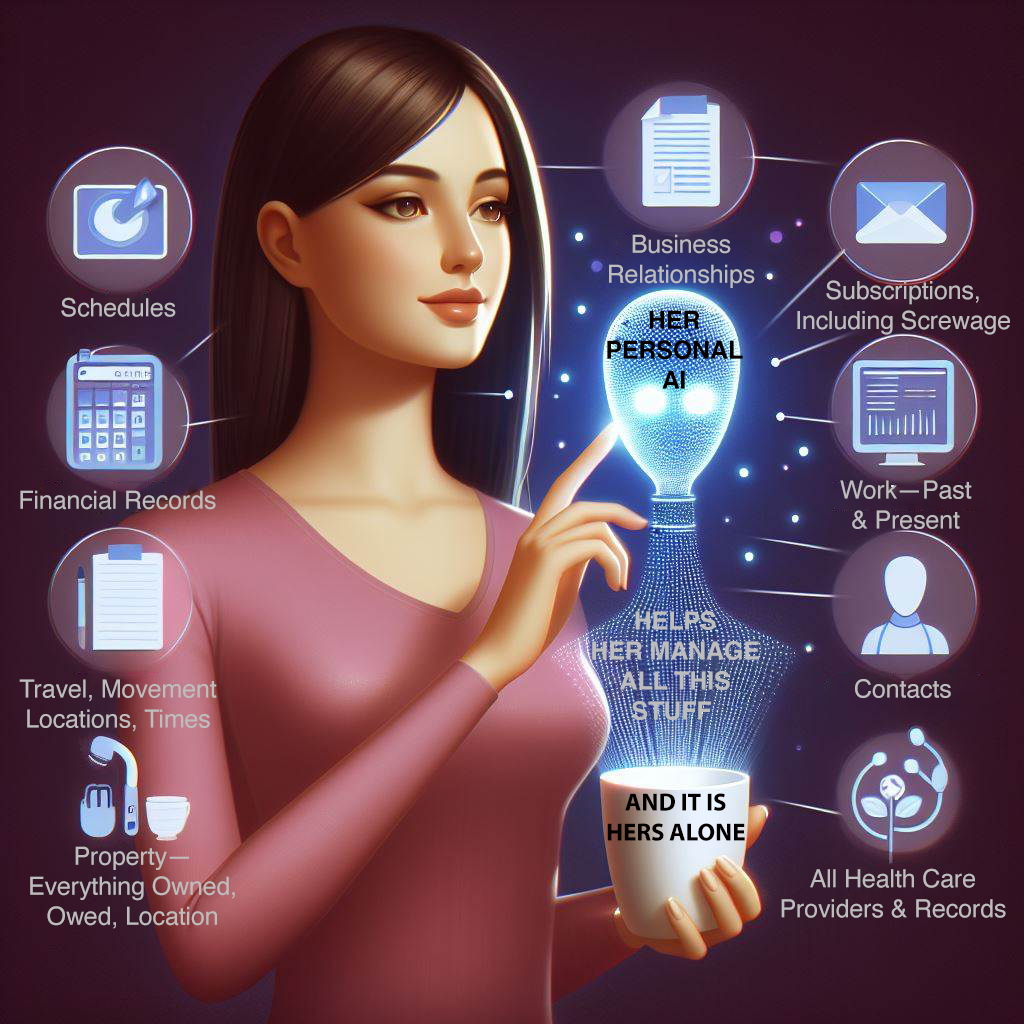
PAIs can extend our own memories by accumulating personal stuff we need to know better, and our ability to meet, access, and use the external abilities of the CAI world. So we’ll have our agents + their agents, working together.
For an example of how that might work, take a look at The most important standard in development today: P7012: Standard for Machine Readable Personal Privacy Terms, which “identifies/addresses the manner in which personal privacy terms are proffered and how they can be read and agreed to by machines.” After seven years with a working group, it is now in the IEEE editing and approval mill, edging toward becoming a finished standard by next year. It works like this:
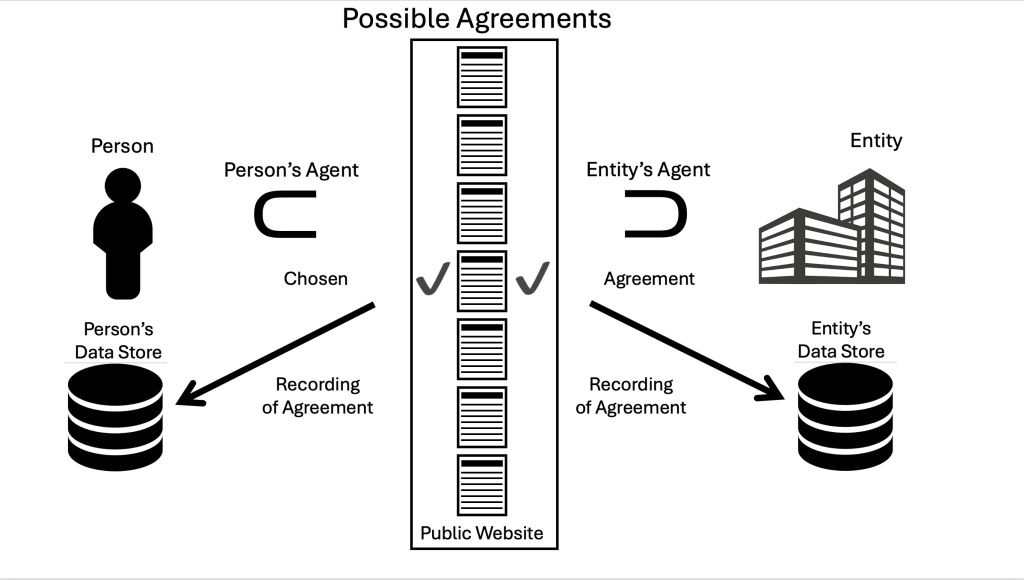
Here your agent (a PAI, represented by the ⊂ symbol) proffers your privacy terms (here is one example) to a corporate agent (which might or might not be a CAI, but is still represented with the reciprocal symbol ⊃. (This should be familiar to ProjectVRM veterans as the r-button. We may finally get to use it!)
The ceremony here is the exact reverse of what we have today with the cookie popovers on most website home pages. This can and should be done ⊂ to ⊃. So should signing and recording the agreement, or the choice of the site, should it tell you to screw off. (An agent running on your PAI will record that diss.)
I also bring this up because it will be a key required ability—not just for you and me but for the world, starting with Europe, where the GDPR lists six lawful bases for processing personal data. They begin—
(a) Consent: the individual has given clear consent for you to process their personal data for a specific purpose.
(b) Contract: the processing is necessary for a contract you have with the individual, or because they have asked you to take specific steps before entering into a contract.
By now everyone knows that (a) Consent has failed. It’s an expensive and meaningless dance, with high cognitive (mostly cynical) overhead, and almost no accountability. Now they’re ready for (b) Contract, especially in ceremonies where the individual (not a mere “user”) takes the lead.
I believe there is less limit to what each of us can do with a PAI than there is to what we can do with a laptop or a phone. Because our PAI is our own. It runs on a deeper machine OS, but is not limited by that. Your PAI, running on your POS, may prove to be the first truly personal layer ever put on a machine OS.
*Full disclosure: I am now the Chief Intention Officer there. At this stage, it’s a voluntary position.
0 Comments
6 Pingbacks